




A government may leave a strong environmental law on the books yet stop enforcing it because compliance makes production more expensive or investment less attractive. The European Union’s published proposal for the trade and sustainable development chapter of an EU–Thailand Free Trade Agreement (FTA) is designed to address that kind of conduct. Under this proposal, prohibited regulatory competition is not simply an environmentally harmful outcome. It involves lowering protection, granting exemptions or persistently failing to enforce the law for the purpose of encouraging trade or investment. The proposal could therefore constrain a deliberate regulatory race to the bottom. It would not provide a general remedy for every environmental governance failure.
The EU and Thailand resumed FTA negotiations in 2023. Some chapters have since been provisionally closed, but the agreement itself has not been concluded or entered into force (European Commission, ‘EU–Thailand agreement’; EU–Thailand Trade Sustainability Impact Assessment, draft inception report, p. 1). The Commission continues to describe the published texts as its initial proposals and states that the final text will result from negotiations (European Commission, ‘EU–Thailand agreement: Documents’). This article consequently examines a negotiating proposal, not an existing treaty obligation.
Can that proposal stop a government from weakening environmental protection in order to encourage trade or investment? It can create a binding discipline against such conduct, but two limits are decisive. Governmental purpose may be difficult to prove, and most environmental breaches would not be backed by temporary trade sanctions. Thailand’s blackchin tilapia crisis illustrates those limits. It is used here to test what evidence the proposed rules would require, not to allege that Thailand has committed a treaty breach.
Can the EU Negotiate Environmental Rules through Trade Policy?
The first practical question is whether the EU has legal authority to negotiate environmental commitments as part of its trade policy. Article 3(5) of the Treaty on European Union (TEU) requires the Union to contribute to sustainable development in its relations with the wider world. Article 21(2)(f) TEU identifies environmental protection and the sustainable management of natural resources as objectives of EU external action. Article 207(1) of the Treaty on the Functioning of the European Union (TFEU) connects those objectives to the common commercial policy (TEU, arts. 3(5) and 21(2)(f); TFEU, arts. 205 and 207(1)). The Treaties therefore connect trade policy with sustainable development, but do not themselves determine every environmental obligation that may appear in a trade agreement.
Opinion 2/15 is a major ruling of the Court of Justice of the European Union concerning which parts of the proposed EU–Singapore trade agreement fell within EU trade competence. The Court accepted that sustainable-development provisions may form part of EU trade policy where they have a sufficiently close connection with trade. The chapter before the Court governed the conditions under which liberalised trade would occur and was capable of having direct and immediate effects on that trade (Opinion 2/15, EU:C:2017:376, paras. 141–163). The envisaged agreement did not harmonise the parties’ domestic environmental or labour standards; it preserved their right to determine their own levels of protection (Opinion 2/15, paras. 164–167).
The proposed EU–Thailand chapter follows that distinction. It would not impose EU environmental law in Thailand. Instead, if retained in a final agreement, it would create reciprocal rules preventing either party from using weaker protection as a means of encouraging trade or investment.
What Conduct Would the Proposal Prohibit?
Article XX.2(1) recognises each party’s right to determine its sustainable-development policies and domestic level of protection. Article XX.2(3) says that each party ‘shall strive’ to provide a high level of environmental and labour protection and to continue improving it. In ordinary language, the provision requires genuine efforts towards higher protection; it does not guarantee a particular legal standard or environmental result (EU Trade and Sustainable Development proposal, art. XX.2(1)–(3), pp. 2–3).
Article XX.2 then addresses three different forms of regulatory competition. The first is lowering the environmental or labour protection already provided by domestic law. This is described here as ‘non-regression’. Article XX.2(4) prohibits that lowering where it is done ‘in order to encourage trade or investment’. Repealing a pollution-control requirement because it imposes costs on exporters could fall within the rule if the required purpose were proved.
The second form is making an exception while leaving the underlying law in force. Article XX.2(5) prohibits a party from waiving or derogating from environmental or labour law, or offering to do so, for the same trade or investment purpose. A particular company, activity or category might receive relief from a rule that continues to apply to others. The distinction is therefore between changing the general level of protection and creating an exception from it.
The third form is ineffective enforcement. Article XX.2(6) provides that a party must not, ‘through a sustained or recurring course of action or inaction’, fail to enforce its environmental or labour law effectively ‘in order to encourage trade or investment’ (EU Trade and Sustainable Development proposal, art. XX.2(4)–(6), p. 3). A government could therefore face scrutiny even where strong legislation remains formally in place. An unsuccessful policy or isolated administrative error would not automatically breach the provision.
What Must Be Proved?
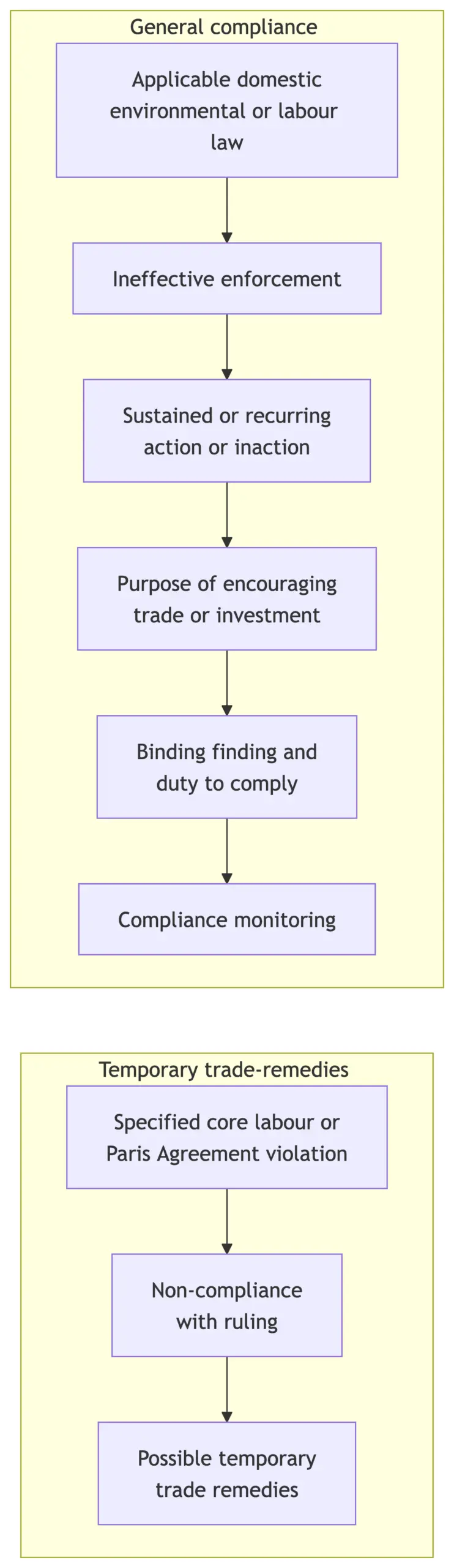
An Article XX.2(6) claim has four requirements, and all four must be met. First, the complainant must identify a particular domestic environmental or labour rule and the enforcement powers available under it. Secondly, it must establish that the party failed to enforce that rule effectively. A panel might examine the legal powers available, the measures taken, the investigation of identified violations and the implementation of remedies. The word ‘effectively’ is not defined in the proposal and would have to be interpreted in good faith, in context and in light of the chapter’s object and purpose (Vienna Convention on the Law of Treaties, art. 31(1)).
Thirdly, the failure must form a sustained or recurring course of action or inaction, rather than a single mistake. Fourthly, the conduct must have occurred ‘in order to encourage trade or investment’. This final requirement concerns why the government acted or failed to act. Environmental harm, an industry’s exports or the fact that a sector is commercially important may supply context. They do not, without more, prove governmental purpose.
Direct evidence might include an instruction not to enforce rules against exporters or a decision granting investors relief from compliance costs. Circumstantial evidence might include a consistent pattern of non-enforcement favouring a trade-exposed sector. A government may answer that the apparent failure resulted from limited resources, scientific uncertainty or an unsuccessful administrative response. Evidence of continuing enforcement activity may support that explanation. The claim succeeds only if the evidence supports a deliberate trade- or investment-related purpose rather than poor administration alone.
The EU–New Zealand FTA provides a useful comparison, but the two formulations ask different questions. The Thailand proposal asks whether the government acted ‘in order to encourage trade or investment’, directing attention to purpose. Article 19.2 of the EU–New Zealand FTA refers to conduct ‘in a manner affecting trade or investment’, directing attention more immediately to its connection or effect on trade or investment. Neither test is automatically broader in every case. The important point is that the Thailand formulation may be especially difficult to prove: commercial benefit or a trade effect does not itself establish why the government acted (EU–New Zealand FTA, art. 19.2(4)–(6)).
Transparency matters because evidence of governmental purpose may be contained in instructions, correspondence, risk assessments or other documents controlled by the government itself. Article XX.13 allows interested persons to submit views and requires due consideration of communications concerning the chapter (EU Trade and Sustainable Development proposal, art. XX.13, p. 18). It does not appear to require publication of every domestic enforcement decision or internal communication. A formally binding rule may therefore remain difficult to invoke if the evidence needed to prove purpose is inaccessible.
The following diagram summarises the four requirements. A binding finding can follow only when each one is established. The separate route to temporary trade remedies arises later and applies to a narrower category of violations.
Biodiversity and Aquaculture
Two additional provisions are relevant to blackchin tilapia. Article XX.7(2)(d) requires each party to take measures to conserve biological diversity when it is subject to ‘pressures linked to trade and investment’, in particular by preventing the spread of invasive alien species. A claim would therefore require an identified pressure on biodiversity, measures falling short of the obligation and evidence connecting that pressure to trade or investment. Unlike Article XX.2(6), the provision does not require proof that the government acted for the purpose of encouraging trade or investment. The phrase ‘linked to’ is not defined, however, and no panel has interpreted the proposed text.
Article XX.9(2)(f) requires each party to ‘promote the development of sustainable and responsible aquaculture’ (EU Trade and Sustainable Development proposal, arts. XX.7(2)(d) and XX.9(2)(f), pp. 11 and 14). It requires action directed towards that objective, not a guarantee that environmental damage will never occur.
A Binding Ruling without Trade Sanctions
A panel ruling under the proposed system could be binding even when trade sanctions are unavailable. Consultations may be followed by a three-person panel, and the proposal provides for panellists with relevant labour or environmental expertise. Hearings would be public, and eligible individuals or organisations could make amicus curiae submissions. A final report would bind the parties, and a party found not to comply would have to take the measures necessary to do so. The proposed Trade and Sustainable Development Committee would monitor implementation (EU dispute-settlement proposal, arts. 6–8, 13–14 and 26).
Temporary trade remedies are narrower. Article 17(2) would permit compensation or a temporary suspension of obligations only following non-compliance with a ruling concerning the specified core labour rights obligation or conduct materially defeating the object and purpose of the Paris Agreement. A ‘temporary suspension’ means withdrawing trade benefits or concessions, such as preferential tariff treatment, until compliance is achieved. An ordinary breach of the effective-enforcement or biodiversity provision could lead to a binding ruling and a duty to comply, but not to temporary trade sanctions under the published proposal (EU dispute-settlement proposal, art. 17(2), pp. 12–14).
The EU–Korea labour dispute shows that sustainable-development commitments can be formally reviewed and interpreted under an EU FTA. The Panel of Experts’ report of 20 January 2021 found three Korean statutory provisions inconsistent with the freedom-of-association commitment in the EU–Korea FTA. It also treated a separate commitment to make ‘continued and sustained efforts’ towards ratification as a binding best-endeavours obligation, while finding no breach of that duty (EU–Korea Panel Report, paras. 196, 208, 227, 277 and 293). The comparison illustrates formal review and interpretation; it does not establish that every sustainable-development ruling will be backed by trade sanctions.
Blackchin Tilapia: An Illustration, Not a Treaty Claim
Thailand’s blackchin tilapia crisis combines invasive-species damage, aquaculture and a prolonged governmental response. The FTA would regulate whether Thailand, as a treaty party, complied with an international obligation. It would not determine a private company’s civil liability, establish who introduced the species or award compensation to individual farmers. Those questions belong to domestic law and domestic institutions.
Official Thai material records substantial government action alongside continuing serious harm. The National Human Rights Commission of Thailand criticised insufficiently proactive inter-agency implementation and inadequate public participation. The Department of Fisheries reported a multi-part response and a reduction in the number of affected provinces, while the Government later announced continued surveys and protective measures following new detections (National Human Rights Commission of Thailand, 3 April 2026; Department of Fisheries, 25 September 2025; Royal Thai Government, 25 June 2026). The record therefore raises a question about the effectiveness and coordination of the response; it does not support the claim that the state did nothing.
The public material examined here is insufficient for a complete Article XX.2(6) claim. The first requirement is an identifiable Thai environmental rule and the enforcement powers available under it. The official sources document the crisis and the response, but do not identify with sufficient precision a particular rule that was left unenforced or a statutory power deliberately withheld. This article therefore treats the crisis as an illustration of the evidence the provision would require, rather than presenting it as a full application establishing breach.
Even if a relevant Thai rule were identified, a claimant would still have to distinguish ineffective enforcement from a substantial but unsuccessful response, demonstrate a sustained or recurring failure and prove that the government acted in order to encourage trade or investment. The available public material does not establish that purpose. Aquaculture’s commercial importance and the effects on farmers cannot substitute for evidence explaining why governmental enforcement decisions were made. This is the central difficulty in using Article XX.2(6) to address the crisis.
The biodiversity provision may be a closer textual fit because it expressly refers to invasive alien species and does not require proof of governmental purpose. Nevertheless, commercial aquaculture does not automatically establish that the pressure on biodiversity is ‘linked to trade and investment’. A claimant would need evidence of that specific connection, such as trade-driven production, relevant investment activity or another factual link. The present material demonstrates environmental harm and difficult questions of administration, but does not establish that trade or investment link.
Conclusion
Can the proposed EU–Thailand FTA stop a regulatory race to the bottom? It could constrain deliberate regulatory competition by making trade-motivated weakening, exemptions and persistent non-enforcement subject to binding review. Its practical reach would nevertheless depend on evidence showing that the government acted for the purpose of encouraging trade or investment. Environmental harm or commercial importance alone would not be enough.
The proposed remedy is also limited. A panel could issue a binding ruling and require compliance with the effective-enforcement or biodiversity provisions, but those ordinary environmental breaches would not open the route to temporary trade sanctions. The proposal therefore targets deliberate regulatory competition; it is not a general solution for every environmental governance failure.
Sources
Court of Justice of the European Union. (2017). Opinion 2/15 (EU–Singapore Free Trade Agreement), EU:C:2017:376.
Department of Fisheries. (2022). Origin and distribution of invasive blackchin tilapia on coastal area of Thailand (Technical Paper No. 2/2022).
Department of Fisheries. (2025, September 25). Update on the implementation of measures to control and eradicate blackchin tilapia [News release in Thai].
European Commission. (2023a). State-to-State Dispute Settlement: EU textual proposal for the EU–Thailand Free Trade Agreement.
European Commission. (2023b). Trade and Sustainable Development: EU textual proposal for the EU–Thailand Free Trade Agreement.
European Commission. (2026a). EU–Thailand agreement.
European Commission. (2026b). EU–Thailand agreement: Documents.
European Union. (2016a). Consolidated version of the Treaty on European Union.
European Union. (2016b). Consolidated version of the Treaty on the Functioning of the European Union.
European Union. (2024). Free Trade Agreement between the European Union and New Zealand.
Milieu Consulting, LSE Consulting, & Tutwa Europe. (2026). Trade Sustainability Impact Assessment in support of EU–Thailand Free Trade Agreement negotiations: Draft inception report.
National Human Rights Commission of Thailand. (2026, April 3). Findings and recommendations concerning the blackchin tilapia crisis [News release in Thai].
Panel of Experts. (2021, January 20). Report of the Panel of Experts constituted under Article 13.15 of the EU–Korea Free Trade Agreement.
Royal Thai Government. (2026, June 25). Government announces further surveys and measures following blackchin tilapia detections [News release in Thai].
United Nations. (1969). Vienna Convention on the Law of Treaties.