



1. Introduction
On the 17th of June 2026, the European Parliament, after the informal deal was reached previously in the Council, approved the new EU Return Regulation with 418 in favour, 218 against and 30 abstentions. That new framework is not a novelty but rather the structural codification of the “Albania Model” that was pushed by the Italian Prime Minister Giorgia Meloni, where there is the normalisation of the allocation of adult migrants to return hubs, transferring them effectively outside of the physical borders of the EU. When the Rwanda migration model was introduced by the UK in 2022, at the time, the concept of offshore asylum processing was seen as controversial and was actively condemned by the European Institutions due to its nature of violating human rights norms, resulting in its abandonment in 2024. However, through calculated, diplomatic manoeuvring, Meloni was able to mould the critical nature of the issue into the realisation of the institutionalisation of the return hubs system in European Law. This shift affects both residents in receiving countries and millions of individuals who decide to migrate, altering the balance of the contemporary geopolitical context. For the scope of this research, we will explore the evolutionary trajectory of these third-country return hubs. This will be attempted through the analysis of the key case studies of Rwanda and Albania, whilst emphasising the decisive role of the Italian Prime Minister as a primary political architect in mainstreaming this radical migration policy.
2. Conceptualising Return Hubs and its predecessor migration externalisation
Before analysing how Giorgia Meloni was able to successfully change the perception of the politicians in the European Parliament, we must dedicate our attention towards the boundaries of what we are trying to analyse. Before Return Hubs became central, the model used by most countries in the European Union was migration externalisation. This policy is defined as a “series of practices whereby States attempt to manage migration flows and enforce immigration policies beyond their borders, often by collaborating with other countries or non-state actors” (Nicolosi, 2024). Historically, this meant that countries were collaborating with third parties to prevent migrants from reaching European soil, for instance, the agreements between the EU and Libya, consisting of money transfers to third countries for border management and anti-smuggling efforts. This allowed for the reduction of irregular migrant arrivals, while also resisting internal political pressure. Similarly, this measure was proven to be utilitarian for the EU due to the lack of full political responsibility of the human rights violations resulting from this policy (Gjiergji, 2026). This is shown in the previous example of Libya, according to the report of the Support Mission in Libya (UNSMIL) and the OHCHR, those migrants and refugees, who were also partially affected by this externalisation policy, were victims of pervasive torture, beatings, physical abuse, slavery, unlawful killings and smuggling in Libya. The actors involved moved within a grey area, evidencing that this method, which used the collaboration of other actors, was a strategically opaque instrument to enforce immigration policy outside of their borders, even if it meant putting human lives at risk without paying the hefty political and legal price.
The previous model showed that it would not work in the long run, and it could have been solely temporary. The paradigm, since the 17th of June, has been revolutionised under the terminology of “Return Hub” or “Third-country Hub”. The latter allows European Countries to send migrants, whose requests for asylum have been rejected, to facilities that are outside the boundaries of the European Union. In addition, those establishments serve the purpose of transit centres before deportation or as locations where those individuals remain in the short term until cooperation is found between the authorities and the countries of origin (Sevinç, 2026). The precursor of this policy is the failed UK-Rwanda pact, whereas the pioneer is the Albania-Italy case study, which best describes this new model. The return hubs, for the first time, allow the EU to have a direct link with the facility, including a legal control over those inhabiting it, something that was not included in the previous model. This is best described by Celoria & De Leo in 2024 as a “functional link” between the offshore facility and EU Law, treating the “supporting state” as an actor that must act within the CJEU framework and not its national law. Based on what we have analysed, we can understand that the two terminologies are not radically different, as, on paper, they achieve the same objective by pushing irregular migrants outside. At the same time, we must stress that the European borders are pushed outwards geographically of their jurisdiction by retaining the ultimate legal responsibility for the individuals in the offshore facilities, a structural shift that has changed the rules of the game fundamentally.
3. Case Studies: UK-Rwanda Policy as the baseline and Albania-Italy as the successor
3.1 UK-Rwanda Policy: The structural failure
We have mentioned the precursor of the Return Hubs; however, we must understand how it was conceived and ultimately failed. Boris Johnson announced the Rwanda Policy pushed by the UK Government on the 14thApril 2022, which was tied to a political agreement known as a “Memorandum of Understanding” (MOU). This “innocuous-sounding agreement” was purposely solely political, and not legal, due to it being passed without the requirement of formal parliamentary scrutiny, which is seen as a sly way to celebrate an agreement that allowed for a one-way ticket to Rwanda for irregular migrants (HLIAC, 2022). More specifically, as we can analyse in Figure 1, the individuals who had illicitly crossed safe countries to reach the UK would be sent to Rwanda to handle their asylum process, and if accepted, they would be granted refugee status in Rwanda, but if rejected, they could apply to other processes for refugees or return to their country of origin (Home Office, 2022). The main point of this policy was to ensure that once they had reached Rwanda, the selected individuals did not have the physical possibility of reaching the UK again. Thus, this political deal emerged as a tool to enforce a policy that was not voted through the parliament, which, as we will see, due to its economic costs and legal framework, will not be fruitful in its results.
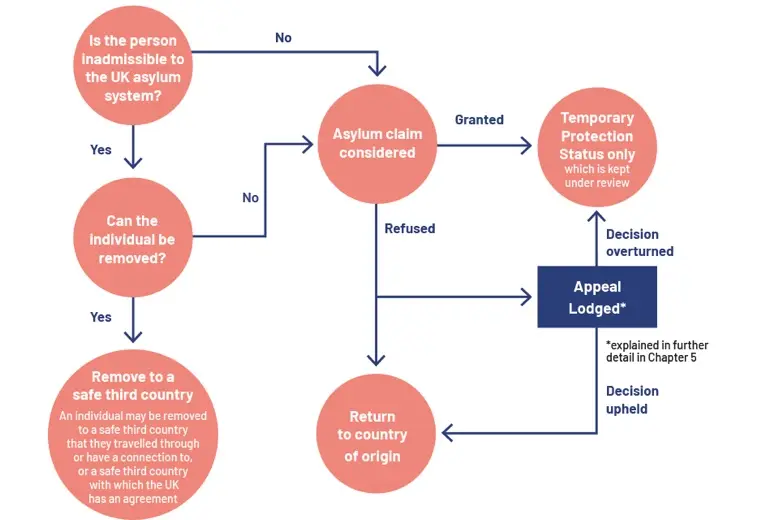
The legal treaty was not formalised yet, and since it was created, it has never been able to send a single flight to Rwanda as the European Court of Human Rights (ECHR) intervened with a last-minute injunction to stop its take-off (The Guardian, 2024). The vulnerability was within the pact itself, due to its non-binding character, as the ECHR, while analysing the agreement, had found three main violations: an absence of a legally enforceable system, a lack of a fair asylum procedure in Rwanda and the scenario of a possible breach of the principle of non-refoulement (Muhambya, 2022). The European arena was not the sole obstacle to this policy, but also domestically, as the UK Supreme Court, on the 15th of November of 2023, deemed the Rwanda policy to be unlawful, particularly when considering that it had declared that Rwanda was not considered a “safe country”, to which Rishi Sunak responded that there would be a new deal with Rwanda (The Guardian, 2024). On the 6th of December, the government was able to address the legal concerns and was able to sign the new legal treaty with Rwanda by introducing the Safety of Rwanda Bill. Nevertheless, when the electoral landslide for Keir Starmer’s Labour Party occurred, the treaty was buried due to its nature, being formally repealed by the “Border Security, Immigration and Asylum Bill” introduced in February 2025 (JUSTICE, 2025). In other words, the treaty had been conceived in a manner that did not follow international norms, concerns for the human rights of the migrant, and it did not get approval from the parliament in the first place, on a publicly salient issue.
3.2 Albania-Italy Model: Giorgia Meloni’s redefinition of EU Migration Policy
When the Rwanda Policy was becoming increasingly troublesome, the Italian Government, led by the coalition of Meloni, signed on the 6th November 2023 the Memorandum of Understanding with Edi Rama, the Prime Minister of Albania, at Palazzo Chigi (RaiNews, 2023). This MOU was first approved by the Senate and then confirmed by the Italian Parliament through the ratification of Law 21/14 (CeRDEF, 2024). According to the previous law, the protocol has a duration of five years, but more importantly, it underlines who is concerned and the geographical scope: non-vulnerable individuals embarked in Italian vessels of the Italian authorities outside of the territorial sea of both the EU and the Italian Republic. This implies that those who are minors, disabled, victims of torture, or, as mentioned, classified as “vulnerable” by the Italian legal framework, are excluded from this process and returned directly to Italy. On the other side of the coin, those who are eligible are brought to the areas defined by the protocol, Shengjin and Gjadër in Albania, where they are detained until the legal matters for border repatriation or asylum procedures are finalised (Integrazionemigranti, 2024). However, the future has proved that this first trial was unsuccessful, as prior to the first test, the Civil Court of Rome issued a landmark ruling, in which it was affirmed that the individuals did not come from “safe countries”, citing the case of the CJEU C-406/22 (CIR Rifugiati, 2024). We can conclude that, similarly to the Rwanda Policy, the first test of the bilateral agreement between Albania and Italy was deemed a failure.
The question that remains unanswered is whether there is a way to legally adopt this bilateral agreement without facing judicial scrutiny from either the CJEU or domestic Italian courts. This is where Meloni’s coalition is able to differentiate itself from the Rwanda Policy of the UK. The Decree Law (DL) 28/37, approved on the 28th March 2025, changed the function of the centre in Gjadër. The latter is systematically repurposed as an offshore pre-deportation hub where adult males within the Italian territory, not outside as before, who have already received an expulsion order from Italy, by being already legally required to leave the country, are not subject to the “safe country” argument provided by the national court. In addition, Article 14 of the DL established that the transfer of an individual to another centre does not nullify the legal basis for detention, meaning that when they are effectively transferred to Albania, there is no legal requirement for a double validation from another judge, which loops around the legislation. After the DL, the national courts were not convinced about the adjustments made by the government and forwarded the case to the European Court. On April 23rd 2026, the CJEU Advocate General Nicholas Emiliou issued a highly influential legal opinion, where he determined that EU law is compatible with the framework provided by the Italy-Albania policy as long as those centres are under Italian jurisdiction, EU law is fully respected and fundamental rights are not breached in practice. The legal battle has still not been finalised, but on the other hand, this prestigious legal opinion marked the temporary victory of the coalition led by Fratelli D’Italia (FDI) as it provided legitimacy and enabled the EP to vote for the Return Legislation on the 17th of June.
3.3 Political dimension of Giorgia Meloni’s victory
Giorgia Meloni’s political breakthrough was forged when, on the 17th of June, the EU approved the EU Return Legislation. Nonetheless, we must infer that this event was the final step and that, to reach this outcome, the process was started after the officialisation of the agreement with Albania on the 6th November of 2023. During the presentation of the agreement, Meloni decided to shape the discourse around EU values and collaboration among EU members and with other external actors. This rhetoric is powerful, especially when considering the terrain of the values, as we must consider the delicate equilibrium inhabiting our societies because of globalisation and the sentiment of economic unease. The latter, explainable through the cultural backlash theory by Inglehart, has led individuals to think that their culture, heritage and identity are being swallowed by the integration of the international system, contributing to the generalised idea that migrants are synonymous of danger towards their values and economic stability. Meloni’s framing of the Albania agreement as a defence of European values directly responds to this cultural anxiety, amplified by modern media and politicians, turning the policy into a political resonance. A clear example is this policy shifting from controversial to normal, accepting the dehumanisation of individuals who are being persecuted. As a consequence, Meloni’s policy directly responds to a societal anxiety injected by media and politicians, a fear shared by citizens across the Western world. This anxiety has become a primary driver in the rise of right-wing populism and the consequent alteration of the balance in the EU Parliament towards right-wing extremism, consisting of 187 seats between ECR, Patriots and ESN.
Understanding the consequences of ideological fragility and identity is crucial, but we must turn our attention to the other factor: collaboration between EU members and external actors. This second element of the rhetoric established is directly linked to Albania, which has been a candidate country since 2014 and began accession negotiations in 2020. Giorgia Meloni has framed on the 6th November 2023 the agreement as a “European-scale agreement. It shows that cooperation is possible on the front of managing migratory flows[…]”. The Italian Prime Minister shifts the discourse from domestic politics towards European-scale policy-making, praised a month later by Ursula Von der Leyen by describing it as “An example of thinking outside the box” (Eunews, 2023). The unwavering support for this policy is underlined on the 9th of July 2025, when the plenary vote passed the European Parliament resolution supporting paragraph 32: “Recognises the closer cooperation between Albania and the EU in managing migration flows and border control processes, […]” (European Parliament, 2025). Paragraph 32 is a crucial stepping stone for Meloni’s political strategy as not only has it passed with 546 votes in favour, but also by including the Socialists and Democrats (S&D), leading the domestic Italian Partito Democratico (PD), who voted against, opposing its own European political family, which was later capitalised by FDI’s coalition in Italy as a national victory against the left. Lastly, this support is given due to the ambivalence of this policy, a tool to temporarily politically solve the anxiety of irregular migration and a way to obtain closer ties with Albania, a country that is planned to join the EU in the upcoming 5 years, resulting in the final institutionalisation of Return Hubs across the European Union.
4. Conclusion
The institutionalisation of return hubs within EU law marks a defining moment in European migration governance, achieved through our analysis. It revealed that the Italian prime minister was able to learn from the mistakes of previous policies, such as the UK-Rwanda pact, for irregular migration. This is demonstrated when the Italy-Albania agreement was able to embed itself within the European Law by excluding vulnerable migrants, retention of Italian jurisdiction over the offshore facilities and the subsequent adjustments made in DL 28/37, which were supported by the Advocate General Emiliou. Nonetheless, this institutionalisation did not occur haphazardly, on the contrary, it is a direct result of the era dominated by uncertainties deeply rooted within our societies. The political strategy employed was to frame this policy at a “European” level and to align national interests within the EU Enlargement in the Western Balkans through Albania as a candidate country, allowing for legitimisation from the EU right-wing populist parties and the rest of the political spectrum to intervene and further isolate the Italian left coalition. As a result, the concept of offshore asylum processing, once dismissed as an aberration, is now a legitimate instrument of EU migration policy, where Albania became the symbol and testing ground, and Giorgia Meloni the pioneer who has altered the status quo prior to the return hubs. The question that remains is whether this is a sustainable answer to the migration issue of the EU, and most importantly, to what extent it is legal and represents the EU’s core values, the cradle of human rights. As Orwell (1945) touches on, a system that proclaims equality while practising double standards becomes a parody of its own principles: “all animals are equal, but some animals are more equal than others”.
5. Sources
Bragagnolo, A. (2024). La difficile costruzione di una politica migratoria europea: tra sfide sovranazionali e freni intergovernativi [Master’s thesis, Università degli Studi di Padova]. https://thesis.unipd.it/retrieve/a1a3b287-08ff-47c8-93ba-d9f2dff7f8bc/BRAGAGNOLO_ALESSANDRA.pdf
Celoria, E., & De Leo, A. (2024). Il protocollo Italia-Albania e il diritto dell’Unione europea: Una relazione complicata. Diritto, Immigrazione e Cittadinanza (1). https://www.dirittoimmigrazionecittadinanza.it/archivio-saggi-commenti/saggi/fascicolo-n-1-2024-1/1414-il-protocollo-italia-albania-e-il-diritto-dell-unione-europea-una-relazione-complicata/file
CerDEF. (n.d.). Documentazione Economica e Finanziaria – Dettaglio Articolo. https://def.finanze.it/DocTribFrontend/getAttoNormativoDetail.do?ACTION=getArticolo&id={98D3669E-F3CD-466C-94F1-A40C8ACE9E23}&codiceOrdinamento=0010000000000000000000000000000000000000000000000000000000000000000000000000000000000000000000000000000000000000000000000000000000&articolo=Allegato
CIR Rifugiati. (2024, November 27). Protocollo Italia-Albania: cosa sta succedendo? – CIR Consiglio Italiano per i Rifugiati. CIR Consiglio Italiano per i Rifugiati. https://cir-rifugiati.org/2024/11/27/protocollo-italia-albania-cosa-sta-succedendo/
Davies, C. (2024, April 23). The tortuous journey of the UK government’s Rwanda plan. The Guardian. https://www.theguardian.com/world/2024/apr/22/uk-rwanda-scheme-courts-key-dates
Emiliou, N. (2026, April 23). Opinion of Advocate General Emiliou in Case C-414/25 | Sedrata [Press release]. Court of Justice of the European Union. https://curia.europa.eu/site/upload/docs/application/pdf/2026-04/cp260064en.pdf
Eunews. (2023, December 19). Meloni can count on von der Leyen for additional EU funds for migration. https://www.eunews.it/en/2023/12/13/albanian-constitutional-court-suspends-the-agreement-with-italy-on-migrants-but-for-von-der-leyen-it-is-in-line-with-eu-law/
European Parliament. (2025). European Parliament Resolution on the 9th of July 2025.
https://www.europarl.europa.eu/doceo/document/TA-10-2025-07-09_EN.html
European Parliament. (n.d.). The Political Groups.
Gjergji, I. (2026). L’Accordo Italia–Albania sulla gestione dei flussi migratori: Tra sicurezza, sovranità e tutela dei diritti fondamentali [Master’s thesis, Università degli Studi di Pavia]
https://unitesi.unipv.it/retrieve/517bc888-b5d3-4f10-8591-159176ee11aa/Tesi_Inis_Gjergji%20.pdf
Home Office news team. (2022, April 14). Factsheet: Migration and Economic Development Partnership.
House of Lords International Agreements Committee. (2022). Memorandum of Understanding between the UK and Rwanda for the provision of an asylum partnership arrangement (1st Report, Session 2022–23, HL Paper 71). UK Parliament.https://publications.parliament.uk/pa/ld5803/ldselect/ldintagr/71/7104.htm#:~:text=Such%20arrangements%20are%20commonly%20referred,Act%202010%20(CRAG%202010)
Integrazionimigranti. (2024). Il Parlamento ha ratificato il protocollo Italia-Albania sui centri per migranti
Justice. (2025). Border Security, Immigration and Asylum Bill Briefing | UK Legal Reform
Charity. (n.d.).
https://www.justice.org.uk/briefings/the-border-security-immigration-and-asylum-bill
New EU system for return of illegally staying third-country nationals | News | European Parliament. (n.d.).
Muhambya, J. (2022). European Court of Human Rights, case of N.S.K. v. the United Kingdom, 13
June 2022, App. no. 28774/22 – Interim measure. (n.d.). Université Catholique De Louvain.
https://www.uclouvain.be/fr/instituts-recherche/juri/cedie/news/muhambyaseptembre2022
Nicolosi, S. F. (2024). Externalisation of migration Controls: A taxonomy of practices and their implications in international and European law. Netherlands International Law Review, 71(1), 1–20. https://doi.org/10.1007/s40802-024-00253-9
Orwell, G. (1945). Animal Farm. Secker and Warburg
Rainews. (2023, November 6). Migranti, Giorgia Meloni firma un accordo con Edi Rama: “In Albania 2 centri italiani di raccolta.” RaiNews.
Sevincş, S. (2026). https://www.aa.com.tr/en/europe/explainer-eu-advances-controversial-return-hubs-plan-as-critics-warn-of-migrant-rights-risks/3971349%20%20
Schröter, V. (2026, June 17). Return Regulation: The European Parliament has given its approval. The People’s Party and the far right. Eunews.
Stato, I. P. E. Z. D. (2025, March 28). DECRETO-LEGGE 28 marzo 2025, n. 37 – Normativa.
https://www.normattiva.it/uri-res/N2Ls?urn:nir:stato:decreto.legge:2025-03-28;37
United Nations Support Mission in Libya & Office of the United Nations High Commissioner for Human Rights. (2018). Desperate and dangerous: Report on the human rights situation of migrants and refugees in Libya.
https://unsmil.unmissions.org/sites/default/files/libya-migration-report-18dec2018.pdf.