


The EU possesses the functional dimensions of grand strategy but lacks the institutional architecture through which they could be integrated into a unified strategic logic.
A doctrine before a strategy: Building the preconditions of European grand strategic reasoning
The European Union confronts acute geopolitical pressure with strategic documents whose vocabulary outruns their substance. I argue that the EU’s three strategic documents — the 2003 European Security Strategy, the 2016 EU Global Strategy, and the 2022 Strategic Compass — each perform the grammar of grand strategy without supplying the architecture through which it could function as strategic reasoning. I therefore propose that the EU adopt a grand strategy doctrine, anchored in Article 22 TEU, performing three operations the existing documents have failed to perform: it specifies a rank-ordered set of long-term political ends; disciplines subordinate strategies through a High Representative-led Strategic Coherence Report; and institutionalises sustained reasoning through a Strategic Reasoning Cell within the EEAS and mandatory national strategic consultations. Without the doctrine, the EU continues to produce strategic vocabulary; with it, the EU constitutes the conceptual and institutional preconditions for grand strategic reasoning.
The concept of grand strategy inhabits a rather awkward and paradoxical position in scholarly literature: it is both the subject of a vast literature on good practices and histories, yet it appears to simultaneously lack a firm theoretical foundation; which is to say, the concept of grand strategy lacks a consensus on how it should be defined despite a broad agreement that possessing a grand strategy is preferable to not possessing one (Freedman 2022). While this definitional instability is frustrating as an academic, it is even more inconvenient when put into practice. Policy makers who deploy the vocabulary of grand strategy without understanding its substance tend to mistake strategic communication for strategic reasoning or reactive prioritisation of commitments for deliberate ends-means alignment. Hence, I submit in this report an operationalizable framework for policymakers. I then test the case of the European Union (EU) against this framework and make a concrete policy recommendation for an EU grand strategy doctrine.
Grand strategy, properly understood, is the highest-order form of political reasoning available to a sovereign or quasi-sovereign actor. Grand strategy is a conceptual superstructure within which all lower-order strategic instruments are situated and given coherent direction. As Henke (2025, 100) argues, grand strategy “sits above strategies that deal with lower levels of statecraft” and is distinguished from a simple plan precisely by its capacity to account for disruption, adversarial resistance, and the irreducible gap between ambition and achievable outcomes. Thus, grand strategy is what a state does with all its instruments of power in the sustained service of a politically defined end. This insight informs the definition I will employ throughout this paper: grand strategy is the sustained, deliberate alignment of all available instruments of power – military, economic, diplomatic, technological, and normative – with a clearly articulated set of long-term political ends, governed by a disciplined calculus of means and constrained by an honest recognition of the gap between aspiration and capacity.
Three features of this definition merit emphasis. First, grand strategy is inherently future-oriented and purposive; it cannot be reduced to a post-hoc rationalisation of observable patterns of behaviour (Brands and Feaver 2022). Second, it performs an essential prioritisation function: in a world of finite resources and competing demands, grand strategy provides the rank-ordered value structure through which decision-makers determine what core is and what is secondary (Brands and Feaver 2022). Third, and crucially for the EU case, grand strategy differs from foreign policy in its macropolitical scope: whereas foreign policy operates at the level of specific regional interactions, grand strategy defines the overarching political course to which those interactions are ultimately subordinated (Henke 2025).
The application of this framework to a non-state actor such as the EU is theoretically non-trivial. Rynning (2003) has argued that what the EU most conspicuously lacks is a shared strategic culture; that is, a common set of “interests and views of the world” capable of sustaining coherent joint action. Hence, this absence undermines the credibility of its security ambitions from the outset. Smith (2011) goes further in mapping the EU’s partial alignment with grand strategic logic, identifying three functional components – physical security, economic prosperity, and value projection – that correspond to the constitutive dimensions of grand strategy, while nonetheless acknowledging that the EU’s institutional architecture systematically prevents their integration into a unified strategic logic. So, these analytical interventions converge on a shared diagnosis: the EU does not lack strategic documents or strategic aspirations, but rather the conceptual coherence to transform those aspirations into grand strategy in the rigorous sense defined here. It is this diagnosis that I test out against my own reading of the three strategic documents the EU has put out thus far: the 2003 European Security Strategy (ESS), the 2016 EU Global Strategy (EUGS), and the 2022 Strategic Compass.
The ESS, the EU’s inaugural attempt at unified strategic articulation, catalogues terrorism, weapons proliferation, state failure, organised crime, and regional instability as constitutive challenges and positions the EU as a globally responsible actor. Yet, these threats, enumerated without prioritisation, read as aspirations articulated without a calculus of means. The EUGS’s organising concept of “principled pragmatism” is a self-defeating formulation that dissolves the distinction between ends and means by treating adaptability as itself the strategic purpose, while its enumeration of five strategic priorities elevates everything to strategic importance and thereby prioritises nothing. The 2022 Strategic Compass, written in the shadow of Russia’s invasion of Ukraine, promises “clear goals” and the “means to achieve them” but delivers an elaborated capability-planning document organized around four operational pillars — Act, Secure, Invest, Partner — that enumerate the instruments of power without specifying any overarching political end to which they are collectively answerable; it tells the EU what to acquire, but not, in any rigorous sense, what for.
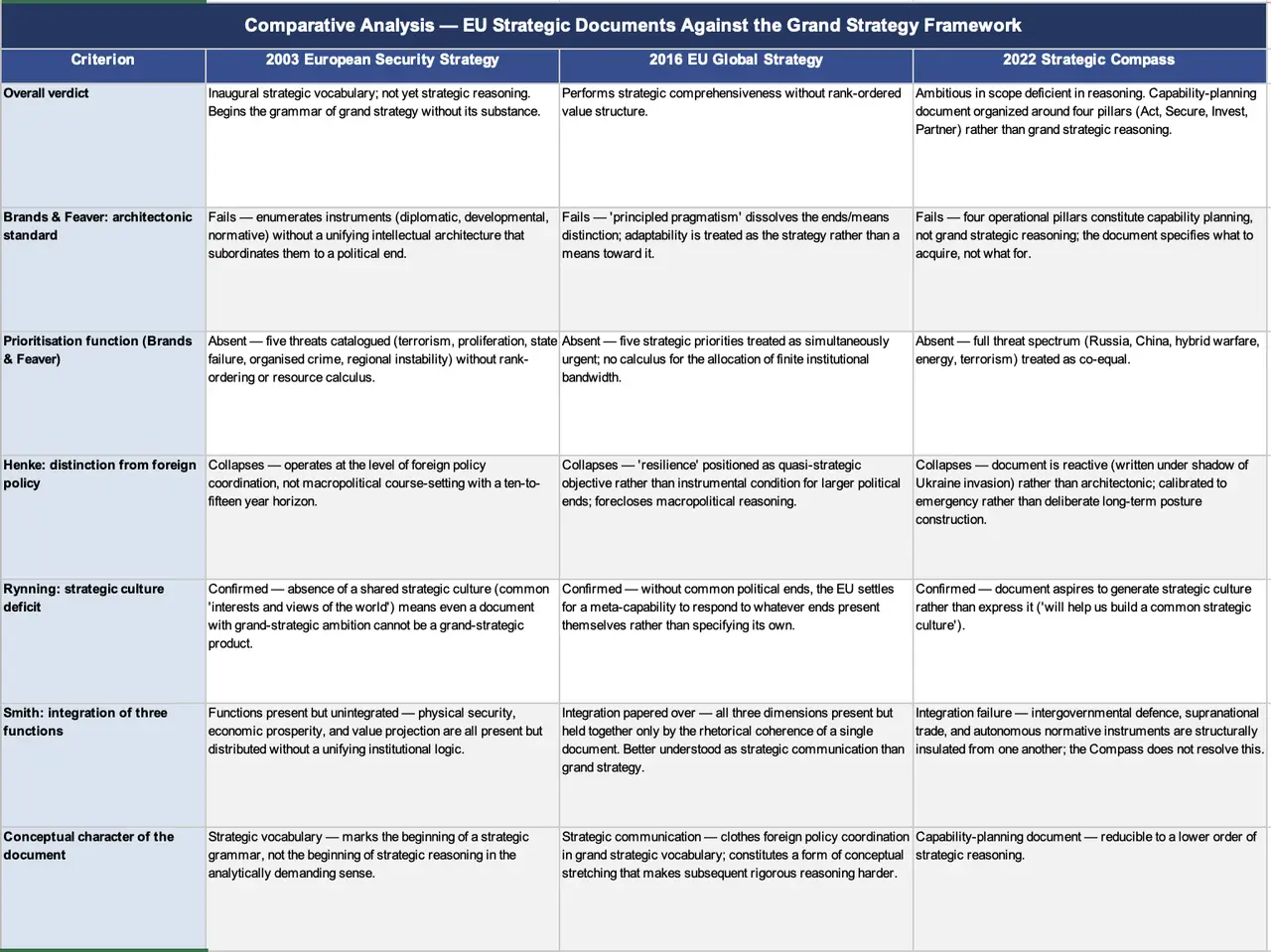
In sum, these successive drafting shortcomings exhibit the structural consequence of the EU’s character as a political project. Each document reproduces, in more sophisticated form, the same constitutive deficit Smith (2011, p. 144) diagnoses: the EU possesses the functional dimensions of grand strategy but lacks the institutional architecture through which they could be integrated into a unified strategic logic, since defence remains intergovernmental, trade supranational, and normative projection operates through largely autonomous conditionality and neighbourhood instruments structurally insulated from the other two. The Strategic Compass renders this circularity most visible by treating strategic culture not as a precondition for grand strategy but as something the document itself will help to generate; this is, in fact, an attempt by the EU to produce through documentation the shared “interests and views of the world” that would need to be constitutively in place before coherent strategic action becomes possible. An entity built on the deliberate dispersion of coercive authority and the procedural sublimation of power cannot, without a categorical transformation of its institutional logic, produce grand strategy as Freedman (2022) understands it — as a form of reasoning that demands not the mere identification of ends but the willingness to concentrate, prioritise, and deploy power in their service. Each successive document thus elaborates a strategic vocabulary; none yet marks the beginning of strategic reasoning.
Figure 1 – A comparative analysis against grand strategy literature
The diagnostic logic developed across the preceding sections precludes the most intuitive policy response: that the EU simply produce another, better strategic document. My previous analysis (summarised for easier readability in Figure 1) identified the absence of the conceptual and institutional scaffolding that would allow such documents to function as the operational expression of strategic reasoning rather than as its declaratory substitute. Each successive iteration has performed the grammar of grand strategy while leaving its logic ungrounded; each has rehearsed the vocabulary of prioritisation, instrument integration, and political ends without specifying the architecture through which any of these would be sustained. I therefore propose that the EU requires a grand strategy doctrine: a meta-text that establishes what grand strategy means for the EU as a sui generis political actor, how it relates to existing planning instruments, and through what institutional process it is to be produced and revised. The doctrine, in this sense, is not itself a strategy, but rather a structuring concept that disciplines all subsidiary strategies and renders them mutually intelligible.
A doctrine, properly conceived, performs three operations that the existing documents have categorically failed to perform. First, it provides an operational definition of grand strategy calibrated to the EU’s institutional and constitutional reality. Second, it specifies the relations of subordination among existing planning instruments by establishing the political ends to which each must answer. Third, it identifies the institutional architecture through which grand strategic reasoning is to be sustained over the long horizon that, following Henke (2025), distinguishes grand strategy from foreign policy. These three functions, taken together, produce the conditions of possibility for a grand strategy.
The first function of an operational definition must be vested with member-state authority. I therefore propose that the doctrine be adopted by the European Council pursuant to Article 22 TEU, which empowers the European Council to “identify the strategic interests and objectives of the Union” based on the foreign policy principles set out in Article 21. This is a legal instrument that, despite its constitutional centrality, has been used sparingly and never to its full grand strategic potential. An Article 22 decision, adopted under unanimity and binding upon both the Council and the Commission in their respective fields, carries the political weight of all member states and provides the doctrine with the consensus base that Rynning (2003) identified as a constitutive precondition of coherent strategic action. In substance, the doctrine must specify a rank-ordered set of long-term political ends – physical security of the EU and its citizens, preservation of a rules-based economic order favourable to European prosperity, projection of European values, and safeguarding of strategic autonomy – and must do so in a hierarchy that permits trade-offs, not in the additive logic of equally weighted “priorities” that has characterised prior documents.
Building on this, the second function of mapping existing instruments is where the doctrine should perform its most consequential disciplining work. At present, the EU produces strategic documents in functional and sectoral silos, where each document advances its own internal logic with no structuring text to specify how, when, and to what extent these logics must yield to a common political end. I contend that the doctrine must explicitly designate these documents as subordinate instruments and establish a consistency requirement: each subsidiary strategy, at the moment of its adoption and at periodic intervals thereafter, must demonstrate its alignment with the doctrinal ends. In this sense, the High Representative for Foreign Affairs and Security Policy, in their dual capacity as Vice-President of the Commission and chair of the Foreign Affairs Council, is positioned to perform this consistency assessment and should be mandated to deliver an annual Strategic Coherence Report to the European Council, identifying drift, contradiction, and misalignment among subordinate instruments. Of course, the draft of such a report should first be submitted to the President of the Commission for a rigorous analysis and final approval. While the responsibility in this sense would fall more within the scope of the EEAS, it will still require a preliminary submission to and approval of the Commission. This could also revitalise the role of the EEAS to the EU, perhaps prompting a reshuffling of responsibilities.
The third function of an architecture for sustained reasoning addresses the Rynning circularity diagnosed in the analysis of the Strategic Compass: the strategic culture that grand strategy requires cannot be generated by the documents it is supposed to enable. What can be generated, however, is the institutional infrastructure through which a shared strategic culture might be cultivated over time. To that end, the doctrine should establish a Strategic Reasoning Cell within the EEAS, tasked exclusively with horizon-scanning, doctrinal interpretation, and the maintenance of an evolving threat-and-opportunity assessment; this body would be conceptually analogous to a national planning staff but constitutionally bound to the doctrine rather than to any specific operational mission. Furthermore, the doctrine should institute a mandatory cycle of national strategic consultation, in which each member state submits, on a defined periodicity, a national strategic outlook that is then synthesized by the General Secretariat of the European Council and integrated into the doctrinal cycle; this corrects for the structural concern that EU strategic documents have historically been Commission-led products and grounds the doctrine in a substantive input from member states. This also takes into account that member states might not wish to submit their sovereignty to the EU but would rather use the EU as a tool of cohesive action.
It would be intellectually dishonest, however, to advance this policy framework without confronting its irreducible structural limit. The EU does not possess the legal authority to direct the use of military force; it neither commands national armed forces nor disposes of the coercive instruments that, in the Clausewitzian tradition, constitute the ultima ratio of grand strategy. The defence competency remains intergovernmental, governed by the unanimity rule of Article 24 TEU and constrained by the persistent reservations of member states concerning sovereignty over the means of violence. Any grand strategy doctrine adopted by the EU is therefore, by constitutive design, a doctrine of qualified Clausewitzianism: it can align the instruments the EU actually disposes of – trade, sanctions, regulation, normative projection, development finance, capability planning, defence industrial coordination – but it can only orchestrate, not command, the military instrument.
In short, my proposed grand strategy doctrine neither pretends that the EU can become a Westphalian strategic actor nor concedes that its post-Westphalian character forecloses grand strategic reasoning altogether. It proposes, instead, that grand strategy be reconceived for an actor whose coercive authority is dispersed across its member states but whose non-coercive instruments are concentrated to a degree unmatched by any other polity in the international system. A doctrine grounded in Article 22 TEU, disciplining subordinate strategies through a High Representative-led consistency mandate, and institutionally sustained by a dedicated cell within the EEAS, would not solve the EU’s grand strategic problem; it would, however, for the first time, constitute it as a problem capable of being worked upon. Without such a doctrine, the EU will continue to produce strategic documents whose vocabulary outruns their substance. With it, the EU acquires what it has never possessed: the conceptual and institutional preconditions for genuine grand strategic reasoning.
Brands, Hal, and Peter Feaver. 2022. “Getting Grand Strategy Right.” In The Oxford Handbook of Grand Strategy, edited by Thierry Balzacq and Ronald R. Krebs, 559–575. Oxford: Oxford University Press.
Council of the European Union. 2003. A Secure Europe in a Better World: European Security Strategy. Brussels: Council of the European Union.
Council of the European Union. 2022. A Strategic Compass for Security and Defence: For a European Union that Protects Its Citizens, Values and Interests and Contributes to International Peace and Security. Brussels: Council of the European Union.
European External Action Service. 2016. Shared Vision, Common Action: A Stronger Europe — A Global Strategy for the European Union’s Foreign and Security Policy. Brussels: European External Action Service.
European Union. 2012. Consolidated Version of the Treaty on European Union. Official Journal of the European Union C 326/13 (October 26, 2012).
Freedman, Lawrence. 2022. “Grand Strategy: The History of a Concept.” In The Oxford Handbook of Grand Strategy, edited by Thierry Balzacq and Ronald R. Krebs, 25–47. Oxford: Oxford University Press.
Henke, Marina E. 2025. “Best Practices in Grand Strategy Design.” Texas National Security Review 8, no. 2: 97–109.
Rynning, Sten. 2003. “The European Union: Towards a Strategic Culture?” Security Dialogue 34, no. 4: 479–496.
Smith, Michael E. 2011. “A Liberal Grand Strategy in a Realist World? Power, Purpose and the EU’s Changing Global Role.” Journal of European Public Policy 18, no. 2: 144–163.