



1. Introduction: Documentary Payment
Every cross-border sale contains the same standoff. The seller will not part with the cargo before payment and the buyer will not pay before knowing the cargo exists and has shipped. With an unknown counterparty, a foreign insolvency regime and weeks of transit in between, neither side can comfortably go first. International trade finance answers this by substituting documents for goods: entitlement to payment is triggered not by delivery but by tender of a defined set of papers, a commercial invoice, bills of lading, and certificates of origin, quality and insurance, which represent the cargo and, in the bill of lading’s case, confer control over it.
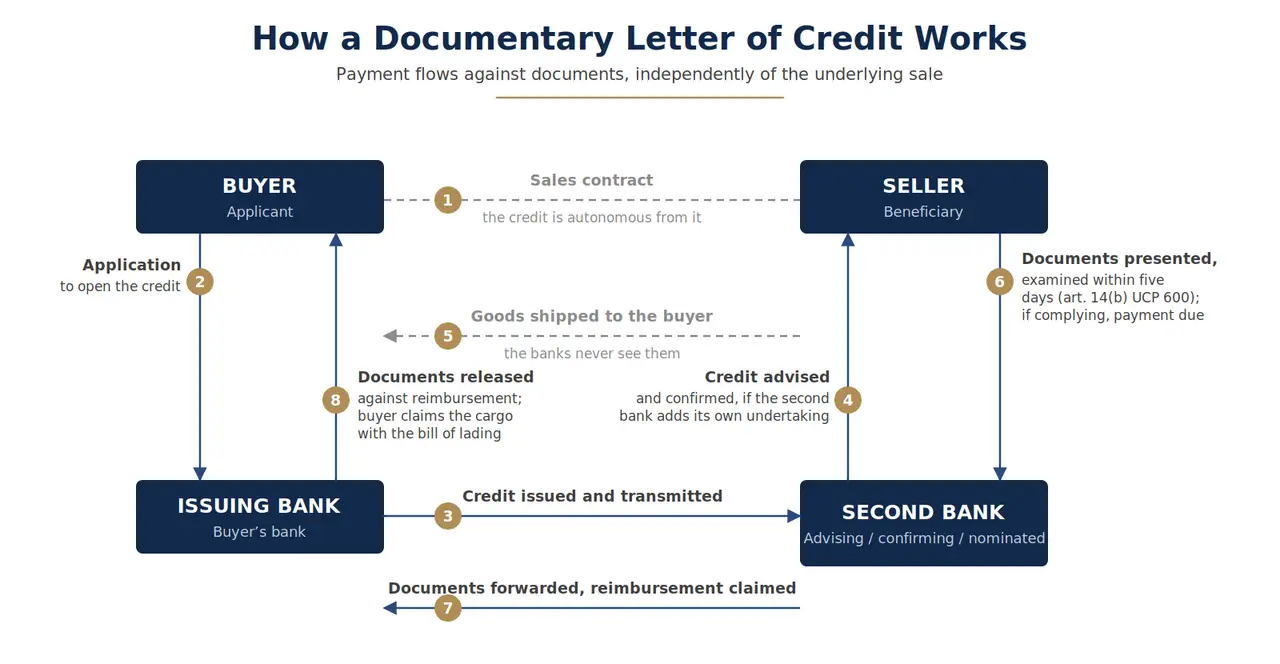
Under a documentary letter of credit (L/C) the buyer instructs its bank (the issuing bank) to issue an irrevocable undertaking in favor of the seller (the beneficiary), promising payment against a complying presentation within a stated validity period. A second bank may be brought in, and its role determines its exposure. An advising bank verifies the credit’s apparent authenticity and owes no payment obligation. A confirming bank adds its own independent undertaking alongside the issuing bank’s. A nominated bank is the one with which the credit is available, authorized to honor or negotiate the credit but not obliged to do so.
The governing regime is unusual. There is a treaty in the field, the UNCITRAL Convention on Independent Guarantees and Stand-by Letters of Credit, adopted in 1995 and in force since 2000, but its practical reach is slight. It covers standbys and independent guarantees rather than commercial documentary credits; it has attracted only eight ratifications, none from a major trade finance centre, with the United States signing in 1997 but never ratifying; and it applies only where the issuer is located in a contracting state or the parties have opted in, and may be excluded by the terms of the undertaking. In practice, therefore, the letter of credit is governed by contractual soft law, principally the ICC’s Uniform Customs and Practice for Documentary Credits (UCP 600), incorporated by the credit itself and supplemented by national law where the UCP is silent (Deschamps, 2022, pp. 246-247).
That last point sets this paper’s question. The UCP says nothing about fraud, so any defense to payment is a matter for national law, and English law is particularly influential here. It has produced a developed body of case law on the fraud exception, and English-law instruments are routinely issued by banks with no other connection to the jurisdiction: the standby credits in Macquarie were issued by a Swiss bank, while the two 2017 Court of Appeal decisions discussed in Section 3 concerned a Spanish and a Portuguese bank, on contracts performed in Trinidad and Venezuela respectively. This paper asks whether the English threshold for invoking the fraud exception strikes a defensible balance between commercial certainty and fairness to the applicant.
Section 2 sets out the two doctrines that give the credit its character, autonomy and strict compliance. Section 3 examines the scope of the fraud exception and what English law excludes from it. Section 4 analyzes the threshold itself, which differs according to whether the bank or the beneficiary is the target of relief, and asks why so few applicants succeed. Section 5 evaluates that threshold against the alternatives and proposes three adjustments. One limit of scope should be noted at the outset. Fraud is not the only ground on which English law contemplates refusal, since illegality in the underlying transaction may also provide a defense (Mahonia Ltd v JP Morgan Chase Bank, 2003), and the two are closely intertwined. This paper is confined to fraud, and the illegality line of authority is left aside.
2. The two doctrines governing L/Cs
The first is autonomy. Articles 4 and 5 UCP 600 provide that the credit is a transaction separate from the sale contract on which it may be based, and that banks deal with documents and not with goods, services or performance. English law recognized the principle long before the UCP: in Hamzeh Malas & Sons v British Imex Industries Ltd (1958) a buyer alleging defective goods could not restrain payment under a confirmed credit, and in R D Harbottle (Mercantile) Ltd v National Westminster Bank Ltd (1978) Kerr J described such instruments as the lifeblood of international commerce. The commercial logic is that the credit must be as good as cash; if it were vulnerable to every dispute about the underlying contract, sellers would price the mechanism out of use.
The second is strict compliance, the procedural corollary. Because the obligation depends only on the documents, the documents must conform strictly to the credit, with Lord Sumner’s formulation in Equitable Trust Co of New York v Dawson Partners Ltd (1927) being that near-equivalence will not do. Article 14(b) UCP 600 gives a bank a maximum of five banking days to decide, and Article 16 requires notice of refusal on pain of losing the right to reject.
The result is a regime of deliberate blindness, and Article 34 UCP 600 goes further, disclaiming any bank liability for the genuineness of any document. The UCP does not address fraud at all. The ICC’s position has been that the gap is for national jurisdictions to fill (Aladwan, 2020, p. 977). Many major trading jurisdictions have done so, but in materially different ways, a divergence Section 5 returns to.
3. The scope of the fraud exception
The exception was born in New York. In Sztejn v J Henry Schroder Banking Corp (1941) the beneficiary shipped cow hair and rubbish instead of the contracted hog bristles, and the fraud reached the bank before the drafts were presented. Shientag J accepted autonomy but held it should not shield an unscrupulous seller: the principle insulates the bank from disputes about quality, not from financing a known fraud.
English law adopted the exception and drew it far more narrowly. In United City Merchants (Investments) Ltd v Royal Bank of Canada (The American Accord) (1983) a loading broker’s employee fraudulently entered 15 December as the shipment date when loading in fact occurred on 16 December. The sellers knew nothing about it. Lord Diplock held that the sole established exception arises where the beneficiary, for the purpose of drawing on the credit, presents documents containing material representations of fact that to its own knowledge are untrue. Fraud by a third party of which the beneficiary is innocent is no defense, and the sellers were paid.
Three consequences define the English position. First, the fraud must be the beneficiary’s own. What The American Accord excludes is fraud by a third party of which the beneficiary is innocent, not every fraud touching the underlying transaction. Where the beneficiary’s own presentation or demand misrepresents its entitlement to payment, the exception is engaged, and the court will look at the underlying contractual position so far as is necessary to test whether the beneficiary honestly believed what it represented; the question asked, and answered against the applicant, in NIDCO and PetroSaudi below. Aladwan (2020, pp. 983-984) nevertheless defends a narrow rule, on the ground that any wider inquiry would require banks to go behind documents they are neither expert nor equipped to assess. Second, breach of contract is not fraud; disputes about quantity or quality sound in damages against the seller, and only cases of no goods at all, or worthless goods presented as conforming goods, cross the line. Third, there is no general nullity exception. In Montrod Ltd v Grundkötter Fleischvertriebs GmbH (2001) the credit required an inspection certificate signed by the applicant, Montrod; the beneficiary, a German meat supplier, signed the certificates in Montrod’s name in the honest but mistaken belief that it was authorized to do so. The certificate was therefore a nullity, but the Court of Appeal held that this did not entitle the bank to refuse, because an honest beneficiary should not bear the risk of documents generated further up a transaction chain.
Standby credits and demand guarantees raise the same question differently, since the misrepresentation is usually the demand itself. English law asks whether the beneficiary honestly believed the sums were due. In National Infrastructure Development Co Ltd v Banco Santander SA (2017) a Trinidadian employer called on standby credits after terminating a highway contract; in PetroSaudi Oil Services (Venezuela) Ltd v Novo Banco SA (2017) the beneficiary of a drilling-contract standby certified that the applicant was obliged to pay, a statement the Court of Appeal treated as in substance a proposition of law. Both demands were upheld: an honest, if mistaken, view of the underlying contract is not fraudulent.
4. How high is the bar?
The test depends on what is being restrained. An injunction against the bank interferes with the bank’s own undertaking, and English law guards that undertaking with two cumulative conditions: the bank must have known of the fraud before it paid, and the evidence of both the fraud and that knowledge must be clear. Relief directed at the beneficiary is analytically distinct and is treated separately below.
a) Restraining the bank
The bank’s knowledge. The fraud must be clear and obvious to the bank before it pays; in Lord Denning MR’s formulation in Edward Owen Engineering Ltd v Barclays Bank International Ltd (1978), a clear fraud of which the bank has notice. A bank that pays in ignorance is protected and the applicant must reimburse it, even if the documents later prove forged (Gian Singh & Co Ltd v Banque de l’Indochine, 1974). No bank is obliged to investigate allegations, and suspicion falling short of knowledge does not engage the exception; what is required is that the fraud be established to the bank’s knowledge before payment, so as to be clear and obvious to it. The point was reinforced from an unusual angle in Macquarie Bank Ltd v Banque Cantonale Vaudoise (2024), where Foxton J declined to let a Swiss stay of proceedings suspend payment under English-law standby credits in the absence of any allegation of fraud against the beneficiary. The case concerns forum rather than the fraud exception, but it shows an English court unwilling to see an issuer’s obligation defeated by procedural means abroad.
Clear evidence. A mere allegation, or even strong suspicion, is not enough. Bolivinter Oil SA v Chase Manhattan Bank NA (1984) required clear evidence both of the fraud and of the bank’s knowledge of it, available at the time of the application; and United Trading Corp SA v Allied Arab Bank Ltd (1985) framed the test as whether the only realistic inference on the material available is fraud. Crucially, the ordinary threshold for interim injunctions is displaced. Under American Cyanamid Co v Ethicon Ltd (1975) an applicant need show only a serious issue to be tried; in this context the Privy Council confirmed in Alternative Power Solution Ltd v Central Electricity Board (2014) that the fraud must effectively be established at the interim stage, not merely arguable. The outcomes bear this out. Injunctions were refused for want of clear evidence in Discount Records Ltd v Barclays Bank Ltd (1975) and, despite forged documents, in Tukan Timber Ltd v Barclays Bank plc (1987); in Czarnikow-Rionda Sugar Trading Inc v Standard Bank London Ltd (1999) Rix J refused relief where the bank was unaware of the alleged fraud and doubted whether damages could ever be inadequate against a solvent bank.
Two structural features compound the difficulty. The first is timing. Article 14(b) UCP 600 sets no limitation period for the applicant; it gives the nominated, confirming or issuing bank a maximum of five banking days after presentation to determine whether the presentation complies. But the practical consequence is severe: once the bank concludes that the documents conform, payment follows, and an applicant who has not by then put clear evidence of fraud before the bank or obtained an injunction is left pursuing the beneficiary rather than resisting payment. The window is a commercial fact rather than a legal deadline, which arguably makes it worse, because it can close sooner than five days if the bank decides early.
The second is that the burden falls very differently across instruments. Under a commercial credit the beneficiary’s right to payment arises because it has performed, so the applicant must prove fraud about goods it may not yet have seen, from documents that are regular on their face. Under a standby or demand guarantee the right arises from the applicant’s alleged default, and the falsity of a certificate of default may be apparent from the instrument and the underlying contract alone (Aladwan, 2023, p. 597). The same evidential standard therefore bites far harder on the commercial credit, a point Section 5 returns to.
b) Restraining the beneficiary
Where the applicant seeks to restrain the beneficiary from making or maintaining a demand, the bank’s undertaking is not directly in issue and the knowledge condition falls away: what matters is the beneficiary’s dishonesty, not what the bank was told. Themehelp Ltd v West (1996) granted such relief where fraudulent inducement of the underlying contract was alleged, reasoning that the integrity of the banking system was not directly engaged. Kvaerner John Brown Ltd v Midland Bank plc (1998) is the clearer illustration: an injunction restrained a beneficiary from maintaining a demand under a standby credit accompanied by a certificate stating that a contractual notice had been given when plainly it had not.
The route has nonetheless been narrowed rather than widened. Evans LJ dissented in Themehelp itself on the ground that such relief damages banking integrity and commercial morality; Group Josi Re v Walbrook Insurance Co Ltd (1996) read the decision restrictively; and in Salam Air SAOC v Latam Airlines Group SA (2020) Foxton J confined it to closely comparable facts and held that the enhanced merits standard applies equally to injunctions sought against a beneficiary. What survives is therefore a narrower difference than it first appears: the bank’s knowledge drops out, but the evidential threshold does not.
5. Does the English threshold get the balance right?
The case for strictness is substantial. The value of a credit lies in its unconditionality, since pricing, discounting and negotiation all depend on it. Banks are document checkers and not investigators; requiring them to police the underlying transaction within five banking days would be unrealistic and reputationally hazardous. A permissive exception invites tactical litigation by buyers with ordinary contractual complaints.
The strictness is only visible, however, against the alternatives. Under Section 5-109 of the revised Uniform Commercial Code, US courts recognize a broader ‘material fraud’ reaching the underlying transaction, and the Supreme Court of Canada took a similar course in Bank of Nova Scotia v Angelica-Whitewear Ltd (1987), extending the exception to fraud in the underlying transaction of such a character as to render the demand for payment itself fraudulent. That is a difference of scope, not merely of proof. Eurobank Ergasias SA v Bombardier Inc (2024) shows how the Canadian courts handle a related question. Arising from a Greek defence procurement contract and a Greek letter of guarantee, it held that a third party’s fraud may be attributed to the beneficiary of a counter-guarantee where the beneficiary knew of and participated in it, the attributed fraud becoming the beneficiary’s own. On that narrow question the reasoning runs close to Lord Diplock’s insistence on the beneficiary’s own knowledge, but the wider divergence between the two systems is substantive and does not reduce to a question of evidence.
The case against is correspondingly about access to the remedy rather than its content. Where the bank is the respondent, the two conditions interlock in a way that makes the exception close to unreachable. The applicant must prove not only fraud but the bank’s knowledge of it, and the bank has both less information and less incentive than the applicant to acknowledge that knowledge. As Aladwan (2023, p. 597) observes, there is something incoherent in treating the banker’s evidence as probative while discounting that of the applicant, who is usually the party with real commercial expertise about the cargo. Ellinger (1981) argued four decades ago that a threshold pitched this high makes the exception practically impossible to invoke, and the case law since has not obviously disproved him. Richards (2019) presses a further objection: that The American Accord overlooked strict compliance itself, since it is hard to explain why a document known at presentation to be forged or null should still count as complying, a route that would close the Montrod gap without enlarging the exception or asking banks to look beyond the documents.
The better view is that the scope of the English exception is right and the evidential architecture around it is not. Restricting the exception to the beneficiary’s own dishonesty keeps banks out of ordinary performance disputes and preserves autonomy, and even where the exception reaches the underlying transaction, as in Canada, the demand must still be a fraudulent one on the beneficiary’s part. Harder to defend is the uniform application of the ‘only realistic inference’ test across instruments with very different risk profiles, and the refusal to calibrate relief.
Three adjustments would preserve certainty while restoring some fairness. First, distinguishing commercial credits from standbys and demand guarantees, since the falsity of a certificate of default is usually demonstrable on the papers while the falsity of a shipping document is not. Second, directing relief at the beneficiary and at the proceeds rather than the bank’s undertaking; freezing orders and beneficiary-directed injunctions interfere far less with banking integrity than an order against the issuer. Third, using security as the balancing mechanism, as the cross-undertaking in damages already allows a court to protect a beneficiary wrongly restrained, and Aladwan (2023, p. 598) proposes a comparable civil law device of a fee lodged with the court, released to the applicant if the allegation proves well founded and to the beneficiary as compensation if it does not. Where security is real, a standard of convincing rather than incontrovertible evidence would not destabilize the system. Deschamps (2022, p. 259) adds a practical corollary for the bank caught in the middle: where genuinely in doubt, it should notify the applicant that payment will follow after a stated deadline unless a restraining order is obtained, which allocates the decision to the party best placed to make it.
6. Conclusion
The fraud exception is the principal recognized exception to the autonomy of documentary credits, and English law has kept it narrow: the beneficiary’s own dishonesty, clearly established to the bank’s knowledge before payment. That narrowness is a policy choice in favor of certainty, made consistently from The American Accord (1983) through Alternative Power Solution (2014), and reflected in the reluctance of English courts to see an issuer’s obligation suspended by other means, as in Macquarie Bank (2024). It is defensible, and probably correct, as a matter of scope. But certainty purchased through an evidential threshold that almost no applicant can meet comes at the expense of the exception’s practical availability.
References
Aladwan, Z. (2020). The implementation of the fraud exception rule: A comparative study. Journal of Financial Crime, 27(3), 977–993.
Aladwan, Z. (2023). Legal basis for the fraud exception in letters of credit under English law. Journal of Financial Crime, 30(2), 594–600.
Deschamps, M. (2022). Letters of credit: The autonomy principle and the fraud exception. Banking & Finance Law Review, 38, 245–259.
Ellinger, E. P. (1981). Fraud in documentary credit transactions. Journal of Business Law, 258.
International Chamber of Commerce. (1995). Uniform rules for collections (URC 522, ICC Publication No. 522).
International Chamber of Commerce. (2007). Uniform customs and practice for documentary credits (UCP 600, ICC Publication No. 600).
Richards, K. (2019). Revisiting the fraud exception: A critique of United City Merchants v Royal Bank of Canada 40 years on. Legal Studies, 39(4), 656–675.
Uniform Commercial Code § 5-109 (1995).
United Nations Commission on International Trade Law. (1995). United Nations Convention on Independent Guarantees and Stand-by Letters of Credit.
Cases
Alternative Power Solution Ltd v Central Electricity Board [2014] UKPC 31.
American Cyanamid Co v Ethicon Ltd [1975] AC 396 (HL).
Bank of Nova Scotia v Angelica-Whitewear Ltd [1987] 1 SCR 59 (SCC).
Bolivinter Oil SA v Chase Manhattan Bank NA [1984] 1 WLR 392 (CA).
Czarnikow-Rionda Sugar Trading Inc v Standard Bank London Ltd [1999] 2 Lloyd’s Rep 187 (Comm).
Discount Records Ltd v Barclays Bank Ltd [1975] 1 Lloyd’s Rep 444 (Ch).
Edward Owen Engineering Ltd v Barclays Bank International Ltd [1978] QB 159 (CA).
Equitable Trust Co of New York v Dawson Partners Ltd (1927) 27 Ll L Rep 49 (HL).
Eurobank Ergasias SA v Bombardier Inc, 2024 SCC 11.
Gian Singh & Co Ltd v Banque de l’Indochine [1974] (PC).
Group Josi Re v Walbrook Insurance Co Ltd [1996] (CA).
Hamzeh Malas & Sons v British Imex Industries Ltd [1958] 2 QB 127 (CA).
Kvaerner John Brown Ltd v Midland Bank plc [1998] CLC 446 (Comm).
Macquarie Bank Ltd v Banque Cantonale Vaudoise [2024] EWHC 114 (Comm).
Mahonia Ltd v JP Morgan Chase Bank [2003] EWHC 1927 (Comm).
Montrod Ltd v Grundkötter Fleischvertriebs GmbH [2001] EWCA Civ 1954.
National Infrastructure Development Co Ltd v Banco Santander SA [2017] EWCA Civ 27.
PetroSaudi Oil Services (Venezuela) Ltd v Novo Banco SA [2017] EWCA Civ 9.
R D Harbottle (Mercantile) Ltd v National Westminster Bank Ltd [1978] QB 146 (QB).
Salam Air SAOC v Latam Airlines Group SA [2020] EWHC 2414 (Comm).
Sztejn v J Henry Schroder Banking Corp, 31 NYS 2d 631 (NY Sup Ct 1941).
Themehelp Ltd v West [1996] QB 84 (CA).
Tukan Timber Ltd v Barclays Bank plc [1987] 1 Lloyd’s Rep 171 (Comm).
United City Merchants (Investments) Ltd v Royal Bank of Canada (The American Accord) [1983] 1 AC 168 (HL).
United Trading Corp SA v Allied Arab Bank Ltd [1985] 2 Lloyd’s Rep 554 (CA).