

By Marina Fernández Gordon
1. Introduction
Meeting ambitious climate targets requires a ‘tad’ more than setting them. States have clearly committed to pursue efforts to limit global warming to 1.5 °C (Paris Agreement, 2015). To achieve this, governments must reshape an economy that remains heavily dependent on fossil fuels (United Nations, 2025). Only two years ago, fossil fuels still accounted for 80% of the global energy supply (United Nations, 2025). Reducing this percentage requires changes to how fossil fuels are produced and used. To do so, states may decide to close a coal plant, stop oil and gas extraction, or cancel a fossil–fuel project to reduce emissions. But doing so can have a cost. Investors who have poured millions into these projects could see their investments lose value and become stranded when governments change course (Semieniuk et al., 2022).
Investors are not necessarily left without legal protection. States have concluded international investment agreements to grant them certain safeguards (Kriebaum et al., 2022). For one, these agreements often provide access to investor–state dispute settlement, a mechanism that allows investors to bring claims against states before an arbitral tribunal (Tienhaara et al., 2023; ISDS). ISDS therefore allows investors to pursue remedies outside national courts where states breach their investment treaty obligations (Johnson et al., 2017; Kriebaum et al., 2022; Tienhaara et al., 2023).
At first glance, the ISDS mechanism seems appropriate. It provides foreign investors with a degree of security when operating outside their home state (Johnson et al., 2017). It makes sense that investors taking risks abroad should not be left entirely at the ‘mercy’ of government changes. That being said, the picture becomes more complicated when a government changes course not arbitrarily, but to pursue a legitimate public interest.
Climate action is a clear example. Measures needed to reduce emissions can also reduce the value of investments that were lawfully made under earlier policies. In turn, investors suffering such losses may seek compensation through ISDS (Kriebaum et al., 2022). Given the large awards that ISDS can produce, the risk of such claims can leave governments with a difficult choice: pursue ambitious climate action and risk costly ISDS, or regulate more cautiously.
Even the possibility of an ISDS claim can influence how governments regulate in the first place (Tienhaara et al., 2023). This phenomenon is referred to as regulatory chill, the idea that the risk of ISDS claims may cause governments to delay, modify, or abandon regulatory measures (Tienhaara, 2011; Johnson et al., 2017; Tienhaara, 2018). Despite growing scholarly attention (Tienhaara, 2011; Tienhaara, 2018; Di Salvatore, 2021; OECD, n.d.), it remains relatively obscure outside academic and policy circles. This article aims to bring this issue to a wider audience by asking: Does the threat of investor–state arbitration discourage governments from adopting ambitious climate measures?
This article argues that ISDS can discourage governments from pursuing ambitious climate measures. It first explains the rationale for investor protection and how ISDS can produce regulatory chill. It then applies the regulatory chill theory to three recent cases from France (the Hulot Law), Denmark, and the Netherlands (ExxonMobil and Shell v. the Netherlands). Finally, the paper assesses whether governments are in fact being chilled from regulating in the climate sphere.
2. Why Protect Foreign Investors?
Before explaining whether investment protection limits climate action, it is useful to understand why these protections exist.
Firstly, investing abroad carries risks (Kriebaum et al., 2022). Foreign investors operate under another state’s laws and authority, making them vulnerable to its changes of heart. International investment agreements were therefore created to reduce those risks and, in turn, encourage investment flows between countries (Johnson et al., 2017).
Additionally, investment protection aimed to depoliticise disputes between investors and states (Johnson et al., 2017). Historically, investors could rely on their home state to pursue claims, turning an investor–state dispute into a state–to–state conflict (Johnson et al., 2017; Kriebaum et al., 2022). It is what occurred in the Mavrommatis Palestine Concessions, where Greece took up the claim of a Greek investor against Great Britain before the Permanent Court of International Justice (PCIJ, 1924; Kriebaum et al., 2022). Investment agreements sought, in part, to avoid this type of diplomatic intervention.
Lastly, investment agreements usually provide foreign investors with a remedy when a host state breaches their protections. Through ISDS, investors can now pursue that remedy directly against the host state rather than relying on their home state.
Ultimately, foreign investment protection emerged from genuine concerns about the risks of investing abroad, but the protections contained in investment agreements can also carry consequences for society (Johnson et al., 2017). One of these is the potential chilling effect of ISDS on government regulation.
3. The Other Side of Investment Protection: ISDS and Regulatory Chill
There are over 2,500 investment treaties in force worldwide (OECD, n.d.). As Figure 1 shows, these form an important network of investment protection.
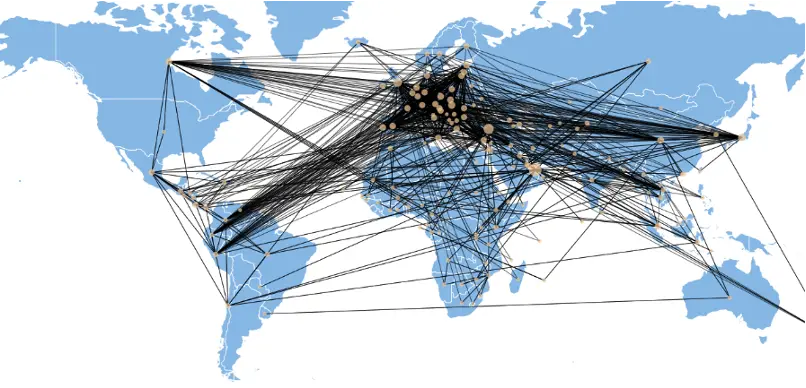
Figure 1. Global network of international investment treaties (spider web). Source: Electronic Database of Investment Treaties (EDIT), World Trade Institute, University of Bern. Licensed under CC BY-NC 4.0.
Most of these agreements provide for ISDS, allowing foreign investors to bring claims directly against states (see Figure 2). In practice, this means that foreign investors may rely on ISDS if their home and host states are parties to the same investment treaty.
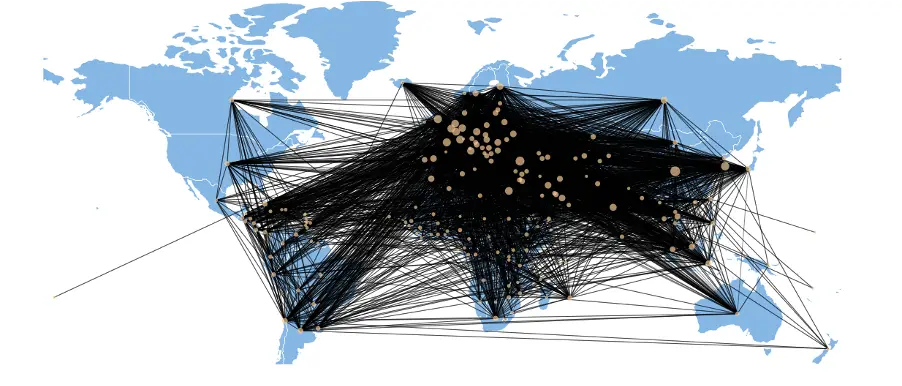
Figure 2. Global network of international investment treaties with an ISDS clause. Source: Electronic Database of Investment Treaties, World Trade Institute, University of Bern. Licensed under CC BY-NC 4.0.
The broad reach of ISDS therefore begs the question: why might governments be concerned about claims brought through this system?
3.1. Why Governments May Worry About ISDS
From a government´s perspective, two aspects of ISDS can raise concerns: the high costs of a claim and how ISDS disputes are decided (Tienhaara, 2018; Tienhaara et al., 2023).
3.1.1 The Costs of ISDS
There are two ways in which ISDS claims can be costly for governments.
First, there is the risk of compensation. If a tribunal finds that the state has breached its treaty obligations, it may award financial compensation to the investor. Among known fossil–fuel projects that resulted in compensation, the awards averaged over US $600 million. Already from this, it is easy to see why states would not be eager to enter into ISDS disputes. (Tienhaara, 2018; Van Harten, 2020; Di Salvatore, 2021; Tienhaara et al., 2023)
Second, defending an ISDS claim is costly in itself. Even if a state ultimately wins, legal and arbitration fees alone can already place a significant financial burden on governments. One could argue that litigation is expensive in all its forms and, therefore, that these costs are not unique to ISDS. At the same time, they cannot be dismissed because governments may still take these potential costs into account when making regulatory decisions. (Van Harten, 2020; Tienhaara et al., 2023)
Ultimately, the risk of having to pay a large award and the intrinsic fees of defending a claim help explain why governments may be ‘wary’ of facing ISDS. Still, the financial costs are only part of the equation. How ISDS claims are decided, and by whom, can also matter.
3.1.2. Who Decides ISDS Cases, and How?
Unlike disputes before domestic courts, ISDS claims are decided by an arbitral tribunal. Typically, a tribunal consists of three arbitrators: one appointed by each party, and a third one agreed upon jointly or appointed by an arbitral body such as the International Centre for the Settlement of Investment Disputes (ICSID) (Tienhaara, 2018).
Over the last decade, concerns have grown about how arbitration works in practice. First, arbitrators are selected by the parties themselves. This has raised questions about whether they are truly independent, impartial, and neutral. There is some empirical evidence supporting these criticisms. This does not necessarily mean that all arbitrators are biased, but such doubts may increase governments’ concerns about facing ISDS claims. (Johnson et al., 2017; Van Harten, 2020; Tienhaara et al., 2023; Tienhaara et al., 2025; Chandran, 2025; Behn et al., 2021; Brekoulakis & Howard, 2023)
Second, ISDS outcomes can be difficult to predict (Tienhaara et al., 2023). In ISDS, there is no formal rule of precedent (stare decisis), meaning that ISDS tribunals are not bound by the decisions of previous cases (Berge & Berger, 2021; Tienhaara et al., 2023). Although panels frequently consider previous decisions, they are not bound to follow them, meaning that similar cases may lead to considerably different outcomes.
A well–known example is Lauder v. Czech Republic and CME v. Czech Republic. They each brought an ISDS claim against the state concerning the same conduct and underlying investment. However, the tribunals reached different conclusions, not awarding damages to Lauder while granting them to CME (Berge & Berger, 2021, footnote 53; CME v. Czech Republic, p. 161; Lauder v. Czech Republic, p. 74). For governments, such divergent outcomes create uncertainty, even unpredictability: a tribunal may have decided in favour of the state over similar conduct before, but who is to say that another will do the same?
In sum, the costs of ISDS, the concerns over arbitrators’ impartiality, and the unpredictability of outcomes help explain why governments may take the risk of ISDS seriously. But being wary of ISDS is one thing and allowing those concerns to influence how they regulate is another. It is this second possibility that brings regulatory chill into focus.
3.2. What does Regulatory Chill mean?
The notion of regulatory chill has been discussed for several years (Horn, 2023; Johnson et al., 2017; Tienhaara, 2011, 2018; Tienhaara et al., 2023). It refers to the idea that concerns about ISDS claims can lead governments to refrain from regulating, or at least to regulate less effectively or quickly (Tienhaara, 2018). Simply put, regulatory chill means that the possibility of facing ISDS can deter governments from adopting policies.
Professor Kyla Tienhaara’s distinction between three types of regulatory chill is particularly useful here. First, she refers to the threat chill, when an investor stops a proposed regulatory measure from being adopted by threatening to bring an ISDS claim (Tienhaara, 2018).
Second, she describes the internalisation chill, essentially referring to cases in which a government internally decides not to pursue harsher regulatory action due to concerns about ISDS (Tienhaara et al., 2023). Although harder to prove, governmental figures have sometimes admitted that the state had not taken more aggressive regulatory action due to fears of facing arbitration claims (Van Harten & Scott, 2016; Meager, 2022). For instance, New Zealand’s climate minister once recognised that ISDS risks had prevented stronger action against fossil–fuel production (Meager, 2022).
Lastly, she refers to cross–border chill: the chilling effect that happens when an ISDS claim against one country makes other states think twice before adopting similar rules. There is empirical evidence suggesting that cross–border chill is not hypothetical. For example, Carolina Moehlecke (2020) studied anti–smoking policies across 92 countries and found that governments were slower to introduce policies when similar ones had faced ISDS claims elsewhere (Moehlecke, 2020).
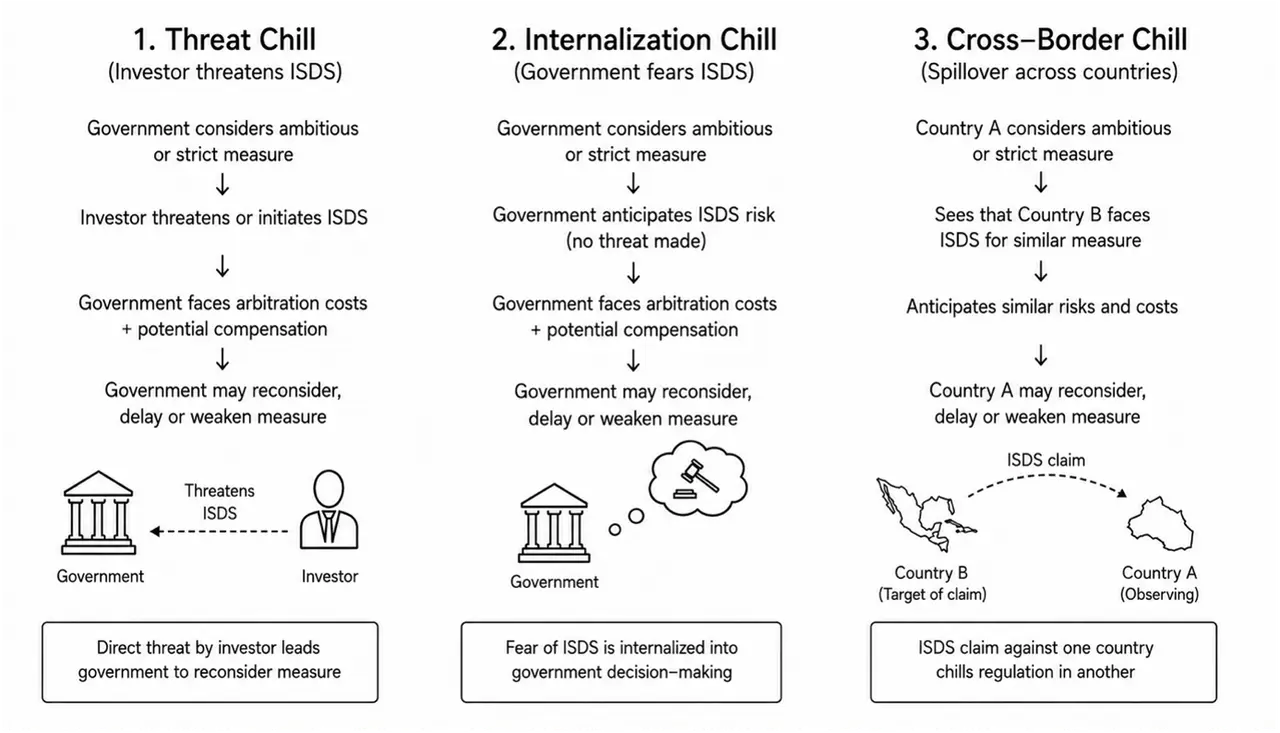
These three forms of chill show that ISDS can influence regulation in different ways. At the same time, identifying when regulatory chill occurs in practice is not simple; proving why a government abandons, weakens, or delays a measure can be difficult.
Still, the possibility of such a chilling effect becomes especially concerning in the context of climate action, where stronger regulation often means restricting existing fossil–fuel investments.
4. Climate Policy and International Investment Law
There is broad consensus on the need for stronger climate action (Paris Agreement, 2015). Yet, current efforts seem insufficient to limit global warming to 1.5 °C (IPCC, 2023). The message is clear: governments need to do more.
Doing more, however, means changing an economy that largely depends on fossil fuels (United Nations, 2025). To achieve this, governments may need to restrict extraction, phase out certain activities, or cancel projects that are no longer compatible with their climate goals. In doing so, they may affect existing investments (Tienhaara, 2018).
The energy sector has been a prominent area in which ISDS claims have been brought. Overall, investors in the energy sector accounted for 25% of all ISDS cases brought (UNCTAD, 2023). This figure makes the energy sector particularly relevant when considering whether ISDS affects climate policy.
4.1. Is there Evidence of Regulatory Chill in Climate Matters?
It is difficult to merely affirm that the risk of ISDS chills ambitious climate policy. Regulatory chill often happens behind closed doors: governments rarely recognise that they took the risk of ISDS into account when implementing climate measures (Cotula, 2014). That being said, there is evidence suggesting that ISDS can indeed influence government decision–making. Arbitration lawyer Toby Landau stated in 2014 that regulatory chill ‘definitely exists’, explaining how he had been instructed by governments to advise on the possible investor–state consequences of proposed policies (Hill, 2015 as cited in Tienhaara, 2018).
Still, evidence of governments considering ISDS risks does not tell us whether all governments do so, or to the same degree. Answering that question comprehensively would require examining many more measures than this article can cover. For this reason, the following discussion looks at selected evidence of how ISDS has interacted with climate policy in recent years.
4.1.1 When ISDS Shapes Climate Policy
Perhaps the clearest example of ISDS concerns influencing climate policy comes from France and its Hulot Law (Loi n° 2017-1839, 2017). In 2017, the then Minister of the Environment, Nicolas Hulot, proposed ending oil and gas production in France and its overseas territories by 2040 (Red Carpet Courts, 2019). Initially, this law would have prevented existing exploitation permits from being renewed once they expired. This meant that oil and gas projects would gradually disappear as their permits came to an end.
However, before the proposal became law, France received numerous lobby letters ‘against’ it (Vaudano, 2018). Lawyers of Vermilion, a Canadian company and one of the largest fossil–fuel producers in France (Vaudano, 2018), argued that banning permit renewals was contrary to France’s obligations under the Energy Charter Treaty, an investment agreement to which France used to be a party. A breach of those treaty obligations, they argued, would have to be duly compensated. The letter therefore warned France that pursuing the measure could expose it to an ISDS claim.
The version of the law that emerged in September 2017 no longer prohibited the renewal of existing exploitation permits. Instead, the permits could be renewed until 2040 and, in some cases, even beyond that date (Loi n° 2017-1839, 2017, art. L. 111-12).
This example is consistent with Tienhaara’s ‘threat chill’ idea. Before the adoption of a law, a foreign investor – in this case Vermilion – warns that the proposed measure could conflict with investment protections and raises the possibility of arbitration. Then, the version ultimately adopted is less restrictive than the original proposal. Of course, this sequence alone does not prove that the threat directly caused the amendment, but it suggests that the risk of arbitration may have influenced such change.
Denmark provides a different example. The government set 2050 as the date to end oil and gas production in the North Sea. In explaining why the government did not choose an earlier date, Denmark’s climate minister pointed to the risk of having to pay ‘incredibly expensive’ compensation to foreign investors (Meager, 2022). This suggests that concerns about ISDS were one factor in selecting the 2050 date.
Unlike the case of France, here there was no direct threat from an investor. Instead, the government itself included the risk of ISDS claims when deciding on the phase–out date. This situation is a ‘textbook example’ of Tienhaara’s ‘internalisation chill’: the government anticipated the risk of arbitration and adjusted its policy accordingly.
4.1.2. When Governments Regulate Anyway
These examples suggest that ISDS can shape climate policy. But there is a difference between can and does: the fact that ISDS has the power to influence policy–making does not mean that it is always the case. Sometimes, governments regulate anyway.
The Netherlands is perhaps the current leader in this. The province of Groningen sits above one of the world’s largest gas fields, making it the Dutch ‘hidden gem’. For decades, the government relied heavily on gas extraction from the field. However, the disruptions caused by these activities ultimately led the government to close the site in 2024. The decision provided for potential investor claims under the Energy Charter Treaty, but the government nevertheless proceeded with the closure. As a result, major operators ExxonMobil and Shell initiated legal action: ExxonMobil formally initiated ECT investment arbitration, while Shell proceeded with distinct commercial proceedings regarding the winding-down framework. These overlapping acts illustrate a broader framework of disputes over regulatory treatment and possible consequences (Verbeek, 2026). Although the outcome of these ISDS proceedings remains uncertain, what is clear is that the risk of costly arbitration did not stop the closure.
The Dutch example shows that the risk of ISDS does not always prevent governments from regulating. One may respond that not all states are equally able to absorb that risk. A wealthy country such as the Netherlands may be better placed to defend a costly arbitration, and potentially pay an award, than countries with more limited public resources. But wealth alone cannot explain how governments respond to ISDS. Why, then, would ISDS concerns appear to have influenced France and Denmark, both wealthy countries themselves?
Overall, the evidence suggests that regulatory chill is real, but the extent of the chilling effect varies. In France, the measure became less restrictive after investors raised the possibility of arbitration. In Denmark, the government itself considered the risk of costly claims when setting the phase–out date. In the Netherlands, the state went ahead with the gas field closure regardless. Therefore, ISDS does not affect every regulatory decision in the same way, but it can make governments think twice when regulating.
5. Conclusion
Are governments, then, simply afraid to regulate in the climate context? As this article has shown, regulatory chill does not necessarily mean abandoning regulation altogether. It may be more subtle than that: delaying an ambitious measure or softening a harsher rule can already be a sign of regulatory chill. In that sense, being ‘afraid’ to regulate does not mean refusing to regulate at all, but being more cautious and lenient than governments otherwise would.
This also provides an answer to the main question of this article: the risk of ISDS arbitration can discourage governments from pursuing ambitious climate measures. Tienhaara’s regulatory chill theory helps to explain how. Sometimes, the pressure to not regulate or to regulate less effectively comes from investors threatening arbitration. Other times, it is governments who anticipate that risk themselves.
At the same time, the chill effect cannot be overstated. The three examples suggest that ISDS may discourage climate regulation, particularly in France and Denmark, but they cannot tell us how common or how strong this effect is more broadly. For this reason, the article draws a fundamental distinction between can and does. The cases presented show that ISDS can discourage governments from pursuing ambitious measures, but this does not mean that it does so every time. The question left for you, then, is whether the fact that it can is enough to raise concern.
List of Sources
Alschner, Wolfgang, Elsig, Manfred and Polanco, Rodrigo (2021), “Introducing the Electronic Database of Investment Treaties (EDIT): The Genesis of a New Database and Its Use”, World Trade Review, Vol. 20 (1), pp. 73-94. ?<https://doi.org/10.1017/S147474562000035X> Published online by Cambridge University Press: 13 August 2020.
Behn, D., Langford, M., Létourneau-Tremblay, L., & Lie, R. H. (2021). Evidence-guided reform: Surveying the empirical research on arbitrator bias and diversity in investor–state arbitration. In M. Elsig, R. Polanco, & P. Van den Bossche (Eds.), International economic dispute settlement: Demise or transformation? (pp. 264–294). Cambridge University Press
Berge, T. L., & Berger, A. (2021). Do investor-state dispute settlement cases influence domestic environmental regulation? The role of respondent state bureaucratic capacity. Journal of International Dispute Settlement, 12(1), 1–41. <https://doi.org/10.1093/jnlids/idaa027>
Brekoulakis, S., & Howard, A. (2023). Impartiality and the construction of trust in investor-state dispute settlement. ICSID Review – Foreign Investment Law Journal, 38(3), 644–669. <https://doi.org/10.1093/icsidreview/siad033>
Chandran, S. (2025, October 27). Reform needed to reinforce the legitimacy of ISDS in resolving societal challenges. Global Arbitration Review. <https://globalarbitrationreview.com/guide/the-guide-investment-treaty-protection-and-enforcement/third-edition/article/reform-needed-reinforce-the-legitimacy-of-isds-in-resolving-societal-challenges>
CME Czech Republic B.V. v. Czech Republic, UNCITRAL, Final Award ( Mar. 14, 2003). <https://www.italaw.com/sites/default/files/case-documents/ita0180.pdf>
Cotula, L. (2014). Do investment treaties unduly constrain regulatory space? QIL, Questions of International Law, 9, 19–31. <https://www.qil-qdi.org/investment-treaties-unduly-constrain-regulatory-space/>
Di Salvatore, L. (2021). Investor–State Disputes in the Fossil Fuel Industry. International Institute for Sustainable Development. <https://www.iisd.org/publications/report/investor-state-disputes-fossil-fuel-industry>
Hill, J. (2015, July 26). ISDS: The devil in the trade deal. ABC Radio National. <https://www.abc.net.au/listen/programs/backgroundbriefing/isds-the-devil-in-the-trade-deal/6634538>
Horn, H. (2023). Investment treaty reform when regulatory chill causes global warming (RSC Working Paper No. 2023/12). European University Institute, Robert Schuman Centre for Advanced Studies. <https://hdl.handle.net/1814/75358>
Intergovernmental Panel on Climate Change. (2023). Climate Change 2023: Synthesis Report. <https://doi.org/10.59327/IPCC/AR6-9789291691647>
Johnson, L., Güven, B. S., & Coleman, J. (2017, December 11). Investor-state dispute settlement: What are we trying to achieve? Does ISDS get us there? Columbia Center on Sustainable Investment. <https://ccsi.columbia.edu/news/investor-state-dispute-settlement-what-are-we-trying-to-achieve-does-isds-get-us-there/>
Kriebaum, U., Schreuer, C., & Dolzer, R. (2022). Principles of international investment law (3rd ed.). Oxford University Press <https://doi.org/10.1093/law/9780192857804.001.0001>
Loi n° 2017-1839 du 30 décembre 2017 mettant fin à la recherche ainsi qu’à l’exploitation des hydrocarbures et portant diverses dispositions relatives à l’énergie et à l’environnement, JORF n° 0305 du 31 décembre 2017 (2017). Official text on Légifrance
Mavrommatis Palestine Concessions (Greece v. United Kingdom), Judgment (Objection to the Jurisdiction of the Court), 1924 P.C.I.J. (ser. A) No. 2.
Meager, E. (2022, January 14). COP26 targets pushed back under threat of being sued. Capital Monitor. <https://www.capitalmonitor.ai/analysis/cop26-ambitions-at-risk-from-energy-charter-treaty-lawsuits/>
Moehlecke, C. (2020). The chilling effect of international investment disputes: Limited challenges to state sovereignty. International Studies Quarterly, 64(1), 1–12. <https://doi.org/10.1093/isq/sqz077>
Organisation for Economic Co-operation and Development (OECD). (n.d.). The future of investment treaties. <https://www.oecd.org/en/topics/the-future-of-investment-treaties.html>
Paris Agreement, Dec. 12, 2015, T.I.A.S. No. 16-1104
Red Carpet Courts. (2019, June). Vermilion vs France: Blocking climate change laws with ISDS threats. 10 ISDS Stories
Ronald S. Lauder v. Czech Republic, UNCITRAL, Final Award (Sept. 3, 2001). <https://www.italaw.com/sites/default/files/case-documents/ita0451.pdf>
Semieniuk, G., Holden, P. B., Mercure, J.-F., Salas, P., Pollitt, H., Jobson, K., Vercoulen, P., Chewpreecha, U., Edwards, N. R., & Viñuales, J. E. (2022). Stranded fossil-fuel assets translate to major losses for investors in advanced economies. Nature Climate Change, 12, 532–538. <https://doi.org/10.1038/s41558-022-01356-y>
Tienhaara, K. (2011). Regulatory chill and the threat of arbitration: A view from political science. In C. Brown & K. Miles (Eds.), Evolution in investment treaty law and arbitration (pp. 606–628). Cambridge University Press. <https://doi.org/10.1017/CBO9781139043809.034>
Tienhaara, K. (2018). Regulatory chill in a warming world: The threat to climate policy posed by investor-state dispute settlement. Transnational Environmental Law, 7(2), 229–250. <https://doi.org/10.1017/S2047102517000309>
Tienhaara, K., Thrasher, R., Simmons, B. A., & Gallagher, K. P. (2023). Investor-state dispute settlement: Obstructing a just energy transition. Climate Policy, 23(9), 1197–1212. <https://doi.org/10.1080/14693062.2022.2153102>
Tienhaara, K., van Asselt, H., & Newell, P. (2025). Radical reform of the international investment treaty regime: A role for climate clubs? Global Policy, 16, 798–810. <https://doi.org/10.1111/1758-5899.70067>
United Nations. (2025). Seizing the moment of opportunity: Supercharging the new energy era of renewables, efficiency, and electrification. <https://www.un.org/en/climatechange/moment-opportunity-2025>
United Nations Conference on Trade and Development. (2023). Trends in the investment treaty regime and a reform toolbox for the energy transition (IIA Issues Note No. 2). United Nations. <https://unctad.org/publication/trends-investment-treaty-regime-and-reform-toolbox-energy-transition>
Van Harten, G. (2020). The trouble with foreign investor protection. Oxford University Press. <https://doi.org/10.1093/oso/9780198866213.001.0001>
Van Harten, G., & Scott, D. N. (2016). Investment treaties and the internal vetting of regulatory proposals: A case study from Canada. Journal of International Dispute Settlement, 7(1), 92–116. <https://doi.org/10.1093/jnlids/idv031>
Vaudano, M. (2018, September 4). Comment la menace d’arbitrage a permis aux lobbys de détricoter la loi Hulot. Le Monde. <https://www.lemonde.fr/accord-commercial-europe-canada-ceta/article/2018/09/04/comment-la-menace-d-arbitrage-a-permis-aux-lobbys-de-detricoter-la-loi-hulot_6005132_4998347.html>
Verbeek, B.-J. (2026, January 19). Aftershock in Groningen: Shell and ExxonMobil’s arbitration cases against the Netherlands. Investment Treaty News. International Institute for Sustainable Development. <https://www.iisd.org/itn/2026/01/19/aftershock-in-groningen-shell-exxonmobil-arbitration-cases-against-the-netherlands-bart-jaap-verbeek/>