

In contrast to decades of westernisation after WWII, most notably as a member of NATO, Türkiye has been increasingly identifying itself with the Global South and therefore Sub-Saharan Africa (Tanrıverdi Yaşar, 2026, p. 115). While Türkiye’s growing involvement in security and defence affairs in Africa has sparked recent attention, this brief will highlight Türkiye’s growing soft-power apparatus in Sub-Saharan Africa. The brief will therefore explore how Türkiye gained ground in the region, arguing that its growing influence rests less on any single soft-power instrument than on a dense ecosystem in which connectivity, development cooperation, construction, religion, and education mutually reinforce one another and increasingly embed Turkish presence in everyday life.
Historic Background
The Justice and Development Party’s (AK Parti) 2002 election victory provided the necessary momentum for the adoption of a less Eurocentric Turkish foreign policy (Tanrıverdi Yaşar, 2026 p. 115; Kaya, 2023 p. 113-115). Although others had advocated a change earlier, former foreign minister (2009-2014) Ahmet Davutoğlu is perhaps the most relevant proponent of a Turkish opening towards Sub-Saharan Africa (Kaya, 2023 p. 112-113). Davutoğlu envisioned Türkiye as a more autonomous actor with the potential to emerge as a global player by moving beyond its traditional Western orientation and making greater use of its strategic position between regions (Heibach & Taş, 2024, p. 314-315). In his book Strategic Depth from 2001, he identified Türkiye’s larger neighbourhood as “Afro-Eurasia” (Tüysüzoğlu, 2014, p. 91). The wording is significant because it gives the traditional Turkish right-wing “From the Adriatic to the Mongolian steppe” sphere of influence an additional African nuance (Heibach & Taş, 2024, p. 315). It also suggested that Africa belongs to a wider sphere in which Türkiye aspires to regional-power status.
Connectivity as Soft Power and Engagement Facilitator
Ever since the AK Parti came to power, Turkish Airlines – once a relatively insignificant carrier – has grown considerably in importance as an instrument for advancing the government’s vision of a multidirectional foreign policy, particularly in Africa. As of 2024, Turkish Airlines stands as the non-African airline with the most connections to Africa – serving 62 destinations in 41 countries (Němečková & Varkočková, 2024 p. 492-493). The government’s stake in the airline (>49%) also keeps its ties to the state relatively strong compared with European competitors such as Air France-KLM (27% & 9%), Lufthansa (0%), or IAG (0%) (Turkish Airlines, n.d.; Air France-KLM, 2026; Deutsche Lufthansa AG, 2022; IAG, 2026).
For travellers from many African states, flying through European hubs still involves additional administrative barriers. France, for instance, well-established in the African aviation market through Air France, requires holders of service passports from major African economies such as Nigeria or Ethiopia to obtain an airport transit visa even when merely connecting through a French airport (France-Visas, n.d.). By contrast, Türkiye does not require any passport holder to apply for a visa as long as they are staying in the transit section of the airport (Republic of Türkiye e-Visa Application System, n.d.). Beyond its liberal visa policy, Turkish Airlines projects a positive image of Türkiye through its service reputation and cultural representation by screening Turkish films and serving Turkish cuisine on board (Němečková & Varkočková, 2024 p. 496-497).
Turkish Airlines’ expansion into underserved African markets therefore often offers more than solely additional flight capacity and helps associate Türkiye not only with international connectivity but also a recognisable cultural identity.
Development Cooperation and Prestigious Construction
Beyond connectivity, Türkiye backs its presence with substantial development funding. Between 2015 and 2024, Turkish official development assistance averaged roughly 0.85% of GNI, even surpassing countries like Norway during its 2018–2020 peak (OECD, n.d.). These figures illustrate the substantial scale of Türkiye’s development assistance, although much of it is humanitarian in nature and concentrated in its immediate neighbourhood (OECD, 2024).
In Sub-Saharan Africa, Turkish engagement regularly materialises in highly visible social infrastructure such as hospitals or religious facilities (Haynes, 2022, p. 7). In Mogadishu, TOKİ (Housing Development Administration of Türkiye) constructed and TİKA (Turkish Cooperation and Coordination Agency) equipped the Recep Tayyip Erdoğan Training and Research Hospital, giving the Turkish president’s name a lasting presence in everyday Somali life through a renowned healthcare institution (TİKA, 2016, p. 17). A similar logic can be observed in Niger, where the Niger-Türkiye Friendship Hospital was built and equipped by TİKA under the patronage of Emine Erdoğan (Anadolu Ajansı, 2019a). The symbolism became particularly striking when the parents of the first child born at the hospital named their daughter “Emine” in appreciation of the Turkish First Lady’s involvement (Anadolu Ajansı, 2019b).
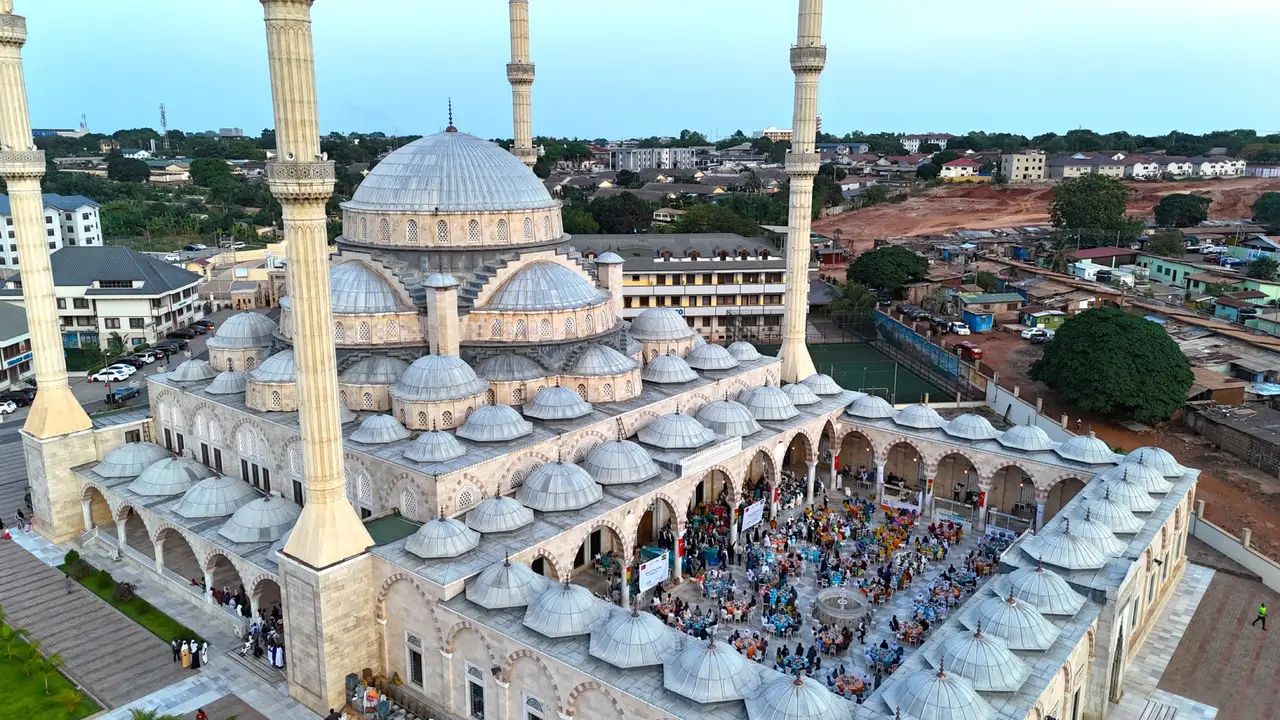
Religious infrastructure adds another layer to this rather tangible development cooperation. The Ghana National Mosque in Accra, inaugurated in 2021 with Turkish support and financing, was deliberately modelled on Istanbul’s Blue Mosque and follows an Ottoman architectural style (Haynes, 2022, p. 7). At the same time, the complex extends far beyond a place of worship, incorporating a school, clinic, conference centre and the residence of Ghana’s National Chief Imam, thus integrating Islam and Ottoman architecture into everyday life (Ghana News Agency, 2021). Türkiye appears to do this intentionally: the Türkiye Diyanet Foundation (TDV) explicitly describes mosque projects in Burkina Faso as being constructed in “our architectural style” (Türkiye Diyanet Foundation, n.d.).
The Turkish private sector has also established a highly visible presence. As of 2025, Turkish firms accounted for 45 of the world’s top 250 international contractors, placing Türkiye second only to China in terms of the number of companies represented (Republic of Türkiye Ministry of Trade, 2026). By August 2025, Turkish contractors had completed 2,039 construction projects worth USD 97.5 billion across Africa (Republic of Türkiye Ministry of Trade, 2025).
Within this broader expansion of Turkish private-sector activity, airport infrastructure stands out as a particularly visible field, developing alongside Turkish Airlines’ growing network across Africa. Since 2013, Turkish firms have been involved in airport construction and planning in Accra, Bissau, Conakry, Dakar, Freetown, Garowe, Lagos (Lekki-Epe), Mogadishu and Niamey (GACL, n.d.; Ministère des Transports de la République de Guinée, 2024; Limak, 2016; Lagos State Office of Public-Private Partnerships, 2025; SLAA, n.d.; SMK Group, n.d.; Anadolu Ajansı, 2015; SUMMA, n.d.).
Social Influence
Alongside the visible investments in the region, Türkiye has also developed a considerably longer-term channel of societal engagement. By 2024, the Turkish Maarif Foundation reported operating 198 schools in 26 African countries with around 23,000 students (Turkish Maarif Foundation, 2024). Long-term effects can already be observed in Gambia, where 13 of the first 42 Maarif graduates continued their university education in Türkiye, indicating that education may facilitate exchange far beyond the school years (Turkish Maarif Foundation, 2025).
Conclusion
Taken together, Türkiye’s growing influence in Sub-Saharan Africa rests not on any single instrument but on several channels that increasingly complement one another: Turkish Airlines connects cities through airports that Turkish firms help develop, hospitals and mosques give Turkish presence a visible and lasting form, and schools foster ties with the next generation. In Sub-Saharan Africa, Turkish soft power is thus not communicated through rhetoric alone, but translates into prestigious physical spaces that have become part of everyday life.
In this regard, the Turkish presence across the region certainly aligns with Davutoğlu’s vision of making greater use of Türkiye’s location in “Afro-Eurasia” and diversifying its influence.
Lastly, the recent Turkish military and security engagement in Africa should not be viewed separately from the developments outlined above. Rather, understanding its expanding strategic role requires closer attention to the multifaceted relationships Türkiye has cultivated across various countries in the region, even if the long-term success of this approach remains uncertain.
References
Air France-KLM (2026): Shareholding Structure. Shareholding information as at 30 June 2026. Available at: https://www.airfranceklm.com/en/finance/air-france-klm-capital/shareholding-structure.
Anadolu Ajansı (2015): ‘Turkish president inaugurates hospital in Somalia’. Anadolu Ajansı, 25 January 2015. Available at: https://www.aa.com.tr/en/turkey/turkish-president-inaugurates-hospital-in-somalia/80873.
Anadolu Ajansı (2019a): ‘Nijer-Türkiye Dostluk Hastanesi açılışında sona doğru’. Anadolu Ajansı, 18 June 2019. Available at: https://www.aa.com.tr/tr/saglik/nijer-turkiye-dostluk-hastanesi-acilisinda-sona-dogru/1507319.
Anadolu Ajansı (2019b): ‘Nijer-Türkiye Dostluk Hastanesinde doğan ilk bebeğe “Emine” adı verildi’. Anadolu Ajansı, 13 October 2019. Available at: https://www.aa.com.tr/tr/dunya/nijer-turkiye-dostluk-hastanesinde-dogan-ilk-bebege-emine-adi-verildi-/1612405.
Deutsche Lufthansa AG (2022): ‘Stabilization of Deutsche Lufthansa AG successfully completed’. Press release, 14 September 2022. Available at: https://newsroom.lufthansagroup.com/en/stabilization-of-deutsche-lufthansa-ag-successfully-completed/.
France-Visas (n.d.): Airport Transit Visa. French Government. Available at: https://france-visas.gouv.fr/en/visa-de-transit-aeroportuaire.
Ghana Airports Company Limited (GACL) (n.d.): Projects – Terminal 3. Available at: https://www.gacl.com.gh/projects/.
Ghana News Agency (2021): ‘Ghana National Mosque Complex: Symbol of friendship between Ghana and Turkey’. Ghana News Agency, 27 July 2021. Available at: https://gna.org.gh/2021/07/ghana-national-mosque-complex-symbol-of-friendship-between-ghana-and-turkey/.
Haynes, J. (2022): ‘Religious and economic soft power in Ghana-Turkey relations’. Religions, 13(11), Article 1030. https://doi.org/10.3390/rel13111030.
Heibach, J. and Taş, H. (2024): ‘Beyond the soft–hard power binary: Resource control in Turkey’s foreign policy towards Sub-Saharan Africa’. Journal of Balkan and Near Eastern Studies, 26(3), pp. 311–326. https://doi.org/10.1080/19448953.2023.2236510.
International Airlines Group (IAG) (2026): Annual Report and Accounts 2025. Available at: https://www.iairgroup.com/media/vdghgv15/iag-annual-report-and-accounts-2025.pdf.
Kaya, A. (2023): ‘After 25 years of Türkiye’s opening to (Sub-Saharan) Africa: From endeavours to state policy’. Avrasya Etüdleri, 62, pp. 107–139. Available at: https://dergipark.org.tr/en/pub/avrasya/article/1397793.
Lagos State Office of Public-Private Partnerships (2025): ‘LASG Sign Lekki-Epe International Airport MoU’. 10 February 2025. Lagos State Government. Available at: https://ppplagos.lagosstate.gov.ng/blog/lasg-sign-lekki-epe-international-airport-mou.
Limak (2016): ‘Limak, Summa ile birlikte Senegal’de AİBD Havalimanı’nın inşaatının tamamlanması ve işletmesi işini aldı’. Press release, 28 April 2016. Available at: https://www.limak.com.tr/news-and-press/press-releases/pb-2016/limak-summa-ile-birlikte-senegalde-aibd-havalimaninin-insaatinin-tamamlanmasi-ve-isletmesi-isini-aldi-en.
Ministère des Transports de la République de Guinée (2024): ‘Transport aérien : Quatre questions à M. Ousmane Gaoual DIALLO [INTERVIEW]’. 31 October 2024. Available at: https://transports.gov.gn/transport-aerien-quatre-questions-a-m-ousmane-gaoual-diallo-interview/.
Němečková, T. and Varkočková, M. (2024): ‘Turkish Airlines: Facilitating Türkiye’s soft power in Africa’. Canadian Journal of African Studies / Revue canadienne des études africaines, 58(3), pp. 491–513. https://doi.org/10.1080/00083968.2024.2353605.
OECD (2024): Development Co-operation Profiles: Türkiye. Paris: OECD Publishing. Available at: https://www.oecd.org/en/publications/development-co-operation-profiles_2dcf1367-en/full-report/turkiye_af9684ef.html.
OECD (n.d.): Net ODA. OECD Data Explorer. Paris: Organisation for Economic Co-operation and Development. Available at: https://www.oecd.org/en/data/indicators/net-oda.html.
Republic of Türkiye e-Visa Application System (n.d.): Frequently Asked Questions. Republic of Türkiye. Available at: https://www.evisa.gov.tr/en/info/required-documents/.
Republic of Türkiye Ministry of Trade (2025): ‘Ticaret Bakanı Bolat, 13. Dünya Sektörler Arası İşbirliği Forumu’nda Konuştu’. 19 August 2025. Available at: https://uhtgm.ticaret.gov.tr/haberler/ticaret-bakani-bolat-13-dunya-sektorler-arasi-isbirligi-forumunda-konustu.
Republic of Türkiye Ministry of Trade (2026): ‘ENR 2026 Listesinde Yeni Bir Rekor Daha Kırıldı’. 21 August 2026. Available at: https://ticaret.gov.tr/haberler/enr-2026-listesinde-yeni-bir-rekor-daha-kirildi.
Sierra Leone Airports Authority (SLAA) (n.d.): Our History. Available at: https://slaa.gov.sl/about/our-history.
SMK Group (n.d.): Garowe Airport Improvement Project. Available at: https://www.smk.com.tr/en/proje_detay.php?id=9.
SUMMA (n.d.): Aviation. Available at: https://summa.com.tr/en/activities/aviation.htm.
Tanrıverdi Yaşar, N. (2026): ‘A relational approach to Turkey’s security engagement with African states’. European Journal of International Security, 11(1), pp. 115–133. https://doi.org/10.1017/eis.2025.9.
Turkish Airlines (n.d.): Capital and Shareholder Structure. Public Disclosure Platform (KAP). Available at: https://www.kap.org.tr/en/sirket-bilgileri/genel/1107-turk-hava-yollari-a-o.
Turkish Cooperation and Coordination Agency (TİKA) (2016): Somalia – 2016. Ankara: TİKA. Available at: https://tika.gov.tr/en/publication/somalia-2016/.
Turkish Maarif Foundation (2024): ‘Turkish Maarif Foundation organized “Understanding Africa” panel on Africa Day’. 28 May 2024. Available at: https://turkiyemaarif.org/news/turkish-maarif-foundation-organized-understanding-africa-panel-on-africa-day.
Turkish Maarif Foundation (2025): ‘Turkish Maarif Foundation prepares Gambian youth for life with quality education’. 5 March 2025. Available at: https://turkiyemaarif.org/news/turkish-maarif-foundation-prepares-gambian-youth-for-life-with-quality-education-20250311105207.
Türkiye Diyanet Foundation (TDV) (n.d.): BFCM001 – Mosque Construction Project in Kougri, Burkina Faso. Available at: https://tdv.org/tr-TR/proje/bfcm001/.
Tüysüzoğlu, G. (2014): ‘Strategic depth: A neo-Ottomanist interpretation of Turkish Eurasianism’. Mediterranean Quarterly, 25(2), pp. 85–104. https://doi.org/10.1215/10474552-2685776.


