

Despite more than two decades of continuous UN peacekeeping presence in the Democratic Republic of the Congo (DRC), the recruitment and use of children by armed groups have not only persisted but increased between the years 2022 and 2024 (UN Secretary General 2023; UN Secretary General 2024; UN Secretary General 2025). This trend is alarming considering that the United Nations Organization Stabilization Mission in the Democratic Republic of the Congo (MONUSCO) operates under a large body of international humanitarian law (IHL) and an increasingly dense normative framework explicitly prohibiting such conduct. Therefore, the following questions arise: how does the case of MONUSCO in the Democratic Republic of the Congo inform our understanding of the structural limitations in UN peacekeeping missions’ ability to uphold IHL obligations concerning child recruitment in non-international armed conflicts? It is argued that MONUSCO’s experience reveals limitations on two levels. First, a normative ambiguity over whether child protection mandates create binding obligations or only authorise action. Second, even where doctrine exists, MONUSCO’s principal tools are not adapted to a conflict increasingly driven by non-state armed groups, and are further weakened by the mission’s ongoing withdrawal. These findings suggest that the persistence of child recruitment reflects not only gaps in implementation, but a deeper structural discrepancy between peacekeeping’s available tools and the actors driving the violation. The paper proceeds by outlining the conflict context, the applicable IHL framework, the UN’s CAAC mandate, and MONUSCO’s operationalisation of child protection.
Context: Conflict in the DRC
Despite peace agreements in place, the presence of UN peacekeeping forces and the establishment of a transitional government between 2002 and 2003, following the First and Second Congo Wars, unrest and violence persisted in the eastern DRC. Since then, conflicts, most often involving ethnic and militant groups with roots in the Congo Wars, have arisen in states on the Congo-Rwanda border. Notably, one of the most prominent groups is the March 23 Movement (M23), which has become an undeniable force in the region since the early 2000s. In 2013, the UN Organisation Stabilisation Mission in the DRC (MONUSCO) was authorised by the UNSC to support the Congolese army in the fight against M23, successfully repressing M23. After five years of inactivity, M23 resurfaced in 2022, gaining control of large territory in North Kivu. While the presence of international security forces has been controversial for several years, during the resurgence of M23 between 2022 and 2023, the anti-intervention sentiment among local officials and the public was exacerbated, and a series of protests against MONUSCO’s presence turned violent. Consequently, the Congolese president called for the withdrawal of the peacekeeping forces; however, the UNSC did not fulfil this demand and extended MONUSCO’s mandate due to the fear of a security vacuum and further obstruction of humanitarian aid (Centre for Preventive Action 2026).
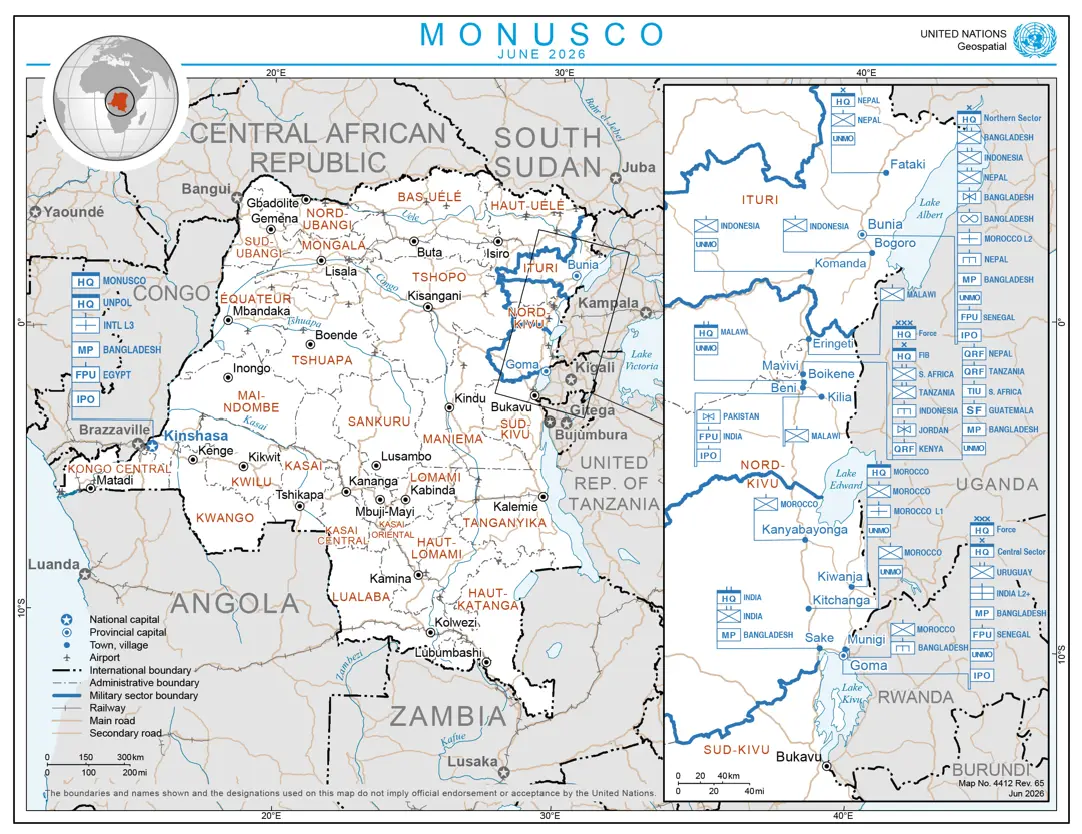
MONUSCO was established in 2010 as the successor to the earlier peacekeeping operation MONUC, which had originally been set up in 1999 to monitor a ceasefire among the DRC, Angola, Namibia, Rwanda, Uganda, and Zimbabwe after the First and Second Congo Wars. The mission’s overarching purpose is to help protect civilians and support the restoration of peace in Congolese territory, with its operations currently concentrated in the Ituri and North Kivu provinces (United Nations Peace Operations 2026). The mission is authorised to use all necessary means to fulfil three strategic priorities, namely, protecting civilians, supporting the goals of Resolution 2773, and helping stabilise and strengthen DRC state institutions. Resolution 2808 tasks MONUSCO with helping end the M23-Rwanda offensive, dismantling parallel administrations, and supporting the wider Washington and Doha peace processes (United Nations Security Council 2025a). Moreover, the mission monitors and reports on human rights abuses and IHL violations and has a child protection section, including the prevention of child soldier recruitment. Although the mission is undergoing a gradual, phased withdrawal, with its area of operations largely limited to North Kivu and Ituri, a pause in disengagement was announced in mid-2025 due to worsening security conditions (United Nations Security Council 2025b).
Local but also external actors are incentivized to get involved in the ongoing conflict because “the DRC has one of the world’s largest reserves of metals and rare earth minerals,” increasingly globalizing the conflict (Center for Preventive Action 2026). For example, Rwanda continues to have a significant military presence in eastern DRC and is accused of supporting M23. Military attacks and exchanges of fire between Congolese forces, M23 and other militia groups, as well as Rwandan troops, remain common, even though both Rwanda and the DRC have agreed to a pact reducing their military presence near the border in 2023. Currently, the DRC is not only facing persistent violence but four converging crises: crisis levels of food insecurity, its 16th Ebola outbreak in 2025 and the severe impact of USAID funding cuts (International Rescue Committee 2026). Hostilities have caused massive displacement, with nearly 123,000 people fleeing eastern DRC to neighbouring countries and 5.7 million internally displaced people (IDPs) in 2025. Moreover, the Fact-Finding Mission by the UN Human Rights Office, launched at the beginning of 2025, “concluded that grave and widespread violations and abuses committed by all parties to the conflict may constitute war crimes and crimes against humanity”; among these crimes are also the recruitment and use of children in the conflict (Human Rights Watch 2026).
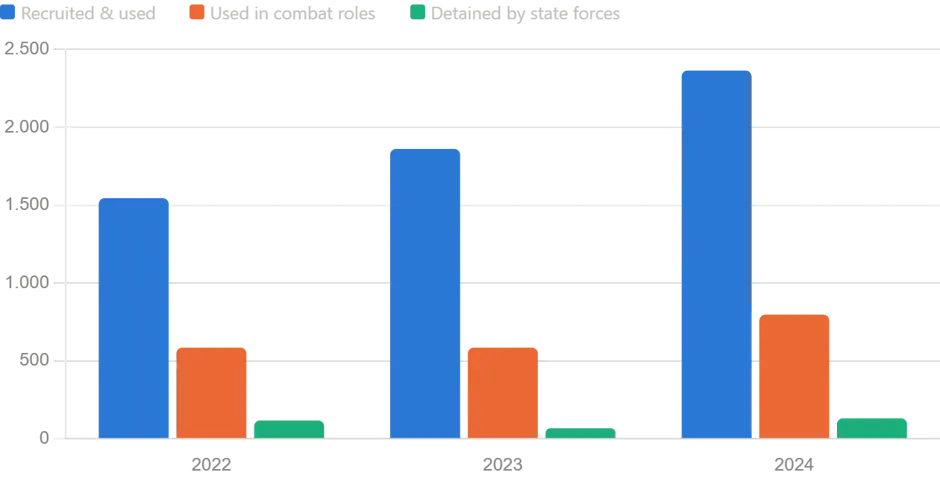
According to the UN Secretary-General’s annual reports on children and armed conflict, the recruitment and use of children in the DRC increased over the three most recent reporting cycles, climbing from 1,545 verified cases in 2022 to 1,861 in 2023 and 2,365 in 2024. This increase was driven mostly by local armed groups, particularly Raia Mutomboki and various Mai-Mai factions, rather than by M23, whose recorded recruitment numbers remained comparatively low and even declined across the period (31 in 2022, 69 in 2023, 22 in 2024). The proportion of children used directly in combat also grew, while the detention of children by Congolese state forces persisted throughout the period, despite UN advocacy that secured the release of most detained children. Verified conflict-related sexual violence against children also increased, from 281 victims in 2023 to 358 in 2024, with M23 among the most frequently cited perpetrators. In sum, the data suggest a deteriorating protection environment for children in eastern DRC even as the UN highlights progress, such as unilateral declarations by armed group commanders that led to the release of over 1,500 children in 2024–2025 (UN Secretary General 2023, 9; UN Secretary General 2024, 9; UN Secretary General 2025, 8-9).
International Humanitarian Law (IHL): The Prohibition of the Recruitment and Use of Children in Non-international Armed Conflicts
Children in armed conflicts are granted special protections by a comprehensive body of international legal provisions and norms. Despite Rwanda’s involvement in the ongoing conflict in the eastern DRC, the conflict remains a non-international armed conflict under international law. Thus, Additional Protocol (II) to the Geneva Conventions (1977) and customary IHL apply to the case, as well as the Convention on the Rights of the Child and its Optional Protocol, specifically defining and protecting children’s civil, social, political, health and economic rights (International Committee of the Red Cross (ICRC) 1977; United Nations General Assembly (UNGA) 1989; UNGA 2000).
Additional Protocol II sets out special protection for children, stipulating that “children who have not attained the age of fifteen years shall neither be recruited in the armed forces or groups nor allowed to take part in hostilities […]” (Protocol II 1977, art. 4(3)(c)). Similarly, the DRC has ratified both the Convention on the Rights of the Child and its Optional Protocol, with the first “prohibiting the recruitment of children below the age of 15” into State Parties’ armed forces (UNGA 1989, art. 38 (3)). The latter differentiates between States (Article 3) and non-State armed groups (Article 4), setting the age limit for compulsory recruitment into State armed forces and direct participation in hostilities at the age of 18. However, they can accept voluntary enlistment from the age of 15. On the other hand, both compulsory and voluntary recruitment into non-State armed groups are prohibited, and State Parties are required to “take all feasible measures to prevent such recruitment and use” (ICRC n.d.).
Under Article 8 of the Rome Statute, recruiting children into armed forces or armed groups constitutes a war crime (Rome Statute 1998, art. 8(2)(e)(vii)). Earlier crimes committed between fall 2002 and summer 2003 in the DRC proved foundational to this body of law. The ICC’s first-ever conviction for child recruitment as a war crime, delivered in 2012, was against Congolese militia leader Thomas Lubanga Dyilo for conscripting and using child soldiers in Ituri (ICC 2012). This translated the protections of Additional Protocol II and the Optional Protocol into binding criminal precedent, consolidating child recruitment as a prosecutable international crime. Where recruitment is accompanied by sexual violence, as documented against child recruits by M23 in the DRC, this conduct may be separately charged as rape or sexual slavery under either framework (Rome Statute 1998, art. 7(1)(g); art. 8(2)(e)(vi)).
UN Children and Armed Conflict (CAAC) Mandate
The aforementioned legal and normative frameworks created obligations for the UN generally, and peace operations specifically, so that the UN Security Council (UNSC) included child protection in its wider peace and security agenda. Specifically, the UN CAAC mandate derives from a series of thematic resolutions, among others, resolution 51/77 (1996) and resolution 1261 (1999), the former establishing the mandate for the Special Representative of the Secretary-General for Children and Armed Conflict (SRSG-CAAC) “as the (UN) system lead entity for the UNSC agenda on children and armed conflict,” and the latter, recognizing the protection of children as a fundamental peace and security concern (DPKO, DFS, DPA 2017, 1-2). In this context, six grave violations against children in conflict were identified, namely, “recruitment and use, killing and maiming, sexual violence, attacks on schools and hospitals, abduction, and denial of humanitarian access” (United Nations, n.d.). Acting on the Secretary-General’s behalf, the SRSG-CAAC leads UN advocacy for conflict-affected children and chairs the UN Headquarters Task Force on CAAC, the principal policy forum for implementing the UNSC’s CAAC agenda. Moreover, UNICEF, given its global child-focused mandate, is a key partner in this effort and is responsible for operationalizing the Monitoring and Reporting Mechanism (MRM) at the country, regional, and headquarters levels (DPKO, DFS, DPA 2017, 17–18).
While there is a plethora of policies addressing the rights of children and their special protections in armed conflict, two frameworks are most directly relevant for MONUSCO and its obligations in upholding IHL on child recruitment. First, the 2017 Policy on Child Protection in United Nations Peace Operations is the UN’s own internal framework that reinforces “the obligation of all United Nations peace operations personnel to uphold and respect children’s rights” (DPKO, DFS, DPA 2017, 2). Moreover, it sets out guiding principles requiring child protection to be mainstreamed across all operational decisions of UN peace operations, including mission planning, mandate implementation, and the overarching guidance documents for military, police, and civilian components alike. The Policy further emphasizes partnership, with the Department of Peacekeeping Operations (DPKO), the Department of Field Support (DFS), and the Department of Political Affairs (DPA) coordinating at headquarters level with actors such as the SRSG-CAAC, UNICEF, OHCHR, and UNHCR, and at field level with national authorities, humanitarian actors, local NGOs and communities. The aim is that each partnership is grounded in respecting the comparative advantage, mandate, and independence of the other actor (DPKO, DFS, DPA 2017, 3, 17).
Second, the 2017 Vancouver Principles on Peacekeeping and the Prevention of the Recruitment and Use of Child Soldiers translate this internal UN policy into a set of political commitments for troop- and police-contributing Member States themselves. Endorsed by over 85 states, the Principles comprise 17 pledges spanning the full lifecycle of a peacekeeping operation, including but not limited to, embedding child protection provisions in Security Council mandates, prioritizing prevention in strategic and operational planning, identifying early warning signs of recruitment and appointing child protection focal points within military and police command structures. The Principles further commit states to holding their own personnel accountable for abuses, including sexual exploitation, prioritizing child soldiers in DDR processes, and pushing for child protection provisions in peace agreements and sanctions regimes (Global Affairs Canada 2017). Canada’s 2019 Implementation Guidance operationalizes these commitments at the national level and explicitly situates MONUSCO within this framework, noting that the mission’s Force Commander’s Child Protection Directive, mainstreaming the child protection mandate throughout its Force component, was only signed in July 2017, making it one of just three UN peacekeeping operations with such a directive as of 2019 (Canada, Department of National Defence 2019, 9, 26).
Operationalization of Child Protection in MONUSCO
The document that translates MONUSCO’s child protection mandate into concrete, actionable guidance for military personnel, the Force Commander’s Directive on the Protection of Children, was only signed in July 2017, seven years after the mission’s mandate was first established under Resolution 1925 (2010) with an explicit child protection mandate (Canada, Department of National Defence 2019, 9, 26). This delay fits into a wider academic and policy debate about whether a child protection mandate imposes binding legal obligations on a mission or merely authorizes it to act (Vicari 2023). In this context, this seven-year gap suggests that the responsibility lies with the mission and troop-contributing states in deciding when and how to operationalize a mandate that carries no enforceable timeline or minimum standard. For a significant portion of MONUSCO’s operational history, the formal legal mandate to prevent and respond to child recruitment existed on paper, stated in the aforementioned UNSC resolutions, without mission-specific standard operating procedures for identifying, reporting, and responding to recruitment for peacekeepers on the ground (Canada, Department of National Defence 2019, 26).
However, the increase of child recruitment, from 1,545 cases in 2022 to 2,365 in 2024, five to seven years after the Directive was signed, suggests that the earlier absence of formal guidance cannot alone explain the trajectory of the problem. (UN Secretary-General 2023; UN Secretary-General 2025). This points to deeper structural constraints that a directive, however well designed, cannot resolve. First, the resurgence of M23 and the proliferation of domestic armed groups such as Raia Mutomboki and various Mai-Mai factions have shifted the primary drivers of recruitment toward non-state actors operating largely outside relationships MONUSCO can leverage through its partnership with the Congolese government. That is, MONUSCO’s traditional levers against recruitment, such as training, advising, and conditioning support to state security forces, have limited success with armed groups with which the mission has no formal relationship to condition or influence (Tabak et al. 2025). Second, the mission’s ongoing withdrawal since 2023 has reduced its presence in the eastern provinces where recruitment is most acute, echoing the broader cross-mission finding that peacekeeping’s protective effect is closely tied to physical presence and shrinks as missions transition or withdraw (Stimson Center 2026). Taken together, these dynamics suggest that MONUSCO’s structural limitations lie less in gaps of internal doctrine, which can in principle be corrected, but more in a fundamental mismatch between the tools available to a peacekeeping mission, namely, advisory relationships with state actors, monitoring and reporting mechanisms, DDR programming and a conflict environment increasingly driven by non-state actors operating beyond the practical reach of those tools.
Conclusion
MONUSCO’s experience in the DRC demonstrates that the persistence of child recruitment cannot be explained by legal or normative gaps alone. Despite a comprehensive IHL framework and an increasingly detailed child protection framework, recruitment has continued to rise in the considered period between 2022 and 2024, revealing structural limitations operating on two levels. First, an uncertainty over the binding force of child protection mandates, and a deeper discrepancy between peacekeeping’s advisory, state-centered tools and a conflict landscape increasingly dominated by non-state armed groups beyond the mission’s practical reach. These findings suggest that upholding IHL obligations on child recruitment requires rethinking peacekeeping’s structural capacities, not merely reinforcing its existing doctrine.
Reference List
Bramlett, Natalie, and Julie Gregory. 2026. “Ensuring Sustainable Child Protection by UN Peacekeeping Missions.” Stimson Center. Last modified February 5, 2026. https://www.stimson.org/2026/ensuring-sustainable-child-protection-by-un-peacekeeping-missions/.
Canada, Department of National Defence. 2019. Implementation Guidance for the Vancouver Principles. Ottawa: Department of National Defence, June 14, 2019. https://www.canada.ca/content/dam/dnd-mdn/documents/reports/2019/igvp-20190614.pdf.
Center for Preventive Action. 2026. “Conflict in the Democratic Republic of Congo.” cfr. Last modified February 18, 2026. https://www.cfr.org/global-conflict-tracker/conflict/violence-democratic-republic-congo.
Department of Peacekeeping Operations (DPKO), Department of Field Support (DFS), Department of Political Affairs (DPA). 2017. Policy on Child Protection in United Nations Peace Operations. United Nations: New York. https://peacekeeping.un.org/sites/default/files/1._protection_-_3_child_protection_policy_0.pdf.
Fritsche, Jan. 2025. “UN Peacekeeping stretched to its limits.” EPIS Insight · Peacekeeping & Conflict Prevention. https://epis-thinktank.com/publications/un-peacekeeping-stretched-to-its-limits.
Global Affairs Canada. 2017. “The Vancouver Principles on Peacekeeping and the Prevention of the Recruitment and Use of Child Soldiers.” Vancouver, November 15, 2017. https://www.international.gc.ca/world-monde/issues_development-enjeux_developpement/human_rights-droits_homme/principles-vancouver-principes-pledge-engageons.aspx?lang=eng.
Human Rights Watch. n.d. “Democratic Republic of Congo – Events of 2025.” Accessed June 1, 2026. https://www.hrw.org/world-report/2026/country-chapters/democratic-republic-of-congo.
ICRC. n.d. “Child Soldiers.” How Does Law Protect in War? – Online Casebook.” Last Accessed June 2, 2026. https://casebook.icrc.org/a_to_z/glossary/child-soldiers.
International Rescue Committee. 2026. “Ebola Outbreak in DRC: What you need to know, and how to help.” Emergency Response. Last modified June 5, 2026. https://www.rescue.org/uk/article/ebola-outbreak-drc-what-you-need-know-and-how-help.
Mangan, Fiona, and Emma Bapt. 2024. “2024 PBF Thematic Review: Synergies between Human Rights and Peacebuilding in PBF-supported Programming.” United Nations University Centre for Policy Research. https://unu.edu/sites/default/files/2024-06/The%20DRC%20Case%20Study%20v4_1.pdf.
Muanda, Florian. 2025. “The Role of Uganda in Eastern Congo: Self-Defence or Interference?” EPIS. Last modified June 24, 2026. https://epis-thinktank.com/publications/the-role-of-uganda-in-eastern-congo.
Protocol Additional to the Geneva Conventions of 12 August 1949, and Relating to the Protection of Victims of Non-International Armed Conflicts (Protocol II). 1977. Geneva, June 8.
Rome Statute of the International Criminal Court. 1998. Rome, July 17.
Tabak, Jana, Marcos Do Vale Araujo, Hugo Benevides De Almeida, and Júlia Sampaio Mendes De Assis. 2025. “The Boundaries of the Future: Child Protection as a Promise of Peace for the Democratic Republic of the Congo.” Contexto Internacional 47 (3). https://doi.org/10.1590/s0102-8529.20244603e20230074.
UN Geospacial. 2026. “MONUSCO Deployment June 2026.” Published June 1, 2026. https://www.un.org/geospatial/content/monusco-deployment-june-2026.
UN Secretary General. 2023. Children and armed conflict: Report of the Secretary-General. UN General Assembly, A/77/895-S/2023/363. https://www.securitycouncilreport.org/atf/cf/%7B65BFCF9B-6D27-4E9C-8CD3-CF6E4FF96FF9%7D/S_2023_363.pdf.
UN Secretary General. 2024. Children and armed conflict: Report of the Secretary-General. UN General Assembly, A/78/842-S/2024/384. https://digitallibrary.un.org/record/4051293?ln=en&v=pdf.
UN Secretary General. 2025. Children and armed conflict: Report of the Secretary-General. UN General Assembly, A/79/878-S/2025/247. https://digitallibrary.un.org/record/4084012?ln=en&v=pdf.
United Nations General Assembly. 1989. Convention on the Rights of the Child. New York: United Nations, November 20, 1989.
United Nations General Assembly. 2000. Optional Protocol to the Convention on the Rights of the Child on the Involvement of Children in Armed Conflict. New York: United Nations, May 25, 2000.
United Nations Peace Operations. 2026. “Home | MONUSCO.” Accessed July 22, 2026. https://monusco.unmissions.org/en.
United Nations Security Council. 2025a. Resolution 2808 (2025). S/RES/2808. New York: United Nations Security Council.
United Nations Security Council. 2025b. Resolution 2773 (2025). S/RES/2773. New York: United Nations Security Council.
United Nations. n.d. “The mandate – The mandate of the Special Representative.” Office of the Special Representative of the Secretary-General for Children and Armed Conflict. Last accessed June 2, 2026. https://childrenandarmedconflict.un.org/en/about/the-mandate.
Vicari, Alessandra. 2023. “Mandated to protect: safeguarding children and their right to education in UN Peace Operations.” CoESPU MAGAZINE 2(1). https://www.coespu.org/articles/mandated-protect-safeguarding-children-and-their-right-education-un-peace-operations.