


NATO’s Woman Peace and Security & Human Security agendas, the Evolution of Inclusive Peacekeeping: Lessons from the NATO Mission Iraq
Keywords: NATO; Women, Peace and Security (WPS); Human Security; Peacekeeping; Conflict Prevention; Intersectionality; the NATO Mission to Iraq (NMI); Security Governance; Inclusive Security and LGBTQ+ inclusion.
Research Question: What is the extent to which NATO’s Women, Peace and Security and Human Security initiatives reflect the wider shift in its peacekeeping and conflict prevention strategies towards more inclusive and intersectional security frameworks?
Answer to RQ: NATO’s WPD and Human Security initiatives show a step-by-step move away from the traditional approach to security that focused on the state towards more inclusive frameworks for peacekeeping and conflict prevention, even though there are still substantial institutional and operational limitations when it comes to implementing these in an intersectional manner.
Methodology: The article uses a qualitative case study method in order to look at the way NATO’s Women, Peace and Security (WPS) and Human Security initiatives have been put into practice by means of the example of the NATO Mission in Iraq (NMI). The analysis is based on NATO’s strategic documents, policy frameworks, mission publications, United Nations (UN) resolutions, and appropriate academic literature concerning peacekeeping, Human Security, and security sector reform. NMI has been chosen as the main case since, as a non-combat advisory and capacity-building mission, it offers a very appropriate setting in which to examine how the principles of inclusive security are implemented in the context of defence institution building. The article evaluates to what extent NATO’s developing strategic commitments have led to real changes in current peacekeeping practice by combining an institutional analysis with an operational case study.
Abstract
International peacekeeping has moved from a main focus on states to more thorough approaches which stress the protection of individuals and communities as well as the usual security goals (Bellamy & Williams, 2021; de Coning, 2018). In NATO, this shift is shown by the incorporation of the Women, Peace and Security (WPS) and Human Security initiatives into strategic planning and operational activities (NATO, 2022, 2024a, 2024b). Taking NATO Mission Iraq (NMI) as a qualitative case study, the article looks at how these frameworks show the wider changes taking place in modern peacekeeping and conflict prevention. It maintains that although NATO has increased its institutional dedication to inclusive security, the implementation is still uneven because of political, organisational, and contextual limitations. The analysis shows that incorporating gender perspectives, civilian protection, local ownership, and Human Security factors can help improve security sector reform, boost institutional resilience, and enhance engagement with local communities (NATO Mission Iraq, 2024; Shepherd, 2016). Yet there remains the difficulty of turning these principles into consistent operational practice (de Coning, 2018; Richmond, 2011). The article concludes that inclusive security should not be seen as a substitute for military effectiveness, but rather as an ever more important element of current peacekeeping that complements traditional military capabilities and contributes to more sustainable conflict prevention.
1. Introduction
Since the end of the Cold War the character of international peacekeeping has changed considerably. In the early days peace operations mainly concentrated on monitoring ceasefires, separating the belligerent forces and preserving state sovereignty, but in current conflicts there is a greater involvement of non-state armed groups, terrorism, organised crime, weak governance and widespread violence against civilians (Bellamy & Williams, 2021; Fortna, 2008). This has shown the shortcomings of conventional military methods, demonstrating that sustainable peace cannot rely merely on territorial security but also requires resilient institutions, legitimate governance and the protection of civilians (de Coning, 2018; Richmond, 2011).
As a result, international organisations have become more inclined to adopt inclusive methods of dealing with security. The idea of Human Security extended the notion of security beyond military threats by focusing on the protection and empowerment of individuals and communities (UNDP, 1994; Kaldor, 2007), and the Women, Peace and Security (WPS) agenda, which was established by United Nations Security Council Resolution 1325, stated that meaningful participation, gender-responsive institutions, and protection from conflict-related sexual violence are all essential for sustainable peacebuilding (UNSC, 2000; Shepherd, 2016; Davies & True, 2019).
NATO has always generally been considered a collective defence alliance, but its strategic perspective has changed as it has become more involved in crisis management and capacity-building operations. The Alliance has step by step incorporated the WPS principles and embraced a Human Security Approach, showing a greater awareness of the fact that military effectiveness is closely connected to the political, social, and human aspects of conflict (NATO, 2022, 2024a, 2024b).
This article uses NATO Mission Iraq (NMI) as a qualitative example to look at the way NATO’s WPS and Human Security initiatives show wider changes in modern peacekeeping and conflict prevention. It contends that although these frameworks do indicate a significant move towards more inclusive security, their actual application is still inconsistent because of political, organisational, and contextual limitations. The article then considers whether NATO’s recent strategic adjustments amount to a real transformation in peacekeeping or merely represent an evolution of its institutional policy (de Coning, 2018; Richmond, 2011).
2. A Shift From Traditional Peacekeeping to Inclusive Security
Over the last thirty years, international peacekeeping has shifted alongside changing concepts of conflict and security. During the Cold War, state-centric operations focused on monitoring ceasefires, separating forces, and respecting state sovereignty based on consent, impartiality, and limited force. Post-Cold War conflicts, however, increasingly involve non-state actors, violent extremism, organized crime, and complex humanitarian crises that blur military, political, and social lines.
Because military force alone cannot secure sustainable peace, peacekeeping has moved toward tackling underlying structural causes like weak institutions and political exclusion. This evolution fostered the concept of human security, which places individuals and communities rather than just the state at the center of security policy. While critics warn that its broad scope lacks analytical clarity, international organizations continue refining it into practical operational frameworks.
A similar development took place when United Nations Security Council Resolution 1325 on Women, Peace and Security (WPS) (UNSC, 2000) was adopted. In addition to promoting gender equality, the WPS agenda acknowledged that conflicts have different effects on various populations and that meaningful participation by women contributes directly to conflict prevention and to the achievement of sustainable peacebuilding. Later resolutions extended this framework to include participation, protection, prevention, relief and recovery, and accountability (UNSC, 2008, 2015). More and more scholars have maintained that WPS should be understood not merely as a
Normative commitment can, however, be used as an operational framework in order to improve situational awareness, strengthen institutional legitimacy, and enhance mission effectiveness (Shepherd, 2016; Davies & True, 2019). Furthermore, empirical evidence indicates that peace processes which involve women are linked to more durable peace agreements (O’Reilly et al., 2015).
Modern scholarly work has added to these discussions by means of the concept of intersectionality. This idea, which was first introduced by Crenshaw in 1989 and 1991, shows how overlapping aspects of identity such as gender, ethnicity, age, disability, displacement, and socioeconomic status influence different experiences of insecurity. In the field of peacekeeping, this approach questions standard methods of protecting civilians by stressing the need to make vulnerability assessments that are specific to the context (Hudson, 2005; Pratt & Richter-Devroe, 2011). Although NATO’s Human Security framework now recognises the existence of different kinds of vulnerability, it still provides only limited explicit guidance concerning LGBTQ+ communities, the inclusion of such groups being dealt with mainly through general principles of non-discrimination and intersectionality rather than through specific operational mechanisms (NATO, 2024b).
Even though there is increasing support for Human Security and the WPS, significant debates still exist about how these initiatives should be put into practice. It is claimed that inclusive security could end up being mostly rhetorical unless political commitments are accompanied by sufficient resources, institutional capacity, and tangible results (Paris, 2001; Shepherd, 2016). There is also concern that constantly broadening the scope of peacekeeping might confuse the military’s responsibilities and lead to unrealistic expectations about what security organisations are able to achieve (Richmond, 2011). Such criticisms are especially pertinent to NATO, since the organisation’s main obligation is still collective defence.
In light of this, the fact that NATO has adopted the Women, Peace and Security and Human Security agendas should not be seen as merely isolated policy initiatives but rather as part of a wider evolution in international peacekeeping. These agendas show the growing awareness that military effectiveness, civilian protection, institutional resilience, and inclusive governance are becoming more and more interlinked. The main question as to whether or not these institutional commitments have resulted in real operational practice is the one that is examined in the following sections via NATO’s developing strategic framework and the example of the NATO Mission Iraq.
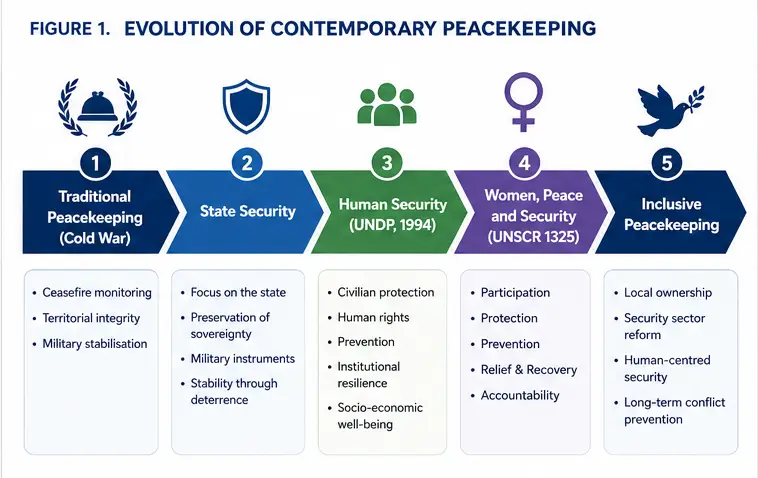
Source: Bellamy and Williams (2021); UNDP (1994); UNSCR 1325 (2000).
3. NATO’s Institutional Response: Embedding WPS and Human Security
The development of NATO’s Women, Peace and Security (WPS) and Human Security initiatives is an indication of the Alliance’s wider adjustment to a more complicated security situation. Even though collective defence remains NATO’s main responsibility, the organisation’s increasing participation in crisis management, stabilisation operations, counterterrorism and defence capacity-building has shown the shortcomings of relying solely on military capabilities. Today’s conflicts are influenced not just by armed struggle but also by governance failures, social fragmentation, harm to civilians and a falling level of institutional legitimacy. As a result, NATO has step by step come to the conclusion that military effectiveness requires an understanding of the political, social and human aspects of conflict as well as the traditional security threats (NATO, 2022; Yost, 2010).
Rather than representing a departure from NATO’s traditional mandate, the WPS and Human Security agendas should therefore be understood as institutional adaptations to the
The nature of today’s conflicts is changing. In order to improve the effectiveness of its missions, boost the resilience of its institutions, and enhance its interaction with local populations, NATO has incorporated gender perspectives, the protection of civilians, and wider human security issues into its operational planning (NATO, 2024a; NATO, 2024b). However, there is still debate as to how far these institutional commitments have been reflected in actual operational practice.
3.1 The Development of NATO’s Women, Peace and Security Agenda
Since the United Nations Security Council passed Resolution 1325 in 2000, NATO’s involvement with the Women, Peace and Security agenda has developed considerably. At first it was concerned with integrating a gender perspective into military planning, but it has since broadened its approach through a series of policy frameworks, such as the 2016 WPS Policy, the 2021–2025 Action Plan, and the 2024 NATO Policy on Women, Peace and Security (NATO, 2016, 2021, 2024a). The various documents now treat gender not as a separate equality issue but as an operational factor that can enhance strategic decision-making and the effectiveness of missions.
There is a wider change taking place in the academic literature. Instead of seeing the WPS only as a normative obligation to promote gender equality, scholars are now more likely to claim that gender analysis improves operational effectiveness by increasing situational awareness, helping in engagement with local communities, and enabling the identification of security factors which would otherwise go unnoticed (Shepherd, 2016; Davies & True, 2019). Moreover, empirical research indicates that inclusive peace processes lead to more sustainable peace agreements and greater institutional legitimacy, thus underscoring the strategic importance of genuine participation beyond its normative aspect (O’Reilly et al., 2015).
To put these principles into practice, NATO has appointed Gender Advisors (GENADs) and Gender Focal Points (GFPs), incorporated gender analysis into its operational planning, and made pre-deployment training a requirement (NATO, 2024a). The intention of these measures is to make sure that commanders take into account the different effects of conflict on various population groups, with the result that civilian engagement is improved, unintended consequences are reduced, and operational planning is strengthened.
Yet there is still an unevenness in turning institutional commitments into action. The success of gender integration still relies to a large extent on political support, on organisational culture, on leadership commitment, and on the authority given to gender advisers in the command structure. As Shepherd (2016) points out, the fact that an institution adopts a policy does not necessarily lead to organisational change. Likewise, Davies and True (2019) observe that the mere existence of WPS policies will not ensure their meaningful implementation if gender expertise remains only marginal in operational decision-making. Although NATO’s institutional framework has expanded considerably, questions still exist as to how consistently these principles affect military practice.
3.2 Human Security: Expanding NATO’s Understanding of Security
NATO’s adoption of a Human Security framework marks a major institutional evolution. Formally established as a cross-cutting element in the 2022 Strategic Concept, Human Security expands traditional defense priorities by recognizing that civilian protection, institutional resilience, and social stability directly impact mission success (NATO, 2022). The framework focuses on systematic attention to civilian protection, conflict-related sexual violence, children in conflict, human trafficking, and cultural property protection (NATO, 2024b). This aligns with broader literature arguing that sustainable peace requires addressing root causes of societal insecurity rather than just military threats (Kaldor, 2007; UNDP, 1994).
Drawing lessons from Afghanistan and the Western Balkans—where military victories failed to guarantee political stability—NATO integrated human security into operational planning, military education, and pre-deployment training (NATO, 2024b; de Coning, 2018). However, practical implementation remains challenging. Human security outcomes are inherently difficult to measure, and responsibilities are often fragmented across national contingents. Furthermore, balancing conceptual ambition with practical feasibility remains an ongoing hurdle when translating broad principles into military operations (Paris, 2001).
3.3 Going Beyond Policy: Institutional Adaptation or Operational Transformation?
The combination of NATO’s Women, Peace and Security and Human Security initiatives shows a marked move beyond the traditional view of security which is centred on the state. Since it has incorporated gender perspectives, the protection of civilians and societal resilience into its strategic doctrine, the Alliance is coming to realise that military effectiveness depends not just on conventional capabilities but also on inclusive methods of conflict prevention and stability (NATO, 2022).
Nevertheless, the degree of this transformation is still disputed. Although NATO’s strategic framework places a greater emphasis on inclusion, local ownership, and resilience, the way it is put into practice still differs from one mission to another depending on political priorities, institutional capacity, the resources available, and cooperation from the host state (Richmond, 2011; Shepherd, 2016). It follows that institutional innovation does not always lead to uniform operational practice.
The fact is especially clear in advisory and capacity-building missions since long-term success relies on strengthening national institutions and on supporting reforms that are owned at the local level. The NATO Mission to Iraq (NMI) therefore offers a good example for assessing
Whether or not the strategic commitments of NATO have resulted in real operational changes or whether substantial gaps still exist between policy and practice.
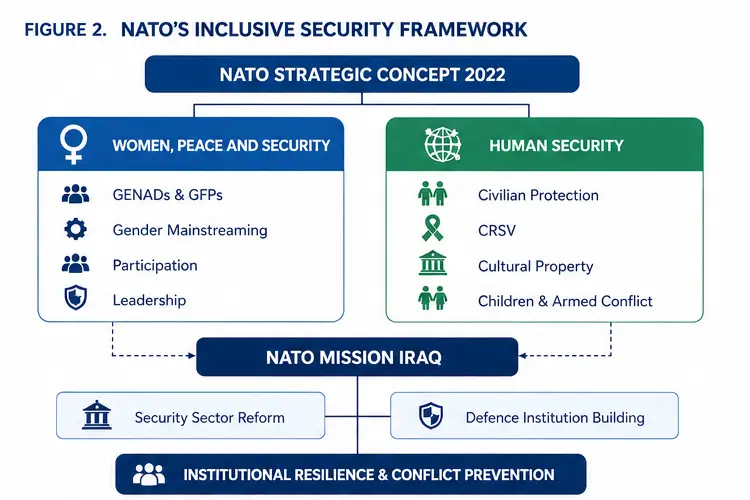
Source: NATO 2022 Strategic Concept; NATO Policy on WPS(2024); Human Security Approach and Guiding Principles (2022). NATO officially defines Human Security around protection of civilians, conflict-related sexual violence, trafficking in human beings, children and armed conflict, and cultural property protection.
4. Testing Inclusive Security: The Case of the NATO Mission Iraq
NATO Mission Iraq (NMI) is a particularly pertinent example when evaluating whether the Alliance’s Women, Peace and Security (WPS) and Human Security initiatives have moved from being institutional commitments to being put into practice in actual operations. The mission was set up in 2018 at the request of the Iraqi government after the territorial defeat of Da’esh, and it is different from conventional peacekeeping operations. Instead,
The mission’s aim is preventive not coercive and it seeks to reduce the structural causes of instability by improving the effectiveness, accountability and inclusiveness of Iraq’s security institutions; it focuses on advising Iraqi security institutions, strengthening defence governance and supporting long-term resilience (NATO, 2024c).
NMI is therefore an especially valuable example to study. Unlike typical military operations, its success is based on continuous cooperation with national institutions, on possessing political legitimacy and on having trust established between the security providers and the local communities. As a result, elements such as institutional governance, civilian involvement, and social inclusion become essential for the effectiveness of the mission (de Coning, 2018). It thus provides a chance to examine whether NATO’s developing approach to inclusive security has led to real operational changes.
4.1 Women, Peace and Security in Security Sector Reform
NATO has mainly pursued the incorporation of WPS principles into NMI through security sector reform (SSR) rather than by concentrating solely on increasing the number of women in the Iraqi security institutions. By integrating a gender perspective into professional military education, defence planning, organisational reform and leadership development, NATO reflects its wider view that inclusive institutions lead to both operational effectiveness and long-term stability (NATO, 2024a).
A key element of this method involves the work of Gender Advisors (GENADs) and Gender Focal Points (GFPs), who assist commanders in integrating gender analysis into their operational planning and training. In the NATO Mission Iraq (NATO Mission Iraq, 2024), training programmes have focused on gender-responsive leadership, conflict-related sexual violence, and the implementation of UNSCR 1325, while also urging Iraqi defence institutions to think about the impact of their security policies on different sections of the population. Instead of acting merely as compliance measures, these initiatives aim to enhance decision-making by improving situational awareness and promoting more effective interaction with local communities.
In terms of operational effectiveness, this shows a wider change in the way legitimacy is viewed as part of security sector reform. As Shepherd (2016) points out, taking a gender perspective leads to greater operational effectiveness since it improves an understanding of the dynamics of conflict which might otherwise be ignored. Likewise, Davies and True (2019) assert that inclusive institutions are more likely to win public confidence and thus to strengthen state legitimacy. In Iraq, a country where decades of conflict have damaged the trust between citizens and the security institutions, achieving these aims is directly connected with preventing conflict rather than involving just symbolic commitments.
Yet the mission also shows the extent of the limits of reform supported from the outside. Progress is largely due to continuous political commitment within the Iraqi institutions, to the presence of specialised expertise, and to wider social and cultural factors. As a result, even though the NMI has managed to incorporate the principles of WPS into its advisory work, the long-term effect of these initiatives will eventually come down to whether national actors carry on with the reforms after external support has decreased.
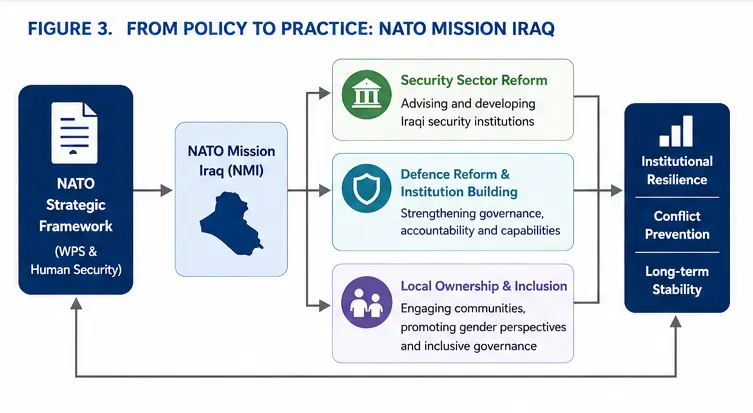
Source: NATO’s official NMI description. It identifies NMI as a non-combat advisory and capacity-building mission supporting sustainable, transparent, inclusive, and effective Iraqi security institutions.
4.2 Operationalising Human Security
NMI also shows the way in which NATO has aimed at putting Human Security into practice through its defence capacity-building efforts. Instead of viewing civilian protection as a separate humanitarian issue, the mission integrates Human Security factors into military education, strategic advice, and institutional reform and thus encourages Iraq’s security institutions to see civilian protection as an essential part of operational effectiveness (NATO, 2024b).
The fact that this method shows that NATO believes security institutions gain their legitimacy not just because they can deal with military threats but also because they are able to protect civilian populations, maintain professional standards, and keep the public’s trust is reflected in the way the NMI deals with a number of issues such as the protection of civilians, conflict-related sexual violence, trafficking in human beings, and the protection of cultural property as part of its advisory functions (NATO Mission Iraq, 2024). The aim of these considerations is to reduce harm to civilians, enhance institutional accountability, and improve the relationships between security providers and the communities they serve.
The fact that Human Security is given such emphasis also shows a significant change in the way mission success is conceived. Instead of assessing progress only by means of traditional indicators like the number of personnel trained or the capabilities developed, the NMI is now more aware that sustainable security relies on enhancing institutional resilience and public confidence. This is in agreement with de Coning’s (2018) view that peacebuilding should be seen as an adaptive process in which resilient national institutions, not external actors, should act as the main guarantors of long-term stability.
It is inherently difficult to measure these outcomes since improvements in institutional legitimacy, community trust, and civilian resilience almost never lead to immediate or easily quantifiable results and thus make it hard to assess the practical effect of Human Security initiatives. As Paris (2001) warns, there remains one of the main challenges facing Human Security in practice when it comes to turning broad conceptual frameworks into measurable operational objectives.
4.3 Local Ownership and Institutional Resilience
Perhaps the clearest illustration of NATO’s evolving approach to conflict prevention is NMI’s emphasis on local ownership. Unlike earlier intervention models characterised by extensive international control, NMI operates exclusively at the invitation of the Iraqi government and seeks to strengthen national institutions rather than replace them (NATO, 2024c). Iraqi authorities retain responsibility for determining reform priorities, while NATO advisers provide technical expertise, professional education, and institutional support.
This method is in line with current scholarship in the field of peacebuilding. As Richmond (2011) points out, sustainable peace cannot be imposed from outside and must instead arise from legitimate domestic institutions which are able to preserve public confidence and ensure political accountability. In the same way, Call and Wyeth (2008) stress that reforms which are pushed from outside tend to be unsustainable if national actors do not take genuine ownership of the reform process. That is why NMI sees NATO’s role as that of a promoter of institutional development rather than as a direct source of security.
At the same time, the model necessarily restricts outside influence since the implementation will in the end rest on the domestic political will of the country and therefore NATO has only limited power to bring about reforms or to speed up institutional change. Progress may therefore be hindered even in the face of ongoing international support due to political instability, competing priorities and fluctuations in Iraq’s security situation. NMI thus shows one of the main problems facing modern peacebuilding, namely that while international organisations can help to achieve reform they cannot take the place of a continuous national commitment.
4.4 From Commitment to Institutional Reality
When looked at as a whole, NMI shows that NATO has gone beyond viewing the WPS and Human Security as simply normative obligations. Gender considerations, the protection of civilians, institutional resilience, and local ownership have become more and more incorporated into its advisory work and defence capacity-building, indicating that inclusive security is now starting to influence operational practice rather than staying limited to strategic doctrine.
The mission also shows the extent to which this transformation is limited. The success of inclusive security still relies on political commitment, the organisational capacity, the resources available, and the cooperation of the institutions of the host state. Furthermore, many of the intended results – such as increased legitimacy, better community trust, and greater institutional resilience – remain hard to measure and usually only appear after a long period of time. It therefore follows that turning institutional aspirations into actual operational changes is not automatic and does not take place in a straight line.
NATO’s Mission in Iraq is not an example of a finished transformation but rather shows an ongoing process of organisational adaptation. It indicates that inclusive security can contribute to conflict prevention by strengthening governance, increasing institutional legitimacy, and promoting civilian engagement, although it also shows that such approaches are only effective when they are backed by continuous political commitment and local ownership. It therefore provides significant evidence that the future of peacekeeping does not lie in replacing traditional military capabilities but in combining them with more people-centred approaches to security.
5. Discussion: What Does NATO Reveal About the Future of Peacekeeping?
The example of the NATO Mission in Iraq (NMI) shows a wider shift in modern peacekeeping. Instead of merely taking on new policy frameworks, NATO’s incorporation of the Women, Peace and Security (WPS) and Human Security initiatives shows an increasing awareness that sustainable peace depends not just on military capabilities but also on political legitimacy, the protection of civilians, and on strong institutions (de Coning, 2018; NATO, 2022). Since today’s conflicts tend to involve armed violence together with failures in governance and social fragmentation, security organisations have had to develop more comprehensive methods of conflict prevention.
The results indicate that the major change is not the substitution of traditional security with approaches that are focused on people, but rather their integration. NATO has gradually come to realise that the effectiveness of military operations is influenced by the broader political and social environment in which they take place. Within this context, the Women, Peace and Security (WPS) agenda and the concept of human security should be seen as more than just normative commitments; they should be regarded as operational frameworks. This can help to strengthen institutional legitimacy, improve interaction with local communities, and enhance the effectiveness of the mission (NATO, 2024a, 2024b).
NMI also points out a more general evolution in the role of international organisations. Instead of mainly functioning as external providers of security, missions are now working to enhance national institutions by offering advisory assistance, helping with defence reform, and building up capacity. This is in keeping with current peacebuilding research, which stresses that sustainable peace relies on legitimate and resilient domestic institutions rather than on long-term external intervention (Richmond, 2011; Call & Wyeth, 2008).
At the same time, the results warn against assuming that institutional innovation is the same as operational transformation. Even though NATO has developed ever more comprehensive strategic frameworks, implementation still relies on political priorities, organisational capacity, the resources available and on continued cooperation with partner governments. The experience of NMI thus lends support to the broader criticisms that ambitious policy frameworks often face major difficulties when turned into complex operational situations (Paris, 2001; Shepherd, 2016).
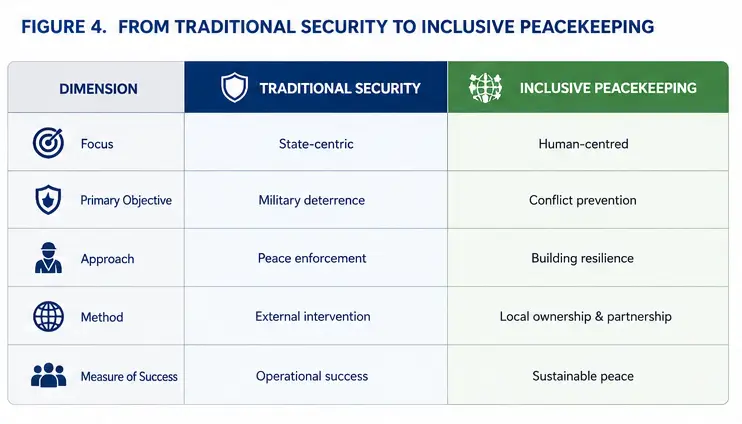
Source: de Coning (2018), Richmond (2011), and NATO (2022), presented explicitly as an analytical synthesis.
6. Conclusion
The article has looked at the way NATO’s Women, Peace and Security (WPS) and Human Security initiatives reflect the wider changes taking place in contemporary peacekeeping, using the example of the NATO Mission in Iraq (NMI). It has maintained that NATO has gradually gone beyond its earlier focus on the state when incorporating civilian protection, local ownership, and institutional resilience into its strategic approach (NATO, 2022, 2024a, 2024b). Instead of abandoning its main defence responsibility, the Alliance has modified its framework to meet the growing complexity of security situations in which military, political and societal factors are closely interlinked.
The analysis shows that this evolution is clearly seen both at an institutional and an operational level. NATO has incorporated WPS and Human Security principles into its strategic doctrine and advisory activities, and NMI shows how these frameworks can be used to support security sector reform, defence institution building, and long-term conflict prevention (NATO Mission Iraq, 2024). Meanwhile, the findings indicate that institutional adaptation does
It does not automatically translate into operational transformation; the effectiveness of inclusive security still relies on political commitment, organisational capacity, and continued cooperation with national partners (Richmond, 2011).
The study ultimately indicates that the future of peacekeeping will not involve a decision between traditional military capabilities and people-centred approaches, but rather the effective integration of the two. Experience gained by NATO shows that inclusive security can complement conventional military capabilities by enhancing the legitimacy of institutions, improving interaction with local communities, and helping to achieve more sustainable conflict prevention (Shepherd, 2016; de Coning, 2018). It would be worthwhile for future research to investigate whether similar patterns of institutional adaptation are appearing in other international organisations and in different operational contexts, so as to allow for a wider comparative evaluation of the development of modern peacekeeping.
References
Bellamy, A. J., & Williams, P. D. (2021). Understanding peacekeeping (4th ed.). Polity Press.
Call, C. T., & Wyeth, V. (Eds.). (2008). Building states to build peace. Lynne Rienner Publishers.
Cornish, P., & Dorman, A. (2010). Complex security and strategic adaptation. International Affairs, 86(2), 395–410.
Crenshaw, K. (1989). Demarginalizing the intersection of race and sex: A Black feminist critique of antidiscrimination doctrine, feminist theory and antiracist politics. University of Chicago Legal Forum, 1989(1), 139–167.
Crenshaw, K. (1991). Mapping the margins: Intersectionality, identity politics, and violence against women of color. Stanford Law Review, 43(6), 1241–1299.
Davies, S. E., & True, J. (2019). The Oxford handbook of women, peace and security. Oxford University Press.
de Coning, C. (2018). Adaptive peacebuilding. International Affairs, 94(2), 301–317.
Enloe, C. (2014). Bananas, beaches and bases: Making feminist sense of international politics (2nd ed.). University of California Press.
Fortna, V. P. (2008). Does peacekeeping work? Shaping belligerents’ choices after civil war. Princeton University Press.
Hudson, H. (2005). “Doing” security as though humans matter: A feminist perspective on gender and the politics of human security. Security Dialogue, 36(2), 155–174.
Kaldor, M. (2007). Human security: Reflections on globalization and intervention. Polity Press.
Newman, E. (2010). Critical human security studies. Review of International Studies, 36(1), 77–94.
Nilsson, D. (2012). Anchoring the peace: Civil society actors in peace accords and durable peace. International Interactions, 38(2), 243–266.
O’Reilly, M., Ó Súilleabháin, A., & Paffenholz, T. (2015). Reimagining peacemaking: Women’s roles in peace processes. International Peace Institute.
Organisation for Economic Co-operation and Development. (2007). OECD DAC handbook on security system reform: Supporting security and justice. OECD Publishing.
Paris, R. (2001). Human security: Paradigm shift or hot air? International Security, 26(2), 87–102.
Pratt, N., & Richter-Devroe, S. (2011). Critically examining UNSCR 1325 on women, peace and security. International Feminist Journal of Politics, 13(4), 489–503.
Richmond, O. P. (2011). A post-liberal peace. Routledge.
Shepherd, L. J. (2016). Gender matters in global politics: A feminist introduction to international relations (2nd ed.). Routledge.
True, J. (2012). The political economy of violence against women. Oxford University Press.
United Nations Development Programme. (1994). Human development report 1994: New dimensions of human security. Oxford University Press.
United Nations Security Council. (2000). Resolution 1325 (2000) on women and peace and security (S/RES/1325).
United Nations Security Council. (2008). Resolution 1820 (2008) on women and peace and security (S/RES/1820).
United Nations Security Council. (2015). Resolution 2242 (2015) on women and peace and security (S/RES/2242).
Yost, D. S. (2010). NATO’s balancing act. United States Institute of Peace Press.
NATO Sources
NATO. (2016). NATO policy and action plan on women, peace and security.
NATO. (2021). NATO action plan on women, peace and security (2021–2025).
NATO. (2022). NATO 2022 strategic concept. https://www.nato.int/cps/en/natohq/topics_210907.htm
NATO. (2024a). NATO policy on women, peace and security.
NATO. (2024b). Human security approach and guiding principles.
NATO. (2024c). NATO Mission Iraq. https://www.nato.int/cps/en/natohq/topics_166936.htm
NATO. (2024d). Women, Peace and Security annual report.