




Introduction & Context
On 9–10 June 2026, AFCEA Europe organised TechNet International 2026 in Brussels, bringing together policymakers, military officials, industry representatives, and experts to discuss the future of defence, digital transformation, cybersecurity, and emerging technologies, offering a platform to discuss how governments and institutions can adapt to a rapidly evolving threat landscape.
Among the participants was the European Centre of Excellence for Countering Hybrid Threats (Hybrid CoE), an international hub in Helsinki that supports states and institutions in responding to hybrid threats. Through research, training, exercises, and dialogue, Hybrid CoE promotes a whole-of-society approach to resilience, helping democratic societies counter actors operating below the threshold of armed conflict.
EPIS Thinktank for Foreign Affairs and Security Policy attended TechNet International 2026 through delegates Andrea Guidotti and Valerio Borgo. Andrea Guidotti is the Leader of the Report Group on AI & Cybersecurity Policy at EPIS, holding an M.A. in World Politics and International Relations from the University of Pavia. His research focuses on European integration, populism, and the impact of crises and technology on political behaviour. Valerio Borgo is a Research Fellow and Policy Competition Director at EPIS, holding an M.A. in European Policy from the University of Amsterdam. His research focuses on peacebuilding, conflict prevention, and European security, with attention to human security and crisis management.
In this age of hybrid warfare, threat actors employ coordinated actions across multiple domains – cyber operations, information manipulation, economic coercion, and attacks on critical infrastructure – to advance their objectives while remaining below the threshold of armed conflict. Operating in this grey zone, these actors exploit vulnerabilities within democratic societies, requiring comprehensive approaches involving governments, international organisations, industry, and society.
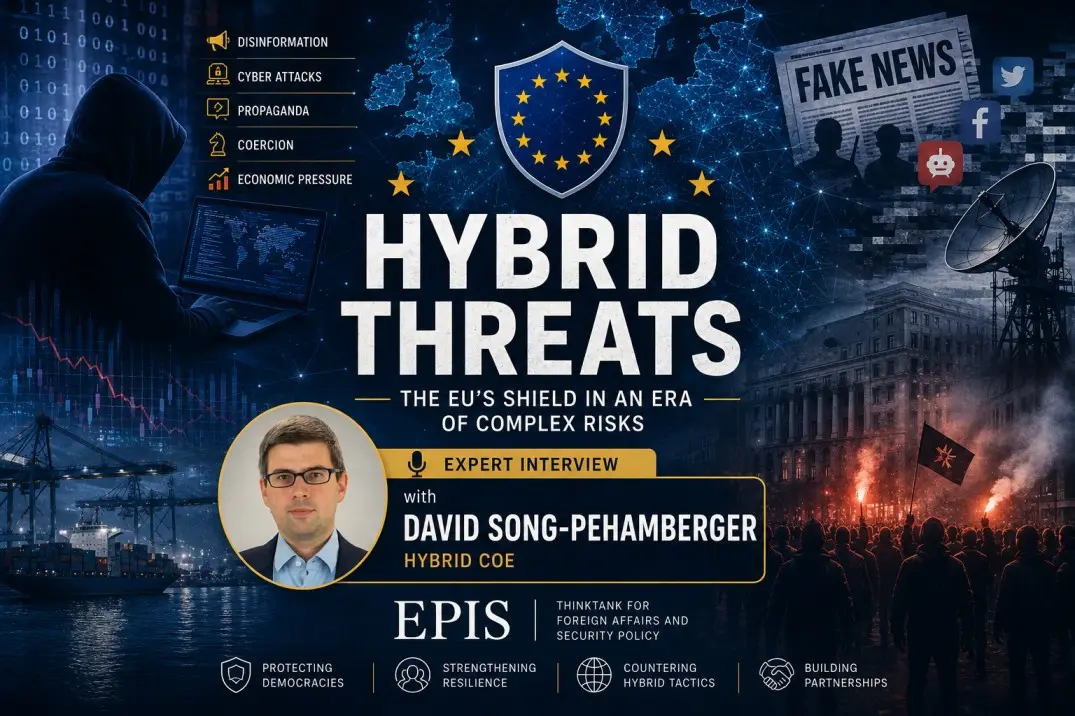
During TechNet International 2026, EPIS delegates spoke with David Song-Pehamberger, Deputy Director of the Community of Interest for Strategy and Defence at Hybrid CoE, where he also leads the Cyber Workstrand, focusing on cyber operations within the hybrid threat landscape and strategies for strengthening resilience.
Interview with David Song-Pehamberger
EPIS: What have been your first impressions of TechNet International 2026, and which discussions or themes have stood out to you most so far?
David Song-Pehamberger: One of the aspects I particularly appreciate about TechNet is that it brings together very different communities. It creates opportunities for industry representatives, policymakers, and practitioners to exchange perspectives and learn from one another. This interaction is essential because addressing today’s security challenges requires cooperation across sectors rather than isolated approaches.
EPIS: Could you briefly summarise the key message of your panel intervention and explain the mission and current priorities of the European Centre of Excellence for Countering Hybrid Threats?
David Song-Pehamberger: My intervention focused on the cyber domain and the role it plays within the broader hybrid threat landscape. Cyber operations represent only one component of hybrid activities, but they are deeply interconnected with other domains. At Hybrid CoE, our mission is to help participating states and organisations understand these linkages and develop comprehensive approaches to resilience.
The Centre serves as a platform for cooperation, research, training, and exercises. Our work is organised around different communities of interest, bringing together experts from across government sectors. Ultimately, our objective is to improve awareness, strengthen preparedness, and support democratic societies in responding effectively to increasingly sophisticated hybrid campaigns.
EPIS: Having listened to fellow speakers and participants throughout the event, was there any particular idea, trend, or perspective that you found especially interesting or thought-provoking?
David Song-Pehamberger: One important theme that emerged repeatedly during the discussions is the growing convergence between cyber security and other domains. Increasingly, we see that technological innovation cannot be considered in isolation. Questions of resilience, information integrity, critical infrastructure protection, and societal preparedness are becoming closely interconnected.
Another important point concerns the speed at which technologies evolve. This requires institutions and societies not only to invest in innovation but also to continuously adapt their frameworks, processes, and mindsets.
EPIS: Hybrid threats increasingly exploit the space between peace and conflict, targeting democratic institutions, critical infrastructure, information environments, and societal resilience. From your perspective, what are currently the most significant hybrid vulnerabilities facing Europe, and how can governments, international organisations, and private-sector actors strengthen their ability to anticipate and counter these evolving threats?
David Song-Pehamberger: One of the main challenges lies in complexity itself. Hybrid threats are designed to exploit seams – between institutions, between sectors, and sometimes even between legal frameworks. Vulnerabilities often emerge where responsibilities are fragmented or where information sharing remains insufficient.
Addressing these challenges requires a whole-of-government and whole-of-society approach. Governments, international organisations, industry, academia, and citizens all have a role to play. Strengthening resilience is not solely about defence capabilities; it is equally about cooperation, preparedness, and building trust across institutions and society.
EPIS: Looking ahead, which digital innovation or technological development do you believe will most significantly shape the future of defence and security, and what role should citizens, European organisations, and public institutions play in supporting responsible innovation and resilience in this domain?
David Song-Pehamberger: Artificial intelligence and the broader acceleration of digital technologies will undoubtedly have a major impact on defence and security. However, technological progress alone is not sufficient. The key challenge will be ensuring that these innovations are adopted responsibly and integrated into systems that remain resilient, trustworthy, and aligned with democratic values.
Citizens, public institutions, and international organisations all have important responsibilities. Building resilience requires not only technological solutions but also awareness, education, and cooperation. Ultimately, security is a shared responsibility, and maintaining it in the digital age demands contributions from all parts of society.
Conclusion
TechNet International 2026 highlighted how contemporary security challenges increasingly transcend traditional domains and require integrated responses. As hybrid actors continue to operate in the grey zone between war and peace, resilience becomes not merely a military objective but a societal one. As David Song-Pehamberger emphasised, effective responses to hybrid threats depend on cooperation across governments, international organisations, industry, and citizens alike. In an era of rapid technological change and growing strategic competition, strengthening democratic resilience will remain one of Europe’s most pressing security priorities.