

AI & Cybersecurity
Safeguarding the digital future
The Working Group Artificial Intelligence & Cybersecurity explores how AI and cyber technologies impact international security and foreign policy. It examines military use, disinformation, cyber threats, and global tech governance. Key topics include ethical AI, digital sovereignty, and strategic competition. Monthly briefings offer insights on the geopolitical and security implications of AI and cybersecurity.

AI-Drafted Arbitral Awards and the Risk of Non-Enforcement
This paper examines when AI assistance in arbitral decision-making may cross the line into delegation and create enforcement risks under Article V(1)(d) of the New York Convention.
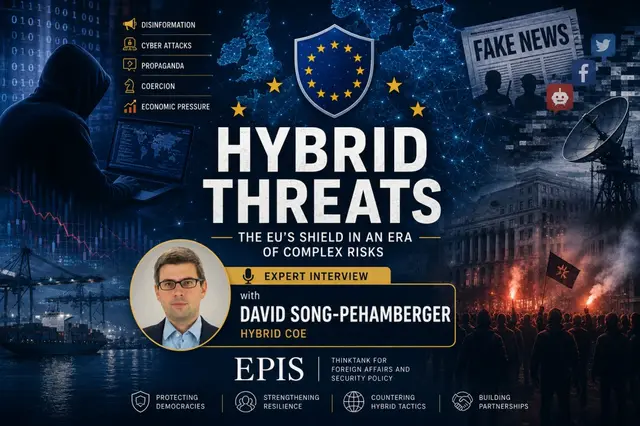
Countering Hybrid Threats in the Grey Zone
As hybrid threats increasingly challenge Europe’s security and democratic resilience, David Song-Pehamberger of Hybrid CoE explores the evolving threat landscape, the EU’s response, and how Europe can strengthen its resilience in an era of complex risks.
Beyond Compliance: Building 360-Degree Cyber Resilience for Society
Cyber threats are evolving and making resilience more important than ever. This article explores how EU regulations and directives strengthen preparedness, response and accountability through a 360-degree approach to cyber resilience.
Europe’s Skynet: Inside the EU Parliament’s Divisive Chat Control Vote
The European Union is struggling to answer one of the information-era dilemmas: for the sake of security, what’s the line of negotiation for privacy exceptionality? The “Chat Control” package may set a precedent in blurring the line of EU citizens’ right of private communications.

Strengthening Europe’s Collective Transition to PQC
Without clear institutional accountability, uneven PQC implementation could cause the EU to miss its 2026, 2030, and 2035 milestones. A coherent accountability framework is therefore essential to strengthening Europe’s quantum resilience and safeguarding its digital sovereignty.

Cyberattacks on EU Critical Infrastructure
Which EU critical infrastructure sectors face the greatest cyber risk, and which threat modalities are most active? The EU threat environment is bifurcated: high-volume DDoS/hacktivism pressures availability, while lower-volume intrusions cause high-consequence outcomes like ransomware and data t…

More Than Disinformation: Economic Coercion and Russia’s Hybrid Influence in Armenia
Examining the June 2026 Armenian parliamentary elections, this brief investigates how Russia combined economic coercion, trade restrictions, and digital information operations to shape the country’s political landscape. It highlights how economic pressure validates foreign disinformation narrativ…

Age Verification on Social Media: Implications for Privacy and Data Security
As social media becomes central to children’s lives, policymakers are increasingly relying on age verification and blanket bans to mitigate online risks. This article explores the political rationale behind these measures, highlighting their limitations—such as easy circumvention and social exclu…

The paradox of obedience
AI that reinforces rather than challenges military assumptions could weaken decision-making. The article argues Europe needs AI systems that embed structured dissent, not compliance.

The Atomic Bomb We Haven’t Faced (Yet)
Does Anthropic’s Mythos change cybersecurity or is it overhyped? While AI lowers the barrier for cyberattacks, Europe’s biggest challenge remains enforcing NIS2, with human error still the weakest link.
From Medicine to Military Tech
From Medicine to Military Tech A Founder’s Journey Himmel: Dr. Andres, you are a doctor, and now you sell optics and advocate for the idea that “defence is a human right.” How did that come about? Dr. Andres: Well, I didn’t start directly in the defence sector. During my studies, I had a PDA, som…

Surveillance State Rhymes with Digital Fate
The global export of Chinese surveillance technologies through the lens of surveillance capitalism: China’s party-state model has instrumentalised commercial data-extraction logics to construct a scalable surveillance apparatus, exported through initiatives such as the Digital Silk Road.

The Contradiction of EU Tech Governance
Main question: What’s the current status of whistleblower protection in the European tech sector? Argument: There is a presence of uneven implementation across EU Member States, which must be addressed. Conclusion: whistleblower protection in the tech sector is critical for democratic legitimacy …

Threats of Artifical Intelligence
How is the UK addressing AI’s challenges for counterterrorism? This article argues that current strategy does not fully address AI-driven risks such as radicalisation and corruption, concluding that adaptability and international cooperation are essential for future security.

From Fragmentation to Flexibility
How can the EU design digital infrastructure ensuring both security and civil rights for times of peace and crisis? The answer lies in resilience by design, through frameworks like the EUDI Wallet, NIS2 Directive, and the IEA, which create distributed, interoperable system. This proactive archite…

The EU’s Strategic Dilemma
This article investigates whether the EU AI Act can balance fundamental rights protection with economic competitiveness. While the Act strengthens a value-based approach to AI governance, its broad regulatory framework combined with considerable exceptions risk undermining both effectiveness and …

Cybersecurity Redefined: Preemptive Defense
How can organizations move beyond a “reactive” cybersecurity mindset that only addresses breaches after they have caused damage? By utilizing “Active Defense” and intelligence, companies can identify malicious infrastructure deployment weeks before an attack, allowing for preemptive disruption of…

Cyberbiosecurity for Brain-Computer-Interfaces
Why is cyberbiosecurity relevant for emerging cyber-bio threats in the context of Brain-Computer-Interfaces (BCIs)? Neurodata serves as strategic infrastructure in future warfare scenarios. With the related risks of exploitation, cyberbiosecurity is needed to protect the vulnerabilities of neurot…

Interview with Lola Aworanti-Ekugo
How can the Global South advance in digital trade and AI? Effective digital trade requires inclusive policies, public-private collaboration, and support for scalable local innovations. With strategic partnerships, infrastructure investment, and global openness, African digital solutions can compe…

Digital Sovereignty in a Fragmented World
How do different countries approach digital sovereignty in a fragmented global tech landscape? States adopt models reflecting politics, economy, and security: China is state-centric, the US market-driven, Europe regulatory, India public-infrastructure based, South Africa hybrid. Controlling digit…