


Rebuilding long-term democratic resilience depends on moving beyond the politics of perpetual emergency and re-establishing the absolute independence of core constitutional bodies
Democratic backsliding in Latin America: erosion from within and the case of Argentina
In modern politics, Latin America has often served as a perfect real-world laboratory for studying major political changes. The “Third Wave” of democratization, which swept the region during the late twentieth century, systematically replaced military dictatorships with institutional architectures grounded in electoral competition, constitutionalism, and the rule of law. For several decades, academic consensus and institutional frameworks operated under the assumption that these formal mechanisms had achieved consolidation.
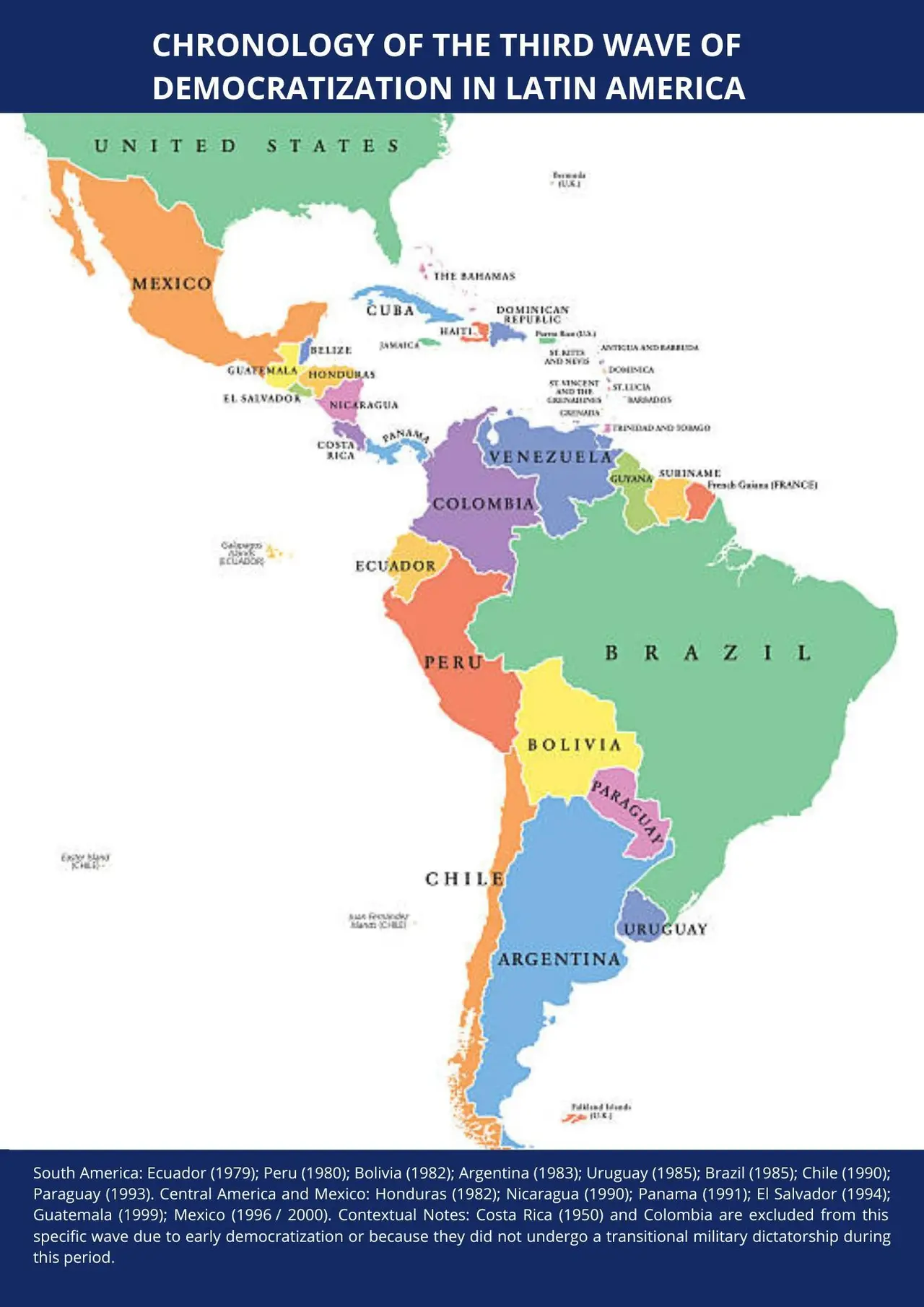
However, over the course of the last two decades, this consolidating trajectory has faced a more insidious challenge than the classical military interventions of the twentieth century. The contemporary risk to democratic stability does not typically manifest via sudden, violent overthrows of elected governments. Instead, as documented across global frameworks by scholars such as Lührmann and Lindberg (2019) and Haggard and Kaufman (2021), it occurs through a process commonly defined as democratic backsliding, which is an incremental, legally orchestrated erosion of the substantive checks, balances, and behavioral norms that safeguard constitutional democracy.
Argentina represents a highly illustrative case study for evaluating the mechanics of this institutional attrition. Characterized by a historical architecture of strong executive authority, often defined in political science as hyper-presidentialism, and subject to chronic, structural macroeconomic shocks, the Argentine state offers an empirical baseline to study how prolonged political polarization and economic crisis-management impact the stability of democratic counterweights. Over the last twenty years, the country has navigated distinct ideological governance paradigms: the left-populist administrations of Néstor Kirchner and Cristina Fernández de Kirchner (2003–2015), the center-right market-oriented administration of Mauricio Macri (2015–2019), the post-pandemic administration of Alberto Fernández (2019–2023), and the libertarian populist administration of Javier Milei (2023–present).
The central research question guiding this study is: To what extent has democratic backsliding occurred in Argentina over the last two decades, and through what specific institutional and legal mechanisms has it manifested, particularly in the post-COVID-19 period?
Rather than arguing that Argentina has experienced a linear transition toward authoritarianism, this article advances a more nuanced core thesis: Argentina exhibits a pattern of systematic institutional strain and uneven democratic degradation. This dynamic is driven primarily by the normalization of emergency governance, executive aggrandizement through decree-based legislating, and deliberate political attrition against the judiciary. While formal electoral integrity and political competition have demonstrated robust systemic resilience, which is evidenced by multiple peaceful transfers of executive power between opposing ideological coalitions, the substantive quality of institutional accountability and the independence of democratic checks have faced progressive erosion. This erosion has significantly accelerated in the post-pandemic era due to heightened socio-economic fragmentation and a widening public disconnect from traditional political elites.
Methodologically, this paper utilizes a qualitative case-study design supported by structured institutional data, international rule-of-law indices, and academic literature. It triangulates long-term metric assessments from Freedom House (Freedom in the World), the Economist Intelligence Unit (Democracy Index), the International Institute for Democracy and Electoral Assistance (International IDEA Global State of Democracy Indices), the World Justice Project (Rule of Law Index), and regional public opinion tracking from the Latinobarómetro database. By integrating these empirical indicators with constitutional and political analysis,
the study maps the structural channels through which executive authority expands and checks erode during periods of compounding socio-economic stress.
To analyze the Argentine trajectory objectively, it is necessary to establish a clear conceptual distinction between classical democratic breakdown and contemporary democratic backsliding.
Classical breakdown, dominant during the mid-to-late twentieth century, was characterized by exogenous disruptions of the constitutional order, typically through military coups d’état, the formal suspension of the constitution, or the overt closure of legislative assemblies. Conversely, contemporary backsliding is endogenous. It is initiated by constitutionally elected actors who utilize legal, legislative, and institutional mechanisms to weaken accountability, isolate the executive branch from judicial scrutiny, and degrade the leveling of the political playing field (Haggard & Kaufman, 2021).
Lührmann and Lindberg (2019) situate this phenomenon within what they term the “third wave of autocratization.” A defining feature of this current wave is its highly ambiguous and incremental nature. Elected executives rarely eliminate democratic institutions entirely; instead, they maintain a facade of democratic conformity, such as holding regular elections and retaining legislative bodies, while systematically hollowing out their substantive, operational autonomy. This strategy leverages the formal mechanisms of democracy to achieve illiberal outcomes, often utilizing public support or acute national crises to justify the concentration of power.
In Latin America, this dynamic frequently interacts with the structural legacy of delegative democracy or hyper-presidentialism, a concept originally formalized by Guillermo O’Donnell. In systems where horizontal accountability, meaning the capacity of state institutions like the judiciary and the legislature to check and balance executive action, is structurally weak, the president is often perceived as authorized to govern entirely as they see fit, restricted only by the vertical accountability of periodic elections. When an economy enters a prolonged phase of instability, the executive’s incentive to bypass institutional friction increases exponentially. Consequently, backsliding in this regional context manifests not as a sudden rupture, but as a normalized, cumulative process where institutional guardrails are systematically dismantled or ignored in the name of efficiency, security, or crisis mitigation.
An evaluation of Argentina’s democratic trajectory over the last twenty years reveals a profile characterized by structural stability in vertical electoral indicators alongside a persistent, downward drift in horizontal accountability and judicial performance.
According to long-term aggregate data from Freedom House’s Freedom in the World reports, Argentina has consistently maintained its classification as a “Free” country. Its score has hovered between 84 and 85 out of 100 over the past decade, driven primarily by the maintenance of competitive, transparent, and highly pluralistic electoral processes (Freedom House, 2026). The state’s capacity to organize complex national elections, ensure universal suffrage, and facilitate the peaceful transfer of power across highly polarized coalitions remains a significant democratic strength.
However, a disaggregated look at international metrics reveals distinct areas of institutional vulnerability. The Economist Intelligence Unit’s (EIU) Democracy Index has classified Argentina as a “Flawed Democracy” throughout the last two decades. While its scores for electoral process and pluralism consistently rank high, typically above 9.0 out of 10, its sub-indices for “Government Functioning” and “Political Culture” reflect structural deficiencies, routinely falling between 5.0 and 6.5 (Economist Intelligence Unit, 2026). This divergence underscores the central paradox of the Argentine case, which presents a highly functional electoral apparatus operating alongside a strained and frequently paralyzed institutional framework.
Furthermore, data from the World Justice Project (WJP) Rule of Law Index tracks a persistent erosion in the specific dimension of horizontal accountability. Argentina’s global and regional rankings in “Constraints on Government Powers” and “Civil Justice” have faced steady downward pressure over the past decade. By 2025, the WJP index flagged long-term challenges related to judicial independence, bureaucratic corruption, and the predictability of enforcement mechanisms (World Justice Project, 2025).
Similarly, International IDEA’s Global State of Democracy Indices illustrate that while Argentina performs above the regional average in terms of Clean Elections and Fundamental Rights, its metrics for Judicial Independence and Effective Parliament have experienced notable fluctuations and declines during periods of intense political polarization or unilateral executive action (International IDEA, 2025).
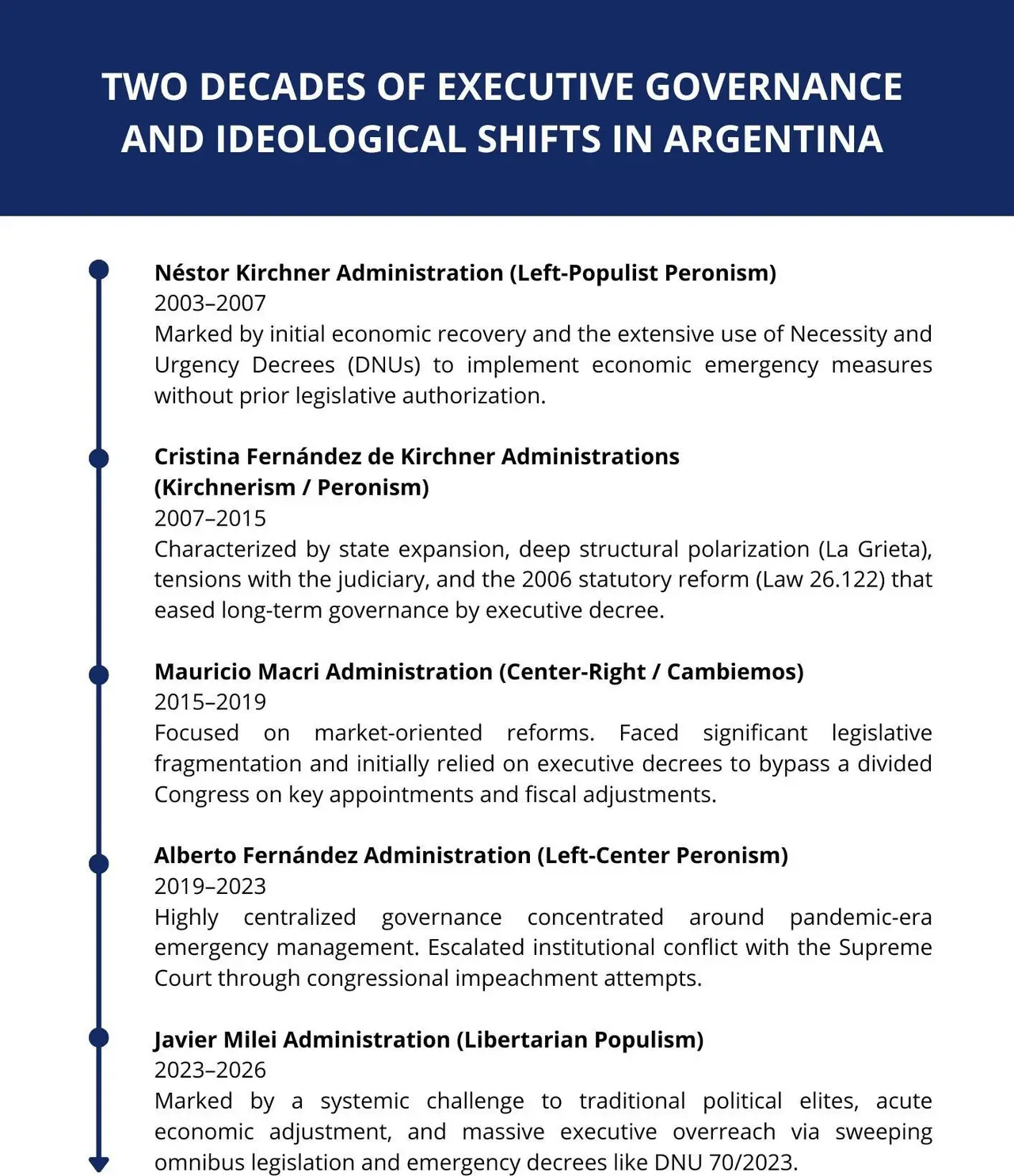
The structural manifestation of democratic backsliding in Argentina over the last two decades can be systematically analyzed through three primary institutional vectors: executive overreach, the politicization of judicial counterweights, and the erosion of substantive civic space under the weight of political polarization.
The most prominent legal mechanism of democratic attrition in Argentina is the normalization of executive decree-making. Under Article 99, Clause 3 of the Argentine National Constitution, the executive is strictly prohibited from issuing legislative regulations under penalty of absolute nullity. However, the constitution allows an explicit exception: Necessity and Urgency Decrees (Decretos de Necesidad y Urgencia, DNUs) may be issued when exceptional circumstances make the normal legislative procedures enacted by Congress impossible, provided they do not cover criminal, tax, electoral, or political party regimes.
Over the last two decades, this exceptional constitutional instrument has been transformed into a standard tool of ordinary governance. The structural cause of this transformation is the recurring invocation of socio-economic crises.
During the presidencies of Néstor Kirchner and Cristina Fernández de Kirchner, DNUs were frequently deployed to pass sweeping economic measures, reallocate budgetary resources, and manage nationalized public services without prior legislative approval. While the original constitutional reform of 1994 intended for DNUs to be subjected to strict, immediate oversight by a permanent bicameral legislative committee, subsequent statutory regulation, specifically Law 26.122, enacted in 2006, significantly weakened this check. Under Law 26.122, a DNU remains legally valid unless it is explicitly rejected by both houses of Congress, allowing an executive to sustain decree-based legislation as long as they maintain a blocking minority in just one legislative chamber.
This institutional practice crossed an important threshold during the post-COVID-19 era and the subsequent transition to the Javier Milei administration. Facing an acute economic crisis and possessing only a distinct minority in both the Senate and the Chamber of Deputies, President Milei issued DNU 70/2023 in December 2023. This massive, single decree sought to deregulate vast sectors of the national economy, repeal dozens of federal statutes, modify labor frameworks, and pave the way for the privatization of state-owned enterprises.
The scale and scope of DNU 70/2023 represented a qualitative leap in executive aggrandizement; rather than responding to a sudden, exogenous physical catastrophe, the executive utilized the decree mechanism to implement a comprehensive, structural ideological program, bypassing ordinary parliamentary debate entirely. While the judiciary subsequently suspended specific labor provisions of the decree following constitutional challenges by labor federations, the broader architecture of the decree demonstrated how hyper-presidentialism can effectively relegate the legislature to a reactive, secondary body during periods of structural stress.
The second vector of democratic backsliding centers on the persistent political and structural pressures applied against the judiciary, particularly the Supreme Court of Justice (Corte Suprema de Justicia de la Nación). In a highly polarized political ecosystem, the judiciary frequently finds itself transformed into an ideological battleground, as successive executives attempt to neutralize the only state organ capable of enforcing horizontal accountability.
During the Cristina Fernández de Kirchner administrations, this took the form of the democratización de la justicia initiative in 2013, which was a legislative package that sought to introduce popular election for members of the Council of the Judiciary (Consejo de la Magistratura), the body responsible for selecting judges and administering the judicial budget. This reform was ultimately declared unconstitutional by the Supreme Court, which ruled that it compromised the structural separation of powers. Following this impasse, the strategy shifted from structural reform to political friction and institutional delay. For years, political fragmentation within Congress prevented the qualified majorities required to appoint a permanent Attorney General (Procurador General), leaving the position held by a provisional official and undermining the independent operational stability of the public prosecution service.
The institutional conflict escalated further during the presidency of Alberto Fernández (2019–2023). Following Supreme Court rulings that invalidated federal executive mandates regarding pandemic-era school closures and overturned legislative maneuvers to alter the representation of political blocs within the Council of the Judiciary, the executive branch initiated a formal impeachment process (juicio político) against all four sitting Supreme Court justices in early 2023.
Although the ruling coalition lacked the necessary two-thirds majority in the Chamber of Deputies to finalize the impeachment and remove the justices, the prolonged congressional proceedings served as an aggressive instrument of political pressure. This process frequently featured high-level rhetoric that characterized the judiciary as a highly politicized corporate cartel intent on blocking the democratic will of the electorate.
This pattern of institutional friction adjusted but persisted under the Milei administration. Instead of traditional impeachment frameworks, the executive exerted pressure through public, highly rhetorical challenges to judicial decisions that restricted executive decrees, alongside strategic calculations regarding nominations to fill vacancies on the Supreme Court. The recurring structural consequence of these alternating strategies across different administrations has been a profound erosion of institutional predictability. According to data from the World Justice Project, public and elite confidence in the independence of the Argentine judicial system has been severely compromised, as the appointment, tenure, and budgetary stability of magistrates remain continuously tied to the outcome of national political cycles (World Justice Project, 2025).
The substantive quality of Argentina’s democracy cannot be detached from its societal context, which has been structurally shaped by an intense form of political and cultural polarization known as La Grieta, or the rift. La Grieta describes a deeply entrenched sociological division that splits the political landscape into two mutually exclusive camps, namely an economic-nationalist, populist paradigm, primarily represented by Kirchnerist Peronism, and an anti-populist, market-oriented or conservative paradigm.
According to data compiled by Latinobarómetro, public satisfaction with the functioning of democracy in Argentina has tracked a long-term downward trend over the past two decades, dropping significantly below the levels recorded during the early years of the post-dictatorship transition. This decline is not driven by a rejection of democracy as an abstract concept; rather, it reflects a deep, systemic frustration with the output legitimacy of democratic institutions. Decades of chronic macroeconomic volatility, characterized by recurrent sovereign debt defaults, structural fiscal deficits, and hyperinflationary cycles, have fostered a widespread public perception that the traditional political class is fundamentally incapable of delivering basic public goods or managing the state effectively.
In this highly polarized environment, civic space and the quality of public discourse have suffered notable degradation. While formal civil liberties, freedom of assembly, and freedom of expression remain legally protected and robustly exercised, the behavioral norms that underpin a deliberative democracy have weakened. Under successive administrations, state-media resources, official advertising funds (pauta oficial), and executive communication channels have been used to reward supportive media outlets and marginalize critical journalism.
In the post-pandemic era, this dynamic has been amplified by digital media ecosystems. Public officials across the ideological spectrum routinely deploy aggressive, personalized rhetoric against journalists, civil society organizations, and constitutional counterweights, framing any institutional opposition as an illegitimate attempt to subvert the mandate of the executive. Consequently, while the formal channels of citizen participation remain open, the middle ground necessary for building cross-party institutional consensus has contracted, leaving the state exposed to sharp policy swings and ongoing institutional instability.
The structural institutional pressures observed in Argentina do not exist in geographic isolation. They reflect a broader, systemic trend across Latin America where the post-pandemic landscape has combined severe socio-economic distress with a marked decline in public trust toward traditional political parties and state structures. To fully grasp the contemporary mechanisms of democratic backsliding, it is highly instructive to analyze Argentina alongside regional political developments, mapping these phenomena across South America’s distinct constitutional geographies.
Historically, Colombia has been evaluated by political scientists as an institutional outlier in South America, characterized by a highly resilient constitutional architecture, a strong and independent Constitutional Court, and a historical political elite that largely maintained continuity despite decades of internal armed conflict. However, much like Argentina, the post-COVID-19 era has subjected Colombia’s democratic framework to unprecedented levels of institutional stress, culminating in a significant realignment of its political party system.
The recent electoral cycles in Colombia highlighted structural parallels with the institutional dynamics observed in Argentina. First, both nations demonstrate the prominence of deep executive-judicial standoffs as a core mechanism of political friction. In Colombia, when the
administration’s sweeping structural reforms regarding health care, labor markets, and pension systems faced gridlock or rejection within a highly fragmented Congress, the executive increasingly sought alternative legal and political channels. This led to direct, high-profile rhetorical confrontations between the presidency and the country’s independent judiciary, specifically the Constitutional Court, the Council of State, and the Office of the Attorney General.
Second, the structural nature of political polarization exhibits a shared trajectory. Just as Argentina’s political landscape remains captured by La Grieta, Colombia has experienced an intense polarization that has effectively paralyzed traditional legislative processes. Populist executives in both nations have routinely responded to legislative gridlock by mobilizing their base through mass public demonstrations, framing institutional checks and balances not as vital democratic safeguards, but as obstructionist maneuvers deployed by an unrepresentative elite to block structural social transformations.
However, a critical point of divergence between the two cases lies in the specific structural resilience of their constitutional architectures. In Colombia, the 1991 Constitution established an exceptionally powerful and autonomous Constitutional Court, alongside a highly institutionalized and independent framework for the heads of control organs. This institutional design has consistently demonstrated a robust capacity to check unilateral executive initiatives, block attempts to bypass legislative scrutiny via emergency decrees, and maintain a predictable legal baseline, even during moments of intense political polarization.
Conversely, the Argentine model of hyper-presidentialism offers fewer structural impediments to the executive during periods of acute economic emergency. Because Law
26.122 allows an Argentine president to sustain sweeping decrees with the passive support of merely a minority in a single congressional chamber, the threshold for executive aggrandizement is significantly lower than in the Colombian system. This comparative analysis underlines that while both nations face the same contemporary regional challenges, namely populist rhetoric, deep polarization, and a public disconnect from traditional elites, the specific trajectory of democratic backsliding is ultimately governed by the formal rules, statutory design, and historical autonomy of each nation’s horizontal accountability mechanisms.
An analytical assessment of Argentina’s political trajectory over the last two decades demonstrates that democratic backsliding in the contemporary era is a highly complex, non-linear phenomenon. The country has not experienced a structural transition into authoritarianism; its electoral institutions remain highly competitive, its civic space is remarkably vibrant, and its citizens continue to exercise their democratic right to replace governing coalitions through peaceful, transparent national elections.
Nevertheless, the substantive quality of Argentina’s democracy has faced a clear process of institutional degradation. The interaction between chronic macroeconomic crises and deep political polarization has institutionalized a model of hyper-presidential emergency
governance. The systematic overreliance on Necessity and Urgency Decrees (DNUs) has steadily altered the separation of powers, enabling successive executives to bypass parliamentary deliberation and implement major structural reforms by unilateral mandate. Concurrently, the persistent political and rhetorical campaigns directed against the judiciary have eroded the predictability of horizontal accountability and severely compromised public confidence in the rule of law.
As comparative evidence from contemporary Colombian politics confirms, the survival of formal democratic procedures and regular electoral competition can easily coexist with the erosion of substantive institutional checks and balances. Elected executives across the region are increasingly testing the boundaries of constitutional law, using public frustration with economic stagnation to justify the concentration of executive authority and the marginalization of independent state counterweights.
For Argentina, reversing this pattern of institutional degradation and rebuilding long-term democratic resilience will require a fundamental shift in political behavior. Restoring the health of the democratic system depends on moving beyond the politics of perpetual emergency and re-establishing the absolute independence of core constitutional bodies. This requires reforming the statutory frameworks that govern emergency decrees, ensuring that the legislative branch retains its primary role in national policy-making, and insulating the judiciary from electoral cycles. Unless the state can successfully decouple its economic management from the systematic concentration of executive power, Argentina will likely remain locked in a cycle of institutional attrition, retaining the formal architecture of a democracy, but experiencing a steady erosion of its substantive, constitutional core.
Economist Intelligence Unit. (2026). Democracy index 2025: Age of conflict. Economist Group.
Freedom House. (2026). Freedom in the world 2026: The annual survey of political rights and civil liberties.
Haggard, S., & Kaufman, R. (2021). Backsliding: Democratic regress in the contemporary world. Cambridge University Press. https://doi.org/10.1017/9781108915007
International Institute for Democracy and Electoral Assistance. (2025). The global state of democracy 2025: Exploring democratic resilience.
Latinobarómetro Corporation. (2025). Informe latinobarómetro 2025: La recesión democrática de América Latina.
Lührmann, A., & Lindberg, S. I. (2019). A third wave of autocratization is here: what is new about it? Democratization, 26(7), 1095–1113. https://doi.org/10.1080/13510347.2019.1581521
O’Donnell, G. (1994). Delegative democracy. Journal of Democracy, 5(1), 55–69. https://doi.org/10.1353/jod.1994.0010


