The concept of “competitiveness” is closely tied to “innovation”. Startups, firms and research institutes invest in better technology, productivity and knowledge. Innovation guarantees a competitive advantage to those who introduce it: if others could free ride on the finished product, there would be no incentive to be the first mover (WIPO, n.d). Intellectual property rights address this by allowing innovators to protect and capture part of the value generated by their creations.
“Intellectual property” is defined as “intangible property resulting from creations of the mind” (European Union, n.d) or as “the legal protection granted to creators and businesses for their inventions, artistic works, brands and designs” (Council of the European Union, n.d). It includes (1) industrial property, such as patents, trademarks, designs and models and protected designations of origin, and (2) copyright and related rights (European Union,n.d)1
The protection of intellectual property has repercussions which go beyond the individual firm. Indeed, IP-intensive firms are responsible for almost half the EU’s GDP and around 40% of employment (European Commission, n.d; European Patent Office and European Union Intellectual Property Office, 2026). In general their contribution to the economy is slowly growing across the years (European Patent Office and European Union Intellectual Property Office, January 2026) Workers in these industries in the EU benefit from a 40.9% wage premium compared to other industries. This reflects the higher added value brought by each worker (European Patent Office and European Union Intellectual Property Office, January 2026, p.19) IP-intensive activities also attract most of the funding, which includes investment and financing, and this also allows such firms to play an important role in overall economic growth (European Union Intellectual Property Office, April 2026)
The EU cannot afford to lag behind the US and China in productivity. The EU-US GDP gap almost doubled from 17% in 2002 to 30% in 2022 (European Union Intellectual Property Office, April 2026). In 2023, EU GDP grew by 0.5%, compared with 3.1% in the US and 5.2% in China (Business Europe, 2024).
The easy maths would be to assume a direct link between IP, innovation,
productivity and competitiveness. However, the report “Intellectual property and the US economy in 2024” notes that IP rights are difficult to disentangle from other firm characteristics (United States Patent and Trademark Office, 2026). Establishing causality is therefore challenging. The European Patent Office and European Union Intellectual Property Office report confirms this: “While this report quantifies the collective contribution of IPRs to the economy, its results do not reveal causal relationships between IP and economic variables” (European Patent Office and European Union Intellectual Property Office, January 2026, p.27). IP is increasingly used as an “output indicator for observing economic phenomena” (p.28). This forms the basis of our work.
The following section compares Europe’s position in the global IP landscape with the US and China.
Section 1 – The global IP landscape: Europe, the US and China
Having explored the link between innovation, IP and productivity in the EU, we now compare Europe’s performance with its main competitors: China and the US.2 These actors differ in many respects. Attributing their successes or drawbacks to IP alone would be inaccurate. Rather than proving that one model is intrinsically better, this section examines how each actor navigates the current IP landscape.
Europe: strong foundations but little scaling
Patent activity is lower in absolute terms in Europe than in China and the US. 3The two latter countries are featured in first and second place respectively across the last few years, with data being consistent whether using the Patent Cooperation Treaty 4 or the number of applicants per country as a measure (WIPO Statistics Database, March 2026 in World Intellectual Property Organization, n.d) Moreover, annual R&D expenditure as a percentage of GDP is lower in the EU than USA, Japan and China (European Commission, 2024) If IP were used as a proxy for innovation, it would be possible to claim that the innovation environment is currently less strong in the EU.
On the other hand, as explained by the SUERF Policy Brief (2025) such argument has its limitations (Angelini, 2025). Data from the European Patents Office suggests that EU residents contribute to ⅓ of the total patent applications to the EPO. Secondly, according to data from the OECD, in 2022 EU and US shared the same percentage of top 10% most cited STEM publications. The EU also produced more founders’ startups than US between 2016 and 2025 (European Union Intellectual Property Office, April 2026)
Finally, the EU internal market also allows IP-intensive industries to generate cross-border benefits. According to EUIPO, 11.8% of EU jobs in these industries were generated by firms from other member states, and another 9.5% by firms from outside the EU (April 2026, p.86).
China: domestic patenting and innovation saturation management
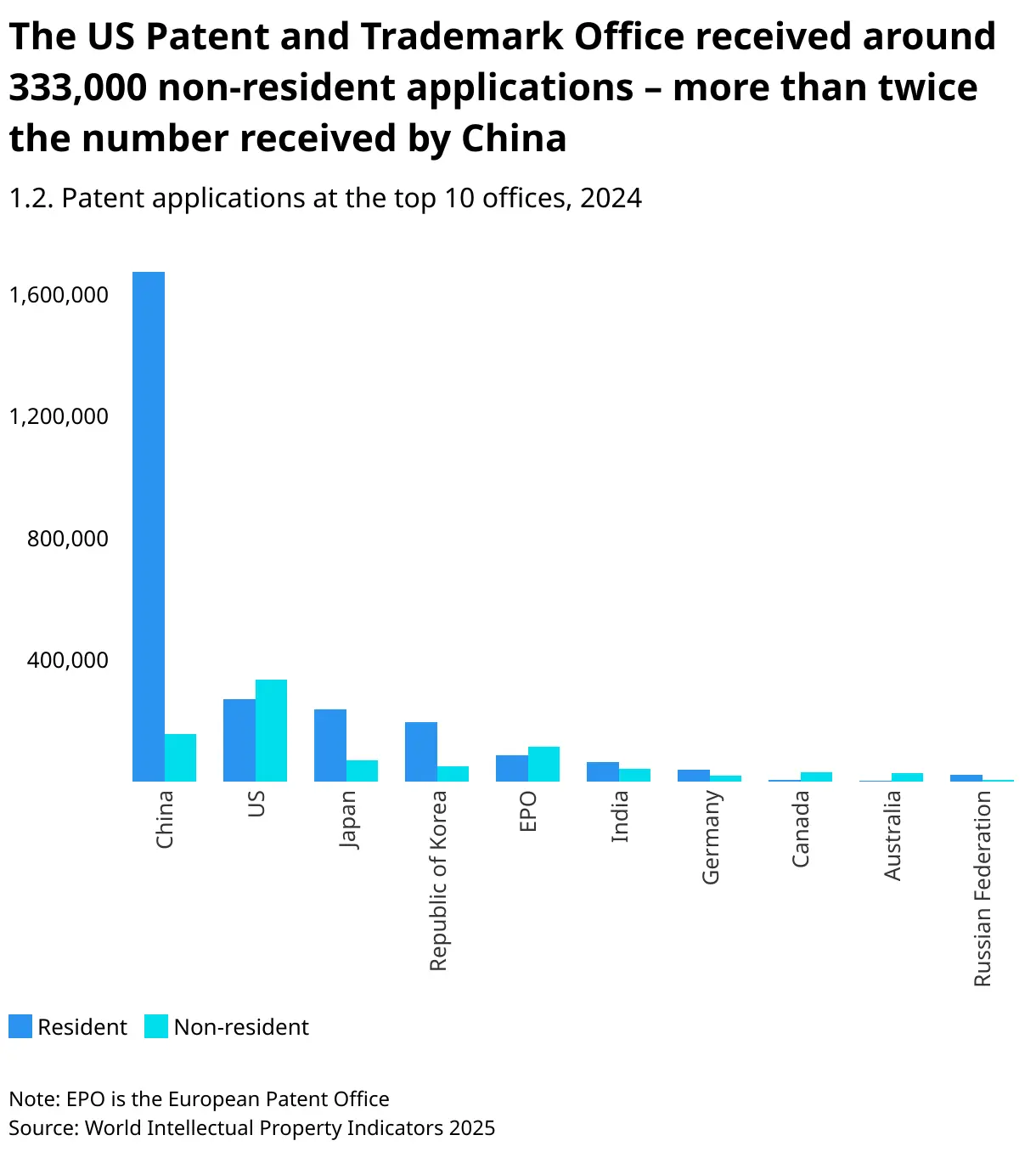
Data from WIPO Statistics Database can help us understand one of the main peculiarities of the Chinese IP system. When considering trademarks5, the ranking of countries by usage of the Madrid System6 features USA, Germany and China in the top 3 positions (year 2024), with other European countries following. The ranking is very different when looking at the general number of applications per each country, with China leading neatly in front of the US and the Russian Federation. This dichotomy can be explained by the prevalence of domestic trademark filing in China, with only a small portion of it being directed to protection abroad (World Intellectual Property Organization, Web, 2025) This entails that the innovation scenario in China is driven by domestic knowledge rather than foreign one.
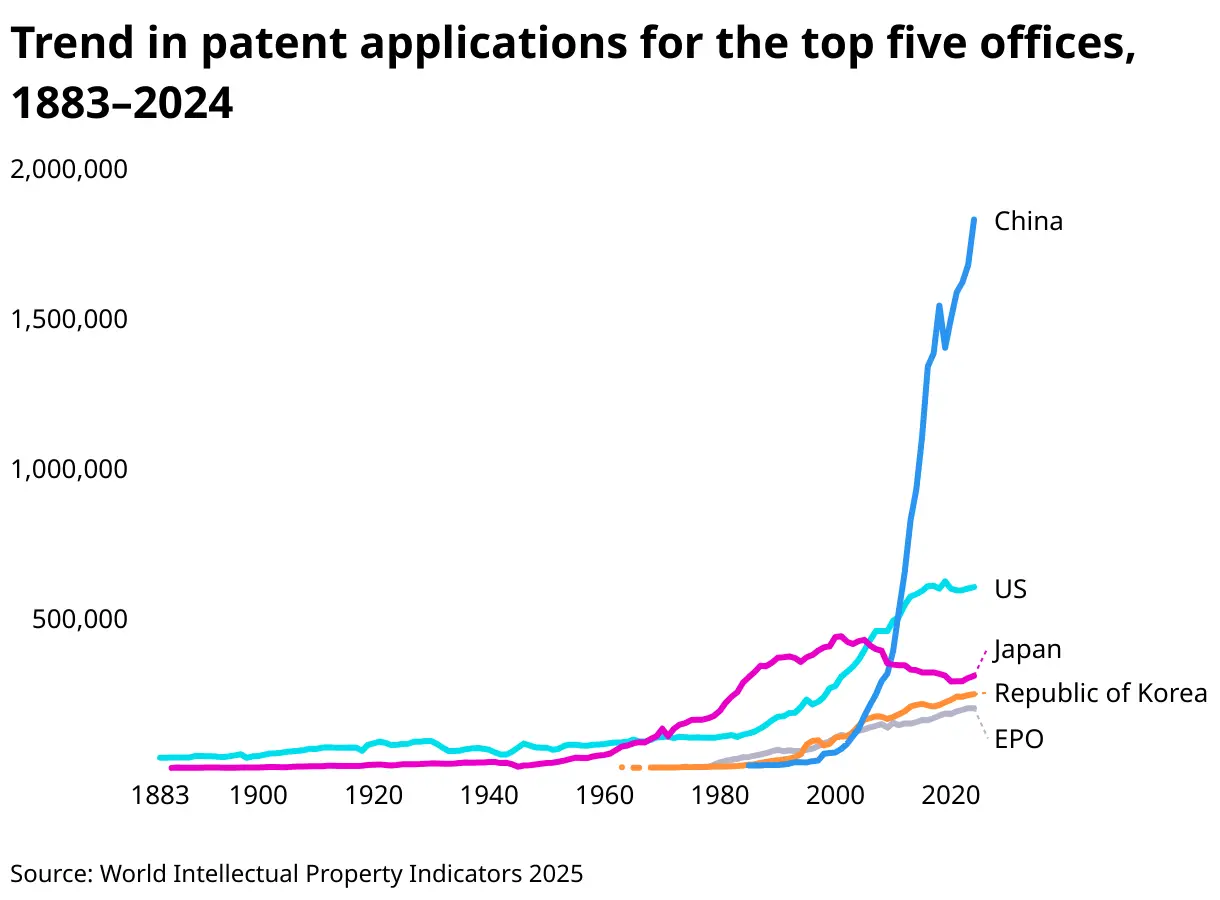
The main difference with the past lies in China’s growth as a global inventor. For years, China was perceived as the world’s production centre and as only capable of replicating. This is far from today’s reality. As shown by the Global Innovation Index 2025, China recently entered the first 10 positions of the world innovation ranking for the first time (World Intellectual Property Organization, 2025). This trend is closely tied to IP. A clear example is the Shenzhen-Hong Kong-Guangzhou cluster, which reached first position as world top innovation cluster (considering VC, patent filings and publications) (p.25) The graph below shows the sharp growth in Chinese patent applications over two decades, compared with the US, Japan, the Republic of Korea and the EPO (World Intellectual Property Organization, Web, 2025).
However, according to the ZEW Policy Brief (June 2025), China’s “state of
knowledge”7 is growing at a declining rate while the patent landscape becomes more crowded (Boeing et al, 2025). This may indicate some stagnation. The 2021 patent law partly addressed this issue by progressively reducing patent subsidies and eliminating lower-quality applications8 (Rao, Wang and Zhao, 2025).
USA: capital to scale up
In the former paragraphs we have seen the contrapposition between the EU and China. On the one hand a more traditional innovation scenario, focused on creation of knowledge. On the other, an intensive patenting activity which aims to preserve all inventions. The US scenario, instead, is characterized by conspicuous investments, especially in venture capital. Between 2021 and 2023, venture capital investment accounted on average for 0.75% of GDP in the US while just below 0.1% in the main EU countries (Angelini, 2025)
Differently from the EU, where the highest patent share can be seen in mature fields such as transport and civil engineering, in the US it is concentrated in information and communication technologies (Angelini, 2025) It is precisely in the ICT sector (and adjacent ones where it has spillovers) that the US faces a higher productivity and this guarantees the country an overall advantage. Indeed, EU and US would be almost at par (only an 0.2% difference in productivity growth) if ICT weren’t considered (Draghi, 2024) The US also patents extensively in Fourth Industrial Revolution (4IR) technologies, including cyber-physical systems, the Industrial Internet of Things, AI, cloud computing and augmented reality. In these fields, accumulated experience, including patenting experience, is critical to competitive advantage (Benassi et al, 2021)
Workers in US IP-intensive industries earn a 53% average weekly wage
premium, compared with just over 40% in the EU (United States Patent and Trademark Office, August 2026)
Unlike China’s predominantly domestic patent landscape, the US Patent and Trademark Office receives a greater share of non-resident applications, as illustrated below:
Section 2 – The EU can improve its chances by tackling issues linked to scaling up
The preceding comparison shows Europe’s untapped potential. This section examines the obstacles preventing EU IP-intensive firms from scaling up.
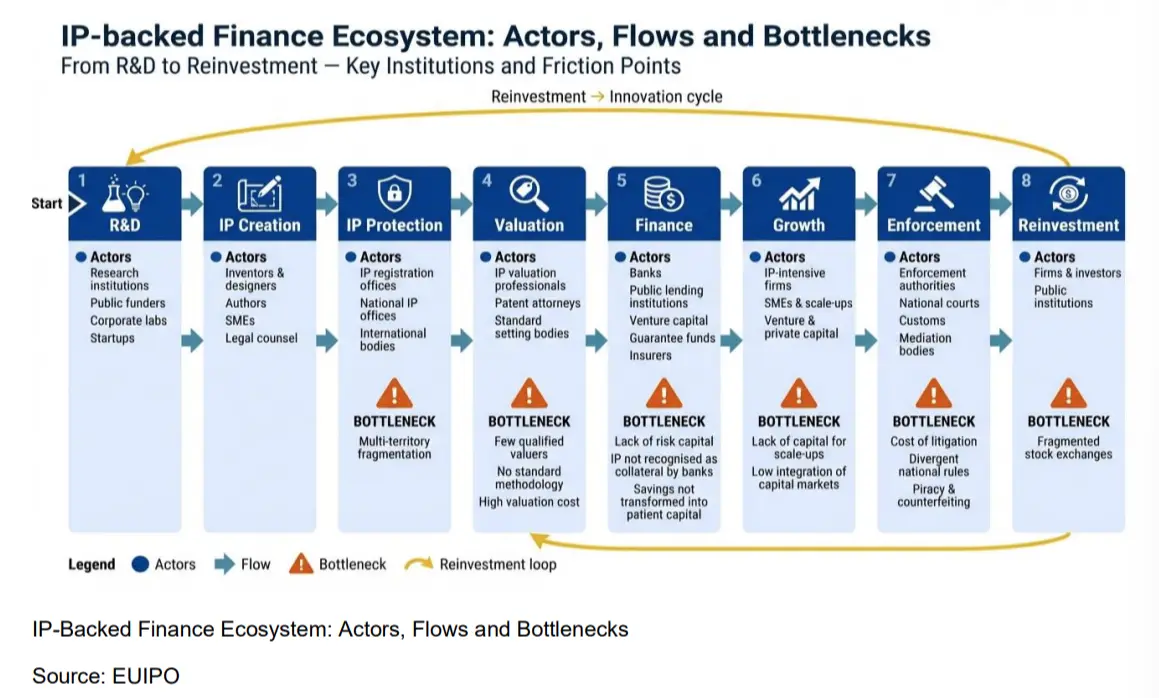
The EUIPO graph, from “IP-backed finance in Europe: State of Play and Future Perspectives”, summarizes and traces IP activity from R&D to reinvestment and identifies its bottlenecks:9
Who funds and under which circumstances
The EUIPO report estimates an annual EU SME credit gap of €365 billion, including €70–150 billion for IP-intensive firms, which is expected to grow. It also notes that no EU company founded in the past 50 years reached a valuation above €100 billion, while six US firms exceeded USD 1 trillion.
Already in 2006, a European Commission discussion paper called for greater use of IP as bank collateral and its integration into credit-risk models (European Commission, 2006) As found by the report, banks in Europe do not always trust the way IP is conferred and they do their own research to check whether it was granted correctly. Also, these institutions frequently focus on “probability of default” and “loss given default” rather than taking into account future cash flow. This is different from what occurs in other countries. In Japan, for instance, the Development Bank had adopted a loan granting system which was based on patents, patent applications and copyrights. The usage of future cash flows (from IPs) as a guarantee for the licensor is prevalent also in IP asset backed securitization, which is another method useful for SMEs to secure financing. For what concerns venture capital, instead, the report highlights how IP is generally evaluated in the broader context of the entire business model. VC investors, indeed, care a lot about “management, employees and market prospects”. Besides an adequate regulatory framework, the report emphasizes the need to build trust among actors.
Funding challenges extend to public support for breakthrough innovation. The Draghi Report (2024) highlights difficulties accessing Horizon Europe funding and it states that nine out of ten such investments go to projects outside the EU (p.29). Moreover, the Pathfinder instrument for less mature technologies had a €256 million budget in 2024, compared with USD 6.1 billion for US Advanced Research Project Agencies.
Another potential source of funding is European savings. Europeans save
considerably but invest relatively little, partly because of risk aversion, limited financial literacy and biases about who should invest (van de Werve, 2025).
Section 3 – To apply or not to apply: the difficulties faced by SMEs in Europe and beyond
SMEs face particular difficulties in the IP field. Their structural characteristics make it harder for them to benefit from IP protection compared with larger companies. This explains the attention they receive in European economic research.
A 2006 European Commission paper identifies low awareness, filing and
administrative costs, enforcement difficulties and the wish to preserve trade secrets as reasons for lower SME filing activity (European Commission, 2006, p.4)10 Registering and enforcing IP is costly for SMEs. Only 9% of EU SMEs register these rights, foregoing the potential 32% higher revenue per employee associated with registration (European Commission, 2016) IP also helps attract investment: most 4IR SMEs surveyed reported that investors considered their IP strategy useful (European Investment Bank and European Patent Office, 2022, p.12) Enforcement is another obstacle. When IP rights are violated, SMEs have a 34% lower chance of survival than larger firms (European Commission, n.d). Violations are not uncommon: in 2023, EU authorities seized counterfeit goods worth an estimated €3.4 billion (Council of the European Union, n.d)
These structural issues go beyond the type of system according to which IP ownership is established. The European Union protects IP under the “first-to-file” principle, which awards the ownership of a technology to the party who files the IP application first. Even under the “first-to-invent” principle, which was present up to 2013 in the US (and which grants ownership to whom can prove the first adoption of the technology) (Simmons, 2025), SMEs can face a disadvantage. In the case of a controversy, indeed, such firms would have to pay high amounts of money in litigation to prove the ownership of a technology and this would result in the same issues mentioned above.
Next steps from Europe’s standpoint
Are SMEs intrinsically bad? Has the EU lost the match? What could improve Europe’s position?
The following graph (taken from the “Draghi report”) shows the shares of firm sizes in the EU and the US:
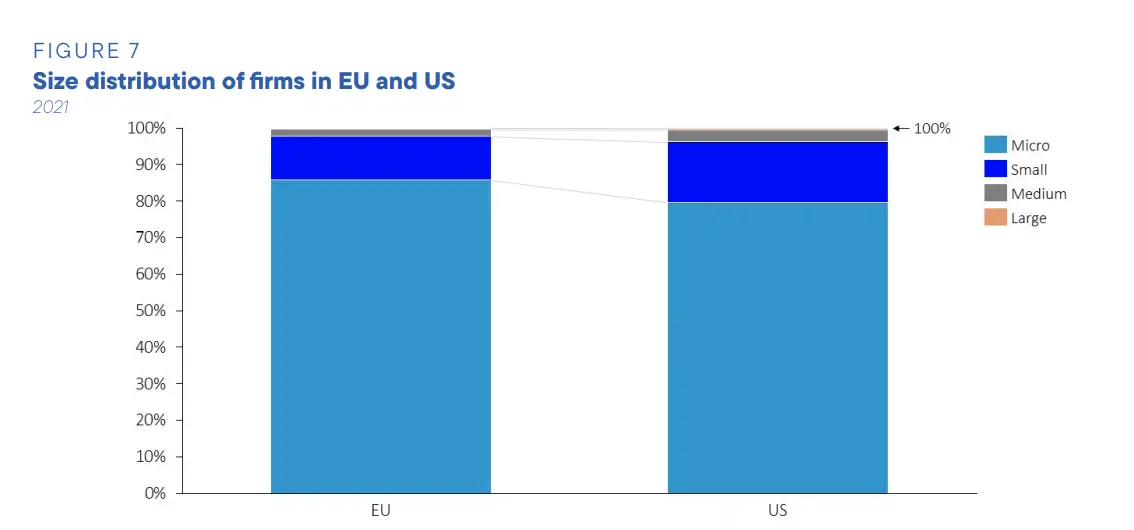
As it can be seen, the EU has a greater share of micro firms and a smaller share of medium and large firms than the US. This is not entirely problematic per se: EU and US productivity are comparable outside ICT. However, size matters when technology adoption is considered: indeed, 30% of large EU firms have adopted AI, but only 7% of SMEs have done so (p.30)
There is no single solution. The Draghi Report calls for greater investment,
coordination and deregulation to improve European competitiveness. The Unitary Patent System offers a positive example of coordination. In June 2024, one year after its introduction, SMEs accounted for over 35% of registrations (European Patent Office, 2024). In 2025, 48.3% of Unitary Patents originated from small innovators, including universities, research organisations, SMEs and microentities (European Patent Office, 2026). This suggests reduced filing costs and burdens. However, convenience depends on circumstances: a unitary patent can be cheaper than separate national patents when broad protection is needed, but a successful central challenge may revoke protection across all participating states (MDLEGAL European Patent Attorneys, 2026).
This report has analysed the current IP scenario and its implications for economic competitiveness. However, a final question remains open in the legal sphere: what level of regulation is necessary to safeguard democracy and promote social welfare? This question must be addressed parallelly to any consideration on IP if the EU is to preserve its strategic independence.
Note: This report does not include new findings from the European Innovation Act
AI Usage: I used AI tools (such as ChatGPT and Gemini) to brainstorm, summarize and polish writing.
Footnotes
- This report is an economic paper; as such it does not tackle the (legal) specificities of each intellectual property protection type. Nonetheless, notes will be added throughout the text to provide context where needed ↩︎
- These countries were chosen following general competitiveness criteria. This text does not consider specific innovation hubs because the main focus is patenting
↩︎ - Data does not correct for population. By correcting for GDP, China still holds first place (World Intellectual Property Indicators, 2025) ↩︎
- This treaty allows applicants to file a single patent application which has validity across 159 contracting States (WIPO, n.d) ↩︎
- Trademark: “sign capable of distinguishing the goods or services of one enterprise from those of other enterprises” (WIPO, n.d) ↩︎
- Madrid System: “convenient and cost-effective solution for registering and managing trademarks worldwide” (WIPO, n.d) ↩︎
- The “state of knowledge” identifies, together with the “direction of innovation”, one of the two dimensions used to measure the importance of patents in alternative to the traditional 2D “impact and novelty” (ZEW Policy Brief, June 2025) ↩︎
- A potential drawback of this reform was that SMEs which relied on the subsidies faced progressively more difficulty in patenting ↩︎
- This section focuses on “Finance” and “Growth” (points 5 and 6). “IP
Protection”, “Valuation” and “Enforcement” are briefly addressed later;
“Reinvestment” lies beyond the scope of this report ↩︎ - Most of these issues can be encountered in bigger firms too, but they are of greater relevance for SMEs ↩︎
Bibliography
Angelini, P. (2025) Innovation and innovation financing in Europe. SUERF Policy Brief No. 1154. Vienna: SUERF – The European Money and Finance Forum. Available at: https://www.suerf.org/publications/suerf-policy-notes-and-briefs/innovation-and-innovation-financing-in-europe/#f3
Benassi, M., Grinza, E., Rentocchini, F. and Rondi, L. (2021) Patenting in 4IR Technologies and Firm Performance. JRC Working Papers on Corporate R&D and Innovation, No. 1/2021. European Commission, Joint Research Centre. Available at: https://publications.jrc.ec.europa.eu/repository/handle/JRC125314
Boeing, P., Brandt, L., Dai, R., Lim, K. and Peters, B. (2025) The Anatomy of Chinese Innovation: Insights on Patent Quality and Ownership. ZEW Policy Brief No. 08, June. Mannheim: ZEW – Leibniz Centre for European Economic Research. Available at: https://www.zew.de/fileadmin/FTP/policybrief/en/pb08-25.pdf
BusinessEurope (2024) Intellectual Property Priorities – Unlocking EU’s Intangible Assets Potential. Brussels. Available at: /api/wp-media/2025/02/2024-11-13_ip_priorities_paper-068-1.pdf (Accessed: 13 September 2026)
Council of the European Union (n.d) ‘Intellectual property rights’. Available at: https://www.consilium.europa.eu/en/policies/intellectual-property-rights/ (Accessed: 23 August 2026)
Draghi, M. (2024) The future of European competitiveness – Part A: A competitiveness strategy for Europe. Luxembourg: Publications Office of the European Union. Available at: https://commission.europa.eu/document/download/97e481fd-2dc3-412d-be4c-f152a8232961_en
European Commission (n.d) ‘Combatting counterfeiting and enhancing enforcement of intellectual property rights’, Single Market Economy. Available at: https://single-market-economy.ec.europa.eu/industry/strategy/intellectual-property/enforcement-intellectual-property-rights/combatting-counterfeiting-and-enhancing-enforcement-intellectual-property-rights_en (Accessed: 23 Augist 2026)
European Commission (2006) Intellectual property and access to finance for high growth SMEs: Discussion paper for the workshop. Brussels: European Commission, Directorate-General for Enterprise and Industry. Available at: https://webgate.ec.europa.eu/circabc-ewpp/rest/download/84a7f89a-2d41-4676-9f8e-e06c743257cf
European Commission (2016) Commission Staff Working Document – “Putting intellectual property at the service of SMEs to foster innovation and growth”. Brussels: European Commission. Available at: https://eur-lex.europa.eu/legal-content/EN/TXT/PDF/?uri=CELEX:52016SC0373
European Commission (2024) Commission Staff Working Document – “The 2024 Annual Single Market and Competitiveness Report”. Brussels: European Commission. Available at: https://eur-lex.europa.eu/legal-content/EN/TXT/?uri=celex:52024SC0078
European Investment Bank (EIB) and European Patent Office (EPO) (2022) Deep tech innovation in smart connected technologies – A comparative analysis of SMEs in Europe and the United States. Available at: https://www.eib.org/files/publications/eib_epo_deep_tech_smes_en.pdf
European Patent Office (EPO) (2024) ‘Unitary Patent exceeds projections in its inaugural year: SME uptake highlights key benefits’, 1 June. Available at: https://www.epo.org/en/news-events/press-centre/press-release/2024/1158768 (Accessed: 13 September 2026)
European Patent Office (EPO) (2026) ‘Demand for European patents in 2025 exceeded 200 000 for first time’, 24 March. Available at: https://www.epo.org/en/news-events/news/demand-european-patents-2025-exceeded-200-000-first-time (Accessed: 13 September 2026)
European Patent Office and European Union Intellectual Property Office (2026) IP and innovation in European sectors: Industry-level analysis report. January 2026. Available at: https://www.euipo.europa.eu/en/publications/ip-and-innovation-in-european-sectors
European Union Intellectual Property Office (EUIPO) (2026) IP-backed finance: State of Play and Future Perspectives – Towards a Functional European IP Finance Market. April 2026. Available at: https://euipo.europa.eu/tunnel-web/secure/webdav/guest/document_library/reports-EUIPO/IP-backed-finance-report-2026_en.pdf (Accessed: 13 September 2026)
European Union (n.d.) ‘Intellectual property’, EUR-Lex. Available at: https://eur-lex.europa.eu/EN/legal-content/glossary/intellectual-property.html (Accessed: 22 August 2026)
MDLEGAL European Patent Attorneys (2026) ‘Unitary Patent 2026: Is It Worth Switching Now? A Direct Comparison of Pros and Cons’, 17 May. Available at: https://legal-patent.com/allgemein-en/unitary-patent-2026-is-it-worth-switching-now-a-direct-comparison-of-pros-and-cons/ (Accessed: 13 September 2026)
Rao, W., Wang, Y. and Zhao, T.-y. (2025) ‘Why the Chinese government is reducing domestic patent filing subsidies and how rights holders can adapt’, World Trademark Review, 15 September. Available at: https://www.worldtrademarkreview.com/guide/china-managing-the-ip-lifecycle/2026/article/why-the-chinese-government-reducing-domestic-patent-filing-subsidies-and-how-rights-holders-can-adapt (Accessed: 13 September 2026)
Simmons, R.K. (2025) ‘First-to-File: A Game-Changer in US Patent Law’, Ward and Smith, P.A., 25 March. Available at: https://www.wardandsmith.com/article/first-to-file-a-game-changer-in-us-patent-law (Accessed: 13 September 2026)
United States Patent and Trademark Office (USPTO) (2026) Intellectual property and the U.S. economy in 2024. August 2026. Available at: https://www.uspto.gov/sites/default/files/documents/uspto-aug2026-report-ip-intensive-industries.pdf
van de Werve, T. (2025) ‘Why Europeans don’t invest, and what to do about it’, Funds Europe, 6 March. Available at: https://funds-europe.com/why-europeans-dont-invest-and-what-to-do-about-it/ (Accessed: 13 September 2026)
World Intellectual Property Organization (WIPO) (n.d) IP Facts and Figures: Patents. Available at: https://www.wipo.int/en/ipfactsandfigures/patents (Accessed: 13 September 2026)
World Intellectual Property Organization (WIPO) (n.d) ‘Patent law developments: Research’. Available at: https://www.wipo.int/en/web/patent-law/developments/research (Accessed: 23 August 2026)
World Intellectual Property Organization (WIPO) (2025) Global Innovation Index 2025: Innovation at a Crossroads. Geneva: WIPO. Available at: https://www.wipo.int/web-publications/global-innovation-index-2025/assets/89507/global-innovation-index-2025-en.pdf
World Intellectual Property Organization (WIPO) (2025) World Intellectual Property Indicators 2025: Highlights – Trademarks highlights. Available at: https://www.wipo.int/web-publications/world-intellectual-property-indicators-2025-highlights/en/trademarks-highlights.html