

The Ecuadorian case shows that the Salvadoran model is not transferable one-to-one, but is rather a response aimed at a specific threat.
Title: One model, distinct results: Why is Bukele model failing in Ecuador
On the 7th of January, guards at La Regional prison in the port city of Guayaquil found the cell of crime boss Adolfo ‘Fito’ Macías empty. In response, Ecuadorian president, Daniel Noboa, then in office for just two months, declared a two-month state of emergency and a curfew, which granted the authorities the powers to suspend certain rights and allowed the mobilisation of the military inside prison facilities (BBC News, 2024). Riots, kidnappings and explosions ensued, culminating with gunmen storming the studio of TC Television during a live broadcast (Le Monde, 2024).
Following the horror scenes, President Noboa declared that Ecuador is in a state of internal armed conflict and designated more than 20 criminal groups as terrorist organisations (ICTJ, 2024). Noboa’s response to the violence was similar to that of another Latin American leader, Salvadoran president Nayib Bukele. His success in curbing crime in El Salvador made him the most popular president in Latin America in 2024 (Harrison & Vilcarino, 2024). In just a few years since his election in 2019, Bukele managed to turn El Salvador from one of the region’s most violent countries to one of its safest. Noboa, running on a security-first platform, sought to replicate these results by following the Salvadoran example.
Yet two years on, Ecuador, following Bukele’s playbook, is unable to contain its security crisis. The difference is highlighted in figure 1. Its homicide rate reached the highest level in the country’s modern history in 2025 with more than 50 homicides per 100 000 people (Statista, 2025a). Between January and April 2026, Ecuador recorded more than 2700 homicides, the second highest number in history and roughly 40% higher than in 2024 (Gobierno de Ecuador, 2026). In this paper, I look into why an approach that produced such spectacular results in El Salvador failed to deliver a durable collapse in violence in Ecuador. Policy analysts warned early on that Ecuador should not replicate the Salvadoran model (Isacson & Walsh, 2024); this paper extends that argument with the actual developments from 2025–2026 and brings forward institutional divergence as a distinct causal factor. I show that the model failed to produce comparable results for three reasons. First, Ecuador faced a fragmented gang structure, rather than a consolidated one found in El Salvador, which limited the effectiveness of mass arrests. Second, Ecuadorian institutions did not allow for a complete subordination of everything to security policy, limiting the executive power of the president. Lastly, Ecuador’s position as a node in the lucrative global cocaine trade means that there is a much bigger incentive for criminal groups to operate in Ecuador. Therefore, the two countries, though superficially alike, differ in a fundamental way, limiting the effectiveness of the Salvadoran security approach.
Figure 1: Homicide Rate in El Salvador and Ecuador, 2020–2025
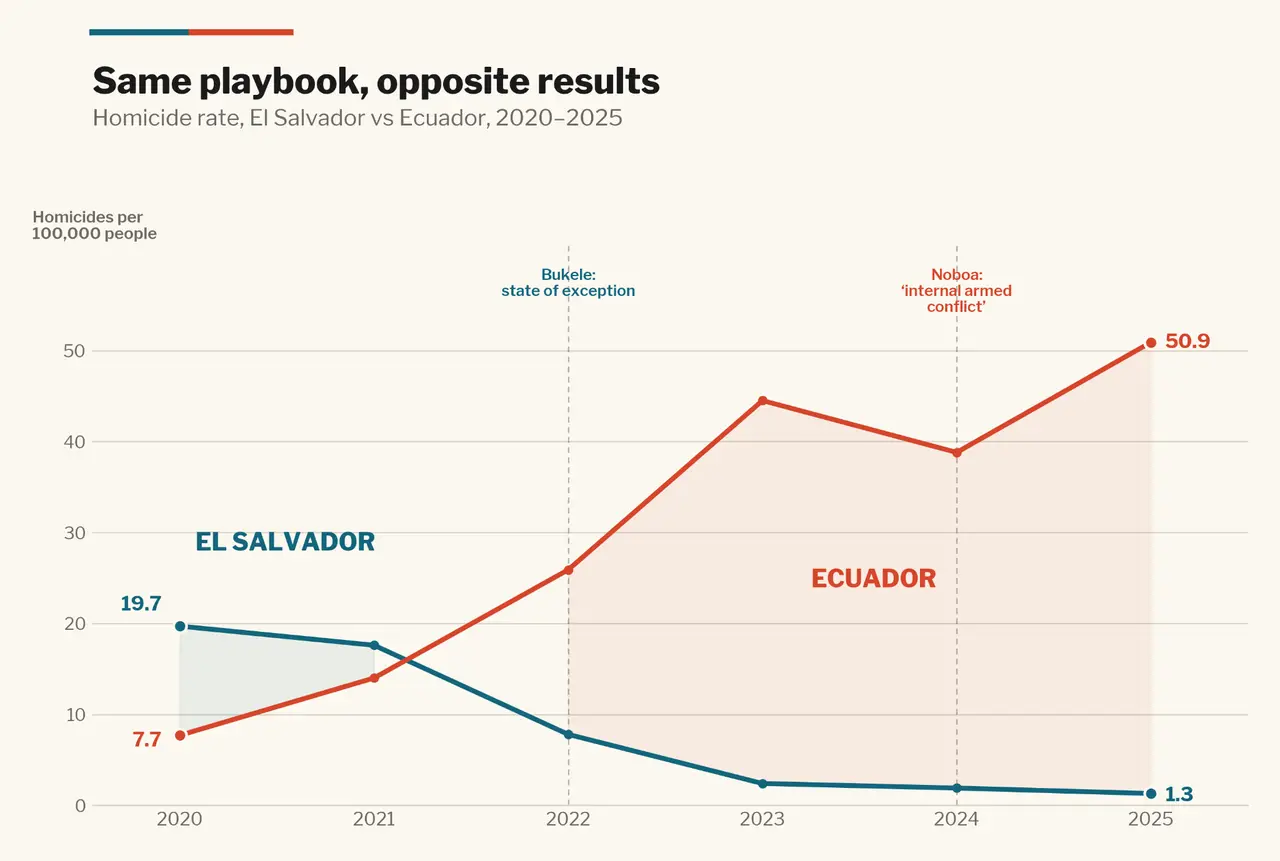
Note: Data from Statista (2025a, 2025b). Figure created by the author using Claude Opus 4.8.
The Salvadoran Model
The successful Salvadoran model stands on three pillars: a permanent state of exception, mass incarceration and total militarisation. After a series of gang killings in March 2022, Bukele declared a state of exception, which has since been extended more than fifty times (Asamblea Legislativa, 2026). The state of exception suspends constitutional guarantees, such as the right to be informed of the reason for arrest, extends the maximum period of administrative detention or suspends the inviolability of correspondence and telecommunications and allows for warrantless arrests (IACHR, 2026). These powers granted to the authorities led to a wave of mass arrests, which made El Salvador the country with the highest incarceration rate in the world, with more than 1,659 inmates per 100,000 people (Statista, 2026). For comparison, the incarceration rate in the EU is 113 per 100 000, roughly fifteen times smaller (Eurostat, 2026). The symbol of this policy of mass arrests became the Terrorism Confinement Centre (CECOT), with a capacity of 40,000 inmates. Furthermore, under the Bukele model, the armed forces gained prominence as one of the most important actors in domestic policy, performing day-to-day policing duties. The armed forces also have the right to cordon off entire neighbourhoods or cities, carefully monitoring who can leave and enter, while conducting searches, looking for members of criminal groups (Alemán, 2024).
This approach, based on mass arrests, permanent state of exception enhancing the powers of security forces, and total militarisation produced its results. Between 2019 and 2025, the homicide rate has fallen almost 30-fold. In 2019 – the year Bukele assumed office – El Salvador recorded a total of 2,390 homicides, whereas in 2025, it recorded only 82 (Alemán, 2026).[1] This collapse is widely credited to the crackdown, but the picture is more layered: homicides had been in continuous decline since their 2015 peak, when El Salvador was the deadliest country in the world. Analysts attribute much of that earlier fall to covert truces with imprisoned gang leaders. However, the security-policy effectiveness after March 2022 is striking, with the rate falling to a low of 1.3 per 100,000 in 2025; roughly thirteen times lower than the 17.6 recorded in 2021, the last full year before the crackdown began (Statista, 2025b).
This approach was not without costs. Human rights organisations report widespread human-rights breaches in the country. First, the arrests were often based on appearance, social background or even anonymous calls. Given the sheer number of detentions, many of those arrested were innocent. In August 2023, the government itself acknowledged that it has released more than 7,000 people since the beginning of the state of exception, but many claim they are still held inside the prison system despite being innocent (Papadovassilakis, 2023). The situation is even worse inside the prison facilities. Basic due-process guarantees are suspended, meaning that detainees are held without formal charges, denied access to their lawyers, waiting for a trial with no set date. Furthermore, a Salvadoran human-rights organisation Cristosal has brought forward hundreds of cases of death in custody, alongside allegations of torture. Simply put, the model normalised mass detention and switched off basic legal checks (Avelar, 2026).
Noboa followed the described model rather faithfully. Even before the January unrest, he announced the building of two new maximum-security prisons, modelled directly after CECOT (Agence France-Presse, 2024). Since the January violence, Noboa designated gangs as terrorist organisations, deployed military to patrol streets and prisons, and has since kept Ecuador in a quasi-permanent state of emergency, rotating between the provinces (Herrera, 2026). According to government figures, under the Plan Fénix, the government detained almost 17,000 people in the first three months of 2024, following the example of Bukele’s mass arrests (González, 2024). As discussed previously, even such measures failed to contain the homicide rate.
If Ecuador adopted the Salvadoran model this faithfully, the failure cannot be explained by implementation alone. The instruments, at least initially, were very similar – mass arrests, military in the streets and prisons, state of emergency – but the results diverged significantly. The following sections examine three fundamental differences explaining the reason for different outcomes.
Gang Structure
The first fundamental difference is that each country was dealing with a different kind of enemy. The Salvadoran gang landscape is dominated by Barrio 18 and MS-13, which are consolidated, territorial, extortion-based groups. That extortion base shapes everything about them. Because extortion is collected from a controlled area, the gangs are place-bound, carving up cities into rigid zones. The gang leadership[2] was often already imprisoned by the time Bukele took office, instead coordinating activities from inside the prison cell (InSight Crime, 2023). Against such structure, the mass arrests and prison lockdowns were an extremely effective tool. They allowed the authorities to seize the gang’s territory, while a total prison lockdown severed the communication between the gang leadership and the foot soldiers.
On the other hand, Ecuador’s criminal landscape is almost exactly the opposite. Rather than being dominated by two hierarchical gangs, more than 70 groups operate across the country. Furthermore, the principal organisations such as Los Lobos, Los Choneros and others, are deeply interconnected with other international criminal groups, be it the Sinaloa Cartel, Jalisco New Generation Cartel, Colombian Armed Groups or the Balkan Mafia (Freeman, 2024). This fragmented and international structure makes it far more resilient to local imprisonment, as there is no concentrated leadership to seize and the trade is often directed from outside the country. Therefore, jailing local operators has much less effect on the criminal groups’ operations than in the case of El Salvador.
The fragmented gang structure carries another risk: splintering. That is a well-documented effect, whereby removing a head of a fragmented criminal network does not decapitate it but rather leads to an outbreak of violence as the different factions compete for primacy over the operations. For instance, one of the most powerful criminal groups in the country, Los Lobos, emerged in late 2020 as a splinter group of Los Choneros, following the assassination of the Choneros leader, Jorge Luis “Rasquiña” Zambrano (InSight Crime, 2022).
Furthermore, Ecuador’s problem is exacerbated by geography. Ecuador, a much larger country than El Salvador, has an extensive area of ungoverned territory with a long and porous border with Colombia. Since Ecuadorian gangs are not as territorial as the Salvadoran, they can disperse in times of danger into these remote regions along the frontier and regroup.
Institutions
The second fundamental difference was that Noboa, unlike Bukele, was unable to completely subordinate the state institutions to his security policy. Bukele, since he assumed office in 2019, systematically dismantled every check on his power. Immediately after gaining a supermajority in the Legislative Assembly in 2021, Bukele dismissed all five magistrates of the Constitutional Chamber of the Supreme Court, along with the Attorney-General, replacing them with loyalists. Crucially, the Constitutional Chamber was the only institution in the country which could meaningfully challenge the executive powers as it could strike down presidential decrees or terminate the state of exception, so vital to Bukele’s security policy (Americas Quarterly, 2025). With no domestic opposition capable of limiting him, Bukele was able to extend the state of exception more than fifty times, as well as make changes to the penal code, allowing for provisions that might otherwise not have been possible. Additionally, the Constitutional Chamber, now staffed with loyalists, allowed for Bukele’s reelection, despite the constitution only allowing one presidential term (Olmedo, 2025).
By contrast, Noboa, who shared the same instinct for centralisation as Bukele, failed to subordinate Ecuadorian institutions to himself and to his security policy, the way Bukele was able to. For instance, the Ecuadorian Constitutional Court suspended and struck down key provisions in his security legislation on procedural grounds (MercoPress, 2025). The legislation included the National Solidarity Law and Public Integrity Law and the Organic Intelligence Law, which were the backbone of Noboa’s security agenda. They expanded executive and intelligence powers. Noboa then tried to circumvent the courts by creating a Constitutional Assembly, tasked with rewriting the constitution, which would enhance the president’s executive powers. The Constitutional Court again intervened, blocking the effort (ConstitutionNet, 2025). Not giving up on his goal, Noboa called a national referendum. Despite his popularity, winning elections in April 2025 with 56% of the vote, the public voted overwhelmingly against in the November referendum. In response to his numerous failed advances, Noboa said the courts are aiding “the enemies of the people” and blamed them for the worsening security situation (Martínez-Moscoso, 2025). The Ecuadorian institutions prevented a complete “Bukelisation” of the security policy. As a result, Ecuador was never able to introduce the Salvadoran model at full strength, limited by the country’s institutions and rule of law.
Position in Global Drug Trade
The third difference is largely the work of geography. El Salvador sits outside the main drug trafficking routes in Latin America (Isacson & Walsh, 2024). Salvadoran gangs are therefore focused on extortion, which inevitably makes them self-contained and largely domestic. According to estimates, the extortion economy was worth roughly 3% of GDP at its peak, bounded mostly within the country (The Economist, 2016). For this reason, the violence is endogenous, without a strong external driver. This means that once destroyed inside the country, there is no external force allowing them to regenerate.
Ecuador’s situation could not be more different. It is wedged between the two largest coca producers in the world: Peru and Colombia (see Figure 2.). This, alongside its deep-water ports on the Pacific Coast, makes it one of the most efficient gateways for shipping cocaine from the region (Dalby, 2019). Its dollarized economy makes the process even more efficient. Ecuador is therefore a crucial node in the enormous cocaine trade. This makes its violence partly exogenous. As long as there is cocaine trade, there is incentive for criminal groups to operate in the country and use its infrastructure. Destroying one criminal group does not end the flow of drugs; that group is simply replaced by another. As the source of the revenue for the groups operating in the country sits outside of it (USA and Europe), the state capacity to reduce the external motivators for the groups to operate is significantly reduced. Compare this with the case of El Salvador, where the revenue is primarily home-grown and within reach of the state.
Figure 2: Ecuador in the global drug trade
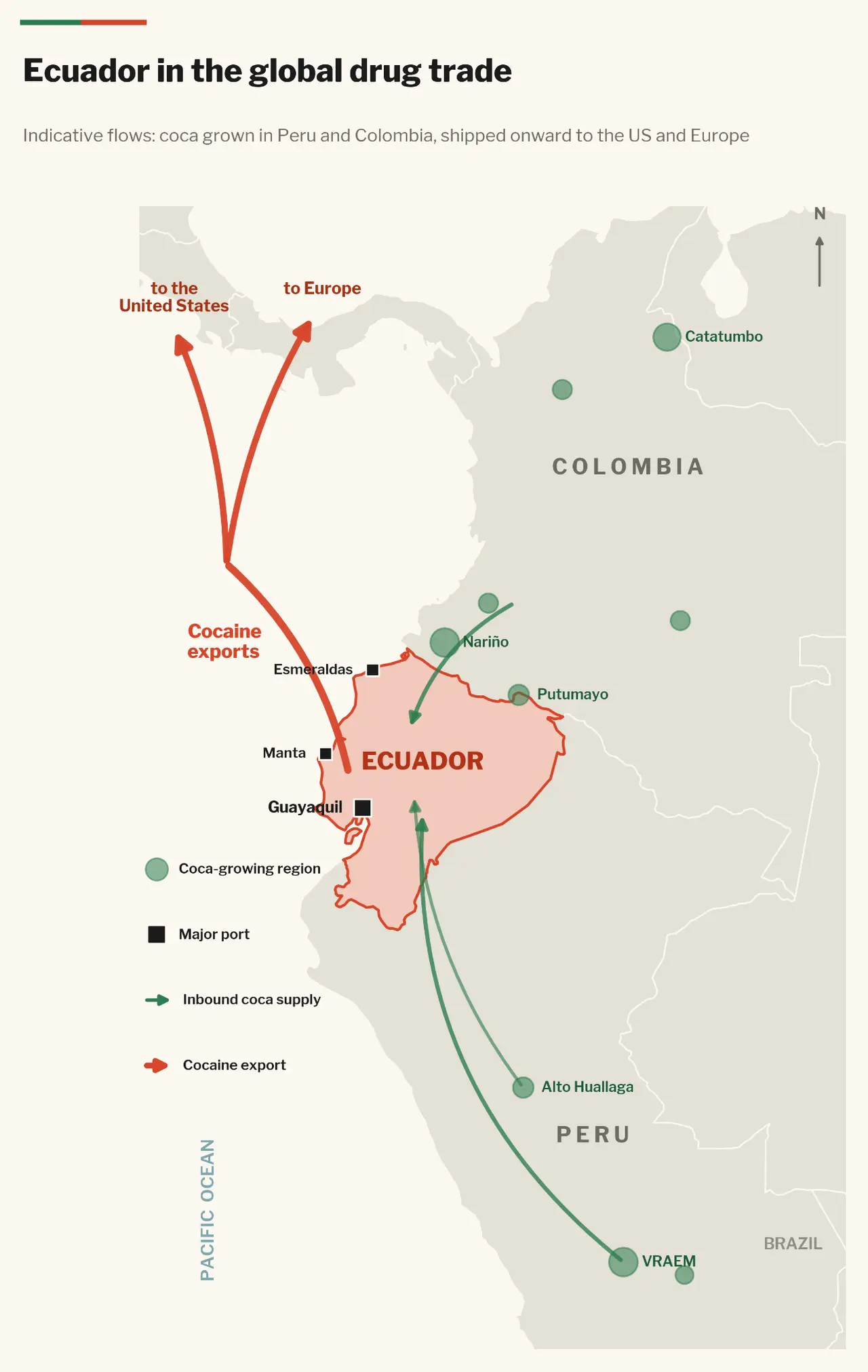
Note: Coca-growing regions adapted from Mallette et al. (2016). Cocaine flows are indicative and not drawn to scale. Figure created by the author using Claude Opus 4.8.
One objection remains: that Ecuador was simply not given enough time, and that the model would bear fruit in a few more years. The problem is that the trajectory under Noboa points the wrong way. Whereas in El Salvador the results were immediate, in Ecuador violence dipped in 2024 before surging to record highs in 2025 (Statista, 2025a). Based on the preliminary data for 2026, violence is slightly below 2025 but still far above 2023 and 2024 levels, nothing like the sustained drop seen in El Salvador (Gobierno de Ecuador, 2026). Crucially, the claim here is not that violence will remain at the extreme 2025 levels indefinitely, but rather that under current conditions the model will fail to bring Ecuador anywhere near to the levels of homicides achieved in El Salvador.
Conclusion
The Ecuadorian case shows that the Salvadoran model is not transferable one-to-one, but is rather a response aimed at a specific threat. In El Salvador, the model succeeded in reducing violence because it fit the enemy: consolidated, extortion-based gangs whose “business model” was bounded mostly within national borders. It also worked because Salvadoran institutions were subordinated to security policy in every aspect. In Ecuador, none of these conditions existed. The fragmented gang landscape, which lacks a central command structure and is tied into international criminal networks, is far less susceptible to mass arrests and prison isolation. Furthermore, Ecuadorian institutions did not allow the same degree of subordination of the state to security policy seen in El Salvador. The broader lesson is that security policy cannot be transferred without acknowledging the specific situation on the ground. For Latin American countries, the Salvadoran model can therefore serve as a useful example, but it should not be viewed as a panacea for the region’s security problems.
References
Agence France-Presse. (2024, January 4). Crime-torn Ecuador to build two maximum security prisons. Barron’s. https://www.barrons.com/news/crime-torn-ecuador-to-build-two-maximum-security-prisons-b80c5d3d
Alemán, M. (2024, October 28). Thousands of soldiers fence off a Salvadoran neighborhood in pursuit of gang remnants. AP News. https://apnews.com/article/el-salvador-gangs-nayib-bukele-state-of-emergency-violence-1f6dcc2fad3b5fc45f724031806d2fc0
Alemán, M. (2026, January 5). El Salvador reporta baja récord en homicidios, en medio de su lucha contra las pandillas [El Salvador reports record low in homicides amid its fight against gangs]. AP News. https://apnews.com/article/el-salvador-bukele-homicidios-a-la-baja-seguridad-pandillas-1b660e1d5b5c90b2e45ce60ebec10926
Americas Quarterly. (2025, June 25). Reaction: What Bukele’s power grab means for El Salvador. https://americasquarterly.org/article/reaction-what-bukeles-big-power-grab-means-for-el-salvador/
Asamblea Legislativa. (2026, May 27). Prórroga 51 de régimen de excepción permitirá continuar preservando seguridad para la población [51st extension of the state of exception will allow continued preservation of security for the population]. https://www.asamblea.gob.sv/node/13984
Avelar, B. (2026, April 24). More than 500 prisoners have died in Bukele’s prisons since 2022. El País English. https://english.elpais.com/international/2026-04-24/more-than-500-prisoners-have-died-in-bukeles-prisons-since-2022.html
BBC News. (2024, January 8). Adolfo Macías Villamar: Curfew in Ecuador after infamous gang leader “Fito” vanishes from cell. https://www.bbc.com/news/world-latin-america-67912235
ConstitutionNet. (2025). In Ecuador, court suspends presidential decree on referendum to create constituent assembly. https://constitutionnet.org/news/ecuador-court-suspends-presidential-decree-referendum-create-constituent-assembly
Dalby, C. (2019, October 30). Ecuador: A cocaine superhighway to the US and Europe. InSight Crime. https://insightcrime.org/investigations/ecuador-a-cocaine-superhighway-to-the-us-and-europe/
The Economist. (2016, May 21). The gangs that cost 16% of GDP. https://www.economist.com/the-americas/2016/05/21/the-gangs-that-cost-16-of-gdp
Eurostat. (2026, April). Prison statistics. Statistics Explained. Retrieved June 23, 2026, from https://ec.europa.eu/eurostat/statistics-explained/index.php?title=Prison_statistics
Freeman, W. (2024, February 14). Can Ecuador avoid becoming a narco-state? Council on Foreign Relations. https://www.cfr.org/articles/can-ecuador-avoid-becoming-narco-state
Gobierno de Ecuador. (2026). Homicidios intencionales [Data set]. Datos Abiertos. Retrieved June 23, 2026, from https://www.datosabiertos.gob.ec/dataset/homicidios-intencionales/resource/cb8f704e-2b27-4d7f-9431-d40c4e27fa48
González, J. (2024, March 30). Casi 17.000 detenidos en los operativos desplegados con el plan Fénix [Almost 17,000 detained in the operations deployed under the Fénix plan]. El Universo. https://www.eluniverso.com/noticias/seguridad/17000-detenidos-operativos-plan-fenix-nota/
Harrison, C., & Vilcarino, J. (2024, January 11). Chart: How popular are Latin America’s presidents in 2024? AS/COA. https://www.as-coa.org/articles/chart-how-popular-are-latin-americas-presidents-2024
Herrera, P. L. (2026, February 20). Ecuador news round-up no. 25: Ecuador’s security and human rights crisis deepens as the government renews attacks on the opposition. CEPR. https://cepr.net/publications/ecuador-news-round-up-no-25/
InSight Crime. (2022, November 8). Los Lobos. https://insightcrime.org/ecuador-organized-crime-news/lobos-ecuador/
InSight Crime. (2023, December). El Salvador’s (perpetual) state of emergency: How Bukele’s government overpowered gangs [Report]. /api/wp-media/2023/08/El-SalvadorsPerpetual-State-of-Emergency-How-Bukeles-Government-Overpowered-Gangs-InSight-Crime-Dec-2023.pdf
InSight Crime. (2025, April 3). MS13. https://insightcrime.org/el-salvador-organized-crime-news/mara-salvatrucha-ms-13-profile/#h-where-does-the-ms13-operate
Inter-American Commission on Human Rights. (2026, April 21). IACHR continues to monitor the effects of the state of emergency on human rights in El Salvador. Organization of American States. https://www.oas.org/en/iachr/jsForm/?File=/en/iachr/media_center/preleases/2026/066.asp
International Center for Transitional Justice. (2024, May 29). Ecuador’s Noboa declares new security state of emergency. https://www.ictj.org/latest-news/ecuadors-noboa-declares-new-security-state-emergency
Isacson, A., & Walsh, J. (2024, February 20). Why Ecuador should not replicate the “Bukele model.” WOLA. https://www.wola.org/analysis/why-ecuador-should-not-replicate-the-bukele-model/
Le Monde. (2024, January 9). Ecuador: Armed men take over live TV broadcast. https://www.lemonde.fr/en/international/article/2024/01/09/ecuador-armed-gang-members-take-over-live-tv-broadcast_6417724_4.html
Mallette, J. R., Casale, J. F., Jordan, J., Morello, D. R., & Beyer, P. M. (2016). Geographically sourcing cocaine’s origin – Delineation of the nineteen major coca growing regions in South America. Scientific Reports, 6, Article 23520. https://doi.org/10.1038/srep23520
Martínez-Moscoso, A. (2025, December 2). The people’s verdict: Why did Ecuador’s constitutional referendum fail? ConstitutionNet. https://constitutionnet.org/news/voices/peoples-verdict-why-did-ecuadors-constitutional-referendum-fail
MercoPress. (2025, August 5). Ecuador’s Constitutional Court blocks Noboa’s initiatives. https://en.mercopress.com/2025/08/05/ecuador-s-constitutional-court-blocks-noboa-s-initiatives
Olmedo, D. (2025, August 26). From term limits to no limits: El Salvador’s constitutional reform on presidential re-election. ConstitutionNet. https://constitutionnet.org/news/voices/term-limits-no-limits-el-salvadors-constitutional-reform-presidential-re-election
Papadovassilakis, A. (2023, December 6). Keeping a lid on prisons. InSight Crime. https://insightcrime.org/investigations/el-salvador-keeping-lid-on-prisons/
Statista. (2025a). Homicide rate in Ecuador 2025. Retrieved June 23, 2026, from https://www.statista.com/statistics/984868/homicide-rate-ecuador/
Statista. (2025b). Homicide rate in El Salvador 2025. Retrieved June 23, 2026, from https://www.statista.com/statistics/696152/homicide-rate-in-el-salvador/
Statista. (2026). Most prisoners per capita by country 2026. Retrieved June 23, 2026, from https://www.statista.com/statistics/262962/countries-with-the-most-prisoners-per-100-000-inhabitants/
[1] El Salvador’s official figures exclude prison deaths, police killings, and bodies in unmarked graves, so the true rate is somewhat higher than reported, though the scale of the fall is not in doubt.
[2] The gangs are not dominated by a single person but rather by leadership councils.


