

The European Green Deal was designed as the EU’s most ambitious attempt to structurally reorient its political economy around climate transition, yet it now operates under conditions it was never built for. The rapid scaling up of defence spending through the ReArm Europe plan is reshaping fiscal priorities across member states, compressing the budgetary space on which climate investment depends.
This article argues that the Green Deal faces not outright abolition, but a more insidious process of gradual erosion: delayed targets, reallocated funds, and diminished political attention. Drawing on EU fiscal data and institutional analysis, it examines the concrete mechanisms through which rearmament pressures are undermining climate commitments, and asks what political and financial conditions would be necessary to protect the green transition as a non-negotiable strategic priority rather than a casualty of the current security conjuncture.
A Green Deal built for a different world
The European Green Deal, when it was launched, was the most ambitious economic overhaul in the history of the European Union. The Union has committed itself to a reduction of greenhouse gas emissions by at least 55% in 2030 compared to 1990 and to be fully climate neutral in 2050, as stated in the Commission Communication COM(2019) 640, part of the European Climate Law (European Commission, 2019; European Union, 2021).
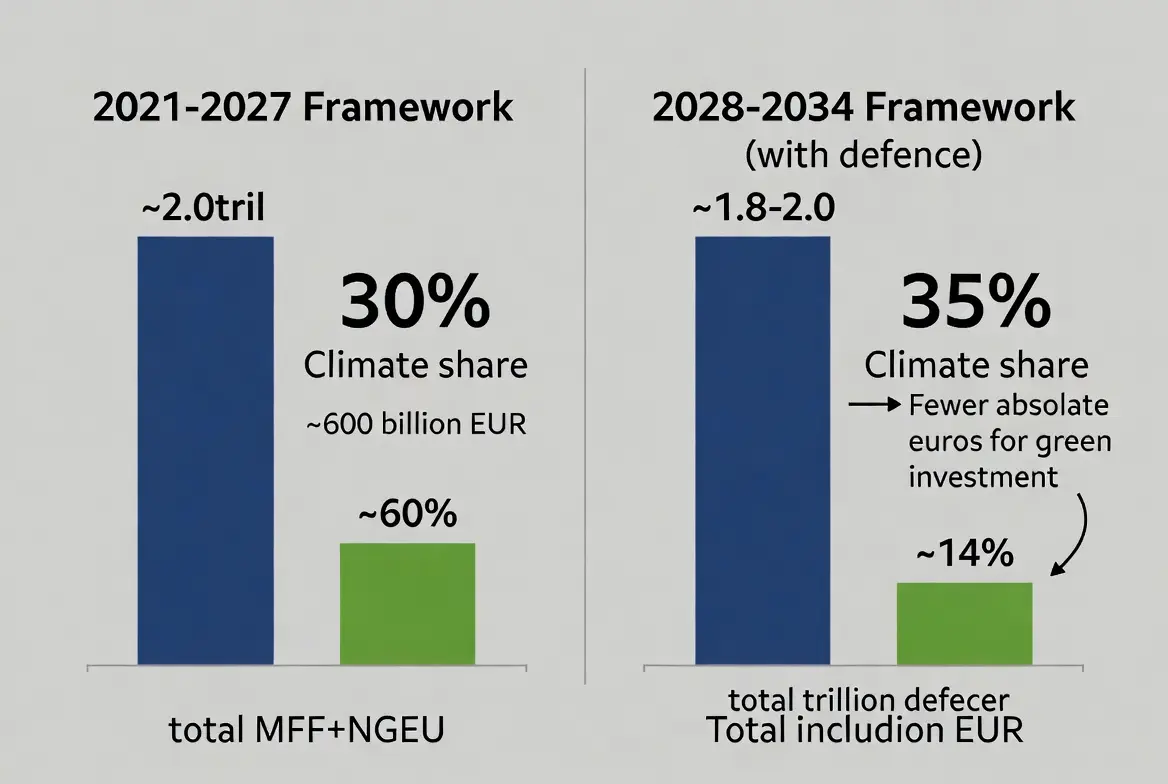
To finance this transition, 30% of the total EU budgetary expenditure was earmarked for green investment in the 2021-2027 Multiannual Financial Framework (MFF) and the NextGenerationEU instrument. The Recovery and Resilience Facility (RRF) also obliged member states to designate at least 37% of their national allocations to climate objectives from an envelope of €672.5 billion (European Commission, 2021). For countries such as Italy, the largest beneficiary of RRF funding, this was not some abstract policy commitment. In terms of the latter, it became the backbone of domestic fiscal planning, with investment priorities across energy, transport and industrial transformation structured through the Piano Nazionale di Ripresa e Resilienza (PNRR).
The turning point: Ukraine and the Strategic Compass
But that architecture was appropriate to a different geopolitical moment. The full-scale invasion of Ukraine by Russia in 2022 and the fracturing of the transatlantic relationship under the Trump administration have fundamentally changed European spending priorities, putting the fiscal underpinnings of the Green Deal under sustained and increasing pressure.
The groundwork for this change was already laid in March 2022 when the Council of the European Union formally adopted the Strategic Compass for Security and Defence, the bloc’s first overarching security strategy.
The Compass committed the EU to an ambitious plan of action to strengthen its security and defence policy by 2030, outlining more than 80 concrete targets to close critical military capability gaps (Council of the European Union, 2022). It also explicitly underlined that a stronger European defence capacity is complementary to NATO and underlined the Union’s ability to act autonomously when collective action is not possible. The fiscal and political logic emanating from that document has steadily reshuffled EU budget priorities ever since.
Europe rearms: ReArm Europe and the escape clause
In March 2025, the Commission announced the ReArm Europe Plan/Readiness 2030, a mobilisation framework for up to €800 billion of additional defence investment by 2030, anchored by the Security Action for Europe (SAFE) facility providing €150 billion of joint procurement loans (European Commission, 2025a). At the same time, the national escape clause of the Stability and Growth Pact was activated for 17 member states, allowing annual defence spending above treaty-mandated limits of up to 1.5% of GDP until 2028 (European Commission, 2025b). The scale of the ongoing reorientation is quantifiable. In 2025, the defence expenditure of the EU member states was projected to reach €381 billion, an increase of 11% with respect to 2024 and almost 63% higher than in 2020 (Council of the European Union, 2026).
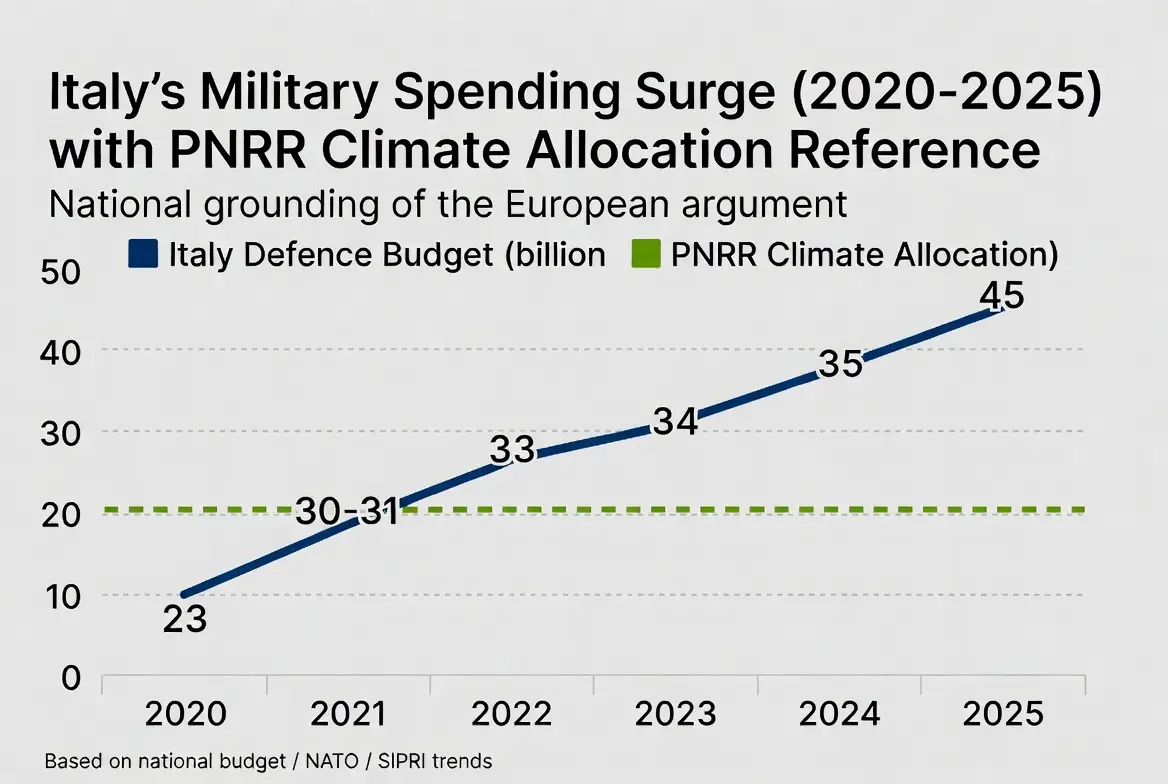
Italy’s defence budget has surpassed the €30 billion mark for the first time, increasing by more than €2.1 billion year on year, with military spending reportedly jumping 20% in 2025 alone (Osservatorio Milex, 2025; SIPRI, 2026).
Driving much of this acceleration is the shifting architecture of NATO itself. At the 2025 NATO Summit in The Hague, allies committed to investing 5% of GDP annually on core defence requirements and defence and security-related spending by 2035, with a floor of at least 3.5% for core defence requirements alone (NATO, 2025).
NATO’s new math: the 5% GDP target
In 2025, European allies and Canada increased defence spending by 20% from the previous year, with all allies exceeding the previous 2% of GDP target for the first time in recorded Alliance history (Atlantic Council, 2026). With the United States signalling a more transactional approach, the European pillar of NATO has moved from a long-standing aspiration to an operational imperative, with European capitals now expected to assume primary responsibility for conventional deterrence on the continent (Howorth, 2025). The 5% GDP target, if met, would require most EU member states to more than double current defence outlays, absorbing precisely the fiscal space that green industrial investment depends upon.
The accounting trick: how the MFF dilutes climate funds
The consequences for climate policy are direct and structural. In the ongoing negotiations for the next Multiannual Financial Framework (2028–2034), the Commission proposed in July 2025 an overall budget of approximately €1,984 billion, equivalent to 1.26% of member states’ gross national income, with a minimum target of 35% for climate and environmental spending (European Commission, 2025c). That headline figure, however, conceals a critical accounting choice: the 35% target now incorporates defence and security expenditure within the denominator (Centro Italiano per l’Economia Climatica, 2025). As defence budgets expand, the effective absolute value of climate finance falls even as the nominal percentage remains constant. The European Green Deal’s protections are not being dismantled outright. An accounting decision quietly dilutes them.
This matters enormously because the NextGenerationEU instrument, which currently funds much of Europe’s green industrial transition, expires in 2026. There is no agreed successor mechanism at scale. The institutional vacuum created by its expiry represents perhaps the single most consequential structural risk to the Green Deal’s implementation, leaving climate investment vulnerable to whatever political settlement emerges from MFF negotiations, in which every member state now broadly agrees that defence must take priority (European Council on Foreign Relations, 2025). The Draghi report, published in September 2024, called for €800 billion per year of EU investment in decarbonisation, innovation, and defence combined. A year later, less than 12% of its recommendations had been implemented in full, with clean technology and energy transition among the weakest areas of follow-through (European Council on Foreign Relations, 2025).
Death by a thousand delays: the legislative slowdown
The trade-off extends beyond public budgets into the domain of technological capacity and emissions trajectories. A 2025 synthesis of eleven peer-reviewed studies found that every €100 billion increase in military spending generates an average of 32 million tonnes of carbon dioxide equivalent in additional emissions, meaning that NATO’s planned spending trajectory adds an estimated 132 million additional tonnes of annual emissions (Parkinson, 2025). The same analysis identifies a 10–25% decrease in patents for climate-mitigation technologies as research capital is redirected toward defence production chains.
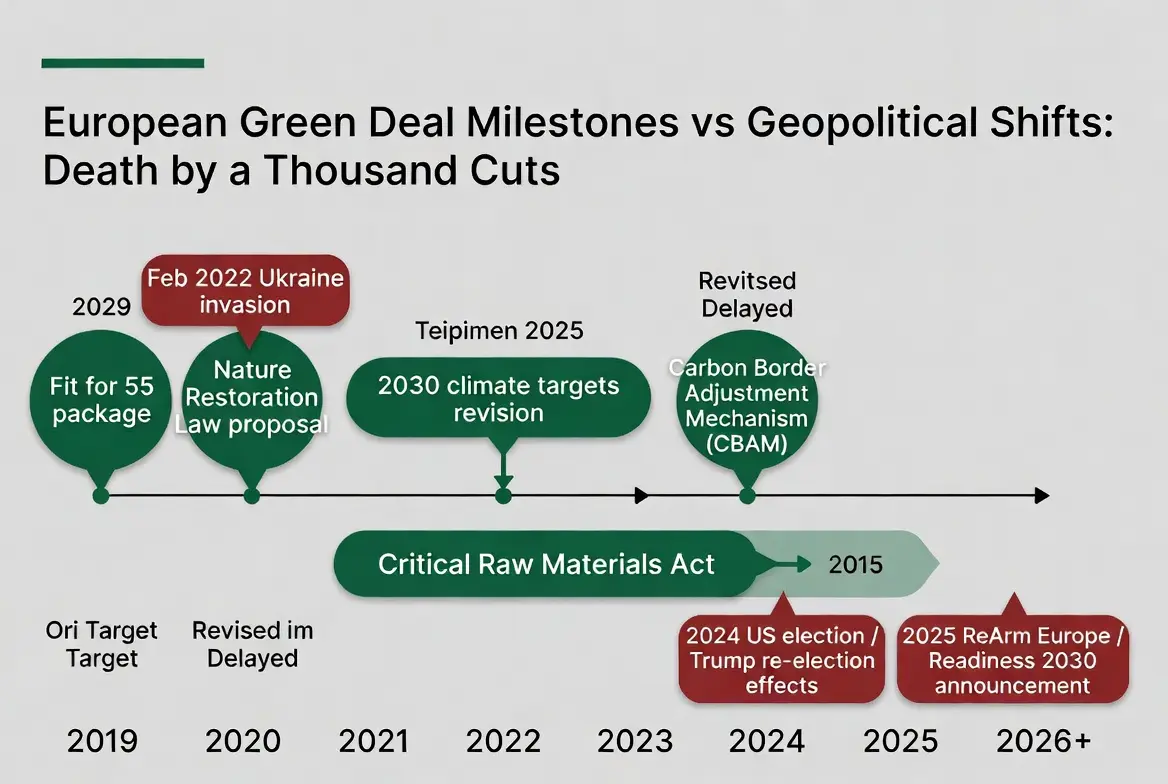
The reallocation of scientific and industrial capacity away from decarbonisation generates a compounding drag on the green transition that goes well beyond what any budget line can capture. Meanwhile, the legislative record of 2025 tells its own story. The start of the Emissions Trading System II was delayed by one year to 2028, and binding car emissions targets for 2030 were replaced with a three-year averaging window. Each adjustment is defensible in isolation. Taken together, however, they slow the structural exit from fossil fuel dependence at precisely the moment when acceleration is required (European Environment Bureau, 2026). Despite formal reassurances that the Green Deal remains intact, analysts have noted that its institutional scaffolding is being quietly dismantled (Brink, 2026).
Conclusion: standing in name, hollow in substance
There will be no formal repeal of the European Green Deal. Its core commitments remain legally enshrined in the European Climate Law, and the political cost of openly abandoning them remains prohibitive for most member state governments. But legal enshrinement is not the same as implementation. The substantive content of those commitments is being steadily hollowed out through three interlocking mechanisms: budgetary substitution, where an expanding denominator absorbs the climate share without triggering formal renegotiation; institutional expiry, where the instruments designed to fund green investment wind down faster than their successors can be agreed upon; and legislative deceleration, where delays and waivers accumulate incrementally and without the visibility of a headline repeal. The question is no longer whether the European Green Deal survives in name but whether, by 2030, it will have delivered anything close to what was promised.
References
Atlantic Council. (2026). NATO defense spending tracker. https://www.atlanticcouncil.org/commentary/trackers-and-data-visualizations/nato-defense-spending-tracker/
Centro Italiano per l’Economia Climatica. (2025, September 10). EU budget proposal 2028–2034: Funding for the energy transition and climate. https://eccoclimate.org/eu-budget-proposal-2028-2034-funding-for-the-energy-transition-and-climate/
Council of the European Union. (2022). A strategic compass for security and defence: For a European Union that protects its citizens, values and interests and contributes to international peace and security. https://www.consilium.europa.eu/it/policies/strategic-compass/
Council of the European Union. (2026). European defence readiness. https://www.consilium.europa.eu/en/policies/european-defence-readiness
Draghi, M. (2024). The future of European competitiveness: A competitiveness strategy for Europe. European Commission. https://commission.europa.eu/document/download/97e481fd-2dc3-412d-be4c-f152a8232961_en
European Commission. (2019). The European Green Deal (COM(2019) 640 final). https://commission.europa.eu/publications/communication-european-green-deal_en
European Commission. (2025a). ReArm Europe Plan / Readiness 2030. https://defence-industry-space.ec.europa.eu/eu-defence-industry/white-paper-future-european-defence-rearming-europe_en
European Commission. (2025b). Communication on accommodating increased defence expenditure within the Stability and Growth Pact (C(2025) 2000 final). https://defence-industry-space.ec.europa.eu/document/download/a57304ce-1a98-4a2c-aed5-36485884f1a0_en?filename=Communication-on-the-national-escape-clause.pdf
European Commission. (2025c). Proposal for a Council regulation laying down the Multiannual Financial Framework for the years 2028 to 2034 (COM(2025) 571). https://commission.europa.eu/strategy-and-policy/eu-budget/long-term-eu-budget/eu-budget-2028-2034_en
European Council on Foreign Relations. (2025). It’s not easy being green: Breaking Europe’s climate spending deadlock. https://ecfr.eu/publication/its-not-easy-being-green-breaking-europes-climate-spending-deadlock/
European Union. (2021). Regulation (EU) 2021/1119 establishing the framework for achieving climate neutrality (European Climate Law). Official Journal of the European Union, L 243, 1–17. https://climate-laws.org/document/regulation-eu-2021-1119-establishing-the-framework-for-achieving-climate-neutrality-european-climate-law
Howorth, J. (2025). European defence and NATO: From competition to co-operation to replacement? Journal of Common Market Studies. Advance online publication. https://onlinelibrary.wiley.com/doi/10.1111/jcms.70010
NATO. (2025). Defence expenditures and NATO’s 5% commitment. https://www.nato.int/en/what-we-do/introduction-to-nato/defence-expenditures-and-natos-5-commitment
Osservatorio Milex. (2025). Spesa militare 2025: Oltre i 32 miliardi. https://www.milex.org
Parkinson, S. (2025, September). Military spending rises and greenhouse gas emissions: What does the research say? Scientists for Global Responsibility. https://www.sgr.org.uk/publications/military-spending-rises-and-greenhouse-gas-emissions-what-does-research-say
SIPRI. (2026). World military expenditure data 2025. https://www.sipri.org/databases/milex
Ten Brink, P. (2026, April 23). Under siege in 2025: The European Green Deal is still standing. European Environment Bureau. https://meta.eeb.org/2026/04/23/under-siege-in-2025-the-european-green-deal-is-still-standing/