


Nikolay Nikolaev Barekov
1. Introduction
The expansion of EU restrictions on trade with Russia has increased concerns about circumvention through third countries, intermediaries, subsidiaries and re-export routes. (Council Regulation (EU) 2024/1745, 2024, recital 32; European Commission, 2024, Question 1; Silingardi, 2024, pp. 1-2) This specific problem causes significant legal tensions, due to the EU needing to prevent goods and products that are restricted from entering Russia due to the sanctions, while at the same time having to respect and follow the jurisdictional limits, which distinguish from conduct linked to the EU and foreign conduct. (Silingardi, 2024, pp. 1, 6) In this case, the paper does not question if stricter sanctions are considered desirable in a political sense, or even successful in an economic sense, the question is if legal design and enforcing rules that are anti-circumvention, remain tied down to conduct and persons within the European Union’s jurisdiction. The main question in this paper is to what extent do Articles 8a, 12g and 12gb of Regulation 833/2014 impose obligations on EU operators whose practical effects extend to independent third-country actors without exceeding the Regulation’s jurisdictional scope or undermining legal certainty? (Council Regulation (EU) No 833/2014, 2014, art. 13; Council Regulation (EU) 2024/1745, 2024, art. 1(22), (27)-(28); Silingardi, 2024, p. 6) The issue is important from both a doctrinal and practical perspective, due to the fact that a boundary that is uncertain can weaken the enforcement of sanctions, make operators vulnerable to serious liability, along with undermining the legal certainty, which the European Commission says some of the new rules in place are intended to improve. (European Commission, 2024, Question 1; Directive (EU) 2024/1226, 2024, arts. 6-7; Silingardi, 2024, p. 2)
The analysis in place focuses on using a method that is doctrinal, and that reads Article 215 TFEU, Regulations 833/2014 and 2024/1745, Directive 2024/1226 and Afrasiabi together, while at the same time utilizing the European Commission’s FAQs in order to examine and analyze how the rules operate within business practice. The analysis assesses every rule by examining and identifying the legal addresses, the conduct that is regulated, the nexus that is relevant within Article 13, the role that ownership or control has, the mental element that is applicable and if the legal consequence is on an operator from EU or from a foreign actor that is independent. Silingardi’s categories when it comes to extraterritoriality that is soft, extraterritoriality that is hard and sanctions that are secondary, are what provides the framework of international law that is for deciding when a foreign effect is supported by jurisdictional link that is recognised and when it becomes controversial from a legal point of view. (Silingardi, 2024, pp. 6-8) The central answer in place, is specifically that the framework can be deemed as generally lawful, specifically regarding the regulation of an operator under Article 13’s export contract or a real influence over a controlled or owned foreign entity, but it turns vulnerable specifically where the effectiveness of sanctions itself is treated as a basis that is widely considered as a sufficient basis for coercion of a foreign actor that is unconnected. The paper specifically first established the governing law, following that it distinguishes the three mechanisms for anti-circumventions, it then tests each specific mechanism against the jurisdictional framework, while evaluating both legal certainty and liability, and finally stating the legal boundary that is reached by the analysis that was conducted.
2. Legal Framework and Scope of EU Sanctions
As for the legal framework, Article 215 TFEU and Regulation 833/2014 are of particular importance. Article 215 TFEU provides the Treaty basis for adopting the necessary economic and financial measures implementing certain CFSP decisions. (Consolidated Version of the Treaty on the Functioning of the European Union [TFEU], 2016, art. 215) Regulation 833/2014 gives those certain restrictive measures, legal form that is both directly applicable and binding, while its authority still does not erase the need to determine to which specific actions and conduct and to whom, the specific regulation is applicable to. Article 13 defines the Regulation’s scope of application, which it does by covering European Union territory, aircrafts and vessels of EU Member States, nationals of Member States regardless of their locations, entities which are incorporated under the law of Member States, and business that is conducted either totally or partially within the EU. (Council Regulation (EU) No 833/2014, 2014, art. 13) Regulation 2024/1745 directly attributes confirmation that Regulation 833/2014 is applicable specifically and only within the jurisdictional limits established by Article 13, even in the case where it introduces duties involving entities that are established outside of the borders of the EU. It is important to note that the recital is not a general jurisdictional rule, it instead assists interpretation, while operative provisions determine the legal obligation. (Council Regulation (EU) 2024/1745, 2024, recital 27) In this case, Article 13 is the first legal filter of the paper, since a fact from a third country does not automatically turn the rule into something unlawful, despite that liability still requires connection that is legally relevant between the EU and the conduct or operator that is regulated.
The legal meaning of circumvention is relevant under Article 12, accompanied by Afrasiabi. Article 12 specifically does not allow knowing along with participation that is intentional, within activities which hold an object or effect, which has a goal of circumventing Regulation 833/2014, which includes participation without the deliberate seeking of a result where the person in question not only recognises but also accepts the possibility. (Council Regulation (EU) 2024/1745, 2024, art. 1(25)) Afrasiabi specifically distinguishes something that can be a direct infringement from circumvention, so in that case the two prohibitions hold different scopes, which allows them to support penalizations under law that is applicable. (Afrasiabi and Others, 2011, paras. 34-35, 60-61) The element of circumvention that is objective covers conduct that holds a formal appearance which avoids the elements of a prohibition that is direct, while holding an aim or even result, whether it is alone or through certain connected activities, that is to cause frustration to the specific prohibition. The subject element in place is requiring knowledge that is cumulative along with intention, with those elements existing in cases where someone is purposefully and deliberately aiming for circumvention, and where that individual is aware that participation could result in that effect, and despite that accepts the possibility. (Afrasiabi and Others, 2011, paras. 62, 66-68) The test is of particular importance since it allows for realistic enforcement that is preventive, without the seeking to convert every possible due-diligence decision that is unsuccessful or even re-export into a third country that is not expected, which is into strict liability regarding intentional circumvention.
Furthermore, there is plenty more subject matter when it comes to Directive 2024/1226 and the enforcement boundary. Specifically Directive 2024/1226 utilizes the framework of Article 83 TFEU in order to establish definitions that are minimum, along with penalties that are used for violations of the restrictive measures of the EU, which includes forms of circumvention that are specified. It is important to add that the Directive does establish minimum rules and does require Member States to ensure that a specific type of conduct is a criminal offence, it still does not work like another sanctions regulation that is directly applicable, like Regulation 833/2014. Article 3 in particular criminalises intentional violations in a principal way, while at the same time having a requirement of negligence liability that is serious regarding prohibited trade which involves items listed on Common Military lists of the specified dual use lists. (Directive (EU) 2024/1226, 2024, p. 1 and arts. 1, 3(1), 3(3)) Particularly both Articles 6 and 7, have a requirements for Member States to establish liability, specifically legal person liability, in which a leading person that commits an offence for the benefit of the entity or in an area where supervision that is inadequate or specific control enables someone that can be deemed a subordinate to commit it, together with penalties that can be described as effective, proportionate and even dissuasive. (Directive (EU) 2024/1226, 2024, arts. 6-7) Article 12 of Directive 2024/1226 is the backbone of criminal jurisdiction that is mandatory in territory, nationality, ships that are registered or aircrafts, while also allowing specified jurisdiction over officials, habitual residents and conduct that benefits legal persons which are either locally established or locally active. (Directive (EU) 2024/1226, 2024, art. 12) Due to this, the Directive plays a role in strengthening enforcement while not erasing the need to prove a covered offence, a mental standard that is applicable, a basis which is in place for attributing corporate liability, along with a jurisdictional connection that is recognised.
3. Anti-Circumvention Duties in Practice
Now for operation of the anti-circumvention duties, Article 12g specially serves as anti-circumvention that is contractual. Article 12g specifically requires exporters that are selling, supplying, transferring or even exporting listed sensitive goods to most third countries, to prohibit re-exportation to sanctioned countries like Russia, contractually, this also includes re-exportation for sure in sanctioned countries. (Council Regulation (EU) 2024/1745, 2024, art. 1(27); European Commission, 2024, Question 1) This obligation specifically covers jet fuel, specific aviation, firearms, and common categories that are considered high priority, while at the same time excluding the partner countries in Annex VIII while also providing exceptions that are both contractual and public-contract. (Council Regulation (EU) 2024/1745, 2024, art. 1(27); European Commission, 2024, Questions 1, 3-4 and 7) Further, the exporter has to involve adequate remedies regarding breach, while also notifying the Member States authority which is competent, immediately as it becomes aware its counterparty, that is a third country, breaches the contractual prohibition. (Council Regulation (EU) 2024/1745, 2024, art. 1(27); European Commission, 2024, Questions 2 and 5) In this case the immediate legal addressee is the EU exporter, while the non EU counterparty becomes a recipient of a contractual obligation that is privately enforceable, instead of a public law liability that is direct under Article 12g. Article 12g specifically and consequently extends the practical effect of the EU’s sanctions, down a commercial chain that is foreign, while also keeping an EU export transaction along with an Article 13 operator who serves as the formal jurisdictional anchor.
As for Article 12g’s practical safeguards and uncertainties, the European Commission specifically explains that the clause has to exist, either before or no later than the relevant export, sale, transfer or supply, and specifically that the exporter has to show compliance to the authority that is competent in this specific case. (European Commission, 2024, Question 2) Remedies that can be adequate in this case involve suspending deliveries, interrupting or even terminating the contract, sanctions like certain financial penalties, or choosing a court that is capable of recognising the re-export as a legitimate contractual breach. (European Commission, 2024, Question 5) Operators should retain flexibility regarding wording, but the European Commission’s model also proposes best efforts that are downstream, monitoring, terms that are information sharding and material breaching, that can have influence over parties beyond just the immediate buyer. The exclusions for partner countries, public contracts and intra-EU transactions narrow the scope of the measure, while the exceptional acceptance of communication that is importantly unilateral, in which a counterparty that is pre existing refuses the clause recognises a possible conflict situation with the law and commercial situational reality of the third country. (European Commission, 2024, Questions 4, 6-7 and 12-13) Therefore, the rule improves certainty specifically by identifying the goods that are covered, along with the minimum contractual outcomes, yet the open standard of adequate remedies, combined with reliance on contractual enforceability from a foreign side, in turn leave businesses with a level of material uncertainty regarding the sufficient amount of downstream control, and how much is sufficient.
Article 12gb specifically requires operators which are covered who trade high priority common items, to assess, update, document and also identify, the existing risk of exportation towards Russia, and in turn to implement controls, policies, along with procedures that exist towards mitigating the risk. Overall in fully clear terms, Article 12gb clearly requires that covered operators have to both identify and assess risks, document and update risk assessments, while implementing policies, controls and procedures which are accurate, and do them proportionally based on the size of the risk and operator. (Council Regulation (EU) 2024/1745, 2024, art. 1(28); European Commission, 2025, Questions 1-2 and 8) It is important to mention the duty does not apply and have force when the operator trades the high priority items within Annex VIII partner states and the EU, since those transactions are viewed as presenting a low risk when it comes to circumvention. (Council Regulation (EU) 2024/1745, 2024, art. 1(28); European Commission, 2025, Questions 2 and 13) The European Commission specifically rejects the due diligence model that is single, and instead identifies beneficial ownership, concerning counterparties, end users, payment structure, transaction rationale, transport routes, documentation and geographic exposure. This design is risk based and focuses on resources that are regulatory on observable warning signs, like unexplained intermediaries, specifically unusual trade routes, places which are hubs for circumvention, recent changes in ownership, indicators of shell companies, along with transactions that lack an economic rationale. (European Commission, 2025, Questions 4-7) For that reason, Article 12gb can be considered more targeted as opposed to a general prohibition on trade of third countries, while its reliance operator specific risk assessment turns the required level of compliance into something less predictable, as opposed to a fixed checklist.
Furthermore, Article 12gb requires a person that is covered, to make sure that a controlled or owned non EU entity that is trading the specific relevant items, follows and implements the same requirements for both risk assessment and management. (Council Regulation (EU) 2024/1745, 2024, art. 1(28); European Commission, 2025, Question 14) Article 8a in particular enforces the broader duty to take on best possible efforts when it comes to ensuring that any controlled or owned non EU entity does not partake in activities that would undermine and not respect the previously stated Regulation 833/2014. (Council Regulation (EU) 2024/1745, 2024, art. 1(22); European Commission, 2025, Question 14) Another regulation, specifically Regulation 2024/1745 connects ownership to possession of 50 percent or more, specifically of proprietary rights, or even a majority interest, while also linking controls to powers like appointing management unified management, using asset or even portraying influence that can be deemed as dominant while at the same time defining bests efforts as appropriate and required actions that remain as practical and feasible in the circumstances of the operator. The FAQ and legislation recognise that the operator in question might not be able to fully exercise control, when it comes to reasons it did not cause, which also includes legislation of third countries, along with Article 12gb which excludes the situation. (Council Regulation (EU) 2024/1745, 2024, recitals 28-30 and art. 1(28); European Commission, 2025, Question 14) The provisions in place here, rest and rely on the specific premise that genuine real ownership or even control grants an EU operator the decisive powerful influence over foreign conduct, while the legality in place becomes more sensitive to facts in which formal ownership has no correspondence to practical control, or even where the expected result exceeds feasible influence.
There is also a bridge that goes from compliance failure, straight to possible liability. Regulation 2024/1745, specifically explains that if an operator plans to rely on protection from liability because of lack of knowledge, that is not possible and is not allowed, even when it comes reasonable suspicion where the operator in question did not perform adequate due diligence, which also involves simple checks with both readily available information and publicly available information. (Council Regulation (EU) 2024/1745, 2024, recital 36) The FAQ from Article 12gb specifies that competent authorities can conduct routine checks, and can even regard due diligence that is inadequate as a violation of sanctions, where goods that were exported through a third actor country, subsequently end up in Russia and are discovered there. (European Commission, 2025, Question 12) Directive 2024/1226 in a separate requirement, requires for criminalisation of prohibited trade that is intentional and for specified military goods and goods that have dual use purposes, trade that is carried out with serious negligence, while at the same time criminalising incitement, aiding, abetting and certain attempts. Corporate liability can additionally also arise in places where deficient supervision or control has enabled an offence for the benefit of a legal person, which also makes the design and implementation of a compliance system significant in a legal way, rather than just in an advisory way. (Directive (EU) 2024/1226, 2024, arts. 3(1), 3(3), 4, 6(2)) Despite this, the analysis has to nevertheless hold onto duties that are preventative, loss of protection with no knowledge, infringement that is administrative, along with criminal guilt that is conceptually separate, since each has a requirement of its own legal elements, while not every single risk assessment that is imperfect, specifically proves circumvention that is intentional.
4. Jurisdiction, Extraterritoriality and Secondary Sanctions
As for jurisdiction, extraterritoriality and secondary sanctions, there is an important framework present that has to be discussed. Article 215 TFEU, provides what is the legal basis for the European Union’s restrictive measures, at the same time Article 13 of Regulation 833/2014 defines both their territorial and personal reach. Article 13 is specifically responsible for covering the territory of the EU, the aircrafts and vessels of Member States, the nationals and entities of Member States, along with business that is taking place in the EU, either fully or partially. (TFEU, 2016, art. 215; Council Regulation (EU) No 833/2014, 2014, art. 13) Silingardi specifically describes and classifies foreign effects that are supported by nationality, territory, incorporation or even control, within the classification of soft extraterritoriality, meanwhile measures which are weakly connected and are based mainly on interests that are protective approach the classification of hard extraterritoriality. In general, secondary sanctions target third country actors which are independent, without an adequate connection to the EU, therefore each rule has to be tested against its nexus within Article 13, and legal addressee. (Silingardi, 2024, pp. 6-8)
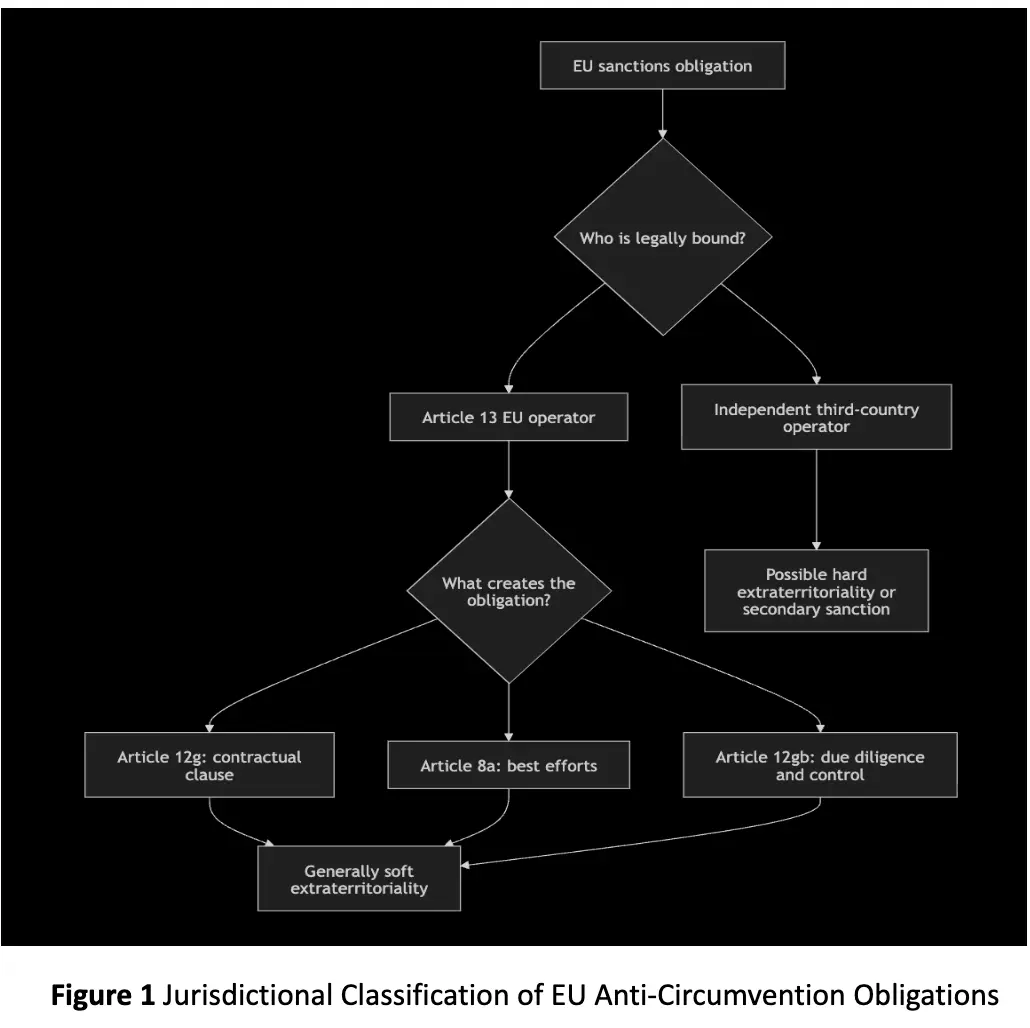
Figure 1 specifically shows how the identity of the person that is legally bound along with the jurisdictional connection that is applicable, distinguishes between the obligations of an EU operator and hard extraterritoriality, along with secondary sanctions. When it comes to applying the framework to Article 12g, this article which is within Regulation 833/2014 requires an exporter that is connected to the EU, to obtain a promise that is labeled as, no re-export, instead of directly binding the foreign buyer. (Council Regulation (EU) No 833/2014, 2014, art. 13; Council Regulation (EU) 2024/1745, 2024, art. 1(27)) Article 13 overall supports for there to be jurisdiction over the exporter, specifically while the buyer is in a situation where they face private remedies, while the exporter has to document compliance, while reporting known breaches. Under Silingardi’s analytical framework, this could be characterised as a representation of soft extraterritoriality, since public law obligations and potential EU penalties remain intact to the exporter that is connected. (Council Regulation (EU) No 833/2014, 2014, art. 13; Council Regulation (EU) 2024/1745, 2024, art. 1(27); European Commission, 2024, Questions 2 and 5; Silingardi, 2024, pp. 5-7) Vulnerability can arise in the case where a re-export by itself establishes exporter liability, while not having any proof for the breach of the exporter, or any knowledge, other legal attribution or due diligence failure for that matter.
As for Articles 8a and 12gb of the same Regulation 833/2014, they regulate the operators within Article 13, this being through foreign entities that are owned or controlled, and are the strongest specifically where decisive influence is present. (Council Regulation (EU) No 833/2014, 2014, art. 13; Council Regulation (EU) 2024/1745, 2024, recitals 27-30 and art. 1(22), (28)) Article 8a specifically requires the best possible efforts, while Article 12gb requires for due diligence, subject to feasibility, proportionality along with the Article 12gb (4) no control exception, to be implemented. These rules remain also when it comes to soft extraterritoriality where liability would concern the failure of an operator to use influence that is demonstrable over the foreign entity in question. Hard extraterritoriality is approached if control is presumed either from ownership or autonomous foreign conduct is accredited and assigned to a parent that cannot prevent it. Although, it is important to state that ownership and control are not always automatically synonymous, which needs to be taken into consideration. (Council Regulation (EU) 2024/1745, 2024, recital 30 and art. 1(22), (28); European Commission, 2025, Question 14; Silingardi, 2024, pp. 7-8)
There is a boundary between hard extraterritoriality and secondary sanctions. Silingardi identifies the risks with hard extraterritoriality, specifically where sanctions effectiveness along with the protective principle, end up replacing jurisdictional connections which are established by Article 13. (Silingardi, 2024, pp. 6, 8-9) When it comes to Article 12, from Regulation 833/2014, it is aligned with Afrasiabi, it requires both knowledge and intention, while also preventing a foreign outcome from alone proving intentional circumvention. Articles 3, 6 and 12, that are a part of Directive 2024/1226, specifically require separately a covered offence, along with corporate attribution that is proper, and along with criminal jurisdiction of a Member State. (Afrasiabi and Others, 2011, paras. 66-68; Council Regulation (EU) 2024/1745, 2024, art. 1(25); Directive (EU) 2024/1226, 2024, arts. 3, 6 and 12) Therefore, Articles 12g and 12 gb, along with Article 8a, are not inherently unlawful, however their application turns vulnerable in the case where enforcement bypasses Article 13, attribution, genuine control, or even the mental element that is required.
5. Liability, Legal Certainty and the Appropriateness of the Balance
The question is whether the framework provides sufficient legal certainty. Article 12g promotes certainty specifically through means of exclusion, dates, specified goods, remedies, along with reporting, while at the same time Article 12gb requires risk and controls assessments that are proportionate. (Council Regulation (EU) 2024/1745, 2024, art. 1(27)-(28); European Commission, 2024, Questions 1-7; European Commission, 2025, Questions 4 and 9) There are safeguards that include the feasible best efforts of Article 8a, regarding EU entities that are owned or controlled. Specifically Article 12gb(4)’s no control exception, the knowledge and intention test from both Afrasiabi and Article 12, along with Directive Article 5 and 7, that are on proportionate penalties. (Afrasiabi and Others, 2011, paras. 66-68; Council Regulation (EU) 2024/1745, 2024, recital 30 and art. 1(22), (25), (28); Directive (EU) 2024/1226, 2024, arts. 5 and 7) There is uncertainty, specifically due to adequate remedies, appropriate steps, effective mitigation that depends on risk, capacity and foreign law together with national guidance, instead of uniform rules. Diligence that is inadequate can also cause the removal of protection that is deemed as no-knowledge, along with supporting serious negligence liability regarding military or dual use trade, specifically under Directive Article 3 or inadequate supervision liability, but under the Article, while triggering maximum fines under Article 7, or at a minimum a 5 percent of turnover worldwide or 40 million euros, this is for a legal person that is held liable for criminal offences, with fines that may be subject to being of a criminal or non-criminal nature. (Council Regulation (EU) 2024/1745, 2024, recital 36; Directive (EU) 2024/1226, 2024, arts. 3(3), 6(2), 7(2)(b); European Commission, 2024, Questions 5 and 12; European Commission, 2025, Questions 4, 6-7, 9 and 14)
Regarding whether the balance is appropriate, there is a requirement for a critical assessment. Specifically, intermediaries, re-export routes, along with formal arrangements can play a part in concealing certain conduct that can frustrate sanctions prohibitions, which can justify downstream safeguards. (European Commission, 2025, Questions 4-5; Silingardi, 2024, p. 2) Contracts under Article 12g along with Article 12gb risk controls, are less intrusive when compared to direct sanctions on foreign traders, since they stem from an operator that is under Article 13, instead of an independent foreign actor. The balance can only be deemed as appropriate, if enforcement can prove a nexus within Article 13, specifically which calibrates duties regarding risk and capacity, while distinguishing compliance failure from Article 12 Afrasiabi test on knowledge and intention, or serious negligence from Directive Article 3. (Afrasiabi and Others, 2011, paras. 66-68; Council Regulation (EU) No 833/2014, 2014, arts. 12-13; Council Regulation (EU) 2024/1745, 2024, recital 30 and art. 1(27)-(28); Directive (EU) 2024/1226, 2024, art. 3(3); European Commission, 2025, Question 9) It is inappropriate when the only evidence probing liability is Russian end use, in that case ownership substitutes regarding control that is feasible or foreign law conflicts are ignored, which makes clearer requirements for diligence, along with remedies and control evidence that are needed in order to prevent over compliance and secondary pressure from taking place.
6. Conclusion
In conclusion, foreign location is not as important as whether liability remains with a person under Article 13 and its control that is based on obligations that are control based and contractual. Overall, Article 12g is generally lawful since it is able to regulate a connected exporter, while at the same time both Article 8a, and 12gb stay defensible where both ownership and control can create considerable influence. (Council Regulation (EU) No 833/2014, 2014, art. 13; Council Regulation (EU) 2024/1745, 2024, recitals 27-30 and art. 1(22), (27)-(28)) Liability has to satisfy Regulations 833/2014’s Article 12 along with the knowledge and intention test of Afrasiabi, the offence requirements of Directive 2024/1226 Article 3, the attribution rules of Article 6 and the jurisdictional rules of Article 12. (Afrasiabi and Others, 2011, paras. 66-68; Council Regulation (EU) 2024/1745, 2024, art. 1(25); Directive (EU) 2024/1226, 2024, arts. 3, 6 and 12) The framework can be considered definitely imperfect, yet defensible, and research should test if national enforcement respects the limits without at the same time converting indirect EU duties into what can be labeled direct coercion of third country actors who are independent.
7. References
References
Council Regulation (EU) No 833/2014 of 31 July 2014 concerning restrictive measures in view of Russia’s actions destabilising the situation in Ukraine. (2014). Official Journal of the European Union, L 229, 1-11. https://eur-lex.europa.eu/eli/reg/2014/833/oj/eng
Council Regulation (EU) 2024/1745 of 24 June 2024 amending Regulation (EU) No 833/2014 concerning restrictive measures in view of Russia’s actions destabilising the situation in Ukraine. (2024). Official Journal of the European Union, L, 2024/1745. https://eur-lex.europa.eu/eli/reg/2024/1745/oj/eng
Directive (EU) 2024/1226 of the European Parliament and of the Council of 24 April 2024 on the definition of criminal offences and penalties for the violation of Union restrictive measures and amending Directive (EU) 2018/1673. (2024). Official Journal of the European Union, L, 2024/1226. https://eur-lex.europa.eu/eli/dir/2024/1226/oj/eng
Consolidated version of the Treaty on the Functioning of the European Union. (2016). Official Journal of the European Union, C 202, 47. https://eur-lex.europa.eu/eli/treaty/tfeu_2016/oj/eng
Afrasiabi and Others, Case C-72/11, ECLI:EU:C:2011:874 (Court of Justice of the European Union 2011). https://eur-lex.europa.eu/legal-content/EN/TXT/?uri=celex:62011CJ0072
Directorate-General for Financial Stability, Financial Services and Capital Markets Union. (2024, December 18). Frequently asked questions concerning the “No re-export to Russia” clause and sanctions adopted following Russia’s military aggression against Ukraine. European Commission. https://finance.ec.europa.eu/publications/no-re-export-russia-clause_en
Directorate-General for Financial Stability, Financial Services and Capital Markets Union. (2025, July 23). Frequently asked questions on enhanced due diligence for operators manufacturing and/or trading with CHP items concerning sanctions adopted following Russia’s military aggression against Ukraine and Belarus’ involvement in it. European Commission. https://finance.ec.europa.eu/publications/enhanced-due-diligence-operators-manufacturing-andor-trading-chp-items_en
Silingardi, S. (2024). The EU 11th and 12th packages of sanctions against Russia: How far is the EU willing to go extraterritorially? Global Trade and Customs Journal, 19(7-8), 546-554. https://kluwerlawonline.com/journalarticle/Global+Trade+and+Customs+Journal/19.13/GTCJ2024063