





‘As open as possible (…) As closed as necessary’. This guiding principle, enshrined in the Economic Security Strategy (EESS) (2023), issued by the European Commission (EC) and the European Union (EU) HR/VP, has been applied to various types of secondary legislation that the EU has adopted since then. Whilst explicitly framing economic security as a pillar of the Union’s resilience, alongside traditional security concerns, the strategy comes in a context of geopolitical fragmentation and weaponised interdependence, in which the EU needs to confront a fundamental tension: how to reconcile its long-standing commitment to open markets with the imperatives of economic security?
This policy brief examines two interrelated responses to this challenge – Foreign Direct Investment (FDI) screening and the burgeoning debate on ‘Buy European preference’ – and argues that, together, they represent a coherent, if still evolving framework towards the EU’s pursuit of (open) strategic autonomy. It then further explores how these tools of economic statecraft are increasingly integrated into the EU’s Common Foreign and Security Policy (CFSP) and Common Security and Defence Policy (CSDP), reflecting a broader securitisation of economic policy.
1. The EU’s Path towards an Economic Security Strategy and FDI Screening
The EU’s shift toward a more assertive economic security posture emerged from a series of catalysts that reshaped its approach to FDI and industrial policy. However, the People’s Republic of China (PRC)’s surge in outbound investment into the EU in the 2010s – exemplified by COSCO’s 2016 controlling stake in the Port of Piraeus – exposed vulnerabilities to state-backed, strategically motivated investment in particularly strategic sectors. Peragovics and Szunomár (2025) argue that such cases were pivotal in shaping the political narrative for a common EU-level screening mechanism.
Regulation (EU) 2019/452 (2019) established the first EU-wide FDI screening framework: Member States (MSs) retained sole decision-making authority (Article 3(1)), while Articles 6–8 introduced cooperation enabling information exchange and EC opinions on collective security risks. Yet cooperation was lopsided: 85% of notifications between 2020 and 2023 came from only a quarter of MSs (EC, 2024, p.1), highlighting the need for greater harmonisation.
The Fifth Annual Report on FDI Screening (EC, 2025) shows that manufacturing accounted for 50% of 2024 detailed assessments, with concerns focused on technology/knowledge leakage and security of supply – directly linked to (open) strategic autonomy. The 2019 Regulation offered effective risk mitigation in critical sectors (OECD, 2022), flexibility for national security priorities, and, per Chan and Meunier (2021), greater transparency and collective risk awareness. Yet, as identified by the European Parliament (EP) Research Service (Grieger, 2024), the regulation has incomplete coverage, weak harmonisation, and procedural inefficiencies.
The EESS marked a watershed moment in the EU’s approach to economic policy. For the first time, the EU explicitly linked economic openness with security risks, arguing that ‘with (rising) geopolitical tensions (…) and (ever-deepened) global economic integration (…), certain economic flows and activities can present a risk to our security’ (EC & HR/VP, 2023, p. 1). It presented a three-pillar approach that included promoting competitiveness, protecting against economic security risks and partnering with like-minded countries to address shared vulnerabilities. Crucially, the strategy identified FDI screening as a key tool for protecting against risks such as technology leakage, critical infrastructure vulnerabilities, and economic coercion.
This set the stage for the Revised FDI screening framework (EP & Council of the EU, 2026), formally adopted by the EU co-legislators in May 2026. With full applicability by January 2028, the updated regime introduces a uniform obligation to establish national screening mechanisms, covering a mandatory minimum sectoral scope, including dual-use items and military equipment, hyper-critical technologies, critical raw materials, and critical entities in energy, transport, and digital infrastructure. In response to the ECJ’s Xella ruling, the framework now covers EU-based entities controlled by non-EU investors, while procedural reforms address the asynchronous, fragmented cooperation that characterised the 2019 regime (Berg et al., 2023).
Its strength lies in institutional consolidation: mandatory scope, harmonised timelines, and routine inter-administrative coordination create durable infrastructure that lowers the cost of future deepening. Nonetheless, final decisions remain the host MS’s exclusive competence – reproducing the original sovereignty constraint – greenfield investment remains outside the mandatory review, risk methodologies and sectoral scopes diverge above the minimum floor, and mitigation measures lack a coordination mechanism. Meunier and Vlasiuk Nibe suggest the framework renders contested transactions more visible, but not resolvable (2026, p.14), a deliberate deferral, reflected in the EC’s plan to pursue investment-conditioning separately under the Industrial Accelerator Act (IAA), which, as of September 2026, still requires approval by the Council/EP. This leads the authors of the September 2026 assessment to characterise the reform as ‘muddling through ’ (Meunier and Vlasiuk Nibe, 2026, p. 15).
In parallel to the evolution of EU secondary legislation on FDI screening, the concept of ‘Buy European preference’ (BEP) began to gain traction, particularly in strategic sectors such as defence, digital infrastructure, and clean technology. This marks a shift from the EU’s non-discriminatory approach to procurement towards a growing consensus that economic resilience requires demand-side interventions to complement supply-side controls like FDI screening (Maillard, 2026).
2. Buy European Preference: State of affairs
The term ‘BEP’ refers to a set of policy measures that prioritise EU-based goods, services, or providers in public procurement, subsidies, and strategic sectors. As Global Counsel (2025) notes, the concept encompasses a spectrum of instruments, ranging from explicit local content requirements to implicit preferences embedded in procurement criteria.
The conclusions of the Stanford-Vienna Transatlantic Technology Law Forum (2025) provide a comprehensive analysis of BEP in the digital services sector, arguing that the policy is driven by three key rationales: Economic justifications to stimulate demand for EU-produced goods to support domestic industries; sovereignty concerns towards reducing dependencies on foreign suppliers in critical sectors; and strategic autonomy towards ensuring that public spending contributes to EU industrial capacity rather than foreign competitors. The following table allows a broader vision of EU instruments that include BEP approaches:
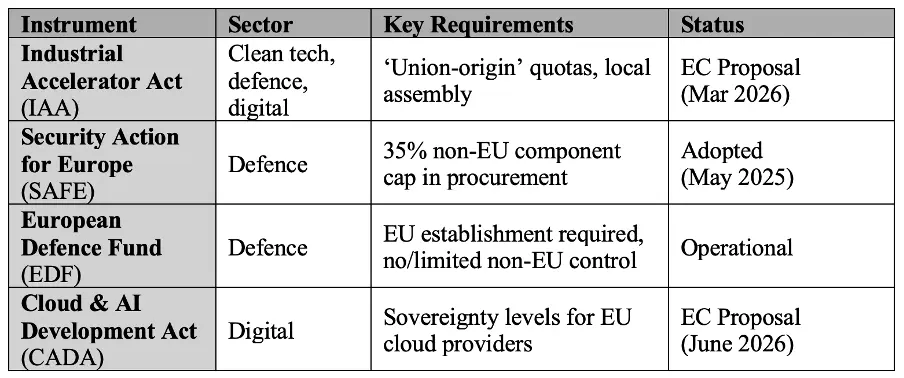
The SAFE Instrument, with a €150 bn budget, is particularly notable. It mandates that no more than 35% of component costs in defence procurement contracts originate from outside the EU, EFTA, or Ukraine. This explicit localisation requirement reflects the EU’s determination to reduce dependencies in critical defence supply chains.
According to Maillard (2026), public procurement accounts for 14% of the EU’s GDP. The IAA seeks to leverage this spending power by introducing ‘Union-origin’ requirements for state-subsidised products in strategic sectors. For instance, state-subsidised electric vehicles would need to be assembled in the EU and contain a substantial share of European components. The EC’s proposal also includes enforcement mechanisms for third-country investors. Under the IAA, foreign companies investing over €100 million in the EU would be required to enter joint ventures with European firms, share intellectual property, and transfer know-how to local partners. This reciprocity-based approach mirrors PRC-style market access restrictions, which the EU has long criticised.
3. Comparative Analysis: FDI Screening versus ‘Buy European preference’
As illustrated by the table below, the FDI screening framework and BEP instruments represent two sides of the same coin: inbound control and outbound demand. While they operate through different mechanisms, they serve complementary functions – reducing strategic vulnerabilities and enhancing the EU’s economic sovereignty.
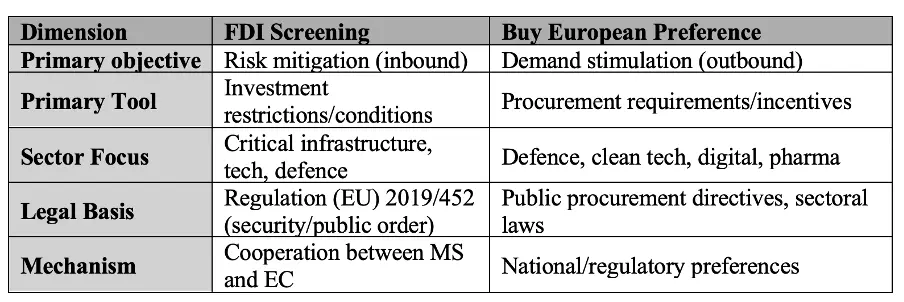
The synergies between FDI screening and BEP are most evident in sectors where both inbound and outbound controls are critical. In the area of defence, screening blocks risky foreign investments in defence firms, while SAFE and EDF ensure that procurement supports EU-based production; in the area of digital infrastructure, screening prevents foreign takeovers, e.g. of cloud providers, while CADA promotes EU-controlled cloud services; in the area of critical technologies, screening monitors investments in semiconductors and AI, while, e.g., the IAA and Chips Act incentivise EU-based production.
As Jarlebring (2026) argues, the EU’s weak position in the global tech stack – dominated by US firms in AI, cloud, and semiconductors – necessitates a more targeted approach. To become more independent in these sectors, the EU can build ‘strategic pockets of autonomy and leadership’ through targeted investments, regulation, and procurement preferences (Jarlebing, 2026, p.1).
However, despite their complementarity, tensions exist between the following dimensions. While FDI screening is explicitly permitted under Article 207(2) TFEU and the General Agreement on Tariffs and Trade (GATT) Article XXI (security exceptions), BEP measures risk violating WTO/Agreement on Government Procurement (GPA) commitments. Furthermore, BEP may increase costs for public authorities, while FDI screening could deter beneficial investments. Ultimately, MS divergences, especially those based on geography and GNI per capita, persist.
4. The CFSP Connection: Economic Tools for Security Objectives
The increased importance of tools of economic statecraft reflects the EU’s recognition that economic security is a dimension of foreign and security policy. The EESS explicitly links FDI screening to CFSP objectives, stating that ‘the EU will deploy its economic security toolkit to protect against risks that threaten its strategic interests, including those arising from foreign investments in critical sectors’.
The EP’s resolution on the 2023 Annual Report on CFSP Implementation (2024) calls for enhanced FDI screening cooperation in critical infrastructure; greater harmonisation of national mechanisms to prevent circumvention and stronger EC opinions for investments affecting Union security interests. The Council Conclusions on the White Paper on Export Controls (2024) similarly endorsed the use of FDI screening as part of a broader economic security framework, alongside export controls and outbound investment monitoring.
Broader EU CSDP increasingly embraces BEP principles to strengthen the EU’s defence industrial base. The SAFE Instrument is a flagship example of this trend. The EDF and the European Defence Industrial Programme (EDIP) are two other examples, indicative of the further entrenchment of BEP principles in defence industrial policy. Broadly speaking, the EDF requires EU establishment and no non-EU control for funded entities, whilst EDIP strengthens localisation by mandating EU-based production, assembly, and IP retention. These measures directly support CSDP objectives by reducing dependency on non-EU suppliers for critical defence capabilities, thereby enhancing interoperability among EU armed forces and strengthening the EU’s (open) strategic autonomy in security and defence.
Conclusion: Towards a holistic framework of EU Economic Security Strategy (?)
The EU’s FDI screening scheme and ‘Buy European preference’ represent two complementary pillars of a broader economic security strategy. Together, they form a dual-pronged approach to mitigating risks and enhancing resilience in an era of geopolitical fragmentation. The analysis yields the following findings: FDI Screening has evolved from a decentralised mechanism to a harmonised, EU-wide framework, with the 2026 revision mandating national screening mechanisms and strengthening the EC’s role; BEP is no longer a theoretical concept but a policy reality, implemented through, amongst others, the IAA, SAFE, IPI, and sectoral procurement rules; both tools are increasingly linked to foreign and security policy, reflecting the securitisation of economic policy in the EU.
Based on these findings, to maximise the effectiveness of this dual-pronged approach, the EU should align FDI Screening and BEP towards a cohesive strategy that links inbound controls (FDI screening) with outbound demand (BEP) in critical sectors. The stated tools should be more deeply embedded within the broader scope of CFSP/CSDP to ensure policy coherence and avoid fragmentation. With a plethora of divergent MS preferences, the EC should push for further harmonisation to prevent regulatory arbitrage. As for monitoring reciprocity, the IPI and other instruments should be used more effectively to address discriminatory practices by third countries, while avoiding protectionist overreach. On a budgetary note, investment in public procurement, whilst ensuring WTO compliance, to support EU-based production in defence, digital, and clean tech should be encouraged.
Ultimately, the question remains: to what extent should European Strategic Autonomy remain open? To that end, further research is needed to assess, e.g. the impact of BEP schemes on EU-US/PRC relations, the effectiveness of FDI screening in preventing technology leakage and the legal boundaries of BEP under WTO/GPA rules.
References
Berg, O., Komninos, A., Wienke, T.-M. (2023). European Court of Justice rules that foreign investment screening cannot be used as a protectionist tool within the EU. White & Case. https://www.whitecase.com/insight-alert/european-court-justice-rules-foreign-investment-screening-cannot-be-used
Chan, Z. T., & Meunier, S. (2021). Behind the screen: Understanding national support for a foreign investment screening mechanism in the European Union. The Review of International Organizations. Springer. https://link.springer.com/article/10.1007/s11558-021-09436-y
Council of the European Union (2024). Council conclusions on the White Paper on export controls. https://data.consilium.europa.eu/doc/document/ST-9439-2024-INIT/en/pdf
Court of Justice of the European Union (2023). Xella International GmbH v. Wirtschaftsprüfungskammer (Case C-106/22, judgment of 27 January 2023). EUR-Lex. https://eur-lex.europa.eu/legal-content/EN/TXT/?uri=CELEX:62022CJ0106
European Commission (2024). Cooperation on screening of foreign direct investments strengthens EU security. Press release. https://ec.europa.eu/commission/presscorner/api/files/document/print/en/ip_24_5327/IP_24_5327_EN.pdf
European Commission (2025). Fifth annual report on the screening of foreign direct investments into the Union (COM(2025) 632 final). Publications Office of the European Union. https://eur-lex.europa.eu/legal-content/EN/TXT/PDF/?uri=CELEX:52025DC0632
European Commission (2026). Proposal for a regulation establishing measures for industrial capacity and decarbonisation in strategic sectors (Industrial Accelerator Act) (COM(2026) 100 final). https://single-market-economy.ec.europa.eu/document/download/9bc8eb85-4d43-4025-be7b-c86b9f3648ec_en?filename=Proposal+establishing+measures+for+industrial+capacity+and+decarbonisation+in+strategic+sectors+.pdf
European Commission & HR/VP (2023). Joint communication to the European Parliament, the European Council and the Council: European economic security strategy (JOIN(2023) 20 final). Publications Office of the European Union. https://eur-lex.europa.eu/legal-content/EN/TXT/?uri=CELEX:52023JC0020
European Parliament. (2025). Annual report on the implementation of the Common Foreign and Security Policy. https://www.europarl.europa.eu/thinktank/en/document/EPRS_ATA(2025)769548
European Parliament (2024). Resolution on the implementation of the common foreign and security policy – annual report 2023 (2023/2117(INI)), https://www.europarl.europa.eu/doceo/document/TA-9-2024-0104_EN.pdf
European Parliament, Council of the EU (2019). Regulation (EU) 2019/452 of the European Parliament and of the Council of 19 March 2019 establishing a framework for the screening of foreign direct investments into the Union. Official Journal of the European Union, L 79I, 1–14. https://eur-lex.europa.eu/eli/reg/2019/452/oj
European Parliament, Council of the EU (2026). Regulation (EU) 2024/0017(COD) of the European Parliament and of the Council of 27 May 2026 on the screening of foreign investments in the Union and repealing Regulation (EU) 2019/452. https://data.consilium.europa.eu/doc/document/PE-10-2026-INIT/en/pdf
Farrell, H., & Newman, A. L. (2019). Weaponized interdependence: How global economic networks shape state coercion. International Security, 44(1), 42–79. https://doi.org/10.1162/isec_a_00351
Global Counsel (2025). Defining “Buy European”: Procurement, resilience, and the politics of Europe’s economic security. https://global-counsel.com/insights/research/defining-buy-european-procurement-resilience-and-politics-europes-economic
Grieger, G. (2024). Evaluation of Regulation (EU) 2019/452 establishing a framework for the screening of foreign direct investments into the Union. European Parliament Research Service. https://www.europarl.europa.eu/RegData/etudes/BRIE/2024/762382/EPRS_BRI(2024)762382_EN.pdf
Guillou, S., Gsell, F. & Lechevalier, F. (2025). Buy European Tech Act: Should public procurement in digital services prioritise European providers?. European Union Law Working Papers No. 119. Stanford–Vienna Transatlantic Technology Law Forum, Stanford Law School. https://law.stanford.edu/publications/no-119-buy-european-tech-act-should-public-procurement-in-digital-services-prioritize-european-providers/
Jarlebring, J. (2026). Tech sovereignty: Can the EU drive a wedge into the US-dominated tech stack?. Swedish Institute for European Policy Studies (SIEPS). https://sieps.se/en/publications/2026/tech-sovereignty-can-the-eu-drive-a-wedge-into-the-us-dominated-tech-stack/
Maillard. S. (2026). ‘European preference’ signals a wider change of EU doctrine. Royal Institute of International Affairs. Chatham House. https://www.chathamhouse.org/2026/03/european-preference-signals-wider-change-eu-doctrine
Meunier, S., & Vlasiuk Nibe, A. (2026). Mind the gaps: Failing forward, muddling through, and the reform of EU investment screening. Law & Geoeconomics. https://www.researchgate.net/publication/414143275_Mind_the_Gaps_Failing_Forward_Muddling_Through_and_the_Reform_of_EU_Investment_Screening
OECD (2022). Framework for Screening Foreign Direct Investment into the EU – Assessing effectiveness and efficiency. https://www.oecd.org/content/dam/oecd/en/publications/reports/2022/01/framework-for-screening-foreign-direct-investment-into-the-eu_d966075e/f75ec890-en.pdf
Peragovics, T., & Szunomár, Á. (2025). The European Union’s investment screening framework and China—a complicated picture. Asia Europe Journal, 23, 479–487, Springer. https://doi.org/10.1007/s10308-025-00757-w