


What the 2026 agreement reveals about the authority of the global minimum tax
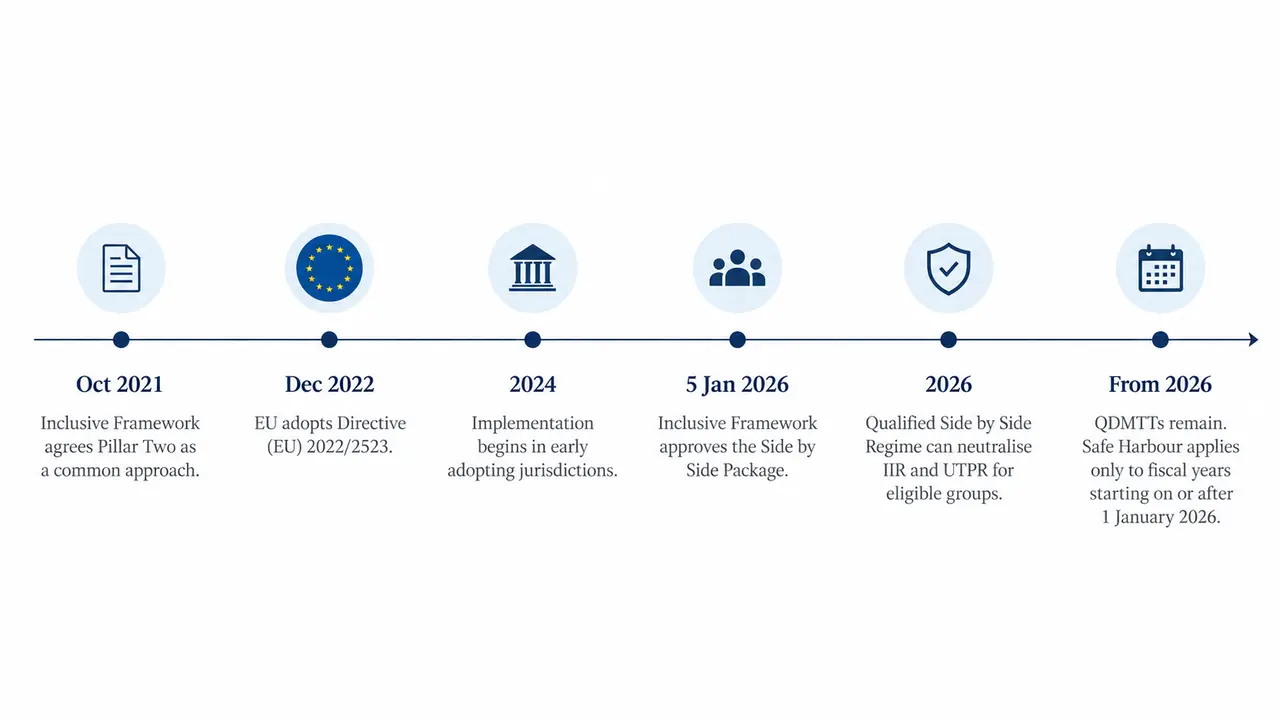
On 5 January 2026, 147 jurisdictions participating in the OECD/G20 Inclusive Framework agreed on a package that changed the operation of the GloBE global minimum-tax framework.1 Its most politically significant element was the new Side-by-Side System. Under that system, an MNE Group whose ultimate parent entity is located in a jurisdiction recognised by the Inclusive Framework as having a Qualified Side-by-Side Regime may, subject to the prescribed conditions and an election, benefit from the Side-by-Side Safe Harbour. For GloBE purposes, the relevant top-up tax is then deemed to be zero under the IIR and UTPR. The United States is currently listed by the OECD as having a Qualified Side-by-Side Regime.2
This article focuses on the GloBE Rules, specifically the IIR, UTPR and QDMTT, rather than Pillar Two as a whole, which also includes the treaty based Subject to Tax Rule (STTR).
The change is substantial, but it is not a complete exemption from the global minimum-tax framework. Qualified Domestic Minimum Top-up Taxes (QDMTTs) remain unaffected, so a jurisdiction may still impose its own minimum tax on low-taxed income arising within its borders.3 Nor does the Side-by-Side Safe Harbour alter the treatment of earlier fiscal years: it applies to fiscal years commencing on or after 1 January 2026.4 Describing US-parented groups simply as “exempt from Pillar Two” therefore obscures both the continuing role of QDMTTs and the temporal limits of the agreement.
The political descriptions of the deal nevertheless differed sharply. The US Treasury presented the agreement as exempting US-headquartered companies from Pillar Two and protecting US “tax sovereignty”.5 The OECD instead described the arrangement as allowing robust pre-existing minimum-tax systems to operate alongside the GloBE Rules while preserving the wider objectives of the global minimum tax.6 The difference reflects more than competing press strategies. It raises a basic question about the authority of the GloBE framework itself.
The GloBE Rules were not adopted through a multilateral tax treaty but as a non-binding “common approach”. Yet they have since shaped binding tax legislation across a growing number of jurisdictions and throughout the European Union. Side-by-Side exposes the tension built into that structure. The framework has enough practical authority to coordinate national tax systems, but the international standards from which those systems draw remain capable of revision through further political agreement.
The events of 2026 therefore offer a useful way of asking not whether the GloBE Rules are simply “law” or “soft law”, but how far a non-binding international framework can exercise regulatory authority once domestic and regional legal systems have been organised around it.
1. A Common Approach, Not an International Obligation
The GloBE Rules were developed as a non-binding common approach rather than as a multilateral tax treaty. The October 2021 agreement is explicit on this point. Inclusive Framework members are not, by virtue of that agreement alone, legally required to adopt the GloBE Rules. If they choose to do so, however, they agree to implement and administer them consistently with the agreed outcomes and to accept the application of compliant GloBE rules by other members, including the agreed rule order and safe harbours.7 That proposition concerns the Inclusive Framework level. In the European Union, Member States subsequently became subject to binding obligations under EU law.
The substantive rules are considerably more demanding than the word “voluntary” might suggest. The GloBE Rules generally apply to Constituent Entities of MNE Groups with consolidated annual revenue of at least EUR 750 million in at least two of the four fiscal years immediately preceding the tested fiscal year, subject to the detailed scope and restructuring rules. They seek to ensure an effective minimum level of taxation of 15 per cent.8 The IIR allows top-up tax to be charged through the ownership chain in relation to low-taxed Constituent Entities. Where a qualified IIR does not collect the relevant amount, the UTPR operates as a backstop. A QDMTT gives the jurisdiction in which the low-taxed income arises the first opportunity to collect the top-up tax domestically.9
None of those liabilities arises merely because the OECD published Model Rules. The rules were designed to be translated into domestic law. A taxpayer becomes legally liable because a legislature has enacted a minimum-tax regime, not because the OECD itself possesses legislative authority over the taxpayer. That distinction is particularly clear in the European Union. Council Directive (EU) 2022/2523 incorporates the core GloBE architecture into EU law and requires Member States to apply an IIR and UTPR in accordance with the Directive, while permitting a qualified domestic top-up tax.10 The international standard remains non-binding at Inclusive Framework level, but much of its substance has become binding within domestic and regional legal orders.
Implementation is no longer abstract. In May 2026, the OECD reported that 37 jurisdictions had implemented a qualified IIR and/or QDMTT applicable to in-scope groups from their 2024 reporting fiscal year. Its Central Record then showed 44 jurisdictions that had completed the transitional qualification process for an IIR and 50 that had completed it for a domestic minimum tax and the QDMTT Safe Harbour.11 These figures measure different aspects of implementation, but they show that the GloBE framework has moved well beyond the stage of a policy proposal.
Its structure also creates a practical reason to participate. Where low-taxed income may otherwise be brought into charge elsewhere in the GloBE system, a state can have an incentive to introduce its own qualified rules rather than leave the relevant top-up tax to another jurisdiction. The resulting pressure does not depend on an international rule legally compelling implementation. It follows from the interaction between national tax systems once enough jurisdictions adopt the framework.
Cees Peters has linked this feature of the global minimum tax to its effectiveness while questioning the accountability and legitimacy of the process through which the rules were developed.12 Whatever view is taken of that broader criticism, the institutional point is important: the GloBE framework can influence state choices because those choices no longer occur in isolation. The decision of one jurisdiction affects the operation of rules elsewhere.
This is why bindingness and authority must be kept separate. The Model Rules do not become binding merely because many states follow them. They can nevertheless exercise considerable influence over the form and operation of binding domestic legislation.
2. Authority Through Recognition and Coordination
International tax law has long depended on instruments that do not fit neatly within the conventional treaty model. OECD model conventions, commentaries, transfer-pricing guidance and other standards routinely influence national policy and treaty interpretation despite differences in their formal legal status. Allison Christians has described OECD tax cooperation as a form of transnational governance in which governments use an international network to produce non-binding tax norms while retaining formal control over national tax policy.13 Ruth Mason has similarly shown that contemporary international tax cooperation has changed not only substantive tax rules but also the institutions, participants, norms and legal forms through which international taxation develops.14
The GloBE framework pushes that model further because its effectiveness depends on coordinated domestic implementation and on recognition decisions made within the system. Jurisdictions give the rules legal effect through their own legal orders. The Inclusive Framework, for its part, makes qualification determinations for GloBE purposes: whether an IIR or domestic minimum tax is treated as qualified, whether a jurisdiction satisfies the criteria for a recognised safe harbour, and how the agreed rule order operates. Domestic and regional law then determines the legal consequences attached to those determinations.
Authority is therefore produced partly through coordination and recognition rather than through a single binding international instrument. A qualification decision does not itself impose tax on a taxpayer. But once national or regional legislation links legal consequences to the GloBE framework, that decision can influence which rule applies, which jurisdiction has priority and whether a top-up tax is due.
Widespread implementation does not, however, transform the GloBE Rules themselves into customary international law. Under the International Law Commission’s two-element approach, a rule of customary international law requires sufficiently general state practice together with acceptance of that practice as law, or opinio juris.15 The Inclusive Framework expressly states that jurisdictions are not legally required, at that level, to adopt the GloBE Rules.16 It is therefore difficult to infer from implementation alone that governments legislate because they believe international law obliges them to impose a 15 per cent minimum tax. They may support the policy, seek to protect their own tax base, respond to the risk that another jurisdiction will collect the tax instead, or, in the EU, act because the Directive obliges them to do so.
The more convincing description is that the GloBE framework has acquired regulatory authority without treaty-like bindingness. Its international standards matter because participating jurisdictions have connected their domestic tax systems to them. That also makes later changes to the framework particularly significant: once states have enacted legislation by reference to a common standard, an international decision to revise that standard can affect the operation of binding rules already embedded in domestic and regional legal systems.
Side-by-Side brings that feature to the surface.
3. What Side-by-Side Actually Changed

U.S. Supreme Court, Washington, D.C. Photo: Al Drago/Bloomberg via Getty Images, 2020. Source: Vox.
The origins of the agreement lie in the United States’ objection to the way the GloBE Rules could apply to US-parented multinational groups. The United States had not implemented the GloBE Rules in the same form as many other jurisdictions and instead relied on its own international minimum-tax rules. By 2025, the prospect that foreign jurisdictions could apply the UTPR to US groups had become a major source of disagreement.
On 28 June 2025, the G7 announced a shared understanding on a proposed Side-by-Side solution. The statement contemplated fully excluding US-parented groups from the IIR and UTPR in recognition of the existing US minimum-tax system.17 The discussions were also linked to proposed section 899 of US tax legislation, which threatened retaliatory tax measures in relation to certain foreign taxes regarded as discriminatory or extraterritorial. The G7 expressly described the removal of section 899 as crucial to the overall understanding.18
The January 2026 outcome was broader than the Side-by-Side issue alone. The Package included a Simplified Effective Tax Rate Safe Harbour, a one-year extension of the Transitional Country-by-Country Reporting Safe Harbour, a Substance-based Tax Incentives Safe Harbour, the new Side-by-Side System and an evidence-based stocktake process.19 The Side-by-Side System itself, by contrast, consists of two safe harbours.
The first is the Side-by-Side Safe Harbour. It applies to MNE Groups whose ultimate parent entity is located in a jurisdiction recognised by the Inclusive Framework as having a Qualified Side-by-Side Regime. Qualification is a defined legal category under the OECD guidance, not simply a description of a jurisdiction with a pre-existing minimum tax. The criteria examine both the jurisdiction’s domestic tax system and its worldwide taxation of foreign income. They are designed to test whether the national minimum-tax architecture produces sufficiently robust minimum-tax outcomes for domestic and foreign profits.
Where the relevant election and conditions are satisfied, the formal effect is that the relevant top-up tax is deemed to be zero for IIR and UTPR purposes.20 In practical terms, this “switches off” the ordinary IIR and UTPR consequences for the eligible group in the circumstances covered by the safe harbour. The United States was added to the OECD Central Record as having a Qualified Side-by-Side Regime after its system was assessed against those criteria.21
The second is the UPE Safe Harbour. Its effect is narrower. Where the ultimate parent jurisdiction has a Qualified UPE Regime, the top-up tax for that jurisdiction is deemed to be zero for UTPR purposes. It does not provide the same group-wide protection from the IIR and UTPR as the full Side-by-Side Safe Harbour.22
Neither safe harbour displaces QDMTTs. The OECD has repeatedly emphasised that qualified domestic minimum top-up taxes continue to apply regardless of where the multinational group is headquartered.23 This preserves the ability of a jurisdiction to collect minimum tax on income arising within its own territory before the IIR or UTPR reallocates the taxing opportunity elsewhere.
Timing also matters. Both components of the Side-by-Side System apply to fiscal years commencing on or after 1 January 2026. The OECD guidance expressly states that the Side-by-Side Safe Harbour does not affect fiscal years commencing before that date.24 The agreement therefore does not retrospectively erase GloBE consequences arising in earlier periods. For US-parented groups, the difference between the political language of “exemption” and the actual legal mechanics is significant.
What changed in 2026 was not whether multinational groups could ever face minimum taxation. Rather, the Inclusive Framework accepted that a qualifying national minimum-tax architecture could be treated as sufficiently robust to operate alongside the GloBE system without the ordinary IIR and UTPR applying in full.
That represents an important shift. The original GloBE design relied heavily on coordinated rules intended to produce comparable treatment across jurisdictions. Side-by-Side gives greater weight to equivalence of outcomes. The framework no longer insists, in every case, on the same legal mechanism. It can instead recognise a different national system where the Inclusive Framework considers the resulting minimum-tax outcomes sufficiently robust.
4. The EU Shows How Soft Law Acquires Legal Effect
The European Union provides perhaps the clearest example of why the distinction between the OECD framework and binding law matters.
Directive 2022/2523 made the core GloBE rules legally binding on Member States. Yet the Directive also anticipated that the international framework would continue to develop. Article 32 provides for safe-harbour treatment where the conditions of a “qualifying international agreement on safe harbours” are met. It defines such an agreement as an international set of rules and conditions to which all Member States have consented.25
That provision became crucial in January 2026.
On 12 January, one week after the Inclusive Framework agreement, the European Commission published a Notice confirming the application of the January safe harbours in the context of the Directive. The Notice expressly identified the Simplified ETR Safe Harbour, the extension of the Transitional CbCR Safe Harbour, the Substance-based Tax Incentive Safe Harbour and the Side-by-Side System, comprising the Side-by-Side and UPE Safe Harbours.26
The sequence is important. The OECD did not amend EU law. The Inclusive Framework structured the new measures as safe harbours. The Commission subsequently took the position that Article 32 of the existing Directive supplied the legal route through which those safe harbours could apply within the EU framework.
Cyprus makes the mechanism particularly visible. Because Cyprus does not participate directly in the OECD process, its Ministry of Finance issued a separate statement on 8 January 2026 giving its consent to the Side-by-Side Package for the purposes of Article 32.27 Three days later, the Commission was able to state that all Member States had consented to the January safe harbours.
This is more than an administrative curiosity. The international agreement did not become binding EU law merely because 147 Inclusive Framework jurisdictions supported it. EU law had already established the conditions under which an internationally agreed safe harbour could affect the operation of the Directive, including the requirement of consent by every Member State.
The legal form chosen for the 2026 changes is therefore significant. The Inclusive Framework adopted the Side-by-Side measures as safe harbours; the Commission then treated Article 32 as the route for their application within the Directive. That interpretation is contested. Benjamin Beer, writing in EC Tax Review, argues that implementing the Side-by-Side System through Article 32 rather than by formally amending the Minimum Tax Directive may stretch the permissible delegation of competence to third parties too far.28 The point should not be presented as proof that the Commission acted unlawfully. It does, however, expose a central consequence of incorporating an evolving international framework into binding legislation.
A domestic or regional legislature can decide in advance that future internationally agreed standards will matter to the operation of its rules. Once it does so, subsequent soft-law developments can produce legal effects through the mechanism created by the legislature itself.
That is very different from saying that OECD guidance directly overrides binding law. It is also stronger evidence of the GloBE framework’s regulatory authority: international decisions can shape legal outcomes because domestic and regional legal systems have created channels through which those decisions can be recognised.
5. The UTPR, Nexus and the Language of Tax Sovereignty
The dispute over the UTPR helps explain the political pressure that produced Side-by-Side. It does not, however, establish that the UTPR was unlawful.
The UTPR has been controversial because it permits jurisdictions to collect residual top-up tax where low-taxed income has not been fully brought into charge under a higher-priority rule. Critics have questioned whether this can lead a state to exercise taxing jurisdiction over income with an insufficient connection to that state. Peter Hongler, Irma Mosquera Valderrama, Filip Debelva, Vikram Chand and Julien Chaisse have examined possible conflicts between the UTPR and tax treaties, customary international law, investment law and other international obligations.29
One version of the objection relies on a supposed customary requirement of nexus. Stjepan Gadžo has argued that international income tax law contains a “genuine link” principle under which taxation requires an adequate personal or territorial connection between the state exercising taxing power and the taxpayer or taxable object.30 The existence and content of such a customary rule are not settled.
A frequently invoked starting point for jurisdiction in public international law is the Permanent Court of International Justice’s judgment in SS Lotus. The Court rejected the idea that a state necessarily requires a permissive rule of international law before exercising jurisdiction and treated restrictions on state independence as something that could not simply be presumed.31 Yet Lotus concerned criminal jurisdiction following a maritime collision in 1927. Treating it as a complete answer to the jurisdictional problems of modern multinational taxation would be difficult.
The opposite proposition also requires proof. Under the ILC’s two-element approach, widespread domestic nexus rules or similar provisions in bilateral tax treaties are relevant but do not automatically establish a customary prohibition on taxation without a genuine link. Evidence of opinio juris remains necessary.32 Reuven Avi-Yonah has argued that customary international tax law does exist and includes rules concerning jurisdiction to tax, but the extent and content of those rules remain the subject of disagreement.33
The Side-by-Side Package did not settle that legal debate. No international court ruled that the UTPR violated customary international law, and the United States’ objection to the rule cannot itself establish the existence of such a prohibition.
What happened instead is revealing for a different reason. The dispute was resolved through negotiation within the international tax framework. The United States challenged the way the GloBE system interacted with its own rules; the G7 developed a political compromise; and the Inclusive Framework converted that compromise into agreed safe-harbour rules.
The language of tax sovereignty should be treated in the same way. The US Treasury described Side-by-Side as recognising US sovereignty over the worldwide activities of American companies.34 The G7 had earlier referred more generally to preserving the tax sovereignty of all countries.35 That language is politically important, but it should not be confused with the principle of sovereign equality in Article 2(1) of the UN Charter.
Sovereign equality means that states possess equal juridical status under international law.36 It does not establish a general rule that every state must receive identical treatment within every international tax arrangement. Differentiated treaty commitments, reservations, transition periods and other forms of different treatment are common features of international cooperation.
The more difficult issue is one of political power and institutional legitimacy. The Side-by-Side System is expressed through general eligibility criteria rather than as a rule naming the United States alone. Yet there is little doubt about the political circumstances in which it emerged: US resistance drove the negotiations, and the United States is currently the jurisdiction recognised under the full Side-by-Side regime.
That raises a legitimate question about how influence is distributed within international tax governance. It does not, without more, establish a breach of sovereign equality.
6. What Side-by-Side Reveals
There are two ways to read the events of 2025 and 2026.
The first is that Side-by-Side exposes a limit of the GloBE framework. A system presented as a coordinated global minimum tax encountered serious resistance from the world’s largest economy, and the rules were revised so that a materially different US system could operate alongside them. If authority is measured by the ability to insist on the same legal mechanism regardless of political pressure, the episode reveals a constraint.
But that conclusion assumes a form of authority the GloBE framework never fully possessed. There was no multilateral treaty from which the United States secured a derogation. At the Inclusive Framework level, the design always left substantial space for national implementation combined with continuing international coordination.
The second interpretation therefore sees Side-by-Side as evidence of institutional adaptability. The United States did not simply withdraw from a functioning global tax arrangement and leave other jurisdictions to respond independently. Its opposition resulted in another consensus-based agreement. The Inclusive Framework developed eligibility criteria, preserved QDMTTs, created an updated qualification process and committed to an evidence-based stocktake to be completed in 2029.37
There is force in this view as well. International standards may survive precisely because they can accommodate differences between domestic tax systems. A framework that insists on complete uniformity can lose participants; one that accepts sufficiently equivalent outcomes may retain broader cooperation.
Side-by-Side therefore marks a shift in the character of GloBE coordination: from greater emphasis on uniformity of legal mechanism toward greater emphasis on recognition of sufficiently equivalent outcomes. That is not simply a relaxation of the rules. It moves regulatory significance toward the criteria and institutions that decide when a different national system is sufficiently comparable to receive recognition.
That power of recognition should not be underestimated. The Inclusive Framework makes qualification determinations for purposes of the GloBE system: whether an IIR is qualified, whether a domestic minimum tax receives qualified status, whether a jurisdiction satisfies the Side-by-Side criteria and when internationally agreed safe harbours apply. Domestic and regional law determines the legal consequences attached to those determinations, but the determinations can materially affect which jurisdiction collects tax and which obligations multinational groups face under binding legislation.
This is a substantial form of regulatory authority, even if it is not equivalent to lawmaking under a treaty.
At the same time, Side-by-Side shows why that authority remains contingent. The international layer of the GloBE framework depends on sustained political agreement. Its standards can become deeply embedded in domestic law, but they remain capable of revision when consensus within the Inclusive Framework changes. The more domestic legal systems rely on future OECD guidance and qualification decisions, the more important questions of accountability, transparency and institutional legitimacy become.
The GloBE framework is therefore neither a conventional system of binding international tax law nor merely a collection of recommendations.
Its international source remains soft. Its domestic consequences can be hard. Between those two levels sits a system of coordination, qualification, recognition and continuing negotiation that gives the Inclusive Framework influence without giving it the formal legislative authority of a treaty regime.
The Side-by-Side Package does not undermine that model so much as expose it. The events of 2026 show both how far international tax coordination can reach without a binding international obligation and where its limits begin.
Footnotes
1. Organisation for Economic Co-operation and Development. (2026, January 5). International community agrees way forward on global minimum tax package.
2. Organisation for Economic Co-operation and Development. (2026). Tax challenges arising from the digitalisation of the economy—Global Anti-Base Erosion Model Rules (Pillar Two): Side-by-Side package. OECD Publishing; Organisation for Economic Co-operation and Development. (2026, May 1).
3. Organisation for Economic Co-operation and Development. (2026). Global Anti-Base Erosion Model Rules (Pillar Two): Side-by-Side package. OECD Publishing.
4. Organisation for Economic Co-operation and Development. (2026). Tax challenges arising from the digitalisation of the economy—Global Anti-Base Erosion Model Rules (Pillar Two): Side-by-Side package. OECD Publishing.
5. U.S. Department of the Treasury. (2026, January 5). Treasury secures agreement to exempt U.S.-headquartered companies from Biden global tax plan.
6. Organisation for Economic Co-operation and Development. (2026, January 5). International community agrees way forward on global minimum tax package; Corwin, M. (2026, March). The continuing value of multilateral tax co-operation—What next for OECD tax work? EU Tax Symposium.
7. OECD/G20 Inclusive Framework on BEPS. (2021, October 8). Statement on a two-pillar solution to address the tax challenges arising from the digitalisation of the economy.
8. OECD/G20 Inclusive Framework on BEPS. (2021, October 8). Statement on a two-pillar solution to address the tax challenges arising from the digitalisation of the economy; Organisation for Economic Co-operation and Development. (n.d.). Global minimum tax.
9. Organisation for Economic Co-operation and Development. (n.d.). Global minimum tax.
10. Council Directive (EU) 2022/2523 of 15 December 2022 on ensuring a global minimum level of taxation for multinational enterprise groups and large-scale domestic groups in the Union, 2022 O.J. (L 328) 1.
11. Organisation for Economic Co-operation and Development. (2026, May 18). Global minimum tax: Release of a common understanding of implementing jurisdictions and further administrative guidance to support compliance.
12. Peters, C. (2023). The legitimacy of the OECD’s work on Pillar Two: An analysis of the overconfidence in a “devilish logic”. Intertax, 51(8/9), 554–571.
13. Christians, A. (2010). Networks, norms, and national tax policy. Washington University Global Studies Law Review, 9(1), 1–37.
14. Mason, R. (2020). The transformation of international tax. American Journal of International Law, 114(3), 353–402.
15. International Law Commission. (2018). Draft conclusions on identification of customary international law, with commentaries. In Report of the International Law Commission on the work of its seventieth session (U.N. Doc. A/73/10). United Nations.
16. OECD/G20 Inclusive Framework on BEPS. (2021, October 8). Statement on a two-pillar solution to address the tax challenges arising from the digitalisation of the economy.
17. Group of Seven. (2025, June 28). G7 statement on global minimum taxes. Department of Finance Canada.
18. Group of Seven. (2025, June 28). G7 statement on global minimum taxes. Department of Finance Canada.
19. Organisation for Economic Co-operation and Development. (2026). Global Anti-Base Erosion Model Rules (Pillar Two): Side-by-Side package. OECD Publishing.
20. OECD/G20 Inclusive Framework on BEPS. (2026). Tax challenges arising from the digitalisation of the economy—Global Anti-Base Erosion Model Rules (Pillar Two): Side-by-Side package. OECD Publishing.
21. Organisation for Economic Co-operation and Development. (2026). OECD Secretary-General tax report to G20 finance ministers and central bank governors: G20 United States, April 2026. OECD Publishing.
22. OECD/G20 Inclusive Framework on BEPS. (2026). Tax challenges arising from the digitalisation of the economy—Global Anti-Base Erosion Model Rules (Pillar Two): Side-by-Side package. OECD Publishing.
23. Corwin, M. (2026, March). The continuing value of multilateral tax co-operation—What next for OECD tax work? [Speech]. EU Tax Symposium; Organisation for Economic Co-operation and Development. (2026, January 13). Understanding the Side-by-Side package [Presentation].
24. OECD/G20 Inclusive Framework on BEPS. (2026). Tax challenges arising from the digitalisation of the economy—Global Anti-Base Erosion Model Rules (Pillar Two): Side-by-Side package. OECD Publishing.
25. Council Directive (EU) 2022/2523 of 15 December 2022 on ensuring a global minimum level of taxation for multinational enterprise groups and large-scale domestic groups in the Union, 2022 O.J. (L 328) 1, art. 32.
26. European Commission. (2026, January 12). Commission notice—The OECD Inclusive Framework Agreement on Safe Harbors and the Pillar Two Directive (C/2026/253). Official Journal of the European Union.
27. Cyprus Ministry of Finance. (2026, January 8). Minister of Finance press release on the Side-by-Side package, approved by the OECD/G20 Inclusive Framework on BEPS on January 5th 2026.
28. Korving, J. (2026, January 12). Side-by-Side as discordant constitutional element: What can EU Member States do? Kluwer International Tax Blog; Beer, B. (2026). The GloBE Side-by-Side System and its Legal Implementation in the EU. EC Tax Review, 35(4).
29. Hongler, P., Mosquera Valderrama, I., Debelva, F., Chand, V., & Chaisse, J. (2023). UTPR—Potential conflicts with international law? Tax Notes International, 111, 140–151.
30. Gadžo, S. (2018). The principle of “nexus” or “genuine link” as a keystone of international income tax law: A reappraisal. Intertax, 46(3), 194–209.
31. The Case of the S.S. “Lotus” (France v. Turkey), P.C.I.J. Series A No. 10 (1927).
32. International Law Commission. (2018). Draft conclusions on identification of customary international law, with commentaries. In Report of the International Law Commission on the work of its seventieth session (U.N. Doc. A/73/10). United Nations.
33. Avi-Yonah, R. S. (2019). Does customary international tax law exist? University of Michigan Law & Economics Research Paper No. 19-005 & Public Law Research Paper No. 640.
34. U.S. Department of the Treasury. (2026, January 5). Treasury secures agreement to exempt U.S.-headquartered companies from Biden global tax plan.
35. Group of Seven. (2025, June 28). G7 statement on global minimum taxes. Department of Finance Canada.
36. United Nations. (1945). Charter of the United Nations, art. 2(1).
37. OECD/G20 Inclusive Framework on BEPS. (2026). Tax challenges arising from the digitalisation of the economy—Global Anti-Base Erosion Model Rules (Pillar Two): Side-by-Side package. OECD Publishing.