


For years, Europe’s technology sovereignty debate, defined by The European Commission as the ability to control critical technologies, data, and infrastructure while reducing dependence on external actors, has wrongly focused only on where data lives. In the meanwhile, the rapid development of the digital economy has also generated new governance challenges, such as data security, social equity, and sustainable development issues, and traditional governance models can hardly adapt to the complexity of the digital era. The main concern is that there is a growing recognition that sovereignty in the Al era runs far deeper than mere geography, so it is time to start asking ourselves, to what extent is this really achievable considering the already mentioned nowadays challenges?
A first contradiction lies in the fact that Europe has spent years trying to build cloud environments insulated from foreign control, while still relying overwhelmingly on non-European tools, and mostly from the US, which dominates the technological foundations of AI, like processors, GPUs, networking infrastructure, and semiconductor supply chains to power them.
The digital economy has become a critical driver for economic growth and structural transformation globally, and this can be seen in this paradigma by looking at the developing EU economy that despite gaining impressive growth in scale, still need breakthroughs in core technology innovation and key industry chain development, resulting in being significant in scale but lacking in core technological capabilities, creating the gap with the U.S.. Starting from this, AI has become a source of economic and geopolitical power, and consequently, it is not creating nor ending a traditionally cooperative transatlantic partnership, but is transforming it, by exposing and amplifying already existing asymmetries. These, are characterized by European regulatory influence and American technological dominance, as most recent policy debates about the topic revolve around the idea that Europe is becoming a regulatory power in AI, as is increasingly seeking digital sovereignty only through regulation and industrial policy, while the United States remains the dominant innovation (The frontier AI ecosystem is overwhelmingly American, as for example OpenAI, Anthropic, Google DeepMind, Microsoft AI, Meta AI) and infrastructure power (which matters as AI depends on cloud computing, data centers and compute capacity, and AWS, Microsoft Azure, and Google Cloud account for roughly 70% of the European cloud market). Recently, several European cloud providers publicly called for reducing reliance on American cloud giants. Moreover, AI investment in the US is several times larger than in Europe: According to a 2025 European Parliament report: the EU represented about 7% of global AI investment, while the US represented roughly 40%.
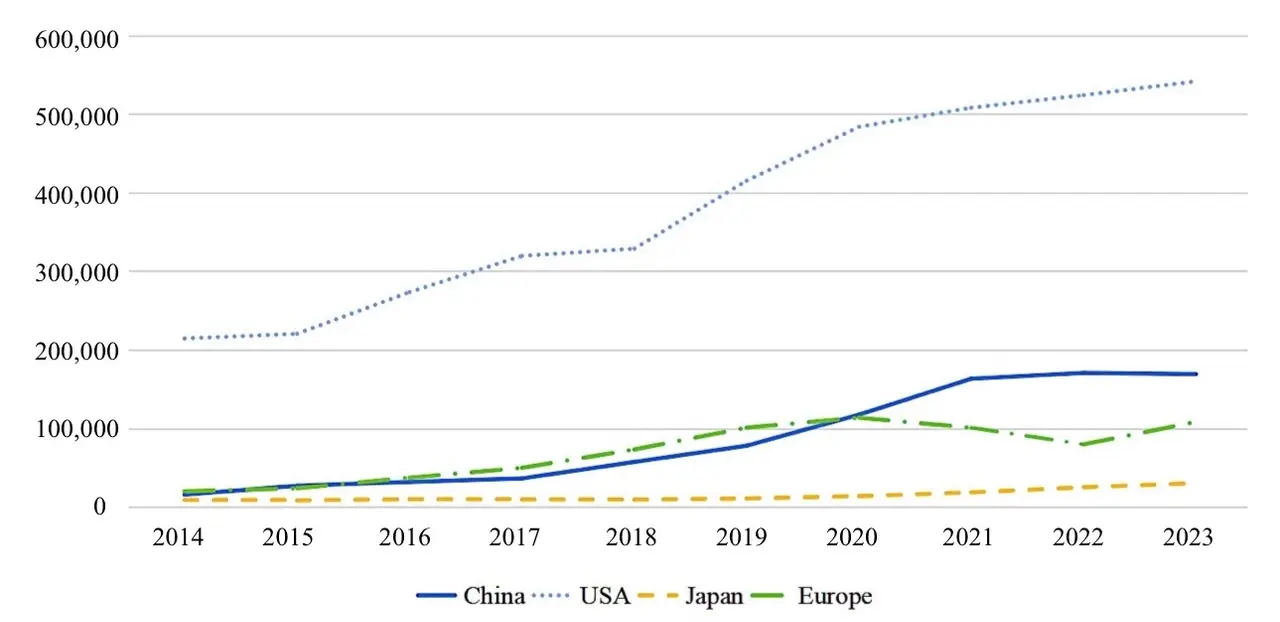
In this framework, it is relevant to take into analysis the U.S. Digital Economy Patent Data as an example as patents reflect a country’s innovation capability, the competitive landscape of market players, and the distribution of technological advantages. Wanting to comparatively analyze the patent competition situation between the U.S. and other major economies in the digital economy field, Figure 1 shows the changing trends in the number of digital economy patents for the United States, China, Japan, and the European Union between 2014 and 2023. The data reveals significant differences in growth characteristics and competitive advantages, with the United States maintaining a global leading position, indicating that it has developed an efficient innovation system and market structure in the digital economy field, mostly thanks to a comprehensive intellectual property protection system, an innovation ecosystem characterized by deep integration of industry, academia, and high-intensity R&D investment.
This article wants to be more than a tech one, by exploring the possibility and challenges that Europe can face while trying to regain control over critical digital infrastructures, that is nowadays clearly reshaping asymmetries in the transatlantic relationship, as there is an existing growing concern, also expressed by the European Parliament, that digital dependence creates geopolitical vulnerability.
A look to the different regulatory frameworks
Starting from the legislative aspect, here data shows how what the EU is facing is more a divergence rather than an asymmetry. By looking at the text of the EU AI Act (Regulation (EU) 2024/1689 of the European Parliament and of the Council), we learn how it establishes an horizontal and risk-based regulatory framework, that means that it concentrates on prohibited practices, high-risk systems, data quality, record-keeping and transparency obligations. So The EU has chosen regulatory harmonisation through substantive regulation. The White House by contrast, signed two Executive Orders, that are the number 14179 of the 23rd of January, 2025, that orders the development of a new AI Action Plan, by explicitly says that the United States should “sustain and enhance America’s global AI dominance” in order to promote human flourishing, economic competitiveness and national security, so that the key regulatory implication is that regulation is conceptualised primarily as a potential barrier to AI leadership; and the EO number 14365 of the 11th of December, 2025, that further updates federal regulatory frameworks to remove barriers to AI adoption, as the White House argues that divergent state AI laws create an “inconsistent and costly compliance regime” for AI companies, so it therefore seeks to prevent a fragmented regulatory landscape in which companies have to comply with substantially different AI rules across the 50 states. Starting from these premises, the White House’s AI Action plan was built with the priority of accelerating private-sector innovation and removing regulatory obstacles. The Plan explicitly calls for AI development to be “unencumbered by bureaucratic red tape” and proposes identifying, modifying or eliminating federal regulations that hinder AI development and deployment.
The EU AI Act’s priorities are citizens’ fundamental rights and individual protection, as well as the rule of law. On the contrary, The White House’ Action Plan places AI much more explicitly within a framework of economic competitiveness and leadership on technological infrastructure, presenting a strategy in terms of winning a global AI race. Under the AI Act, providers and deployers face specific transparency requirements, including obligations concerning interaction with AI systems and the identification or labelling of certain AI-generated or manipulated content. These rules are becoming operational as the relevant provisions of the Act enter into application. The American Action Plan does not establish an equivalent horizontal transparency regime applicable across AI applications. Instead, its regulatory philosophy is largely focused on removing rules that could slow AI development and deployment, that then creates a significant issue for US AI companies operating in Europe, that will have to implement compliance mechanisms that are not requires for the same product in the U.S.. This divergence would imply having to consider different costs and business incentives depending on the market conditions.
EU Regulation as geopolitical leverage
On a geo-political and geo-economical plan, it is particularly relevant to take into account also two other important documents. On one side, there is the EU–US Joint Statement of 21 August 2025, that in Article 17 states that the EU and the US “commit to address unjustified digital trade barriers.” However, the provision itself does not identify the Digital Markets Act (DMA) and Digital Services Act (DSA), internal-market regulation designed to ensure fair, contestable and safe digital markets, as such barriers. It specifically mentions that the EU will not adopt network usage fees and that both sides will maintain the moratorium on customs duties on electronic transmissions. From the American side, the 2025 United States Trade Representative (USTR) National Trade Estimate, released in March 2025, explicitly discusses the two acts under “Electronic Commerce / Digital Trade Barriers”, arguing that the DSA creates regulatory burdens that disproportionately affect US firms and highlights the Commission’s powers under both the DSA and DMA. This divergence is crucial because it transforms regulatory divergence into a transatlantic trade dispute, showing that the asymmetry is not defined by a one-way relationship. Later, the April 2025 DMA decisions are particularly powerful evidence of this as the Commission fined Apple for €500 million for anti-steering violations in its App Store and initiated investigations into Meta’s restrictions on third-party AI integration within its messaging platforms, also for other breaches of it. These were not symbolic statements, but actual enforcement actions against two of the world’s largest US technology companies, by also defying them as structural “gatekeepers”, setting anticompetitive barriers, and in July 2026, the Commission went further by imposing €890 million in fines on Google, consisting of €460 million for self-preferencing in Google Search and €430 million concerning steering restrictions on Google Play. American firms have responded by deliberately withholding product features and delaying launches across the European Union. Apple has recently halted the European release of its contextual Siri AI and its broader Apple Intelligence suite across iOS 27 and iPadOS 27 platforms, citing regulatory uncertainty under the DMA. Similarly, Meta announced that it would not launch its multimodal Llama models in the EU, citing an unpredictable and restrictive enforcement environment under European data protection authorities, who challenged the lawful basis of training foundation models on public user posts. The result is an emerging technological divide: while American and Asian consumers receive integrated, real-time operating system intelligence, European users face delayed or restricted functionality. This corporate friction has escalated directly into state-level trade diplomacy, as US President Trump responded by threatening the EU with substantial tariffs and implementing USTR trade investigations. In fact, the European Commission’s official Q&A of the 21th August 2025 subsequently clarified that the agreement “does not include any commitment on EU digital regulations” and that changes to the DMA and DSA “were not on the table.” This is analytically important because it demonstrates that the EU did not trade away its regulatory autonomy in exchange for the broader trade agreement.
The Washington’s response of the costs generated from EU regulations for US companies has then been refusing this regulatory power by framing elements of it not simply as neutral domestic rules, but as potential protectionist barriers to transatlantic trade. Again, The 2025 USTR explicitly states that the majority of DSA designated VLOPs (The DSA classifies platforms or search engines that have more than 45 million users per month in the EU as Very Large Online Platforms (VLOPs) or Very Large Online Search Engines (VLOSEs)) are US firms and argues that the resulting regulatory burdens disproportionately affect US companies. For the DMA, USTR highlights the Commission’s powers to regulate gatekeepers and impose fines of up to 10% of annual global turnover, rising to 20% for repeat infringements.
What presented shows how the EU may lack US-level technological giants in several digital sectors, but it possesses something different, that is the possibility of imposing legally binding obligations on companies such as Apple, Meta and Google because they need access to the European market. The ability to impose substantial compliance costs as these fines on dominant US companies demonstrates how the EU possesses this form of market-based power. In addition, the US response itself demonstrates that this regulatory power has material consequences, as if EU enforcement were economically irrelevant, Washington would have little reason to respond. Then this framing is important while analysing the asymmetry, as the European regulation becomes a matter of US trade policy when its economic effects are perceived as disproportionately affecting American firms. Anu Bradford categorises these postures as the American “market-driven model”, focusing on ex-post antitrust enforcement and innovation primacy, and the European “rights-driven model”, with the latter one characterised for treating digital regulation as a constitutional imperative, anchoring digital policy in the protection of fundamental human rights, fair market competition, and democratic institutional integrity. This doctrine has been codified through sweeping horizontal, ex-ante legislative regimes, mentioned above, including also the General Data Protection Regulation (GDPR).
Strategic trajectories and possible future scenarios
Then, the transatlantic AI relationship is becoming structurally asymmetric, but not unidirectionally so. The enforcement of the DMA against major US technology companies, with high-profile antitrust penalties and ex-ante platform legislation, demonstrates that European regulatory power can impose material costs on American firms and can even trigger US trade retaliation. Rather than eliminating the asymmetry, this interaction reveals its multidimensional character: Washington possesses greater technological power, whereas Brussels retains the capacity to shape the conditions under which that technology accesses the European market.
Looking towards how the relations will shape in the future, maybe the EU would keep responding by maintaining strict antitrust remedies and mandatory data localisation, accepting as a consequence a slower productivity in the digital industry and GDP growth as well, as the cost of preserving regulatory autonomy and consumer protections; but that would not last much long. That is why a second path could involve a deliberate European pivot toward industrial pragmatism, by recognising that regulatory influence without native technological capacity is a diminishing asset, and adopting a framework with the objective of lowering internal corporate barriers in order to retain domestic capital. Rather than attempting to duplicate American consumer or cloud platforms, the focus would be Europe’s industrial policy on domain-specific AI applications in other sectors like robotics, automotive engineering, green technology, and digital healthcare. In exchange for guaranteed European access to American tools and models, Brussels could align its dual-use export control policies and protects the allied lithography supply chain. This could led to a transformation of this relationship into a functional, highly specialised division of labor based on mutual technical dependencies. Although, this is a less probable scenario as we will probably continue to see permanent normative divergence accompanied by pragmatic security cooperation, with the United States pursuing domestic deregulation in order to achieve rapid frontier AI development.
However, driven by the strategic imperative of countering Chinese technological expansion, the two powers might establish and agree on creating an operational firewall around critical infrastructure and national security vulnerabilities. Transatlantic cooperation would then be restructured into a transactional security cartel focused on concrete points of alignment: the collective defence of undersea telecommunication cables, bilateral critical raw materials agreements, coordinated outbound investment screening, and mutual supply guarantees for advanced lithography and semiconductor fabrication. Domestic regulatory friction remains unresolved, but it is managed to protect core defence and economic security ties.
Finally, further strengthening the idea that this is an actual and always active debate, it is relevant to include in this perspective the last declarations made, from one side, by European Commission’s President Ursula Von Der Leyen in the State of The European Union 2026 that took place in Strasbourg last 16th of September, in which she has shared the key priorities and flagship projects for the year to come, building on the progress the EU has made in recent years. The president’s speech offers direct evidence of how the EU is responding to American technological hegemony, corporate pushback, and retaliatory trade threats. “Europe has the power to act. It is we who decide our rules, not big tech… We want AI with human agency. This is the essence of the European way”, with these statements, she emphasised that the EU AI Act’s enforceable powers over general-purpose model developers are non-negotiable, and that Brussels will use its regulatory leverage to slow down recursive systems that lack safety verifiability, together with developing upcoming frameworks such as the Digital Fairness Act to curb algorithmic manipulation and addictive digital design. It is important to mention how in announcing this, Von Der Leyen did not mention the United States once, and emphasised instead the building of a European compute capacity in order to break supply dependencies, also while inviting Canada to be an associate member of the EU, demonstrating how in a climate of rising trade friction Europe is visibly hedging. Then, a second recent and relevant declaration is the one made by UN Human Rights Chief Volker Türk on the 14th of September, warning and calling for an urgent action against the ungoverned race for AI which has already become a concrete human rights emergency. The High Commissioner condemned the oligopoly of certain States that host leading frontier AI companies, which should require particular obligations to act responsibly, aligning with EU’s perspective on ‘gatekeepers’ and concentrated market dominance. In stating so, he validated on behalf of the United Nations the EU AI Act’s risk-stratified, rights-based governance architecture on the global stage, elevating the european regulatory approach from a regional trade policy to an international moral baseline. “No country can govern this technology alone. No company should be able to decide by itself which risks the world must accept. No person should be required to surrender their human rights in exchange for claims of technological progress… The generation now entering adulthood will inherit the consequences of the decisions being taken on this issue without having a say in them. We owe it to them to ensure those decisions are made openly, with their rights in view, and with the humility that the scale of this undertaking demands.”
References
European Commission. (2023). A European approach to Artificial intelligence | Shaping Europe’s digital future. In digital-strategy.ec.europa.eu. European Commission. https://digital-strategy.ec.europa.eu/en/policies/european-approach-artificial-intelligence
Strengthening Europe’s Tech Sovereignty. (2026). In Shaping Europe’s digital future. https://digital-strategy.ec.europa.eu/en/policies/eu-tech-sovereignty
European Parliament & Council of the European Union. (2022). Regulation (EU) 2022/2065 of the European Parliament and of the Council of 19 October 2022 on a Single Market for Digital Services and amending Directive 2000/31/EC (Digital Services Act). Official Journal of the European Union, L 277, 1–102. EUR-Lex — Regulation (EU) 2022/2065
Commission proposes tech sovereignty package to strengthen Europe\’s digital autonomy and resilience. (2026). In European Commission – European Commission. https://ec.europa.eu/commission/presscorner/detail/en/ip_26_1187
European Software and Cyber Dependencies | Think Tank | European Parliament. (2025). In Europa.eu.
https://www.europarl.europa.eu/thinktank/en/document/ECTI_STU(2025)778576
Regulation – EU – 2024/1689 – EN – EUR-Lex. (2024). In Europa.eu. https://eur-lex.europa.eu/legal-content/EN/TXT/?uri=CELEX%3A32024R1689#
AI Action Plan. (2025). In Ai.gov. https://www.ai.gov/action-plan
EO 14179 (2026). In Govinfo.gov. https://www.govinfo.gov/app/details/DCPD-202500170
Ensuring a National Policy Framework for Artificial Intelligence. (2025). In The White House. https://www.whitehouse.gov/presidential-actions/2025/12/eliminating-state-law-obstruction-of-national-artificial-intelligence-policy/
Joint Statement on a United States-European Union framework on an agreement on reciprocal, fair and balanced trade. (2025). In Trade and Economic Security. https://policy.trade.ec.europa.eu/news/joint-statement-united-states-european-union-framework-agreement-reciprocal-fair-and-balanced-trade-2025-08-21_en
European Commission -Questions and answers Questions and answers on the EU-US Joint Statement on Transatlantic Trade and Investment *. (n.d.). Retrieved August 19, 2026, from https://ec.europa.eu/commission/presscorner/api/files/document/print/en/qanda_25_1974/QANDA_25_1974_EN.pdf
FOREIGN TRADE BARRIERS of the President of the United States on the Trade Agreements Program UNITED STATES TRADE REPRESENTATIVE. (n.d.). Retrieved August 19, 2026, from https://ustr.gov/sites/default/files/files/Press/Reports/2025NTE.pdf
Hendrix, J. (2023, October 8). Digital Empires: A Conversation with Anu Bradford. Tech Policy Press. https://techpolicy.press/digital-empires-a-conversation-with-anu-bradford
Due to DMA, Siri AI delayed in EU for iOS 27 and iPadOS 27. (2026, July 21). Apple Newsroom. https://www.apple.com/newsroom/2026/06/due-to-dma-siri-ai-delayed-in-eu-for-ios-27-and-ipados-27/
Shapiro, A. (2025, March 21). Meta AI Launches in EU with Limited Features Due to Privacy Rules. AiNews.Com. https://www.ainews.com/p/meta-ai-launches-in-eu-with-limited-features-due-to-privacy-rules
Strand, M. (2026). The Near-term Future of the Transatlantic Relationship. https://espas.secure.europarl.europa.eu/orbis/system/files/generated/document/en/Near-term-Future-Transatlantic-Relationship-FINAL.pdf
Berggren, H., Eu, I., & Eu, W. (2025). Making the EU’s digital regulatory reset count: Four recommendations CER INSIGHT: MAKING THE EU’S DIGITAL REGULATORY RESET COUNT: FOUR RECOMMENDATIONS 2 September 2025. https://www.cer.eu/sites/default/files/HB_digital_regs_2.9.25.pdf
OHCHR. (2026, September 14). Türk calls for urgent, meaningful action to tackle unprecedented AI risks. Ohchr. https://www.ohchr.org/en/press-releases/2026/09/turk-calls-urgent-meaningful-action-tackle-unprecedented-ai-risks
Von Der Leyen, U. (n.d.). State of the Union 2026 Address. Retrieved September 24, 2026, from https://commission.europa.eu/document/download/0e4622b7-6970-49c5-a4d8-0f803e1717f5_en?filename=State%20of%20the%20Union%202026%20-%20Multilingual%20address.pdf