

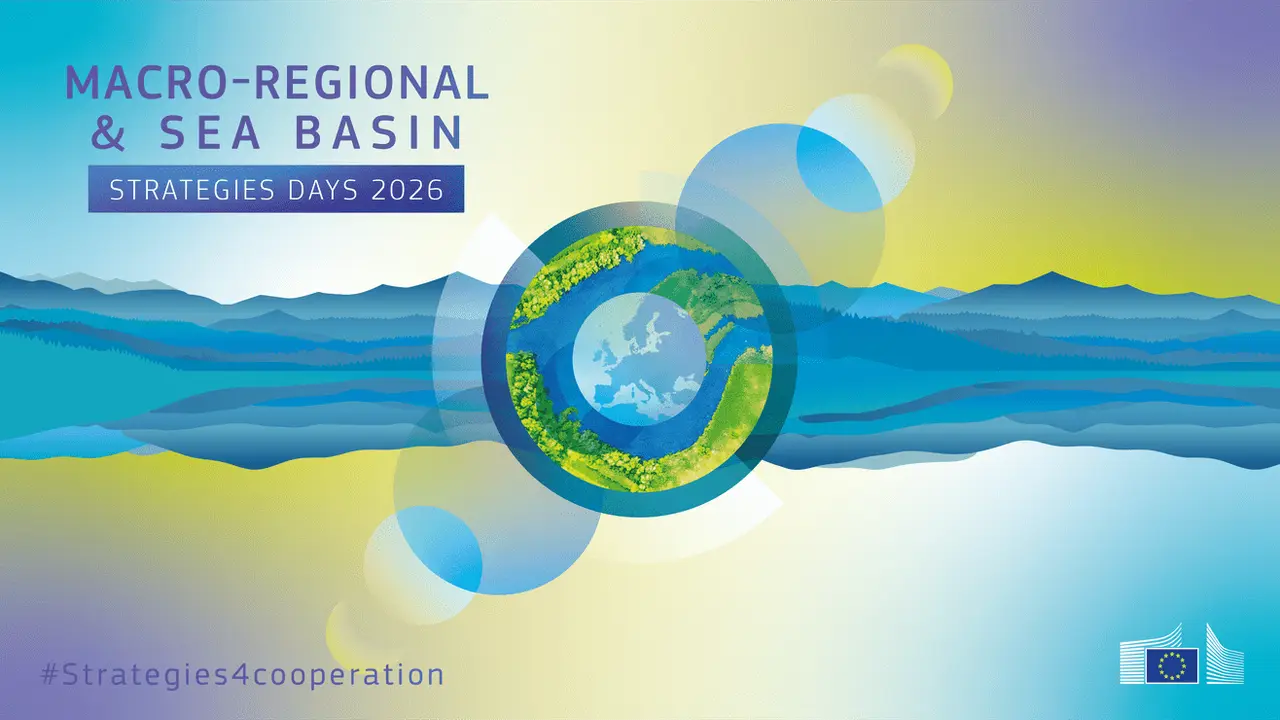

Macro-regional and Sea Basin Strategies Days 2026
Both EU Macro-regional and Sea Basin Strategies are evolving from coordination networks into implementation frameworks that help translate EU priorities into regional policies across the Member States. They connect EU objectives with national and regional actors through voluntary cooperation among Member States and partner countries while respecting existing institutional and regulatory frameworks. The future success of the strategies lies in strengthening policy coordination, embedding strategic priorities into existing and emerging funding programmes, and strengthening cross-border cooperation.
The Macro-regional and Sea Basin Strategies Days highlighted the growing importance of cooperation, stakeholder engagement, and innovation as central themes in Member States’ cooperation. Importantly, the preparation and the preconditions for the new Atlantic Macro-regional Strategy were discussed by the experts.
The Macro-regional and Sea Basin Strategy Days were held in Brussels on 8-9 July 2026. The event was organised by the European Commission’s Directorate-General for Regional and Urban Policy and Directorate-General for Maritime Affairs and Fisheries. The event brought together representatives and experts from the EU’s four Macro-regional and four Sea Basin Strategies. The purpose of the event was to discuss synergies between the strategies and possible future cooperation.
Over the two days, the participants attended a high-level panel with representatives of the presidencies of the Macro-regional and Sea Basin Strategies, plenary sessions, and several workshops. The participants and experts examined different ways of cross-border cooperation across varying regional contexts and priorities.
From cooperation framework to implementation tools
One of the key topics discussed was the transition from recognising the existence of Macro-regional and Sea Basin Strategies to their effective implementation. The experts highlighted that there is no need to create new structures to improve the implementation of existing strategies. Instead, it was highlighted that capitalising on existing mechanisms and integrating strategies into policy frameworks is essential.
The EU Strategy for the Alpine Region (EUSALP) was presented as an example of effective embedding of a Macro-regional strategy’s priorities into existing structures and frameworks. As presented at the conference, 45 programmes in the Alpine area were reviewed to assess how macro-regional priorities had been embedded into their programming. Over 80% of these programmes contained references to EUSALP priorities, most often in innovation and research, biodiversity, and energy transition.
Nevertheless, the experts identified several challenges to successful implementation. The identified challenges included scaling up successful practices across regions, enhancing project results across territories, stakeholders, and national institutions, and strengthening cooperation between strategies and different programmes. Experts outlined exchanges between project leaders and Action Groups as an important precondition for communication and learning between structures and long-term policy development.
Strengthening resilience through cross-border cooperation
During a workshop on sharing experiences in the Baltic and Black Sea Regions, the importance of resilience and preparedness in regional cooperation in the context of emerging environmental challenges, technological and hybrid threats was mentioned as a central factor for the EU’s ability to respond to shared challenges.
The experts discussed example initiatives such as OpenRisk II in the Baltic Sea, which provides risk assessment and management tools for maritime authorities. Two other examples are DARE-EU-BSB01060, a two-year project that provides assistance in disaster management in Moldova, Bulgaria, and Türkiye, and NAT-RES – BSB01415, another two-year project that aims to enhance resilience to technological accidents in the Black Sea Basin.
Furthermore, maritime security was discussed as another important point of cooperation and resilience between regions. The ORMOBASS project can detect jamming, spoofing, and even act as a backup to satellite navigation in case of disruptions.
Innovation, maritime cooperation, and the future of regional strategies
The second day of the event focused on potential thematic cooperation between Macro-regional Strategies (MRS) and Sea Basin Strategies (SBS), including greener ports, blue skills and the blue economy, investments, sustainability, and other areas. These points included developing green, smart, sustainable, and innovative ports by collaborating with port authorities, conducting research, and forming industry associations. The aim is to use ports not only as transportation hubs but also as centres for innovation, economic development, and regional competitiveness.
Different sea basin strategies demonstrated similar challenges and opportunities, such as sustainable tourism, greener shipping, renewable energy, maritime spatial planning, and synergies between the strategies as well as academia and the private sector.
Such changes will require an increased involvement of regional stakeholders and reskilling and upskilling of the population. In this context, participation of young people is an important element. The EUSALP Youth Council presented several projects, including EUSALP summer workshops, Pitch Your Project Awards, and other initiatives that create opportunities for exchange and enable youth to express their priorities and contribute to future EUSALP activities.
A new phase of macro-regional cooperation
The European Council invited the European Commission and the Member States to develop a Macro-regional Strategy for the Atlantic by June 2027. The primary objective is to foster the blue economy, renewable energy, and environmental resilience. Importantly, the speakers noted that there is a need to define the concept of the blue economy more precisely to align with strategic priorities and funding opportunities.
It was emphasised that the new strategy should be built on the existing framework of the Atlantic Maritime Strategy to avoid fragmentation and make use of existing knowledge and expertise. Key priorities identified were the improvement of transport connectivity, supporting the blue economy, attraction of talent, stakeholder involvement, and strengthened alignment between objectives and funding opportunities.
The workshop confirmed the wider question faced by all strategies: how to translate the existing frameworks into effective tools for delivering results and promoting European priorities at the territorial level.
The 2026 Macro-regional and Sea Basin Strategies Days showed that these frameworks are entering a new stage of development. The future success of these strategies will depend on their implementation, integration of policy into national frameworks, and the ability to deliver measurable results. In this context, regional cooperation, involvement of stakeholders, youth, funding opportunities, and the ability to align regional needs with EU priorities will determine the long-term effectiveness of Macro-regional and Sea Basin Strategies.