



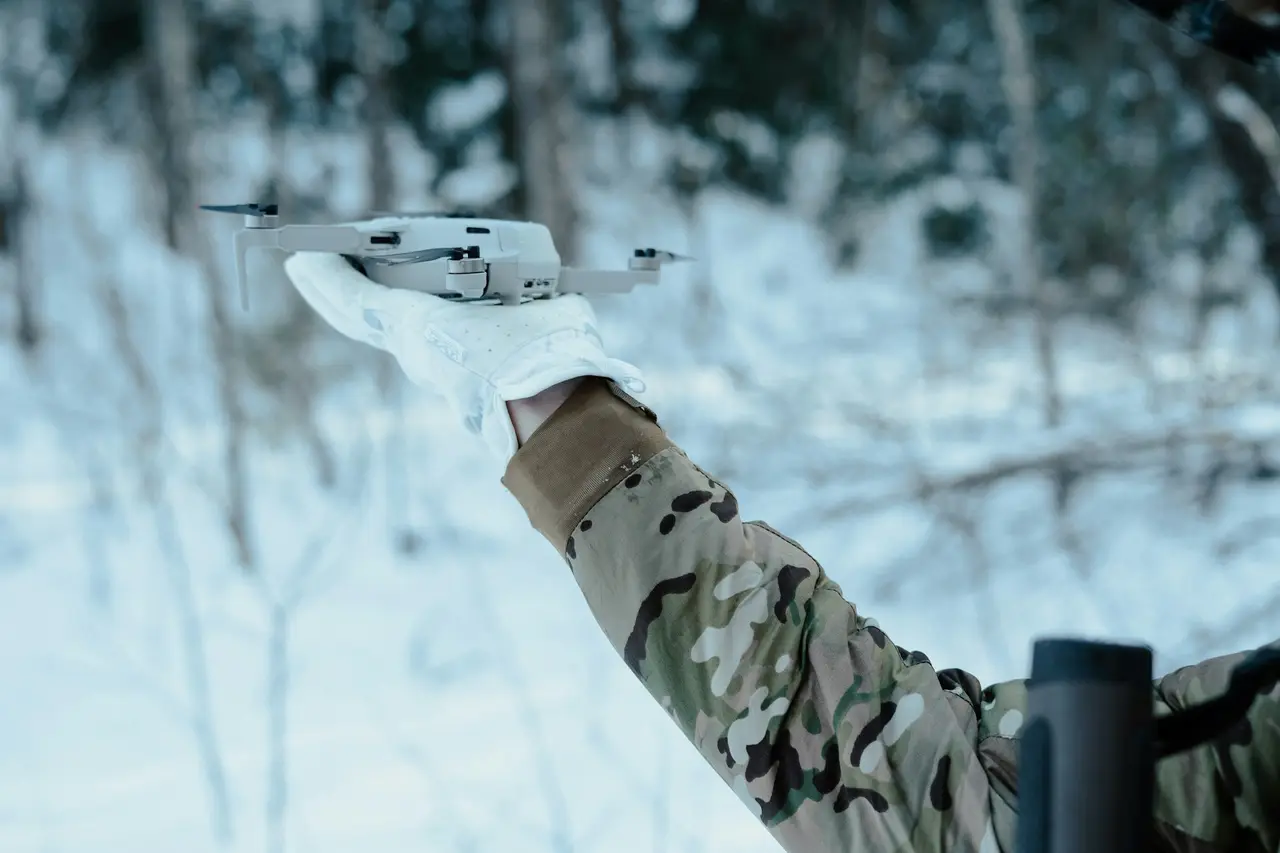

Since Russia’s invasion of Ukraine in 2022, there has been a significant shift in modern warfare strategy. Rapid advancements in drone technology enable military operations without using military personnel. Across Europe, reports of unmanned aerial vehicles (UAVs) operating in the proximity of critical infrastructure have become frequent. The recent incident at Leipzig Airport on 4th of August highlights this growing threat and has led to further escalation in German-Russian diplomatic relations (Jovanovic, Margolin, Burridge 2026).
The emergence of UAVs raises complex legal, military and geopolitical challenges. Acts of hostility from a foreign government must be redefined, Counter-UAV (C-UAV) systems become a necessary military component, and global demand for both offensive and defensive drones has skyrocketed. As hostilities with Russia continue to rise, relations with China remain multifaceted and trust in security guarantees from the United States has been damaged. The European Union has decided to bolster its military capabilities independently.
To achieve strategic autonomy, the European Commission seeks to shift away from foreign-produced defence materiel. However, despite its focus on developing a resilient industrial base, the European Commission would benefit from reevaluating its strategic partnerships in the Indo-Pacific. Being exposed to constant threat from its neighbour, China, Taiwan has absorbed lessons from the Ukraine War at a rapid pace. While Europe has developed significant supply chain dependencies on China, Taiwan has paved the way for building a large industrial base capable of mass-producing drones entirely free of Chinese components. Taiwan’s thriving microelectronics ecosystem is uniquely positioned to transform into a global drone manufacturing hub, one that corresponds remarkably well to the European Union’s defence objectives.
Defence Policy of the EU
The European Commission has defined comprehensive military objectives to be realised by 2030. The foundational framework was proposed in the White Paper for European Defence – Readiness 2030, published on March 19th 2025. This strategy was subsequently translated into concrete policy frameworks, which define four flagship projects alongside their required regulatory and financial mechanisms (European Commission 2026):
- Eastern Flank Watch
- European Air Shield
- European Space Shield
- European Drone Defence Initiative
In order to accomplish these objectives, the Readiness Roadmap 2030 (2026) outlines four imperatives:
- Strengthen the EU’s industrial base
- Close capability gaps
- Boost defence investment
- Standing firmly with Ukraine
The European Drone Defence Initiative is a direct countermeasure to hybrid attacks, such as the 4th August incident. To prevent unauthorised access by UAVs to EU soil, the Commission seeks to build an integrated C-UAV system that is interoperable across all 27 member states. This network will offer a holistic approach, from detection to neutralisation through precise counter-drone strikes.
To regulate the EU defence market, the EU has established two major mechanisms.
- The Defence Omnibus 2025 reduces market fragmentation by fast-tracking permitting for critical defence infrastructure projects and by reducing bureaucratic barriers to cross-border transfers of defence material within the EU (European Parliament 2026).
- The European Defence Industry Program (EDIP) (2025): Directs financial and industrial aspects. This mechanism increases member states’ debt tolerances for defence expenditure by up to 1.5 billion €. Additionally, it incentivises collaborative procurement among EU governments, which leads to a more equal distribution of defence equipment within the Union (European Council 2025).
However, it remains questionable whether the Union’s ambitious plan to spend 65% of its defence procurement budget on European suppliers by 2030 (European Council 2026) will be achieved. This uncertainty underscores the need to evaluate external strategic partnerships, particularly between the United States and Taiwan.
US – TW cooperation: A model for the EU
The US provides a compelling case study for how Europe can secure its industrial defence base. The United States’ Department of Defense (DoD) introduced the Blue UAV initiative. Under this framework, government institutions and critical infrastructure operators are strictly prohibited from purchasing drone components from certain countries, such as China or Russia. (Mobilcom) To operationalise this policy, the DoD has established the Blue UAS Cleared List, a catalogue of pre-approved secure components for drone manufacturing. Components outside this list must undergo rigorous verification by the Blue UAS Working Group to ensure compliance (Droneauthority 2026 …).
Furthermore, Washington, D.C., demonstrates how to connect to a foreign, highly prosperous drone ecosystem. The White House formulated the Blue Skies for Taiwan Act (2026) to elevate cooperation with Taiwanese drone companies to the institutional level. In concrete terms, corporations from both governments are enabled to undergo fast-track procedures for Taiwanese UAV systems. Thus, administrative barriers can be overcome much more easily through reducing customs friction, establishing mutual recognition of equivalent components and issuing compliance certifications (119th Congress).
Washington values Taiwan for its ability to produce UAVs free of Chinese components (“non-red”) on a scale no one else can match. The basis for this is Taiwan’s highly advanced microelectronic industry. Rather than emerging by chance, this industrial strength was deliberately fostered through government initiatives, led by the National Chung-Shan Institute of Science and Technology (NCSIST) and executed by the Drone National Team. Taiwan is expected to reach an annual production capacity of 180.000 drones by 2030 (Brar 2025).
Hence, Taipei’s market model aligns seamlessly with defence objectives of both Washington and Brussels. The US strategy combines Taiwan’s unmatched microelectronics capabilities with the US’s expertise in application systems to enable rapid scaling of high-performance autonomous drones (Taiwan Talks 2026).
Recent Memorandums of Understanding (MoUs) illustrate this synergy:
- Metal Industries Research & Development Center (MIRDC) and Anduril provide a prime example. Taiwan’s industrial research institute provides material research findings to Anduril, while the US company contributes autonomous software integration. This partnership is thus designed to incorporate Anduril’s hardware components into Anduril’s UAV production series while advancing joint R&D (EnergyOmni 2025).
- Another notable MoU was signed between the US-based software company Shield AI and the Taiwanese drone manufacturer Thunder Tiger. This integration focuses on applying GPS-denied navigation systems to unmanned underwater vehicles (UUVs) and unmanned surface vessels (USVs). Through this partnership, Taiwan will receive highly sophisticated and innovative drone systems that are not dependent on a remote controller. By scaling up these new drone types, Taiwan has greater capacity to deter China and further expand its porcupine strategy (Brar 2025).
Friction within the Taiwanese Government
Despite strong economic growth of 14,15% (Trading Economics 2026), expanding defence partnerships and a promising position on the evolving global drone market, Taiwan still struggles to facilitate its military efforts in the long run.
This structural challenge was highlighted during a recent battle over defence budget allocations. The ruling Democratic Progressive Party (DPP) proposed raising expenses to up to 6.6 billion USD through 2030. However, the opposition-controlled legislature blocked the proposal, capping annual spending at 1,26 Billion USD over six years (Blanchard, Fernandez, Heritage 2026). Opposition lawmakers from the Kuomintang (KMT) and Taiwan People’s Party (TPP) – who together hold a parliamentary majority of 60 to 51 seats- justified the blockade by demanding greater legislative oversight of defence expenditures (TaiwanPlus 2024). Even though this increased the budget, Premier Cho Jung-tai criticises this step for slowing Taipei’s efforts (Blanchard, Singleton 2026).
According to anonymous Taipei Times intelligence, the recent blockade of the bill was an act of hybrid warfare. The source claims that Beijing attempts to slow down Taiwan’s drone initiative by bribing KMT members to torpedo the Taiwanese drone initiative. While the article does not show concrete proof, the possibility of such actions seems plausible and must be taken into account (Jiing-wen, Hetherington, 2026).
Despite internal government friction over the drone initiative, the DPP has managed to compensate for the budgetary delay. The party has passed a new bill for an overall supplementary defence budget, totalling 4,58 billion USD. This money will be used to purchase a variety of UAV systems, which the DPP attempted to acquire in the initial budget proposal (Blanchard, Fernandez, Heritage 2026).
Strategic Recommendation for the EU
The expanding scope of hybrid threats and rising geopolitical tensions requires the European Union to adopt pragmatic supply chain solutions. To fulfil its ambition of building a sovereign and resilient defence technological base, the EU should execute the following strategic measures:
- Standardise Transatlantic and Indo-Pacific defence cooperation: Fragmented procurement strategies among member states slow down progress. A unified approach corresponds better with regulatory streamlining, established by the Defence Omnibus 2025. Drawing from a select group of EU drone suppliers guarantees predictable demand, higher order volumes and more in-depth research and development. Economies of scale will ultimately lead to faster procurement cycles and lower per-unit costs. Due to its remarkable scaling capabilities, Taiwan appears to be a suitable partner in this regard, arguably the best. However, only Poland and Czechia seem to have identified Taiwan as such. This is reflected in DSET’s figures for January and February 2026, for example, as both countries account for 88,13% of Taiwan’s drone exports (Lin 2026).
- Upgrade cooperation level from B2B to Institutional channels: The US’s Blue Skies for Taiwan Act 2026 showcases how drone cooperation can be managed at the policy level. While policy-channel cooperation is likely to provoke a strong backlash from Beijing, Taiwan’s capabilities will offset it through the strategic benefits of mass-producing non-red UAVs Without clear MoUs and unified regulations for Taiwanese companies to enter the European market, significant potential will be wasted.
- Formulate the necessary financial and regulatory tools: Over the short term, the Commission should establish annual purchase plans with US/Taiwan companies to stock trusted UAVs and C-UAVs. Given that global production capacity is limited, early commitments are vital now. Implementing fast-track procedures and standardised certifications will foster efficient procurement cycles.
Conclusion
The integration of Taiwan’s dual-track defence ecosystem offers a compelling blueprint for European Readiness. Combining MIRDC’s hardware scaling with NCSIST’s strategic system architecture. However, translating these dynamic B2B partnerships into a resilient EU framework requires bridging persistent regulatory fragmentation and reconciling the EU’s “non-associated third country” rules with a dedicated “non-red” supply strategy. Ultimately, institutionalising a trusted Transatlantic-Indo-Pacific drone architecture depends not only on industrial capacity but on the EU’s willingness to streamline procurement cycles and establish formal, co-production channels with Taiwanese partners.
References
Blanchard, B., Fernandez, C. and Heritage, T. (2026, August 27). Taiwan parliament rejects government military drone plan, passes own version. Reuters. https://www.reuters.com/world/china/taiwan-parliament-approves-military-drone-spending-rejects-special-budget-2026-08-27/
Blanchard, B. and Singleton, S. (2026, September 3). Taiwan proposes extra $4.6 billion in defence spending for this year. Reuters. https://www.reuters.com/world/china/taiwan-proposes-extra-46-billion-defence-spending-this-year-2026-09-03/
Brar, A. (2025, August 7). Drones over the Strait: How Taiwan’s UAV programme is redrawing cross-strait red lines. Nanyang Technological University. https://www.rsis.edu.sg/rsis-publication/rsis/drones-over-the-strait-how-taiwans-uav-programme-is-redrawing-cross-strait-red-lines/
EnergyOmni. (2026, June 5). MIRDC and Anduril sign MoU to build non-red drone supply chain. https://www.energy-omni.com/en/news/article/5E6ZifFww5hPfUnE
European Commission. (2025, March 21). White paper for European defence – Readiness 2030. European Union. https://defence-industry-space.ec.europa.eu/eu-defence-industry/white-paper-european-defence-readiness-2030_en
European Commission. (2025, October 16). Joint communication to the European Parliament and the Council: Preserving peace – Defence Readiness Roadmap 2030. European Union. https://defence-industry-space.ec.europa.eu/eu-defence-industry/readiness-roadmap-2030_en
European Commission. (2025, October 16). Preserving Peace Defence Readiness Roadmap 2030. European Union. https://defence-industry-space.ec.europa.eu/eu-defence-industry/readiness-roadmap-2030_en
European Council. (2025, December 8). European Defence Industry Programme (EDIP). European Union. https://www.consilium.europa.eu/en/policies/defence-industry-programme/
European Parliament Scientific Research Service. (2026, September 7). Omnibus V – Defence readiness: At a Glance. European Parliament. https://www.europarl.europa.eu/thinktank/en/document/EPRS_ATA(2026)791466
GovTrackUS. (2026, July 27). Blue Skies for Taiwan Act of 2026, 119th Congress. https://www.govtrack.us/congress/bills/119/s4259/text
Jiing-wen, T. and Hetherington, W. (2026, August 17). China wants to block drone bill. Taipei Times. https://www.taipeitimes.com/News/front/archives/2026/08/17/2003862613
Kelly, J. (2026, July 26). What is Blue UAS? Understanding U.S. defence drone compliance. DroneAuthority. https://droneauthority.org/gear/ndaa-blue-uas-drones
Lin, T. (2026, April 22). The invisible drone wall: Taiwan’s quiet support for a China-free European drone supply chain. Research Institute for Democracy, Society and Emerging Technology (DSET). https://dset.tw/en/research/the-invisible-drone-wall-taiwans-quiet-support-for-a-china-free-european-drone-supply-chain/
Mobilcom. (n.d.). What is Blue UAS? The ultimate guide to secure drone compliance. https://mobilicom.com/insight/what-is-blue-uas-the-ultimate-guide-to-secure-drone-compliance/
TaiwanTalks. (2026, June 25). US-Taiwan defence integration to build China free supply chain for the World. YouTube. https://www.youtube.com/watch?v=WsRqaCwdiXE
Trading Economics. (2026). Taiwan’s GDP annual growth rate. https://tradingeconomics.com/taiwan/gdp-growth-annual