


1. Introduction
Poland operates the largest electricity system in the European Union that has never produced a single kilowatt-hour from a domestic nuclear reactor, although building one has been declared government policy for more than four decades. Coal still supplied 56.2% of the country’s electricity in 2024, a record low that nonetheless leaves Poland the most coal-dependent electricity system in the Union (Forum Energii, 2025). Successive governments, regardless of political colour, have named nuclear energy as the technology meant to reconcile decarbonisation with energy security. Between a construction site abandoned in 1990 and a construction start now scheduled for 2028, the programme has survived one change of political and economic system, several changes of governing coalition, and at least two formal restarts.
The occasion for revisiting this record is immediate. In December 2025, the European Commission approved the state aid scheme financing the first Polish nuclear power station, clearing the principal legal obstacle to public co-financing of the Lubiatowo-Kopalino project (European Commission, 2025), and Polskie Elektrownie Jądrowe (PEJ) is now negotiating the engineering, procurement and construction contract with Westinghouse and Bechtel that must be concluded before construction can begin (PAP, 2026b; Rzeczpospolita, 2024). At the same time, Poland’s only operating reactor, the small Maria research unit, was shut down for several months in 2025 after its licence lapsed because the National Centre for Nuclear Research had not filed the required regulatory documents in time (Wiech, 2025; Świat OZE, 2025). One development signals progress, the other institutional fragility, and together they make the present a natural point to ask why the programme has taken so long.
This article asks why Poland has not built a nuclear power plant despite four decades of official commitment to the technology, and what conditions would need to be met for the current programme to reach completion. The analysis covers the political economy of the programme: government decisions since the collapse of central planning, the coalitions of interest that have supported and opposed construction, the institutional barriers documented by regulators, and the balance of costs and benefits of nuclear generation relative to coal and wind. It does not extend to the engineering merits of the AP1000 reactor design or to an independent safety assessment, questions that belong to the licensing process conducted by the National Atomic Energy Agency (PAA) rather than to a policy analysis of this kind.
The article’s central claim can be stated directly: Poland’s nuclear programme has been delayed principally by political and institutional instability rather than by an absence of technical feasibility or public support, and its completion now depends less on further site studies or a change of technology than on a financing model and legal framework able to survive a change of government. The article traces the programme through four political periods, examines the coalitions of interest and institutional barriers that recur across them, sets out the alternatives on the table today, and turns to the economic evidence before closing with recommendations addressed to the actors named above.
2. Historic background
2.1. The fall of communism in Poland
Poland’s first attempt to build a nuclear power station was a product of the same centrally planned system that shaped the rest of its energy sector, and its cancellation reflected the collapse of that system rather than a judgement against nuclear technology as such. Central planning in communist Poland allocated large, capital-intensive energy investments from the top down, matching a single state-owned generator to a single state-owned fuel source rather than testing the pairing against a market price. The Bełchatów complex illustrates the model: a lignite-fired power station commissioned in 1982 beside a purpose-built strip mine, planned and built as one integrated unit under state ownership, and still, decades later, the largest lignite plant in Europe by installed capacity. Coal mining in Silesia followed the same logic on a larger scale, with investment and infrastructure planned centrally around the coal seam rather than around demand, tying Poland’s electricity system, and its politics, to domestic coal for the rest of the century.
Nuclear power was planned on identical lines. Construction of four Soviet-designed VVER-440 reactors began at Żarnowiec, on the Baltic coast west of Gdańsk, in the early 1980s, with a combined planned capacity of 1,600 megawatts (World Nuclear Association, 2026), proceeding under the same top-down financing arrangements that built Bełchatów and insulated from any market test of its cost.
Two developments dissolved that insulation before the plant could be completed. The Chernobyl accident of 1986 changed the political calculus of nuclear power across Europe well beyond the Soviet bloc: the Netherlands suspended plans for two additional reactors, West Germany created a federal ministry for environmental and reactor safety, and public opposition to nuclear power rose by between 30 and 60 percentage points in Finland, Yugoslavia and Greece within the following years (Onero Institute, 2024). The second development was domestic: the negotiated end of communist rule in 1989 removed the political and financial guarantees that had kept an increasingly costly project alive. The incoming government suspended work at Żarnowiec in December 1989 and formally cancelled it in September 1990, by which point roughly 40% of the first reactor unit had been built and a substantial share of the planned budget already spent (Gierszewski et al., 2021; World Nuclear Association, 2026). Central planning had made the investment possible in the first place, and its disappearance, more than any technical judgement about the reactors themselves, is what made completion impossible.
2.2. Early 2000s
The revival of Poland’s nuclear ambitions responded to the same structural weakness that had undone the communist-era programme, dependence on a single domestic fuel source, but this time the government pursued it through market institutions rather than central allocation. In early 2005, the cabinet concluded that nuclear power was needed for energy diversification and for reducing carbon dioxide and sulphur emissions, and resolved to introduce it without further delay (World Nuclear Association, 2026). PGE followed in January 2009 with plans for two stations of 3,000 megawatts each, and in January 2010 established PGE EJ1, a dedicated subsidiary responsible for site selection, licensing and construction oversight.
The 2009 programme set out a five-stage timetable: a regulatory framework legislated in 2010 and passed in May 2011 as the amended Atomic Law; investor, site and technology decisions in 2011 to 2013; technical planning and site works in 2014 and 2015; and construction of the first unit between 2016 and 2020, with commercial operation implied for the early 2020s (World Nuclear Association, 2026). A 2009 shortlist identified Żarnowiec, Kopań and Lubiatowo-Klempicz as the most likely sites. Site preparation advanced furthest in January 2013, when PGE EJ1 awarded an 81.5 million dollar contract to WorleyParsons for site characterisation and permitting work at the shortlisted locations.
The programme did not survive its own timetable. PGE EJ1 terminated the WorleyParsons contract in December 2014, citing slow progress, and by mid-2015 the target for the first unit had already slipped from 2020 to 2024. The decisive blow came in June 2016, when the incoming government rejected the contracts-for-difference financing model PGE had proposed as too costly and stated a preference for continued reliance on coal (World Nuclear Association, 2026). Unlike the Żarnowiec cancellation, this stalling brought no formal decision to abandon the programme: no site was released and no legislation was repealed, yet the practical effect was the same, since site works stopped and the target, once fixed for the early 2020s, was left without a credible successor for several years.
2.3. Law and Justice government
In the period between 2015 and 2023, the nuclear energy programme in Poland achieved considerable success under the Law and Justice (PiS) government. Nuclear energy became an integral part of Poland’s energy transition and energy security policies. This approach was codified by the adoption of the Energy Policy of Poland until 2040 (PEP2040) in 2021, which recognized nuclear energy as a stable and low-emission energy resource that facilitates the replacement of coal-fired power stations (Betkowski, 2022; Gierszewski et al., 2021).
An important step in this period was the selection of the optimal location for Poland’s first nuclear power station. The new version of the Polish Nuclear Power Programme evaluated 27 sites for the construction of such plants, and two sites (Lubiatowo–Kopalino and Żarnowiec) were recognized as the most appropriate (Gierszewski et al., 2021). Site selection involved the assessment of several environmental and technical factors, such as geology, cooling water availability, environmental protection measures, existing infrastructure, and public opinion.
Following such an evaluation, Lubiatowo–Kopalino was found to be the best choice due to the advantageous position near the coast and other factors. Meanwhile, PEP2040 has been developing plans for building six nuclear power units with a total capacity of 6–9 GW and the first of them being operational in 2033. The plan was meant to provide support in decarbonisation and ensure the stable provision of electricity in Poland (Betkowski, 2022; Gierszewski et al., 2021).
2.4. After the PIS deafeat in 2023
The newly elected government conducted a review of Poland’s nuclear energy program launched by the previous Law and Justice Party (PiS) government after parliamentary elections held in October 2023. Despite the fact that the coalition government restated its commitment to continue prioritizing nuclear power for the energy transition program of the country, it ordered a review of the program with regard to its progress and funding (Reuters, 2024).
Importantly, the new government preserved the site of the first nuclear power plant, which remained Lubiatowo-Kopalino located near the Baltic Sea. Nonetheless, there was an agreement that the delays, inherited from the previous government, made the initial deadline of commissioning the reactor in 2033 unfeasible. Thus, the updated Polish Nuclear Power Programme pushed the deadline to 2036 with the start of construction planned for 2028 (NucNet, 2024).
The new Polish Nuclear Power Programme kept the long-term goal of building 6-9 GW of nuclear power capacity at two different sites and announced that the site of the second nuclear power plant would be determined through a competitive process in 2025. Besides, the Polish government concentrated its efforts on devising a sustainable funding scheme and initiating negotiations on state aid approval with the European Commission (NucNet, 2024).
2.5. Current policy status and timeline
Since 2024 to 2026, there was the period of realisation of Poland’s nuclear power programme, the construction of the first nuclear power plant in Poland, and some organisational and administrative problems emerged. The government supports the application of nuclear energy, but it has adjusted the schedule of realisation received from the previous government. As a result, the first AP1000 unit at Lubiatowo-Kopalino is expected to be commissioned in about 2036 (not in 2033 as it was planned before), and subsequent units in 2037 and 2038 (Polskie Elektrownie Jądrowe, 2025; PAP, 2026a).
Now, the key factor that affects the development of the project is the conclusion of the EPC agreement and the procurement of long lead components considered necessary for the adjustment of the schedule (PAP, 2026b).
The current policy is related to the discussion of the balance between large nuclear reactors and Small Modular Reactors (SMRs). Even though SMRs continue to be a component of Poland’s nuclear programme, large reactors continue to form the main route through which the country seeks to achieve decarbonisation and energy security (Ministry of Industry, 2025).
The situation in Poland’s nuclear industry is exemplified by the Maria research reactor, which is currently the sole nuclear reactor in operation in Poland. In 2025, the reactor ceased operations temporarily because of expiry of its licence as a result of failure on the part of the National Centre for Nuclear Research to provide adequate regulatory documents. Despite renewal of the licence, the case brought out problems in the regulatory framework that could affect the country’s nuclear programme (Wiech, 2025; Świat OZE, 2025).
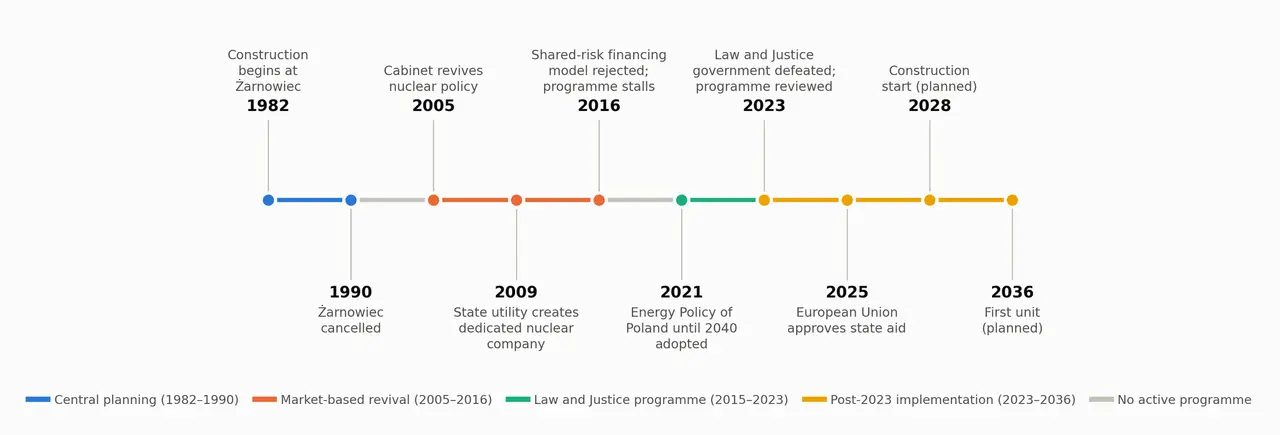
The four periods traced above share a pattern that is easier to see than to read from prose alone: an active phase of construction or policy commitment, a stall in which the programme falls dormant, and a restart under different political and financing terms.
3. Interest groups and politics
The development of nuclear energy in Poland requires parties with varying degrees of power and conflicting interests. From the perspective of stakeholder theory, the most important actors will be those that combine a high degree of power and a strong personal interest in the success of the venture (Bryson, 2004; Reed et al., 2009).
In Poland, the government with the backing of the Ministry of Industry, the Ministry of Climate and Environment, and Polskie Elektrownie Jądrowe (PEJ) is spearheading the nuclear project, with the regulation and safety of the program being taken care of by the National Atomic Energy Agency (PAA). There are state owned companies like PGE, ORLEN, Orlen Synthos Green Energy, and ZE PAK that are taking part in future nuclear and SMR projects, while Westinghouse and Bechtel offer technology and construction knowledge.
The most significant opposition stakeholder is the coal sector, consisting of coal mining firms, labour unions, and politicians representing coal dependent areas. Because of coal’s economic and political significance, consecutive governments have had to reconcile their support for nuclear energy with the safeguarding of the interests of the coal sector. This dynamic is well-known as one of the major barriers to the energy transition in Poland (Świątkowski & Domagała, 2020).
Another conflict of interest occurs between large nuclear reactor advocates and SMR developers. Similarly, there is also a conflict between the objectives of decarbonisation and regional job creation. Despite growing public support for nuclear energy in recent times, the turnover of governments keeps on generating political instability through the modification of priorities, funding, and timelines (World Nuclear Association, 2025).
4. Key political and institutional barriers
The nuclear program of Poland still faces many political and institutional barriers even though there is much political support. The first barrier is linked to political and electoral considerations, which impacted the process of implementation many times. Changes of governments led to changes in terms of financing model, planning and institutions, which caused delay of the program (International Atomic Energy Agency [IAEA], 2024; Ministry of Industry, 2020).
The second barrier consists of regulatory requirements that include the compliance with the Polish Atomic Law, environmental impact assessment, licensing by Poleskie Atomowe Agencja (PAA) and state aid approval in accordance with EU legislation. The processes mentioned are necessary to ensure nuclear safety and significantly prolong project preparation and implementation process (European Commission, 2024; IAEA, 2024).
Public acceptance and risk communication are also important aspects. Even though the support of nuclear energy grows, the negative experience from cancellation of Zarnowiec nuclear power plant and consequences of Chernobyl catastrophe affects the attitude of the society towards it. Thus, communication with stakeholders at all stages of project development is crucial (World Nuclear Association, 2025).
Thirdly, there are shortages of well-trained staff and domestic suppliers in Poland. In the absence of a nuclear industry for decades, well-trained human resources and the capacity to regulate, as well as integration of Polish companies into global nuclear supply chains, are critical preconditions for programme implementation (IAEA, 2024).
5. Analysis of political options
In the case of Poland, its energy transition will be influenced by a number of opposing political-technological approaches. The key approach is associated with the construction of the so-called nuclear power plant generation III+, which is regarded as one of the most important components of energy security and decarbonization policy. The project includes the commissioning of the first reactor around 2030, in partnership with companies like Westinghouse and Bechtel (World Nuclear Association, 2026).
Another approach implies the use of Small Modular Reactors, advocated by industry as a more flexible and decentralized technology. Nevertheless, in the case of Poland, the use of such reactors is currently at the stage of planning and development, and there is uncertainty in terms of commercial viability of such projects (World Nuclear Association, 2026).
Pathway three includes rapid development of renewable energy generation, such as offshore wind, solar PV, and storage. The Polish electricity generation portfolio already undergoes a process of diversification with growth in the generation of wind and solar energy, while maintaining the coal-based electricity generation as dominant (World Nuclear Association, 2026). Even though renewable energy is critical to decarbonization, it is inherently intermittent and thus needs flexibility and backup for its reliable performance.
Finally, there are emerging forms of governance that can be represented by energy clusters and decentralized energy systems. Such systems include generation from wind, solar, and biogas in order to achieve regional balance between energy production and consumption.
6. Analysis from an economic perspective
Four recurring economic factors explain why investment in nuclear energy has repeatedly failed to reach completion in Poland. The first is a lack of funds: nuclear projects require capital far beyond what a single state utility can raise from its own balance sheet, and every Polish attempt so far has stalled where private or market-based financing was expected to take over from state guarantees. The second is insufficient economic viability under the financing terms on offer, illustrated by the 2016 government’s rejection of the contracts-for-difference model PGE had proposed as too costly to the public purse (World Nuclear Association, 2026). The third is a lack of proven domestic technology and supply chain, forcing Poland to depend entirely on foreign vendors, first Areva and now Westinghouse and Bechtel, for reactor design and a substantial share of construction. The fourth is the set of conflicts of interest examined in section 3, particularly the coal sector’s capacity to make continued reliance on coal a lower-risk political choice than a multi-decade nuclear commitment (Brauers & Oei, 2020).
These four factors interact rather than operate independently. A government facing a powerful coal lobby has less incentive to accept the financing risk private capital demands for a first of a kind reactor. Problem is also a reliance on state guarantees limits how much capital the programme can raise without breaching European Union state aid rules, precisely the constraint behind the Commission investigation opened in December 2024 (European Commission, 2024). The economic and political barriers are therefore not two separate obstacles to be solved in sequence, but a single constraint that must be resolved jointly if construction is to proceed.
6.1. Analysis of economic benefits
Assessing whether a nuclear power station is a sound use of public and private capital requires standard investment-appraisal tool used in energy sector. The levelised cost of electricity (LCOE) expresses the minimum price per unit of electricity needed to recover all construction, financing, fuel and decommissioning costs over the plant’s lifetime, and is the figure most often used to compare generation technologies.
The Polish case illustrates the scale of capital this method must be applied to. PGE’s own 2012 estimate put the levelised cost of the planned station at €6.5 cents to 6.8 cents per kWh, and its capital cost estimate rose from roughly €2,500 to 3,000 per kilowatt of capacity in 2012 to about €4,660 per kilowatt by 2018 (World Nuclear Association, 2026), a trajectory consistent with the cost escalation that first of a kind reactors have experienced elsewhere. The current Lubiatowo-Kopalino project is estimated to cost approximately 192 billion złoty, of which around 60 billion złoty is expected to come from direct public subsidy, with the remainder financed through loans and bonds (Drosińska-Komor et al., 2026). No Polish study has yet published a comparative LCOE figure setting the first nuclear plant in Poland project directly against domestic coal or offshore wind, which is an evidentiary gap rather than a settled comparison. The available evidence instead indicates that the plant’s fuel cost is markedly less volatile than that of coal or gas, an advantage that standard LCOE calculations tend to understate because they typically use a single fuel-price assumption rather than modelling price risk (Drosińska-Komor et al., 2026).
The economic loss from thirty-five years without a domestic reactor is harder to quantify than the cost of building one, since no published Polish study offers a full counterfactual estimate of the price, emissions and import effects an operating plant would have produced since 1990. What is documented is the cost of the path taken instead: the abandonment of Żarnowiec destroyed an estimated 500 million US dollars of invested capital, of which only about six million was recovered through equipment sales (World Nuclear Association, 2026). Moreover, continued reliance on coal now carries a recurring cost through the EU Emissions Trading System, which accounted for an estimated 15 to 16% of a typical Polish household’s electricity bill in 2024 and 2025 (Notes from Poland, 2026). Against coal, nuclear’s case rests on predictable fuel costs and low lifetime emissions, which the ageing Polish coal fleet lacks. Against offshore wind, it rests on firm output, though wind proceeds on a shorter timeline and at lower capital cost per megawatt, a trade-off Polish policy has resolved by pursuing both technologies at once (Drosińska-Komor et al., 2026; World Nuclear Association, 2026).
6.2. Benefits of building a nuclear power plant for the Polish economy
The clearest economic benefit of a domestic nuclear plant is a reduction in Poland’s exposure to imported fuel. Overall energy import dependency rose from 29% to 45% over the decade to 2024, even as the country eliminated its imports of Russian gas and coal, and it spent 112 billion złoty on fossil fuel imports in 2024 alone, with crude oil import dependency at about 97% and natural gas dependency at about 82% (Forum Energii, 2025). A nuclear station runs on fuel that is imported in small, easily stockpiled quantities and traded on a diversified global market, which insulates the generation source.
Lower and more predictable electricity prices matter beyond household bills, because industry accounts for roughly one-fifth of national output and includes energy intensive sectors such as chemicals, metals and mining, for which electricity is a principal determinant of production cost and competitiveness (gmk.center, 2025). Nuclear generation, has the potential to ease a cost pressure that is unusually large in Poland, though this remains an argument for the technology’s contribution to growth rather than a demonstrated effect, since no published study yet quantifies the gross domestic product impact of the planned station directly. Construction and operation of Lubiatowo-Kopalino are nonetheless expected to create between 8,000 and 10,000 jobs during the building phase and around 1,000 permanent positions once operational, together with indirect employment that a competitive procurement process could allow Polish firms to capture in part (Drosińska-Komor et al., 2026).
Finally, nuclear power carries a social mandate that follows from the government’s own commitments to coal communities. Poland’s 2022 social contract with the mining trade unions provides for coal extraction to continue, with government subsidy, until 2049, alongside guaranteed relocation or early retirement on 80% of salary for miners affected by closures (International Energy Agency, 2023). That agreement makes an abrupt coal phase out politically and financially costly, yet it does not remove the pressure to build low emission capacity to meet Poland’s climate obligations in the meantime.
7. Political and economic recommendations
Four recommendations follow directly from the barriers identified above, each addressed to a specific actor named earlier in the article. The first is stabilisation of the legal and financing framework, so that it no longer resets with every change of government. Poland’s Atomic Law and the state aid architecture approved by the European Commission in December 2025 already provide a starting point (European Commission, 2025). What is missing is a durable, cross-party commitment, of the kind that has kept the coal sector’s subsidy regime intact through several changes of government, extended to the nuclear programme on comparable terms.
The second is selection of a financing model that shares risk between the state and private capital rather than resting entirely on public subsidy or on a market structure investors have already rejected once. The rejection of the contracts-for-difference proposal in 2016 shows that the choice of model matters as much as its existence, since a technically sound instrument can still fail if the government that must approve it judges it too costly (World Nuclear Association, 2026).
The third is a sustained capacity-building programme addressing the shortage of trained personnel, licensing capacity within the National Atomic Energy Agency, and domestic suppliers able to meet international nuclear quality standards, since the International Atomic Energy Agency identifies this shortage as a precondition for delivery rather than a secondary concern (IAEA, 2024). The supplier symposia already held with Westinghouse and Bechtel are a reasonable start, but need to be matched by domestic training on a timescale that keeps pace with construction rather than following it.
The fourth is sustained, differentiated public communication. Aggregate support for nuclear power in Poland is high, but unevenly distributed across the political spectrum and appears to rest more on ideological alignment than on an assessment of risk and benefit, so a single national campaign is unlikely to be as effective as messaging tailored to distinct audiences: energy independence for those sceptical of the technology’s safety, and environmental benefit for those already convinced of its safety but unconvinced of its necessity (Smolinski et al., 2024).
8. Summary
Poland has not built a nuclear power plant to date because every serious attempt has depended on a combination of financing, legal continuity and coalition support that has not survived a change of government, not because the technology has been judged unsafe, uneconomic in principle, or unwanted by the public. The Żarnowiec project fell with the central-planning system that had made it possible, the 2009 to 2016 revival fell when a new government judged its financing model too costly; and the current attempt, further along than either predecessor, still depends on concluding an EPC contract and holding a schedule that has already slipped once, from 2033 to 2036.
What would have to change for the outcome to differ this time follows from that diagnosis. The legal and financing framework needs to survive the next change of coalition, the financing model needs to distribute risk in a way that both government and private capital accept rather than one later governments can disown as too costly, the domestic workforce and supply chain need to be built on a timetable that matches construction rather than trailing it, and public communication needs to address the specific, politically differentiated sources of scepticism that current research identifies rather than assuming aggregate support translates automatically into durable backing. None of these conditions requires a change of reactor technology or a further site study, all are institutional and political, consistent with the finding that political and institutional instability, not technical or economic infeasibility, has been the binding constraint on Poland’s nuclear programme since 1990.
References
Betkowski, P. (2022). Energy security in Poland – transformation and role of nuclear energy. Eastern European Journal of Transnational Relations, 6(2), 79-92. https://doi.org/10.15290/eejtr.2022.06.02.06
Brauers, H., & Oei, P.-Y. (2020). The political economy of coal in Poland: Drivers and barriers for a shift away from fossil fuels. Energy Policy, 144, 111621. https://doi.org/10.1016/j.enpol.2020.111621
Bryson, J. M. (2004). What to do when stakeholders matter: Stakeholder identification and analysis techniques. Public Management Review, 6(1), 21-53. https://doi.org/10.1080/14719030410001675722
Drosińska-Komor, M., Głuch, J., Blaut, J., Szewieczek, A., & Breńkacz, Ł. (2026). The role of nuclear energy in the economic transformation of developing countries: A systematic review of evidence from Poland. Sustainability, 18(5), 2604. https://doi.org/10.3390/su18052604
European Commission. (2024, December 20). Commission opens in-depth State aid investigation into Polish support for nuclear power plant [Press release, IP/24/6437]. https://ec.europa.eu/commission/presscorner/detail/en/ip_24_6437
European Commission. (2025, December 10). Commission approves State aid for the construction and operation of Poland’s first nuclear power plant [Press release, IP/25/2963]. https://ec.europa.eu/commission/presscorner/detail/en/ip_25_2963
Forum Energii. (2025). Energy transition in Poland: Edition 2025. https://www.forum-energii.eu/en/transformacja-energetyczna-polski-edycja-2025
Gierszewski, J., Młynarkiewicz, Ł., Nowacki, T. R., & Dworzecki, J. (2021). Nuclear power in Poland’s energy transition. Energies, 14(12), 3626. https://doi.org/10.3390/en14123626
gmk.center. (2025). High energy prices affect Polish industry. https://gmk.center/en/news/high-energy-prices-affect-polish-industry/
International Atomic Energy Agency [IAEA]. (2024). Integrated Nuclear Infrastructure Review (INIR) mission report: Poland. https://www.iaea.org/sites/default/files/documents/review-missions/inir-report-poland-250424.pdf
International Energy Agency. (2023). Poland’s just transition for coal workers https://www.iea.org/policies/17726-polands-just-transition-for-coal-workers
Kharitonov, V. V., & Kosterin, N. N. (2017). Criteria of return on investment in nuclear energy. Nuclear Energy and Technology, 3(3), 176-182. https://doi.org/10.1016/j.nucet.2017.08.006
Ministry of Industry. (2020). Statement on institutional and financing changes affecting Poland’s nuclear programme
Ministry of Industry. (2025). Statement on the balance between large-scale nuclear reactors and small modular reactors in Poland’s nuclear programme
NucNet. (2024, December 4). Poland: New schedule sees three-year delay for first nuclear power plant. https://www.nucnet.org/news/new-schedule-sees-three-year-delay-for-first-nuclear-power-plant-12-4-2024
Notes from Poland. (2026, May 4). The ETS bogeyman: Is the EU’s climate tool as costly as the Polish right claims? https://notesfrompoland.com/2026/05/04/the-ets-bogeyman-is-the-eus-climate-tool-as-costly-as-the-polish-right-claims/
Onero Institute. (2024, June 4). 40 years on from the Chernobyl disaster: What were the impacts on a European stage? https://www.oneroinstitute.org/research/40-years-on-from-the-chernobyl-disaster-what-were-the-impacts-on-a-european-stage
PAP (Polish Press Agency). (2026a). Harmonogram budowy elektrowni jądrowej ambitny, ale do zrealizowania
PAP (Polish Press Agency). (2026b). Umowa EPC z Westinghouse-Bechtel do końca II kw. ’26; trwa intensywna wymiana z KE
Polskie Elektrownie Jądrowe. (2025). Press centre: Project updates on the Lubiatowo-Kopalino nuclear power plant. https://pej.pl/en/press-center/
Reed, M. S., Graves, A., Dandy, N., Posthumus, H., Hubacek, K., Morris, J., Prell, C., Quinn, C. H., & Stringer, L. C. (2009). Who’s in and why? A typology of stakeholder analysis methods for natural resource management. Journal of Environmental Management, 90(5), 1933-1949. https://doi.org/10.1016/j.jenvman.2009.01.001
Reuters. (2024). Poland’s new government reviews nuclear power programme
Rzeczpospolita. (2024). Polish companies and the AP1000 supply chain
Smolinski, P. R., Januszewicz, J., Pawlowska, B., & Winiarski, J. (2024). Nuclear energy acceptance in Poland: From societal attitudes to effective policy strategies, a network modelling approach. PLOS ONE, 19(8), e0305115. https://doi.org/10.1371/journal.pone.0305115
Świat OZE. (2025). Maria research reactor licence renewal [EVIDENCE NEEDED: exact article, date and URL to be supplied by the author; see also World Nuclear News, “Polish research reactor permitted to continue operating,” 2025].
Wiech, P. (2025). Coverage of the Maria research reactor licensing suspension
World Nuclear Association. (2025). Nuclear power in Poland https://world-nuclear.org/information-library/country-profiles/countries-o-s/poland
World Nuclear Association. (2026, July 6). Nuclear power in Poland https://world-nuclear.org/information-library/country-profiles/countries-o-s/poland