

Introduction
According to the Draghi Report (2024) on the future of European competitiveness, the European Union’s underdevelopment in AI innovation is due to excessive regulation, mainly caused by the overlap of several European digital frameworks, such as the General Data Protection Regulation (GDPR), the Digital Services Act (DSA) and one of the most recent regulations, the EU AI Act, which entered into force in 2024 (Regulation (EU) 2024/1689). For this reason, the Digital Omnibus was proposed, with the aim of bringing relief to businesses through amendments to the current digital legislation (European Commission, 2025). However, the other two superpowers at the lead of the AI race—namely the United States and China—need not resort to such excessive regulatory measures.
These regulations are scarce in comparison to those of the EU: while there is no AI regulation at the federal level in the US and Artificial Intelligence Technologies (AIT) regulations remain strictly at the domestic level (White House, n.d.), the People’s Republic of China (PRC) has only a few domestic initiatives that specifically target AI, such as the Interim Measures on Generative AI. However, albeit its voluntary core, it must be noted that the Chinese state promoted the Global AI Governance Initiative, encouraging countries to develop a people-centred approach to AI (Ministry of Foreign Affairs of the People’s Republic of China, 2023). By contrast, the EU AI Act attempts to exercise binding force at an international level, showing a much stronger international stance.
Overall, the big picture suggests that the current AI regulatory frameworks are fragmented, with the US preserving regulation at a rather domestic level compared to the rest. The paper at hand will delve deeper into the regulatory differences among the three frameworks (the EU, China and the US) and will provide an explanation for such divergence based on the capitalist regime of each of the countries, drawing on the theory presented by Hall & Soskice (2001) and Nölke (2018).
The state of the debate
Paul (2022) has identified three main streams of literature regarding AIT’s regulations: applied ethics and its main implications, the use of risk-analytical models to intervene in businesses and lastly, the politics behind AI regulation, with an emphasis on the role of capture by big tech businesses. However, the inclusion of capitalism into the frame expands the scope. In this way, four different streams of literature have been identified, relative to AIT regulation and its interplay with capitalist regimes.
Firstly, existing studies explore how actors at the lead of the AI race—primarily the EU, the US and China—regulate these technologies. Authors like Hilliard et al. (2026) focus on the complete landscape of AI policy initiatives worldwide, and highlight the similarities and differences between regulations. They find that horizontal laws converge on a risk-based approach, but countries disagree on which systems are classified as “high-risk”.
On the one hand, the EU AI regulatory framework is characterised as horizontal, risk-based and binding, which was unprecedented until recently. Ebers (2025) emphasises the importance and appropriateness of the risk-based component of the EU AI Act, along with the limitations of such an approach. More precisely, he mentions the complexity of reaching a consensus on the prioritisation of each risk, especially among different actors with diverse interests. On the other hand, the US relies on fragmented federal and state initiatives and sector-specific rules, with a lack of binding effect (White House, n.d.). Additionally, Sloane & Wüllhorst (2025) compare both frameworks against Canada’s AI regulations, finding that transparency acts as the main mechanism for the effective mitigation of AI harms.
There is a third part of this specific stream of literature focused on the Chinese initiatives to regulate AI technologies, exemplified by authors such as Sheehan (2023) or Roberts et al. (2021). The former’s investigation indicates that China’s rules on algorithms are mainly shaped by the concern of the Chinese Communist Party (CCP) with controlling online content, even though it may also be influenced by scholars and international debates. Overall, the Chinese regulatory approach to AI is carried out by the state, oriented towards industrial promotion and politically driven. Simultaneously, the government may hold back from regulating these technologies in order to foster innovation (Zhang, 2024).
Secondly, the literature focuses on the ethical implications of AI and whether they are correctly addressed and covered by current AI regulatory frameworks. Principles such as transparency, accountability and privacy are the core of this stream. Corrêa et al. (2023) claim that the weight distributed to each principle diverges not only across countries, but also across the public sphere, the private sphere and NGOs within states. Furthermore, they provide a detailed explanation of the regulatory focus of each of the cases: the EU AI regulation is risk-based, the US AI regulation is based on the protection of individuals’ rights alongside a preservation of national integrity, and China’s AI regulation is extraterritorial and focuses on content moderation. Thus, this literature identifies some convergence in the ethical narrative surrounding AI, but this does not necessarily imply the existence of institutions with the same ability to enforce these principles.
Next, a third stream presents AI governance as a field where geopolitics and regulatory competition play a big role. Smuha (2019) claims that said “race to AI” also involves a “race to AI regulation”. Additionally, Bradford (2020) coined the concept of “the Brussels Effect”, which suggests that access to the EU market can encourage multinational companies to adopt European standards beyond EU territory.
Finally, a fourth stream investigates whether there is existing literature connecting capitalist regimes with AI regulation. To do so, topics from political economy and innovation were linked to AIT regulation. Mittelman (2022) examines the term “algorithmic capitalism” and how AI expands corporate and platform power. Similarly, Tallberg et al. (2024) focus on non-state actor preferences on AI regulation in the EU. Next, Kulothungan et al. (2025) investigate whether AI regulation enhances or inhibits growth in capitalist economies. Closer to this study, we find Hayakawa (2026), who argues that contemporary capitalism is shaped by AI-driven governance. Then, Witt and Jackson (2016) examine the correlation between Varieties of Capitalism (VoC) theory and innovation. However, while these studies link capitalism to AI, none of them explains how different economic models shape the way countries regulate AI.
Capitalism as the missing variable
The previous literature review suggests that studies to date focus on explaining the content and diffusion of AI regulation, whereas less attention is given to whether economic institutions influence regulatory preferences. The purpose of this research is to extend VoC theory to AI regulation. The mechanism behind this is that capitalist institutions shape firm coordination and state-business relations, which in turn affect AI regulatory architecture.
The Varieties of Capitalism (VoC) approach, developed by Hall and Soskice (2001), posits that capitalist economies differ in their institutional arrangements, and that these differences give each economy divergent comparative advantages rather than converging on a single model. The authors define firms as central actors that have intrinsic coordination problems, which they identify in several dimensions, including corporate finance, relations between firms and employees and education and vocational training. Coordination refers in this instance to the way in which firms obtain capital, labour or technology from other actors. The authors distinguish two models of economies based on this coordination: Liberal Market Economies (LMEs)—such as the US, the UK or Canada—, where firms coordinate mainly through competitive market arrangements and hierarchies, and Coordinated Market Economies (CMEs)—such as Germany, Japan or Sweden—, where firms coordinate through non-market relationships, such as networks or business associations. Even though Hall and Soskice associate LMEs with radical innovation and CMEs with incremental innovation, Witt and Jackson (2016) find that radical innovation may emerge from hybrid institutions. Nevertheless, not all economies can conform to these two systems.
Nölke (2018) extends Hall & Soskice’s (2001) theory by adding another category to the scheme: State-Permeated Economies (SMEs). Firms’ coordination in these economies depends more directly on relationships with public authorities, without the requirement of it being a centrally planned economy. In these economies, the state supports particular firms according to strategic priorities, while at the same time it keeps domestic firms competitive. Examples include most of the members of the BRICS, such as China and India.
All in all, the question of how these economic models regulate AI arises. They may influence how governments interact with companies, which is key to understanding more permissive or more limited regulations. Additionally, the literature portrays the US as an LME, while China is classified as an SME. Although the European Union contains both CMEs and LMEs, it will be treated as a CME in this study for simplification, as it is mainly led by this group (Khan et al., 2026). Its largest economy, Germany, is the classic example of a CME, and EU policymaking itself is built on coordination similar to that of CMEs (Consolidated Version of the Treaty on the Functioning of the European Union [TFEU], 2016, Art. 154-155). However, one must not assume that the whole EU works strictly as a CME, as countries like Ireland are still classified as LMEs.
The three AI superpowers
This research attempts to evaluate whether current AI regulations in each of the case studies logically match hypotheses as to how each economic model behaves with regard to regulation. To do so, regulatory assumptions have been extracted for three common dimensions for each of the models – and the respective case studies associated with them – based on the theory that has been outlined above. The comparison focuses on the following dimensions: the form of regulation, the relationship between governments and companies and the balance between innovation and risk.
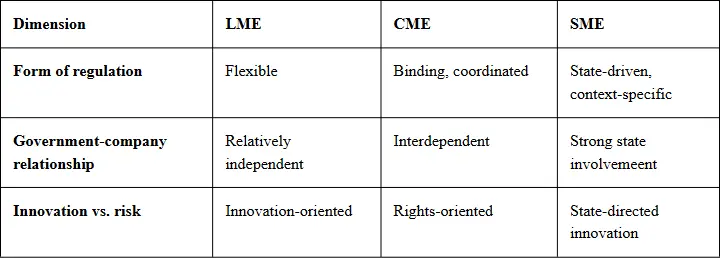
For LMEs, flexible labour markets and the importance of capital markets suggest a more adaptable regulatory environment. Regulation is expected to be less strict and more responsive to market interests, with companies maintaining a relatively independent relationship with governments. Given the focus on competition and disruptive innovation, I also expect more willingness to accept risks when they encourage technological development, potentially placing less emphasis on individual privacy rights.
For CMEs, stronger coordination and long-term relationships suggest a more stable and structured regulatory environment. Stricter and more homogeneous frameworks are expected, with a more interdependent relationship between governments and companies. The stronger emphasis on worker protection and bargaining also suggests greater attention to human rights and individual protections, with lower tolerance for risks that could undermine them.
For SMEs, the close relationship between public authorities and domestic corporations suggests a more state-driven regulatory environment. Therefore, regulation is expected to have a stronger political dimension and to adapt to state priorities and specific contexts. Finally, as the state can actively promote strategic sectors and technologies, I expect innovation to be more strongly guided by government priorities, with greater willingness to accept risks when they support strategic objectives.
Moving on to the actual AI regulatory measures taken by each of the case studies, the EU framework mostly corresponds to the expectations derived from the CME model. The AI Act establishes a binding and relatively homogeneous regulatory framework based on different levels of risk, with a strong focus on fundamental rights and safety, reflecting the expectation that stronger workers’ protections lower the tolerance for regulatory risk-taking. Companies are subject to clear obligations and public authorities have an important role in supervision, suggesting a more coordinated relationship between governments and companies. At the same time, innovation is encouraged within defined limits, supporting the expectation of a more cautious and gradual approach to technological development.
Consistent with LME expectations, US AI governance is more fragmented and flexible, and relies on voluntary instruments (rather than binding rules) such as the NIST AI Risk Management Framework (NIST, 2021), leaving companies room for flexibility. This reflects a more independent relationship between governments and companies, while firms are allowed to respond more quickly to technological developments according to market pressures. This strategy also places emphasis on innovation and competition, suggesting a greater willingness to accept certain risks in exchange for technological development. In contrast, individual rights protections are addressed through specific sector regulations—such as data privacy laws at the state level, as there is also no comprehensive national regulation in the country (DLA Piper, 2026)—instead of a cohesive federal rights framework.
Likewise, the Chinese framework supports several of the expectations associated with the SME model. In terms of regulatory form, Chinese AI governance has developed a series of context-specific measures rather than a general regulation applicable within its borders (Ding, 2025). The state plays a central role in regulating AI and defining the conditions under which companies can develop and use these technologies. At the same time, regulation is combined with the promotion of AI innovation and strategic technological development. This suggests that the government does not simply seek to limit risk, but rather attempts to direct innovation towards state priorities, resulting in a more politically driven and context-specific regulatory approach.
To visually compare the case studies with the expectations stated in Figure 1, the following figure places each case on an ordinal scale composed of five points for each dimension. The purpose of this division is to reflect relative standing, rather than quantified differences. In this way, end points suggest that a case clearly follows one dominant logic, intermediate points suggest that one logic dominates while elements of the other logic still remain, and the middle point suggests that both logics weigh roughly equally for that factor.
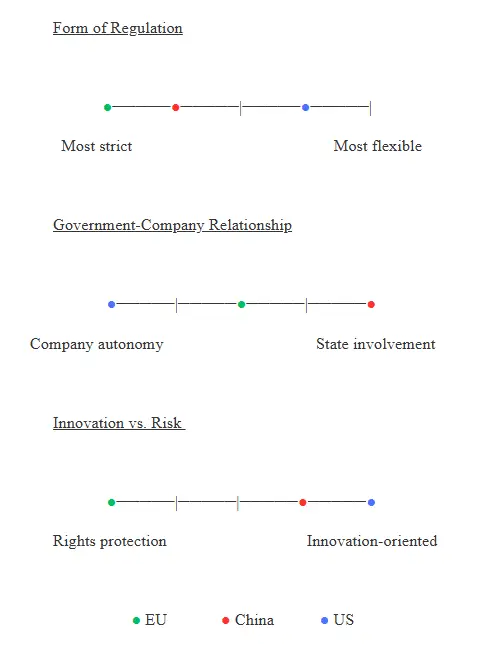
While each case broadly aligns with its predicted model, closer examination reveals points of friction. In the EU, the AI Act’s risk-based approach leaves low-risk applications out of the frame for most obligations, introducing “free market” logic into a binding CME framework. In the US, reliance on voluntary frameworks does not necessarily translate into the absence of government involvement. For instance, Executive Order 14365 – which reinforces the purpose of establishing a unified national policy framework – signed under Trump’s mandate states that the government can intervene in rolling out excessive laws that hinder innovation (White House, 2025). In China, the rules governing generative AI concerning content and ideology reveal political risk alongside the innovation-risk trade-off, highlighting a limitation of the study: political risk is a distinct regulatory factor that the innovation-risk aspect does not entirely cover. These tensions indicate that strategic influences can divert regulatory action from the predictions of each model when considered separately, despite the institutional logics remaining different.
Finally, the findings provide partial support for the expectations derived from the three models. The US shows a more flexible approach, the EU a more binding and rights-oriented framework, and China a stronger state-driven approach that does not overshadow its political principles. These differences broadly correspond to the expected forms of regulation and government–company relationships, but the frictions mentioned above also indicate that there are conflicting aspects within my hypotheses.
Does regulation follow capitalism?
Overall, the paper has examined whether the AI regulatory frameworks of each case study correspond to the expectations derived from their respective capitalist regimes. The findings suggest partial support for these theoretical expectations. The EU, as the exemplar CME, shows strong coordination in AI governance, with comprehensive regulations, coordination among different actors and a binding effect. The US, as the exemplar LME, presents a more fragmented approach, with no federal AI law and greater flexibility for companies to respond to different regulatory requirements across states. Finally, the PRC, as the exemplar SME, shows strong state involvement in AI regulation while simultaneously promoting innovation and strategic technological development. Additionally, the US has demonstrated a rather domestic approach compared to the other two powers, which have shown greater interest in promoting their approaches to AI governance worldwide. Nevertheless, it must be noted that capitalist regimes cannot fully explain all differences observed, and that only three dimensions within each regime were considered, which is an important limitation of this study. While the form of regulation and the relationship between governments and companies broadly correspond to the stated expectations, the balance between innovation and risk is less clear, as all three cases promote technological development while addressing its associated risks. Therefore, the VoC framework provides a useful approach for understanding differences in AI regulation, but should not be considered the only explanation of regulatory choices. Competitive and other economic factors may also influence the pace and manner in which governments shape their regulation.
References
Bradford, A. (2020). The Brussels effect: How the European Union rules the world. Oxford University Press. https://doi.org/10.1093/oso/9780190088583.001.0001
Consolidated version of the Treaty on the Functioning of the European Union. (2016). http://data.europa.eu/eli/treaty/tfeu_2016/oj
Corrêa, N. K., Galvão, C., Santos, J. W., Pino, C. D., Pinto, E. P., Barbosa, C., Massmann, D., Mambrini, R., Galvão, L., Terem, E., & Oliveira, N. de. (2023). Worldwide AI ethics: A review of 200 guidelines and recommendations for AI governance. Patterns, 4(10), Article 100857. https://doi.org/10.1016/j.patter.2023.100857
Ding, L. (2025). China’s regulation of artificial intelligence – progress and challenges. International Bar Association. https://www.ibanet.org/China-Regulation-of-Artificial-Intelligence-Progress-and-Challenges
DLA Piper. (2026). Data protection laws in the United States. https://www.dlapiperdataprotection.com/?t=law&c=US
Draghi, M. (2024). The Draghi report on EU competitiveness. European Commission. https://commission.europa.eu/topics/competitiveness/draghi-report_en
Ebers, M. (2025). Truly risk-based regulation of artificial intelligence: How to implement the EU’s AI Act. European Journal of Risk Regulation, 16(2), 684–703. https://doi.org/10.1017/err.2024.78
European Commission. (2025). Digital omnibus regulation proposal. https://digital-strategy.ec.europa.eu/en/library/digital-omnibus-regulation-proposal
Hall, P. A., & Soskice, D. (Eds.). (2001). Varieties of capitalism: The institutional foundations of comparative advantage. Oxford University Press. https://academic.oup.com/book/301
Hayakawa, H. (2026). AI-driven capitalism and the transformation of democratic governance: Financialization, platform power, and blended sovereignty. SSRN. https://doi.org/10.2139/ssrn.6923278
Hilliard, A., Gulley, A., Kazim, E., & Koshiyama, A. S. (2026). Artificial intelligence policy worldwide: A comparative analysis. Royal Society Open Science, 13(2), Article 242234. https://doi.org/10.1098/rsos.242234
Khan, H., Stylianou, K., Khan, Z., & Wood, G. (2026). Strategic responses of platform multinational enterprises: Rethinking competition policy through a comparative institutional perspective. Long Range Planning, 59(3), Article 102636. https://doi.org/10.1016/j.lrp.2026.102636
Kulothungan, V., Mohan, P. R., & Gupta, D. (2025). AI regulation and capitalist growth: Balancing innovation, ethics, and global governance. In 2025 IEEE 11th Conference on Big Data Security on Cloud (BigDataSecurity) (pp. 39–45). IEEE. https://doi.org/10.1109/BigDataSecurity66063.2025.00020
Ministry of Foreign Affairs of the People’s Republic of China. (2023). Global AI governance initiative. https://www.mfa.gov.cn/eng/zy/gb/202405/t20240531_11367503.html
Mittelman, J. H. (2022). The power of algorithmic capitalism. International Critical Thought, 12(3), 448–469. https://doi.org/10.1080/21598282.2022.2070858
NIST. (2021). AI RMF development. https://www.nist.gov/itl/ai-risk-management-framework/ai-rmf-development
Nölke, A. (2018). Dependent versus state-permeated capitalism: Two basic options for emerging markets. International Journal of Management and Economics, 54(4), 269–282. https://doi.org/10.2478/ijme-2018-0026
Paul, R. (2022). The politics of regulating artificial intelligence technologies: A competition state perspective. SSRN. https://doi.org/10.2139/ssrn.4272867
Regulation (EU) 2024/1689 of the European Parliament and of the Council of 13 June 2024 laying down harmonised rules on artificial intelligence (Artificial Intelligence Act) (2024). http://data.europa.eu/eli/reg/2024/1689/oj
Roberts, H., Cowls, J., Morley, J., Taddeo, M., Wang, V., & Floridi, L. (2021). The Chinese approach to artificial intelligence: An analysis of policy, ethics, and regulation. In L. Floridi (Ed.), Ethics, governance, and policies in artificial intelligence (pp. 47–79). Springer. https://doi.org/10.1007/978-3-030-81907-1_5
Sheehan, M. (2023). China’s AI regulations and how they get made. Horizons: Journal of International Relations and Sustainable Development, (24), 108–125.
Sloane, M., & Wüllhorst, E. (2025). A systematic review of regulatory strategies and transparency mandates in AI regulation in Europe, the United States, and Canada. Data & Policy, 7, Article e11. https://doi.org/10.1017/dap.2024.54
Smuha, N. A. (2019). From a ‘race to AI’ to a ‘race to AI regulation’: Regulatory competition for artificial intelligence. SSRN. https://doi.org/10.2139/ssrn.3501410
Tallberg, J., Lundgren, M., & Geith, J. (2024). AI regulation in the European Union: Examining non-state actor preferences. Business and Politics, 26(2), 218–239. https://doi.org/10.1017/bap.2023.36
White House. (n.d.). Artificial intelligence for the American people. https://trumpwhitehouse.archives.gov/ai/ai-american-worker/
White House. (2025, December 11). Ensuring a national policy framework for artificial intelligence. https://www.whitehouse.gov/presidential-actions/2025/12/eliminating-state-law-obstruction-of-national-artificial-intelligence-policy/
Witt, M. A., & Jackson, G. (2016). Varieties of capitalism and institutional comparative advantage: A test and reinterpretation. Journal of International Business Studies, 47(7), 778–806. https://doi.org/10.1057/s41267-016-0001-8
Zhang, A. H. (2024). The promise and perils of China’s regulation of artificial intelligence. SSRN. https://doi.org/10.2139/ssrn.4708676