

Introduction
Cross-border conflict, displacement and contestation over resources continues to have a disproportionate impact on women and girls in the region of the Horn of Africa which is one of the most conflict-prone regions in the world. In the last 20 years, the Intergovernmental Authority on Development (IGAD) and the African Union (AU) have become more and more ambitious in introducing the inclusion of gender in peacebuilding and conflict prevention. Both organizations have developed strategies, action plans and institutional mechanisms which explicitly engage them with the Women, Peace and Security (WPS) agenda. However, the central question that this essay explores is not whether these organizations made these commitments, they clearly did but rather focuses on whether they have taken a step beyond their formal inclusion to actually include gender perspectives in their responses in practice. Based on primary institutional documents and scholarly analysis, this essay suggests that both organizations have built up very strong normative architecture but for each, there is a significant gap between vision and implementation, due to institutional resistance, lack of funding and coordination problems. In order to take this argument beyond policy documents, this essay repeatedly brings the cases of the region back to the ground: the war in northern Ethiopia, the current crisis in Sudan, and pastoralist regions like the Karamoja Cluster.
This question is especially relevant in the context of the Horn of Africa region. The area is home to some of the most entrenched and interlinked security issues in Africa, such as the ongoing conflict in Tigray, Ethiopia, the civil war in Sudan, the persistent instability in Somalia, and pastoralist violence across Kenya, Ethiopia, South Sudan and Uganda. Frequently these conflicts are transnational, involving refugee movements, competition over water, and cross-border movements of armed groups. Women and girls are particularly impacted by displacement, sexual and gender-based violence, as well as livelihood disruption and lack of access to peace negotiations. While women are key figures in the community-level peace processes and humanitarian responses in the region, women’s participation in political representation and decision-making on Women, Peace and Security remains limited across the region (IGAD, 2023b)”. Therefore, the issue of whether there has been an integration of gender concerns in IGAD and the AU’s approach to conflict prevention is not only institutional but also directly related to the security and wellbeing of millions of women in conflict affected regions in the Horn of Africa.
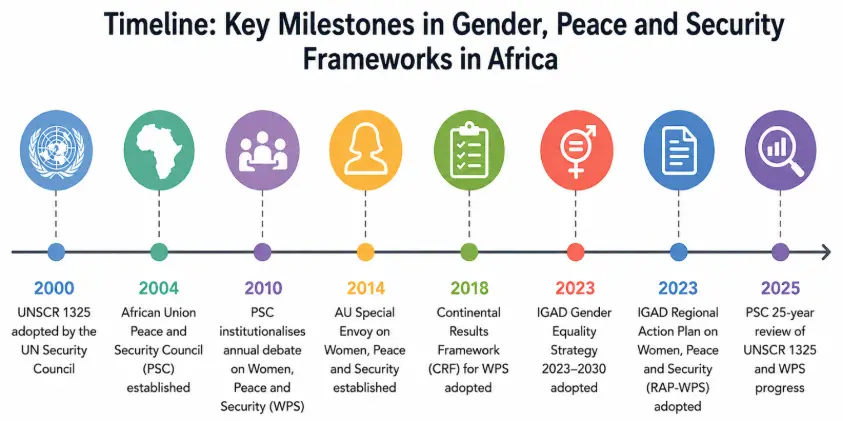
Figure 1
Key Milestones in Gender, Peace and Security Frameworks in Africa (2000–2025)
Note. Figure created by the author using ChatGPT (OpenAI, 2026). Content adapted from IGAD (2023a), IGAD (2023b), Amani Africa (2025), and the African Union Peace and Security Council documentation.
The Normative Architecture: Substantial but Insufficient
There is no doubt about IGAD’s and the AU’s formal commitments to gender sensitive peacebuilding. Adopted at a Ministerial Meeting in November 2023 in Mombasa with support from the governments of Sweden and Canada and the UN Women, IGAD’s Gender Equality Strategy 2023-2030 is an ambitious regional framework (IGAD, 2023a). In its fourth strategic priority, it formally encourages “the meaningful participation and leadership of women in peace building and conflict management at all levels of decision-making and protect women living in situations of conflict.”. The strategy also commits IGAD to align its work in global agenda and frameworks such as the UN Sustainable Development Goals and AU’s Agenda 2063, within which Aspiration 6 obligates that the development of Africa be “people-driven, relying on the potential of African people, especially its women and youth.
During the same 2023 Ministerial Meeting, IGAD has also adopted a Gender Strategy, in addition to a Regional Action Plan on Women, Peace and Security (RAP-WPS). The RAP explicitly recognizes that that “women’s participation in peace processes remains low” across the region, that “financing and monitoring the implementation of National Action Plans remain weak,” and that “implementation of most National Action Plans on WPS are not budgeted and hence their implementation is heavily dependent on donor funding” (IGAD, 2023b). These are institutional self-critical admissions of structural failure included in the same documents promising to fix them.
Similarly, at a continental level, the AU has built an equally multi-layered normative framework. A unanimous decision was taken at the 223rd meeting of the AU Peace and Security Council (PSC) (established in 2004 and the key body responsible for conflict prevention, management and resolution on the continent) in March 2010 to institutionalize an annual debate on Women, Peace and Security. During that meeting, the PSC acknowledged that women are one of the most vulnerable groups in the context of armed conflicts and it resolved to step up its actions regarding women to ensure their equal representation in national and regional decision-making bodies and peace negotiations (AU, 2010 cited in Losekann and Santos, 2024). In 2018, the AU has developed the Continental Results Framework (CRF), the main monitoring tool to track the implementation of the WPS agenda against 41 indicators, across four pillars: participation, prevention, protection and relief and recovery, of which member states and AU institutions are responsible. The PSC in its October 2025 session, commemorating 25 years of UNSCR 1325, discussed progress made on these various instruments, highlighting the increased prevalence of National Action Plans adopted by 37 member states, the expansion of FemWise-Africa as a women’s mediation network and the activities of the AU Special Envoy on Women, Peace and Security, created in 2014 (Amani Africa, 2025).
Scholarly analysis demonstrates that this normative foundation is solid. The PSC’s concept on the WPS agenda is more comprehensive than the UN model, which is based on a human security perspective that extends the protection of women beyond the state security/defense to socioeconomic development contexts, as proposed by Losekann and Santos (2024). The PSC has taken a different approach from the UNSC which has traditionally had a statist and realist perspective on the military aspects of the state, The PSC “considers a less-centered approach on the state’s military dimension more appropriate to African realities,”, and noting the factors that make women vulnerable, such as their structural position, poverty, displacement and resource scarcity. This normative division is important as it goes beyond a mere reflection of external frameworks and instead shows a local notion of gendered insecurity.
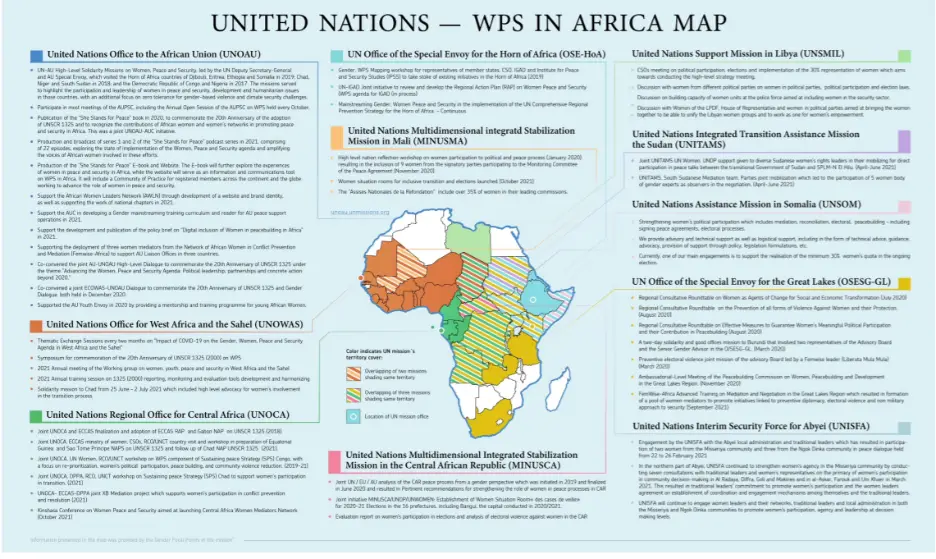
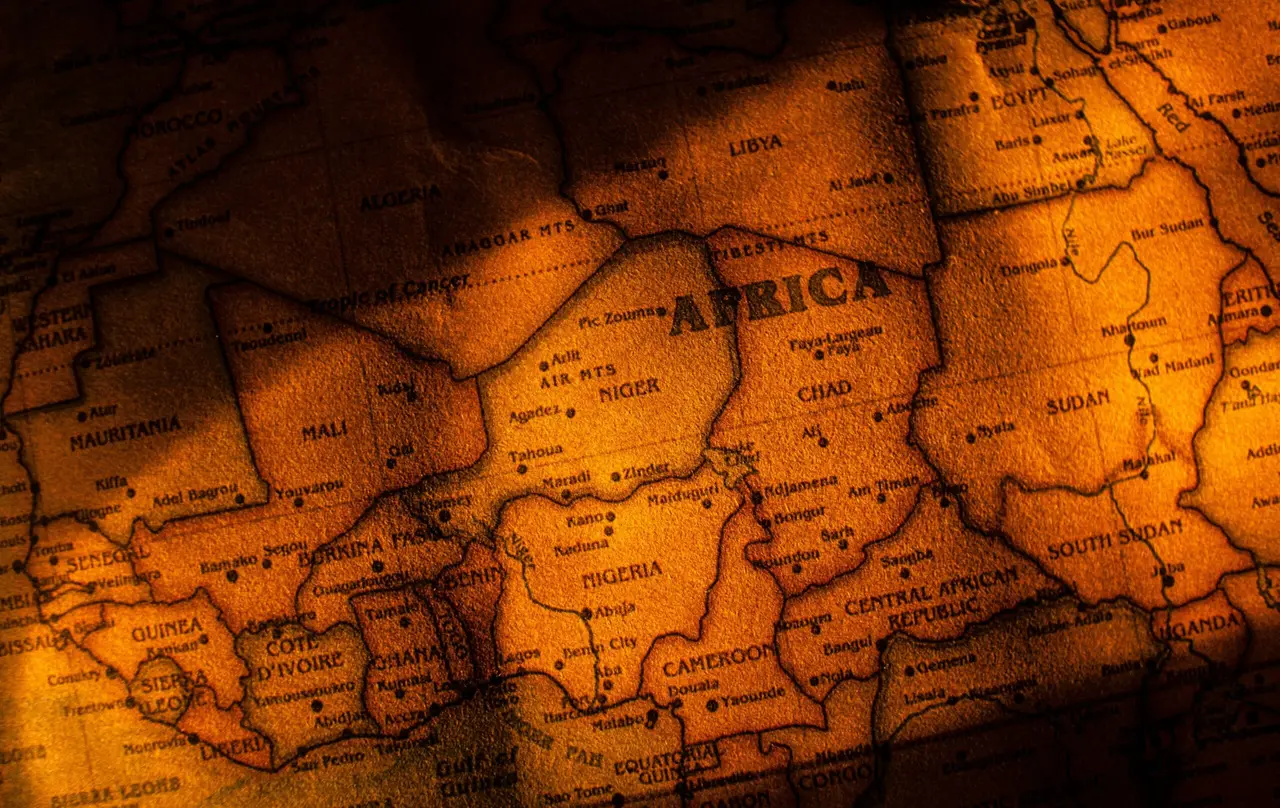
(United Nations – Women, Peace and Security (WPS) in Africa MAP | She Stands for Peace, n.d.)
The Implementation Gap: Structural and Political Failures
This strong normative architecture is not without its implementation problems, which are well documented in both institutions. In her 2017 analysis paper on the AU’s performance in relation to the implementation of WPS, Cheryl Hendricks notes that while “progress has been made in relation to the development of frameworks, policies and strategies,” the AU still has “a long way to go”’ in terms of programmatic results, especially in peace negotiations and peace support operations (Hendricks, 2017). The programmes and activities undertaken seem “rather ad hoc and attempts at quick-fix measurable exercises.”. More specifically, Hendricks argues that the WPS agenda has been limited to talking about the integration of women into peace and security institutions and processes without serious consideration of the implications of their inclusion, such as the risk of legitimizing “post-conflict patriarchal and militarized orders” through performative inclusion.
This diagnosis is confirmed by IGAD’s own institutional documents. The Gender Strategy 2023-2030 takes lessons from the previous strategy period (2016-2020) as “most project proposals have not included gender scrutiny at the design stage,” “low support across divisions and resistance by programme leaders” was noted due to “long-held cultural biases,” and “the capacity of the gender department remains low”. As well as “a lack of A regional data sharing protocol and inadequate monitoring”. The most telling statement on the peace and security aspect is the explicit recognition in the document that IGAD’s Gender Department still has a wish to engage CEWARN, the Conflict Early Warning and Response Mechanism, in “Improving the gender responsiveness of its field monitoring system.” Framing this as a future goal, not a current reality, is important: it shows that, although IGAD has formally committed to mainstreaming its primary conflict prevention mechanism, it has not yet done so substantially.
Losekann and Santos (2024) detect failures that are similar at the AU-level. Analysis of PSC activities reveals that most of the work being done by the body is on the participation pillar (training women mediators, deploying more women to peace operations), with less substantive work carried out on the prevention and reconstruction pillars. The socioeconomic inclusion of structural issues of post-conflict reconstruction are seldom tackled in a systematic way and “there is no systematic reference to translate them into practice.”. The quantitative evidence confirms the pattern, the 30 per cent women participation in peace quota has not happened and even women trained in the FemWise-Africa initiative are “not even sent to conflict scenarios” when deployed.
This implementation gap is seen in recent conflicts in the Horn of Africa. Widespread conflict-related sexual violence has been documented by the United Nations during the war in northern Ethiopia (2020-2022), and it was reported that millions of people were displaced, including numerous women and children. Likewise, the current Sudanese situation has created one of the world’s largest displacement crises and has left women vulnerable to increased threats of violence, exploitation and economic insecurity. While women have been adequately represented in informal discussions and mediation, they have not been sufficiently represented in formal negotiations and mediation processes, as demonstrated by the lack of women’s specific inclusion in IGAD and the AU peace process and humanitarian response statements.
Delegations in the IGAD-led mediation tracks on Sudan, for instance, have been strongly male-dominated, with women’s groups confined mostly to parallel civil society consultations rather than the negotiating table itself, which is a classic example of the formal-informal divide which IGAD’s own Gender Strategy identifies as a recurring problem. The key paradox of gender-sensitive peacebuilding at the regional level is that political institutions are committed to inclusion, but women remain underrepresented in political processes that drive conflict resolution and post-conflict recovery.
A key structural reason for these failures is funding. According to Losekann and Santos (2024), only 0.25 per cent of the AU Commission’s budget is allocated to the WPS agenda, and it is not optimally allocated between the pillars. The Peace Fund does not make any specific allocations to activities related to gender. In general, over 90 per cent of the financial needs of the AU are fulfilled from external sources of funding. This consideration of donor dependency as an intervening variable is in itself an issue since it questions the extent to which WPS programming responds to regional priorities and needs, rather than to the perceptions and cycles of donor agencies. The very fact that the figure is 0.25 per cent indicates that such a level of resources is insufficient to allow for the sustained adoption and embedding of gender mainstreaming, shifting IGAD and AU towards project-based, donor-dependent programming, rather than building their own institutionalized capacities and funding mechanisms.
The resource issue is exacerbated by “Coordination Failures.” In addition, although the AU and the Regional Economic Communities (RECs) have signed a Memorandum of Understanding in 2008, and the PSC’s guidelines have been implemented, there is still an element of ambiguity about the scope of the respective mandate of the two bodies when it comes to peace and security (Losekann and Santos, 2024). In IGAD, the gender responsibility is formally shared by various divisions and specialized offices, but inconsistencies and gaps in mainstreaming gender practices were noted internally during the 2024 institutional gender needs assessment, and a workshop in May 2025 for the revision and validation of the Gender Mainstreaming Toolkit (IGAD, 2025) was held.
Toward a Critical Assessment: between Inclusion and Transformation
While these situations might be administrative failures, they are also structural tensions which are inherent in the way both organizations approach their work. The core issue is gender equality interventions are enacted mostly in the form of inclusion, meaning including women into the institutions and processes, rather than transformation of the gendered institutions and processes that create insecurity in the first place, as pointed out by Hendricks (2017).
In this sense, inclusion would mean ‘adding’ women as members of mediation panels, monitoring bodies, or peace delegations that were conceived within a state-centered and militarized logic to secure ‘the security of the state’, leaving existing power structures untouched. True transformation would imply redesigning these institutions anew around the priorities and power relations that women set within their communities, for instance by formally incorporating community mediation and early warning systems as constitutive elements of peacemaking and conflict prevention in IGAD and AU member states. This is the nuance that makes Hendricks’s (2017) take on inclusion without transformation all the more pertinent, as ‘adding women’ could very well entail embedding them as guests in “post-conflict patriarchal and militarized orders”, without any transformation of structures, relations and distributions of power.
Expanding women’s presence in peace delegations or conducting training for women as mediators is not enough to change the norms and practices that marginalize women in conflict governance, nor is it sufficient to tackle their economic vulnerability, which they face in conflict settings. “Drawing up policies without the involvement of the local population tends to produce unsatisfactory results,”, as Lewis, cited by Losekann and Santos (2024), notes, and full participation of local women in the peacekeeping process has proved counterproductive.
The limitations of an inclusion-centered approach are also extremely evident in the Horn of Africa. Women often have informal peacebuilding roles in pastoralist border areas like the Kenya-Ethiopia borderlands and the Karamoja Cluster, through community mediation, resource sharing, and early warning systems. But many of these contributions take place outside of formal regional peace and security processes. Local women have been found to have key knowledge in local resource conflicts, migration trends and community tensions that could be utilized in building conflict prevention capacity, according to research from the Rift Valley Institute and the United Nations Development Programme. However, the rules and procedures still favor the elite citizens of the political arena and the representatives of the State. A transformative process would entail integrating this local knowledge into IGAD’s own architecture for conflict prevention, for example by enabling women’s community mediation networks to have a formal role in reporting within IGAD’s CEWARN, as opposed to calling on them as an informal resource on an ad hoc basis. As mentioned above, IGAD’s Gender Strategy 2023-2030 still treats the gender responsiveness of IGAD’s engagements with CEWARN as a future objective, indicating that IGAD is still far from this form of structural change. This leaves room for gender mainstreaming to become a ‘bureaucratic exercise’ instead of a process of building gender into the design of peacebuilding strategies, thus neglecting women’s lived experiences.
This critique is particularly relevant for the region of the Horn of Africa, where pastoralist inter-border violence, insecurity due to resource scarcity, and weak state institutions, are often the cause of gender-based violence. IGAD’s Gender Strategy 2023–2030 recognizes that, violent conflict and fragility impacts men, women, boys and girls differently, which is often not recognized and not acted upon in the mainstream policies and programmes on conflict and reconstruction” and that “contextual factors in each country in IGAD Member States require different operational approaches.” However, the overall implementation architecture of the strategy continues to be based on a top-down approach of coordination at the national level (national focal points) and monitoring at the secretariat level, which the strategy itself describes as inadequate at other times.
Amani Africa’s review of UNSCR 1325’s 25th anniversary (2025) reached the same conclusion as this analysis not that there is a lack of normative and institutional frameworks, but an issue in “converting commitments into measurable results”. In its March meeting, the PSC noted “the need to establish clear indicators and robust monitoring and evaluation mechanisms” which should have been formally addressed much earlier than the second decade of the agenda. A basic accountability infrastructure is still far from being mature, as evidenced by the need for a simplified digital reporting tool and biennial reporting and feedback loops that were recommended for the Continental Results Framework at a workshop in June 2025 (Amani Africa, 2025).
Conclusion
At the normative level, both IGAD and the African Union have developed regional gender-sensitive peacebuilding architectures, which are one of the most advanced in the world. Women’s commitments in IGAD’s Gender Strategy and Regional Action Plan on WPS and the AU’s Continental Results Framework as well as the PSC’s institutionalized reflection on women, peace and security are real and meaningful. However, there are structural, enduring, and documented differences between the frameworks and their reality, as evidenced by the institutions. Formal inclusion is often unachievable due to a range of institutional resistances, lack of funding, reliance on external donors, coordination problems between secretariat and member states, and limited incorporation of gender into core mechanisms.
Recent wars in Ethiopia and Sudan confirm that the problem is not a lack of gender sensitive frameworks but how the frameworks are being translated into meaningful influence over conflict prevention, mediation and post, conflict reconstruction on the regional level. The absences of the Horn of Africa’s women, who are affected by the cross-border conflicts which these organizations are supposed to manage, are not necessarily due to their absence in strategy documents but to the political and resource dynamics that need to be put in place to ensure they are present on the table for peace to be made.
Bibliography
Amani Africa (2025). Women, Peace and Security in Africa: 25 Years of UNSCR 1325. Insights on the PSC, 29 October 2025. Available at: https://amaniafrica-et.org/women-peace-and-security-in-africa-25-years-of-unscr-1325/
Hendricks, C. (2017). ‘Progress and Challenges in Implementing the Women, Peace and Security Agenda in the African Union’s Peace and Security Architecture.’ Africa Development, 42(3), pp. 73–98. DOI: 10.57054/ad.v42i3.756
IGAD (2023a). IGAD Gender Equality Strategy 2023–2030: Equality, Inclusion, and Empowerment. IGAD Secretariat, Djibouti. Available at: /api/wp-media/2023/11/IGAD-Gender-Strategy-2023-2030-2.pdf
IGAD (2023b). IGAD Regional Action Plan on Women, Peace and Security for the IGAD Region. IGAD Secretariat, Djibouti. Available at: /api/wp-media/2023/11/IGAD_RAP_WPS.pdf
IGAD (2025). IGAD Concludes Review and Validation Workshop for Customised Gender Mainstreaming Guidelines and Tools. 26 May 2025. Available at: https://igad.int/igad-concludes-review-and-validation-workshop-for-customised-gender-mainstreaming-guidelines-and-tools/
Losekann, R.Z. and Santos, L.H.P. (2024). ‘The Gender Issue in the African Union Peace and Security Council: African Contributions, Challenges and Opportunities.’ Conjuntura Austral, 15(71), pp. 7–21. DOI: 10.22456/2178-8839.140761
United Nations – Women, Peace and Security (WPS) in Africa MAP | She stands for peace. (n.d.). https://www.un.org/shestandsforpeace/content/united-nations-women-peace-and-security-wps-africa-map
This article examines how IGAD and the African Union integrate gender into peacebuilding and conflict prevention in the Horn of Africa. Despite strong Women, Peace and Security frameworks, institutional resistance, inadequate funding and coordination problems hinder implementation. Through cases in Ethiopia, Sudan and pastoralist border regions, it argues that meaningful progress requires transforming existing structures,…