Eurasia26 November 20261 min read

China-Backed Mines In Myanmar Fuel Thailand’s Severe Pollution Crisis

Beijing's representatives to support addressing pollution

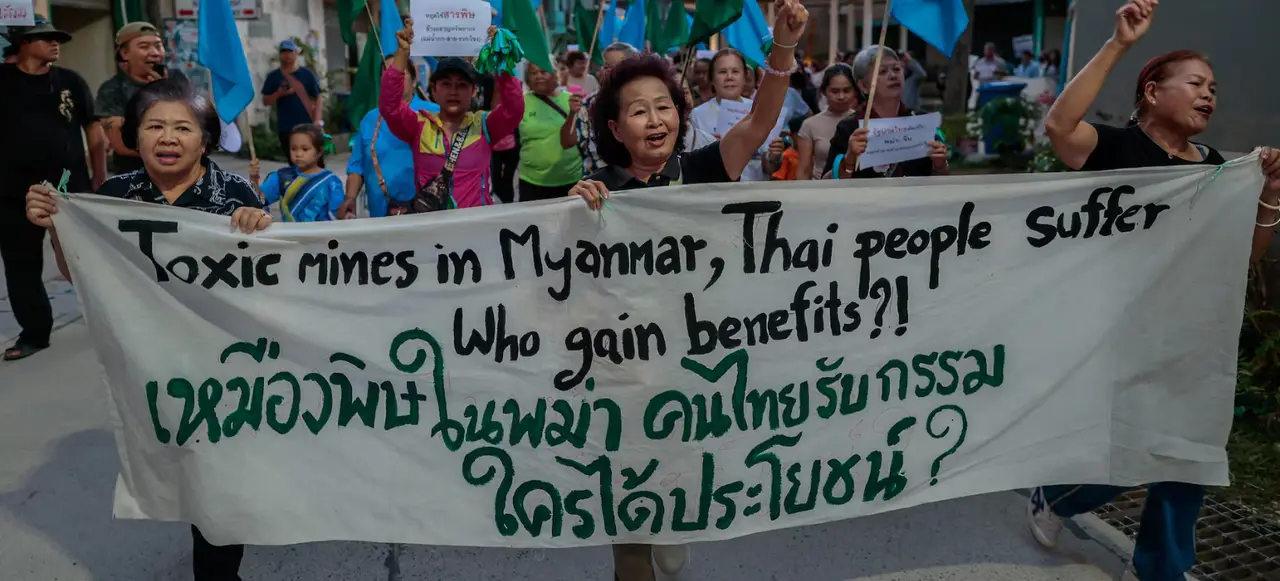
Thai protests against pollution from Myanmar, November 22, 2026. REUTERS/Patipat Janthong
Thai protests against pollution from Myanmar, November 22, 2026. REUTERS/Patipat JanthongMany of the mines responsible for the contamination are linked backed to Chinese investors
Key Insights

Bangkok has urged Beijing to help halt mining operations in Myanmar for six months, and assist in tracing the companies involved, as Chinese firms have played a central role in the pollution crisis.

Following a trilateral meeting of representatives from China, Myanmar, and Thailand in Bangkok on Tuesday, China has agreed to help combat the pollution crisis Thailand currently faces. This comes after investigators uncovered that the severe arsenic and heavy-metal contamination in multiple Thai rivers stems from unregulated rare earth mining upstream, in Myanmar’s northeastern Shan State – a region predominantly financed by Chinese investors.

Beijing has long dominated the rare earth industry worldwide, accounting for roughly 69% of mining and 91% of processing capacity in 2026. War-torn Myanmar, which is one of the world’s main sources of heavy rare earths, largely relies on financial and technical support from China.

Against this background, Bangkok has urged Beijing to help halt mining operations in northeastern Myanmar for at least six months, as well as assist in tracing the companies involved, noting that Chinese firms have played a central role in the pollution crisis.

Guo Jiakun, spokesperson for China’s Foreign Ministry, stated that Beijing will dispatch experts to actively participate and provide technical support in combating the crisis. Though this suggests aid in countering the effects of pollution, it falls in line with China’s reluctance to hold accountability for the impacts of its mining in the past.

Sophia Arenhold Sophia Arenhold is currently finalising her degree in Politics, Philosophy and Economics in Hamburg, Germany. Her research focuses on international relations and diplomacy, particularly on global power shifts concerning key players such as China, the U.S., Russia and Europe.

Cite this brief
Arenhold, S. (2026). China-Backed Mines In Myanmar Fuel Thailand’s Severe Pollution Crisis. EPIS Insight · Eurasia.
Drawing of a café terrace on a street in Cologne around 1900. A postman cycles past and papers fly from his bag, a waiter carries Kölsch glasses, and the cathedral's spires rise behind the houses.

EPIS PublicationsEvery Monday

New EPIS publications, in your inbox

One email a week with the new EPIS publications. You choose the topics on the next page.

FreeCancel at any timeYou confirm your address by email

© 2026 EPIS · Independent · Non-partisan · Funded by the EPIS FellowsLegal Notice · Privacy Policy · · Cancel contracts here · RSS

Privacy preference centre

When you visit a website, it may store or read information in your browser, mostly in the form of cookies. Choose below which categories we may use. Your choice is kept for 12 months, and you can change it here at any time. Privacy Policy

Manage consent preferences

Always active