The NORDEEP Nordic Deep Tech Business Summit is Northern Europe’s largest business-focused conference for deep technology, and organized every year in Espoo, Finland. Its main idea is to bring together scientific research, start-ups and corporations, and investors around the topics of artificial intelligence (AI), industrial tech, scaling strategies and defence politics (nordeep.com, 2026).
The conference of the year 2026 took place on September 16- 17. No doubt, a conference just 12 km away from my apartment felt like an easy introduction to conference culture as well as to the work of EPIS, but as a student of social and political science, technology is not really my cup of tea. I still saw the event as a good opportunity to gain experience in attending conferences and networking as well as report writing and social media and communication-related tasks which I am very interested in.
After arriving at Aalto University, I listened to the opening words of Jarno Limnell, a member of Parliament and the chairperson of the City Council of Espoo. He welcomed all of us to Espoo “the happiest city of the happiest country in the world” and spoke about the growing role of technology in the security policy and international cooperation. He also described how trust is one of the most relevant factors in all types of cooperation. Finally, he underlined how in these kinds of events, the speeches and panel discussions are not more important than sharing thoughts and building bridges over a cup of coffee. That is something that, in my opinion, walks hand in hand with EPIS: Building bridges and networking over cultural and professional backgrounds can, not only promote one’s own career but also create and maintain the trust that is important in the storms of the contemporary world.
I spoke with a representative of the city of Espoo about international business and she described, how in her opinion Finns tend to be good at developing technology but somewhat bad at designing and marketing it and how these kinds of events are organized mostly to bring small and big enterprises together to build cooperation. A bit of similar message was delivered by people at the stand of Business Finland and Work in Finland who described the role of international cooperation and the need to combine international knowledge to the professionalism that already exists in Finland. The discussions offered me concrete examples of questions and opportunities related to international relations, the theme I am extremely interested in. We also discussed the times of the COVID-19 pandemic and, on the other hand, the development of tools for remote work, which might not have happened without the pandemic. That was an interesting takeaway because also the work of EPIS is strongly based on international cooperation which is partly enabled by the possibilities of remote work. All in all, it was amazing to meet people from so many professional backgrounds and discuss the themes that in the contemporary societal situation are relevant for so many of us and understand how in social sciences all the themes are tied together and have an effect on one another.
I felt much more out of the place when listening to the official talks. Out of the five possible tracks I had chosen Security, Resilience, Sovereign Capability & Dual-Use because in comparison to themes like Chips, Photonics & AI Infrastructure and Energy, Advanced Materials & Circular Industry (Impact Engine) I felt that it was closest to the themes I actually had studied. The talks about defence industry, Nordic and European cooperation and the role of the Baltic Sea in defence cooperation were definitely interesting and there was even an event where different actors of the field got to present their defence related innovations, such as drones and 3D modelling tools. Therefore, the next conference is definitely worth visiting for EPIS fellows who in their studies and research concentrate on business strategy and corporate affairs because everyone was easy to approach, happy answering to questions and eager to network. After the talks I spent time visiting the stands presenting the innovations for the summit attendees. As a student the wide representation of Finnish universities caught my eye, and it was great to see how many young people under 25 also had an opportunity to present the innovations from their universities.
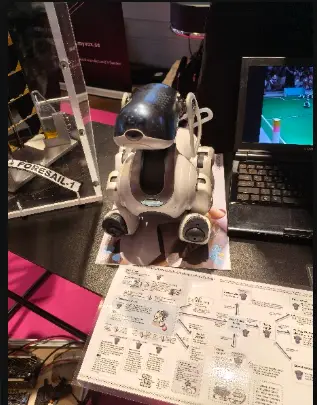
In addition to that, I had a chance to see cute Japanese robot dogs and a videotape of them playing football. The clumsy video was shot in 2005, but I was told that the rematch will happen 2027 and then the development will be notable. The robot dogs were also walking around the conference area and the visitors got to pet them and ask questions. In addition to football, they can be used to rescue wounded soldiers in war or help old people who live alone if, for example, they fall down to the floor and cannot get up on their own or otherwise need help. At the tent of IrisX, I familiarized myself with an Estonian innovation, a personality test which after a quiz of 15 minutes created a profile about my use of money and offers concrete investment tips. That was an interesting experience as the humanist in me is very interested in psychology.
All in all, the experience was very good. Like the representative of the city of Espoo told me when I described I am not very familiar with the topic, I took a bit more journalistic point of view to everything I saw, and people were surprisingly happy explaining things to me even though discussing with me might not have been very useful to them. None of my courses at university had given concrete examples of technologies used in security politics and therefore hearing the key actors of the field discussing them was useful. Therefore, I also started to feel more motivated to learn the use of AI. Especially smaller enterprises and organizations were encouraged to join and therefore I felt that as an EPIS member, my participation was warmly welcomed.