Due to Finland’s challenging geographical landscape, often described as the land of thousands of lakes and forests, and its extensive land territory and small population, covering only 0.07% of the world’s population, security and crisis preparedness questions have played a central role in Finnish society during the 20th century. This has led Finland to build its defence capabilities on mandatory military service for men, introduced in February 1919, and on its ability to rapidly transform its peacetime strength into wartime strength in just a few days (Army Command Finland, 2019).
These questions matter more in modern Finnish society, as Finland has the longest eastern border among EU countries, accounting for 1,340 kilometres (Ministry of the Interior, 2026a). Since Finland joined NATO on 4 April 2023 (Ministry for Foreign Affairs of Finland, n.d.), this border has gained a new dimension. NATO’s land border with Russia has roughly doubled in length. Finland’s NATO membership, along with Sweden’s, was a significant milestone in Northern Europe’s politico-military geography as Euro-Atlantic deterrence’s role grows in the region (Pesu, 2023). This shift has led Finland into a new phase of foreign policy, after decades of neutrality during the Cold War, followed later by military non-alignment (Kyllönen, 2025).
The new European security landscape, marked by hybrid threats, crises, and war, has drawn international attention to Finland, known for its crisis preparedness methods and comprehensive security concept. This shift in the security environment has led the Finnish government to introduce the renewed Security Strategy for Society in January 2025 to ensure society’s security in all circumstances (Ministry of Defence, 2025).
Firstly, this article introduces Finland’s changing security landscape since Russia’s invasion of Ukraine on 24 February 2022, which marked a turning point towards Finland joining NATO. Secondly, this article explains Finland’s unique comprehensive security concept and its applications. Thirdly, this article provides a brief overview of Finland’s AI readiness and how Finland uses artificial intelligence to enhance social resilience. Overall, the article addresses the following research question: How do Finland’s pre-existing higher levels of AI readiness reflect in higher societal resilience and defence sector innovation?
Finland’s changing security landscape
The nature of warfare has changed in the early 21st century as it has gained a new dimension, notably hybrid warfare, whose importance is growing. The term refers to combinations of political, military, economic, and other non-physical actions used to achieve political objectives. Hybrid warfare can include cyberattacks, information operations, physical strikes aimed at creating uncertainty among citizens, and economic coercive measures. One key feature of hybrid warfare is its unpredictability. Normally, hybrid warfare is not declared directly, which makes the line between peace and warfare uncertain (Salonius-Pasternak & Limnéll, 2015).
Finland’s significant role in countering hybrid threats is reflected in the establishment of the Centre of Excellence for Countering Hybrid Threats in Helsinki in April 2017. This centre builds counter-hybrid capacity and trains participants from academia and the public, private, civil and military sectors (European Centre of Excellence for Countering Hybrid Threats, n.d.).
Events in Ukraine, beginning with Russia’s annexation of Crimea in 2014, signalled to Finland the need to strengthen its societal preparedness, especially its comprehensive security concept, a core part of responding to hybrid warfare because it covers all forms of society. According to experts, Finland is well placed to respond to the threats posed by hybrid warfare, but it must strengthen its society’s psychological and physical resilience, as well as its non-physical performance. These changes should be included in Finland’s Security Strategy for Society in order that Finland can respond more effectively to power cuts, withstand the effects of cyberattacks, and better filter impactful information (Salonius-Pasternak & Limnéll, 2015). Since 2022, Finland has also increased its defence expenditure.
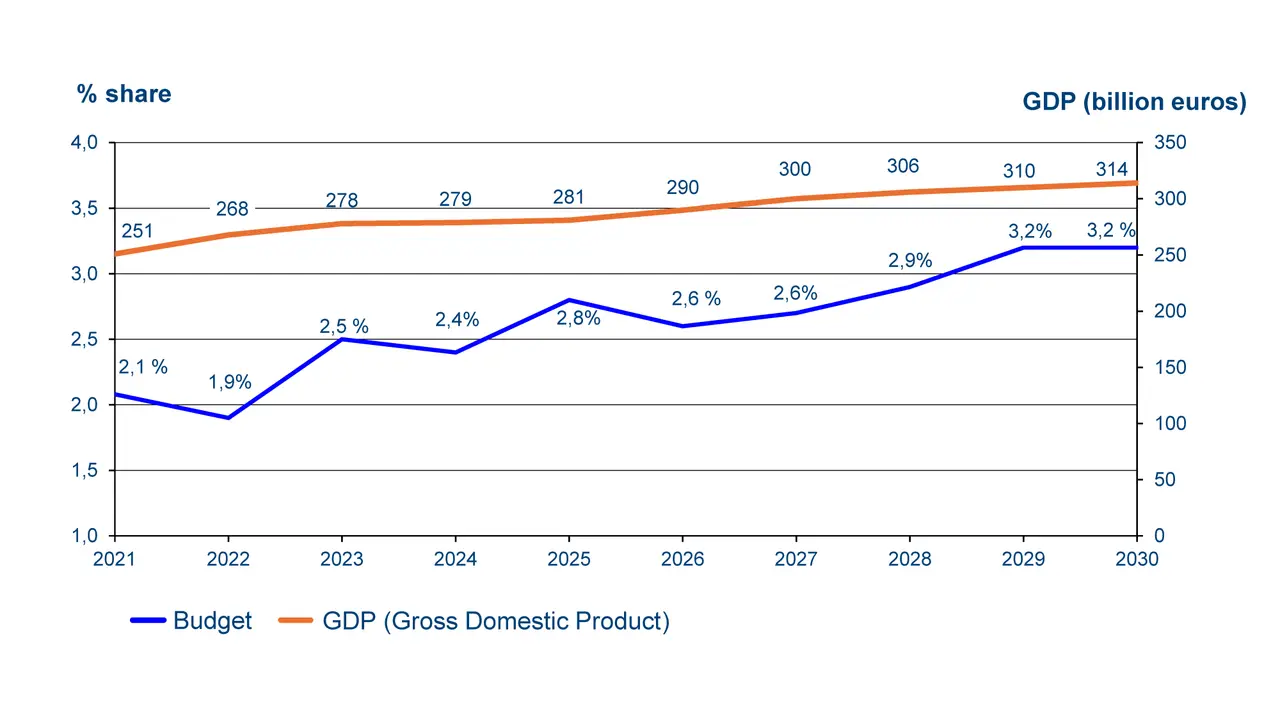
Finland increased its defence sector expenditure to 2.5% from 2.1% (2021) right after expressing its interest in joining NATO on 17 May 2022 (Ministry for Foreign Affairs of Finland, 2022), as shown in Figure 1. Finland aims to reach 3.2% of GDP for defence expenditure by 2030. Still, this evolution falls far short of NATO’s commitment at the Hague summit of Allies to increase defence investment to 5% of GDP annually by 2035, but Finland could reach the minimum target of 3.5% of GDP for defence requirements by 2035 (North Atlantic Treaty Organization, 2026).
Finland’s role in defending European and Alliance security is crucial because of its long eastern frontline. Finland should increase its investment in the defence sector beyond NATO’s minimum target of 3.5% of GDP to safeguard deterrence in the region. Finland has also made major procurements, notably the contract for 64 Lockheed Martin F-35A Lightning II multi-role fighters to replace Finland’s old Hornet fleet (Finnish Air Force, 2021).
The changing Finnish security landscape is also reflected in Finnish political life. Finland closed all border crossing points on the eastern border in November 2023 because of Russia’s instrumentalisation of people at Finland’s eastern border and the increased threat of hybrid operations (Ministry of the Interior & Prime Minister’s Office, 2023). Most recently, in June 2026, the Finnish government decided to keep Finland’s eastern border closed until further notice to protect national security and public order (Ministry of the Interior, 2026b).
This change is also reflected in the Finnish president’s discourses. Finland, long known as a mediator between East and West, changed its foreign policy significantly since Russia’s invasion of Ukraine, when Finland strongly condemned Russia’s actions and warfare (President of the Republic of Finland, 2022). Finland’s former president Niinistö’s famous declaration summarises Finland’s changed security landscape well: “now the masks are off, only the cold face of war is visible” (Tikkala et al., 2022).
Finland’s preparation for crises dominated by the comprehensive security concept
Finland’s expertise in crisis preparation is appreciated worldwide: in 2024, former president Niinistö, as Special Adviser to the President of the European Commission, submitted the report Safer Together: Strengthening Europe’s Civilian and Military Preparedness and Readiness. It proposes 80 short- and long-term recommendations for Europe’s changing security landscape (Niinistö, 2024).
Finland also promotes its comprehensive security concept abroad, for example through a free online course on its principles produced by the Security Committee (Security Committee, n.d.).
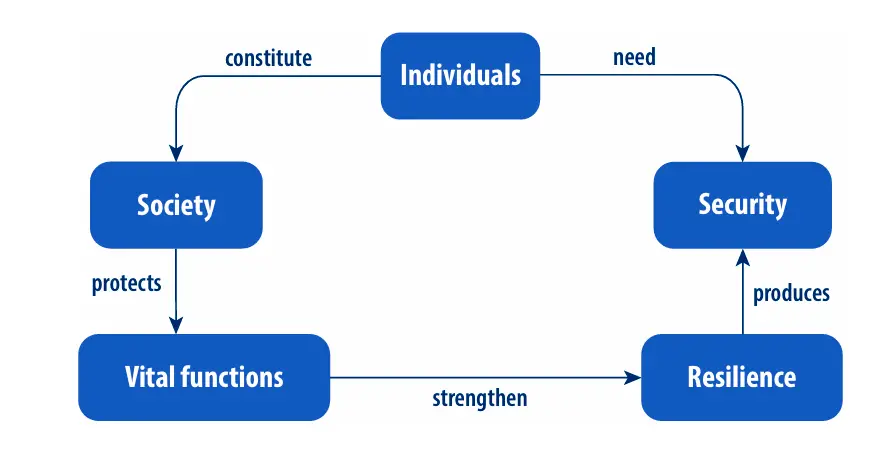
But what does the comprehensive security concept emphasise? Finland’s crisis preparedness plan, the so-called comprehensive security concept, plays a key role in increasing society’s resilience to crises and in better responding to hybrid threats, for example. It is based on cooperation among several actors in society, as shown in Figure 2: authorities, the business community, citizens, and organisations, sharing responsibility for society’s vital functions. This concept emphasises, above all, the individual’s role in responding to threats, as well as their knowledge, skills, and security-strengthening attitude, by highlighting individuals’ mutual trust. Preparedness and response readiness also help society face threats and recover from them (Security Committee, 2025).
Local civic actors also play a significant role in crisis preparedness by providing advice and building citizens’ capacity. A 2025 Prime Minister’s Office report on local civic activity concluded that civic engagement plays a primary role in basic resilience and during crises and acute disruptions. This shows in neighbourly help in sparsely populated areas and in civil society organisations’ ability to reach people (Mäenpää et al., 2025).
The Women’s National Emergency Preparedness Association is a good example of how local civic actors can strengthen social preparedness. This association brings together 10 subassociations working in national defence and comprehensive security, uniting over 100,000 women by organising safety and preparedness training such as civil defence, cybersecurity, outdoor survival skills, and information influence (Naisten valmiusliitto, n.d.).
A concrete example of civil society’s support for citizens is the website named 72 hours, created by the Finnish National Rescue Association and the National Emergency Supply Agency (n.d.) in cooperation with multiple NGOs. It advises households to keep enough supplies, such as food and water, to cope for at least three days. As noted earlier, Finland’s defence capability is built primarily around mandatory military service for men. However, women have also been able to complete their military service since 1995 (Embassy of Finland, Athens, 2017). This individual’s contribution to societal resilience is a concrete example of how Finland’s comprehensive security concept functions.
Society’s central role in comprehensive security was also visible in September 2026, when a massive civil defence exercise, Suojaan 2026, was organised in Kuopio. It regrouped over 2,000 people from different sectors, such as public authorities, NGOs, the business sector, and educational institutions, to test how a large population can be protected in exceptional circumstances and how emergency communication, cooperation and leadership can be improved. This exercise reinforced that Finnish security is built on cooperation among societal actors (Security Committee, 2026).
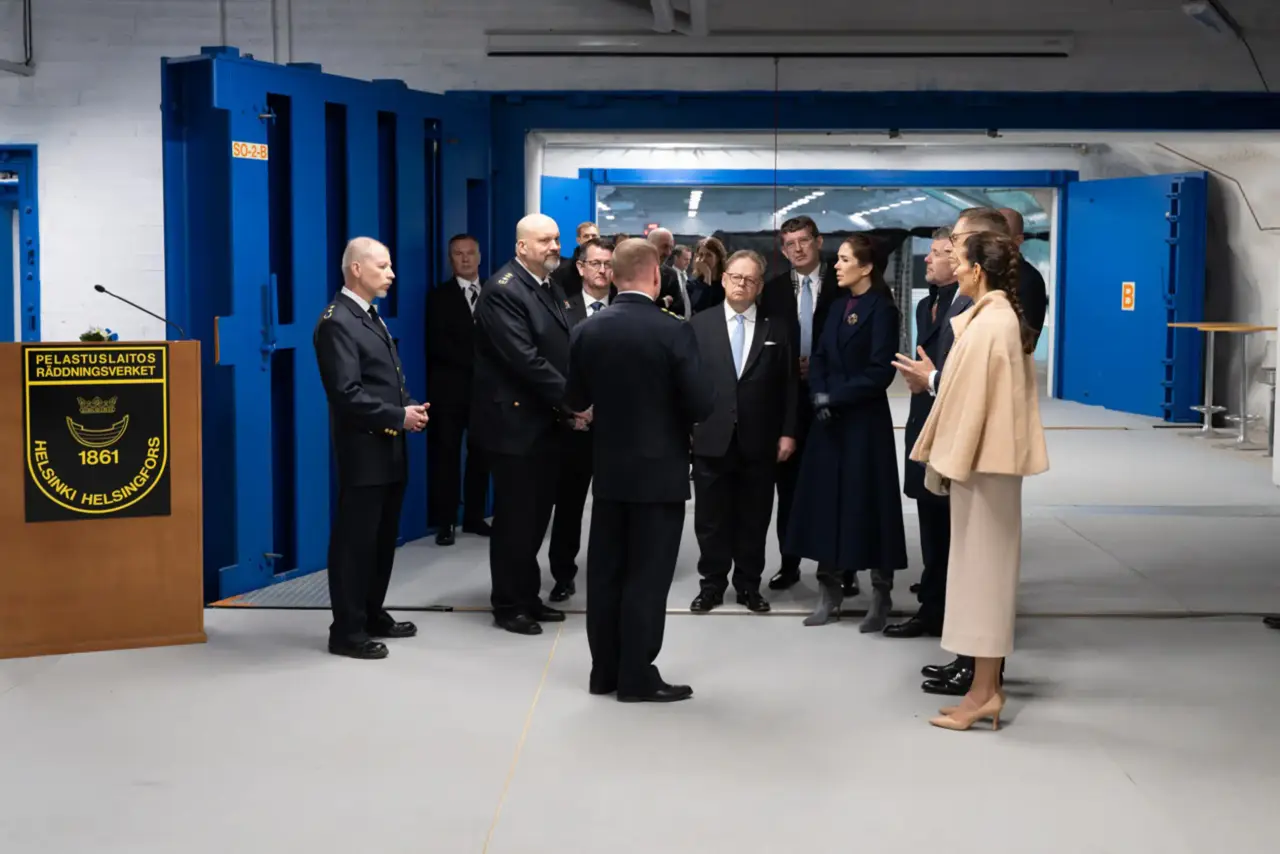
The massive exercise and its large shelter network buttress Finland’s global reputation for civil defence. Finland has over 50,500 civil defence shelters that can protect over 4.8 million people (Ministry of the Interior, 2023). As Picture 1 shows, these shelters are often shown to visiting heads of state.
Strong artificial intelligence readiness among Finnish society and its characteristics
Finland is ranked among the most advanced states globally in AI readiness. According to Eurostat (2026), Finland’s SMEs have the highest digital intensity in business among member states, and Finland has the highest percentage (79.2%) of all member states for businesses buying cloud computing services in 2025. Finland also ranks second, after Denmark, in business use of AI (37.8%) (Eurostat, 2026).
Finland’s success in AI adoption stems from the widespread use of AI technologies across Finnish society, a strong government model based on predictable principles, and strong ICT expertise and innovation capacity (AI Finland & Business Finland, 2026).
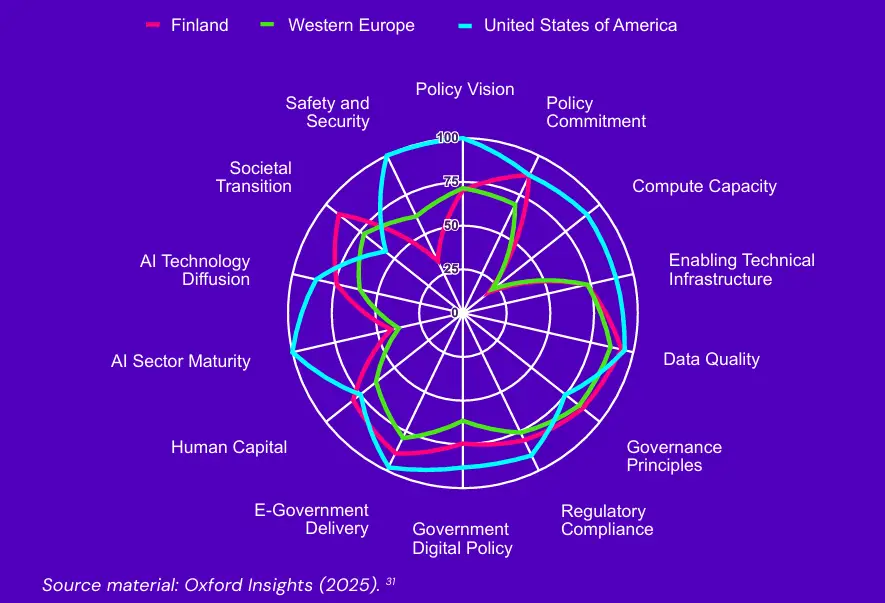
As Figure 3 indicates, the United States leads AI readiness worldwide, leaving Finland and Western Europe behind, especially in safety and security, compute capacity and AI sector maturity. According to the Oxford Insights report (Iida et al., 2026), China ranks 8th in state, public sector, and society capability for AI readiness, with strengths in policy vision, governance principles, and safety and security. Finland ranks 18th, scoring well in data quality, e-government delivery and especially societal transition (90.67/100), compared with the two superpowers, the United States and China, both of which score just above 50/100 (Iida et al., 2026).
One reason for Finland’s strong position in AI readiness can be its first place in the 2023 Digibarometer, which measures the degree of digitalisation in societies. Finland has strengthened its digitalisation across businesses, citizens and the public sector compared with previous years. Finland is among the world leaders in many sectors, especially in citizens’ digital skills and the number of mobile and fixed broadband connections (Ali-Yrkkö et al., 2023). A good example of leveraging Finland’s citizens’ digital skills is the VBS3 video game-style war simulator, used to train conscripts by providing realistic scenarios for practising military skills (Roslander, 2021).
Artificial intelligence, defence and social resilience
An early example of Finland’s embrace of AI is Finland’s Age of Artificial Intelligence (Steering Group of the Artificial Intelligence Programme, 2017), a report published by the Ministry of Economic Affairs and Employment. The report recognises the advantages of using AI in the security sector to better detect threats, increase society’s preparedness, and ensure society’s capacity for quick recovery, but it also stresses that individuals’ privacy and protection must be guaranteed. In addition, this publication highlights Finland’s strong starting position as a technology multiskilled actor to become an expert at adapting AI in the defence sector (Steering Group of the Artificial Intelligence Programme, 2017).
In November 2025, the Finnish Defence Forces introduced a data and AI strategy outlining how AI and data can support decision-making, development, learning and operations in the long term, with the aim of making AI and data-driven management a seamless part of decision-making at all levels. Ideally, data is treated as a strategic resource to gain an advantage in administration and operational action, freeing resources for the Finnish Defence Forces’ core task (Pääesikunta, 2025).
As Major General Samu Nurmi highlights, the modern battlefield extends beyond land, air and sea to include cyberspace and the information environment, and data has become a key resource rather than a mere tool (Finnish Defence Forces, 2025). The Finnish Defence Forces therefore sees data and AI as central tools for improving military performance through unmanned systems such as drones, and as essential for filtering, analysing, and combining information (Finnish Defence Forces, 2025).
Finland’s AI readiness is also reflected in its defence innovation sector. As the war in Ukraine has shifted the battlefield towards unmanned systems, many Finnish companies have begun producing drones. For example, Patria, a major Finnish defence company, began cooperating with the AI start-up NestAI to produce AI-enabled unmanned aerial systems for European defence markets (Patria, 2026). Start-ups such as NestAI and Kova Labs aim to increase European defence autonomy and sovereignty. Kova Labs develops drone technology with GNSS-free navigation and obstacle avoidance for complex, contested terrain (Kova Labs, n.d.). NestAI focuses on developing a modular platform for defence systems to gain sovereign control (NestAI, n.d.).
As noted earlier in the chapter, Finland has recognised the multiple advantages of AI in increasing societal resilience, such as combating cyber threats, supporting decision-making, and helping establish situational awareness. Finnish society is still approaching the AI revolution with caution. For example, Finnish security authorities used AI for the first time as a target in the national cyber exercise (KYHA) in September 2026 in Jyväskylä, providing valuable information on the consequences of an attack on an AI service (Ministry of Transport and Communications, 2026).
Conclusion
Russia’s 2022 invasion of Ukraine pushed Finland to renew its Security Strategy for Society in January 2025 to counter hybrid threats. Finland’s unique comprehensive security concept is a key factor in establishing greater resilience in Finnish society. It rests on shared responsibility among authorities, businesses, citizens and organisations, with particular emphasis on the individual.
Finnish civil society plays a crucial role in preparing citizens for crises through online advice such as the 72 hours website, large civil defence exercises organised with the authorities, and voluntary preparedness training.
Finland also has strong AI readiness, reflected in SMEs’ digital intensity and businesses’ high adoption of AI. In answer to the research question, this readiness can be seen especially in the defence sector’s start-ups like NestAI and Kova Labs, whose technology strengthens European defence autonomy and resilience against crises.
Beyond defence companies, the Finnish government has also recognised AI’s advantages, for example in detecting threats, supporting decision-making, and helping establish situational awareness to increase societal resilience. The Finnish Defence Forces’ 2025 data and AI strategy aims to make AI and data-driven management a seamless part of decision-making at all levels.
References
AI Finland & Business Finland. (2026). AI in Finnish business 2026. /api/wp-media/2026/04/AI-in-Finnish-Business-2026.pdf
Ali-Yrkkö, J., Kässi, O., Pajarinen, M., & Rouvinen, P. (2023). Digibarometri 2023: Data, tekoäly ja talouskasvu [Digibarometer 2023: Data, artificial intelligence and economic growth]. Taloustieto Oy. https://www.etla.fi/en/publications/other-publications/digibarometri-2023-data-tekoaly-ja-talouskasvu/
Army Command Finland. (2019, February 8). Finnish liability for military service – the bedrock of our defence for 100 years. https://maavoimat.fi/-/suomalainen-asevelvollisuus-puolustuksemme-perusta-100-vuotta?languageId=en_US
City of Helsinki. (2025). Helsinki Mayor hosts Danish royalty at City Hall. https://www.hel.fi/en/news/helsinki-mayor-hosts-danish-royalty-at-city-hall
Embassy of Finland, Athens. (2017, June 16). Naisten vapaaehtoinen asepalvelus [Women’s voluntary military service]. https://finlandabroad.fi/web/grc/ajankohtaista/-/asset_publisher/TV8iYvdcF3tq/content/naisten-vapaaehtoinen-asepalvelus/384951
European Centre of Excellence for Countering Hybrid Threats. (n.d.). Establishment. https://www.hybridcoe.fi/establishment/
Eurostat. (2026). Digitalisation in Europe – 2026 edition. https://ec.europa.eu/eurostat/web/interactive-publications/digitalisation-2026
Finnish Air Force. (2021, December 10). The Lockheed Martin F-35A Lightning II is Finland’s next multi-role fighter. https://ilmavoimat.fi/-/lockheed-martin-f-35a-lightning-ii-on-suomen-seuraava-monitoimihavittaja?languageId=en_US
Finnish Defence Forces. (2025, November 27). Puolustusvoimien data- ja tekoälystrategia on julkaistu [The Finnish Defence Forces’ data and AI strategy has been published]. https://puolustusvoimat.fi/-/puolustusvoimien-data-ja-tekoalystrategia-on-julkaistu
Finnish National Rescue Association & National Emergency Supply Agency. (n.d.). 72 hours – could you cope on your own? https://72tuntia.fi/en/#varaudu
Iida, K., Rahim, S., Hutber, C., Grau, G., Moss, C., & Douglas, O. (2026). Government AI readiness index 2025. Oxford Insights. /api/wp-media/2026/06/LATEST-GAIRI-Report-2025.pdf
Kova Labs. (n.d.). Kova Labs is an advanced engineering lab building the autonomous land force. https://kovahq.com/
Kyllönen, K.-M. (2025). Redefining national identity through security discourse: Finland’s transition from military non-alignment to active defence cooperation. Cooperation and Conflict, 60(4), 702–726. https://doi.org/10.1177/00108367251377603
Mäenpää, P., Faehnle, M., Grönlund, H., Pitkänen, K., Alanko, L., & Sarkia, K. (2025). Reaction speed, local information and care: Local civic activity strengthens society’s long-term resilience and crises preparedness (Publications of the Government’s analysis, assessment and research activities 2025:2). Prime Minister’s Office. https://urn.fi/URN:ISBN:978-952-383-340-1
Ministry for Foreign Affairs of Finland. (n.d.). Finland’s membership in NATO. Finland Abroad. https://finlandabroad.fi/web/nato/finlands-membership-in-nato
Ministry for Foreign Affairs of Finland. (2022, May 17). Finland declares its interest to accede to NATO. https://um.fi/current-affairs/-/asset_publisher/gc654PySnjTX/content/suomi-ilmoittaa-kiinnostuksensa-liittya-natoon
Ministry of Defence. (n.d.). Defence budget. https://defmin.fi/en/ministry-of-defence/economy-and-activities/defence-budget
Ministry of Defence. (2025, January 16). Finland’s comprehensive security reinforced through new security strategy for society. Finnish Government. https://valtioneuvosto.fi/en/-/236553176/finland-s-comprehensive-security-reinforced-through-new-security-strategy-for-society
Ministry of the Interior. (2023, February 9). Finland has civil defence shelters for about 4.8 million people. Finnish Government. https://valtioneuvosto.fi/-/1410869/suomessa-on-vaestonsuojapaikkoja-noin-4-8-miljoonalle-ihmiselle?languageId=en_US
Ministry of the Interior. (2026a, March 20). EU provide Finland with EUR 17 million for surveillance of the eastern border and Gulf of Finland. Finnish Government. https://valtioneuvosto.fi/-/1410869/eu-tukee-valvontajarjestelmien-hankintaa-suomen-itarajalle-ja-suomenlahdelle-17-miljoonalla-eurolla?languageId=en_US
Ministry of the Interior. (2026b, June 4). Finland’s eastern border to remain closed until further notice. https://intermin.fi/-/itaraja-pysyy-suljettuna-toistaiseksi?languageId=en_US
Ministry of the Interior & Prime Minister’s Office. (2023, November 28). Finland’s entire eastern border to be closed. Finnish Government. https://valtioneuvosto.fi/en/-/1410869/finland-s-entire-eastern-border-to-be-closed
Ministry of Transport and Communications. (2026, September 28). Tekoäly ensimmäistä kertaa hyökkäyksen kohteena kansallisessa kyberharjoituksessa [AI targeted by an attack for the first time in a national cyber exercise]. Finnish Government. https://valtioneuvosto.fi/-/1410829/tekoaly-ensimmaista-kertaa-hyokkayksen-kohteena-kansallisessa-kyberharjoituksessa
Naisten valmiusliitto. (n.d.). Kaiken varalta! [Prepared for anything!]. https://naistenvalmiusliitto.fi/
NestAI. (n.d.). Adaptive intelligence for Europe’s security. https://www.nestai.com/
Niinistö, S. (2024). Safer together: Strengthening Europe’s civilian and military preparedness and readiness. European Commission. https://commission.europa.eu/document/download/5bb2881f-9e29-42f2-8b77-8739b19d047c_en?filename=2024_Niinisto-report_Book_VF.pdf
North Atlantic Treaty Organization. (2026, June 29). Defence investment and NATO’s 5% commitment. https://www.nato.int/en/what-we-do/introduction-to-nato/defence-expenditures-and-natos-5-commitment
Pääesikunta. (2025). Puolustusvoimien data- ja tekoälystrategia [Data and AI strategy of the Finnish Defence Forces]. Finnish Defence Forces. https://puolustusvoimat.fi/documents/1948673/2273743/Puolustusvoimien_Data_ja_teko%C3%A4lystrategia_JULK.pdf/96190125-e811-e08b-dcbc-660f67a94a81/Puolustusvoimien_Data_ja_teko%C3%A4lystrategia_JULK.pdf?t=1764246963044
Patria. (2026, May 25). Patria and NestAI partner on AI-enabled unmanned aerial systems for European defence. https://www.patriagroup.com/newsroom/news/2026/patria-and-nestai-partner-on-ai-enabled-unmanned-aerial-systems-for-european-defence
Pesu, M. (2023). NATO in the North: The emerging division of labour in Northern European security (FIIA Briefing Paper No. 370). Finnish Institute of International Affairs. /api/wp-media/2023/09/bp370_nato-in-the-north.pdf
President of the Republic of Finland. (2022, February 24). President Niinistö: Finland strongly condemns Russia’s actions and warfare. https://www.presidentti.fi/niinisto/en/news/president-niinisto-finland-strongly-condemns-russias-actions-and-warfare/index.html
Roslander, E. (2021, January 22). Sotasimulaattori tuo taistelukoulutuksen ruudulle [War simulator brings combat training to the screen]. Ruotuväki. https://ruotuvaki.fi/-/sotasimulaattori-tuo-taistelukoulutuksen-ruudulle
Salonius-Pasternak, C., & Limnéll, J. (2015). Preparing Finland for hybrid warfare: Social vulnerabilities and the threat of military force (FIIA Comment 6/2015). Finnish Institute of International Affairs. /api/wp-media/2017/01/comment6_2015eng.pdf
Security Committee. (n.d.). Online course on comprehensive security now available in English at eOppiva. https://turvallisuuskomitea.fi/en/online-course-on-comprehensive-security-now-available-in-english-at-eoppiva/
Security Committee. (2025). Security strategy for society [Government resolution]. Finnish Government. https://julkaisut.valtioneuvosto.fi/server/api/core/bitstreams/aff0ba13-4037-43e8-8b85-e138215ce3ac/content
Security Committee. (2026). Suojaan 2026 toi yhteiskunnan turvallisuusstrategian käytäntöön Kuopiossa [Suojaan 2026 put the Security Strategy for Society into practice in Kuopio]. https://turvallisuuskomitea.fi/suojaan-2026-toi-yhteiskunnan-turvallisuusstrategian-kaytantoon-kuopiossa/
Steering Group of the Artificial Intelligence Programme. (2017). Finland’s age of artificial intelligence: Turning Finland into a leading country in the application of artificial intelligence. Objective and recommendations for measures. Ministry of Economic Affairs and Employment of Finland. https://tem.fi/en/publication?pubid=URN:ISBN:978-952-327-290-3
Tikkala, H., Harjumaa, M., Orjala, A., Tolkki, K., & Hakahuhta, A. (2022, February 24). Presidentti Sauli Niinistö: “Nyt naamiot on riisuttu, vain sodan kylmät kasvot näkyvät” – näin Suomen johto tuomitsi Venäjän hyökkäyksen [President Sauli Niinistö: “Now the masks are off, only the cold face of war is visible” – how Finland’s leadership condemned Russia’s attack]. Yle. https://yle.fi/a/3-12331829