



Interpreting the EU AI Act Research Exemption in the Transition to Operational Use
1. Introduction
The EU AI Act (Regulation (EU) 2024/1689) establishes a risk-based regulatory framework designed to ensure a high level of protection while recognising the importance of innovation and scientific progress. Article 2(8) excludes research, testing and development activities concerning AI systems or AI models from the direct application of the Regulation before they are placed on the market or put into service. This exclusion reflects the importance attributed to scientific research and innovation under Recital 25 of the AI Act.
The exclusion nevertheless raises questions concerning the legal relevance of development-stage activities where an AI system or model is subsequently intended for regulated use. This article therefore examines whether the exclusion from direct application under Article 2(8) also means that development-stage activities have no legal relevance for subsequent regulatory requirements, or whether information, decisions and processes generated during development may remain relevant to later compliance. The analysis focuses specifically on Article 2(8) and its interaction with the wider structure of the AI Act.
The analysis applies literal, systematic and teleological interpretation, with reference to the legislative history where relevant. Particular attention is given to Articles 9 to 11 and Annex IV, as well as to the lifecycle-oriented structure of the Regulation. The article argues that Article 2(8) provides a genuine exclusion from direct application during qualifying research, testing and development activities, while later compliance may nevertheless depend on evidence, documentation, decisions and processes originating in the development phase.
2. Legal Analysis of the Research-to-Deployment Transition under the EU AI Act
2.1 The Research Exemption under the EU AI Act: Scope, Purpose and Legal Boundaries
2.1.1 Purpose and rationale of the exemption
The early stages of AI development are characterised by activities that are ‘aimed at gaining new insights in a methodical, systematic and verifiable manner’. Development then encompasses the application and implementation of these insights (Böning & Schindler, 2026, § 28, para. 47). Subjecting these experimental and uncertain technical activities to the full range of obligations under the AI Act could impede innovation and discourage research initiatives.
Against this background, Recital 25 clarifies that, as a general rule, research, testing and development activities should remain outside the scope of the Regulation. The exemption therefore pursues a dual objective. Firstly, it preserves the freedom necessary for technological progress. Secondly, it ensures that the regulatory framework remains applicable to AI systems that cross the research threshold and enter operational use, thereby posing potential risks to individuals or society (European Commission, 2021, p. 1). Thus, the exemption appears to be intended as a means of balancing the promotion of innovation and research with the protection of individuals and society from potential risks associated with AI systems.
2.1.2 Legal scope and limitations
Article 2(8) of the AI Act implements this objective by exempting specific research and development activities from the provisions of the Regulation during the research phase. The exemption is not linked to a particular category of AI systems, but rather to the context in which the relevant activities are carried out. Consequently, the exemption’s scope is inherently temporal, as Art. 2(8) expressly refers to qualifying research, testing and development activities carried out before an AI system or AI model is placed on the market or put into service. The temporal limitation is clearly supported by the wording of this provision, which states that the exemption only applies prior to deployment (see also Pistillo, 2026, paras. 56–57).
The exclusion is nevertheless subject to important limitations. Article 2(8) provides that such activities must be conducted in accordance with applicable Union law, while testing in real-world conditions is excluded from the scope of the exclusion.
This temporal character also determines the scope of the exemption. AI systems developed in research environments may subsequently be placed on the market or put into service (Art. 2(1)(a)). Once this happens, the rationale behind the exemption ceases to apply, and the legal framework of the AI Act becomes applicable (Pistillo, 2026, paras. 56–57).
2.2 The Research-to-Deployment Transition under the EU AI Act: The Legal Relevance of the Development Phase
The legal implications of the exclusion become less straightforward when Article 2(8) is considered alongside the wider structure of the AI Act. Finck (2025) identifies a tension between the broad wording of Article 2(8) and provisions that expressly address the design, development and testing of high-risk AI systems. She describes this as an “interpretative conundrum” and identifies two possible approaches: either requirements expressly addressing development and testing fall outside the exclusion, or the exclusion covers qualifying activities prior to placing on the market or putting into service, with the relevant requirements becoming applicable only thereafter (pp. 903–904). Both approaches raise difficulties, particularly concerning the scope and practical effect of Article 2(8).
Mészáros et al. (2026) likewise identify uncertainty in applying the research exclusions to contemporary AI research, particularly where the boundary between development and real-world use becomes difficult to determine (p. 1). Taken together, these contributions indicate that the precise legal implications of Article 2(8) during the development phase remain unsettled. The present analysis therefore examines whether exclusion from the direct application of the AI Act also means that development-stage activities have no legal relevance for subsequent regulatory requirements.
2.2.1 Interpreting the Legal Relevance of Regulatory Requirements during the Development Phase
A literal interpretation of Article 2(8) suggests that qualifying research, testing and development activities are generally outside the scope of application, provided they are not placed on the market or put into service. The wording establishes a time-limited exemption for qualifying research, testing and development activities, indicating that they are not subject to the regulatory framework before deployment.
This interpretation is also supported by the legislative rationale underlying the research exemption. Recital 25 of the AI Act emphasises that the regulation should support innovation, respect freedom of science and should not undermine research and development activities (Rec. 25 Regulation (EU) 2024/1689). The exemption therefore aims to preserve sufficient regulatory flexibility during early stages of innovation.
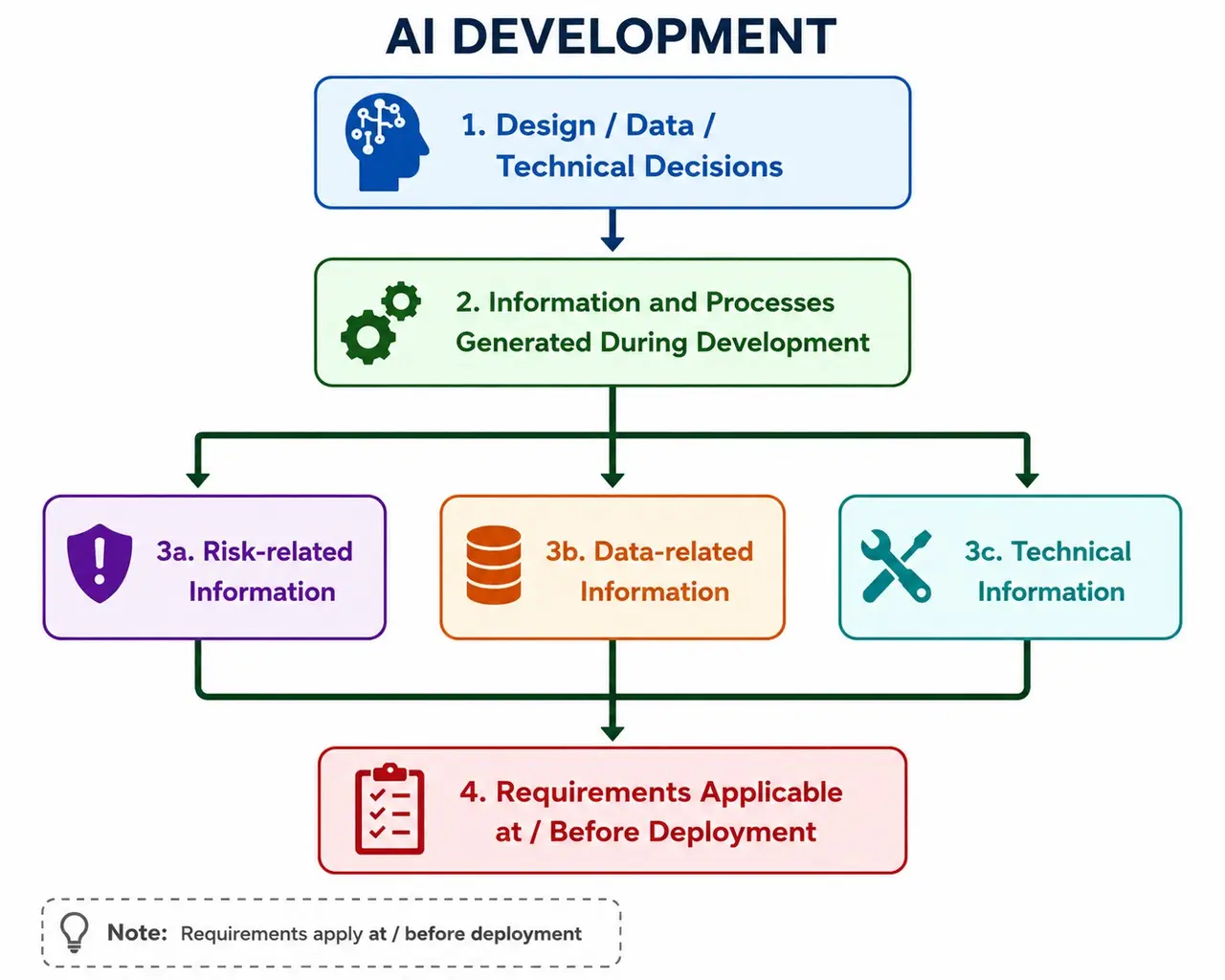
A systematic interpretation supports considering the relationship between Article 2(8) and the provisions governing the later regulatory treatment of AI systems. Several provisions relate to processes and information generated during the development of high-risk AI systems. Article 9 requires providers to establish, implement, document and maintain a risk management system and describes risk management as a continuous and iterative process planned and run throughout the entire lifecycle of a high-risk AI system. Article 10 connects data governance and management with matters including design choices, data collection, data preparation and assumptions concerning the data. Article 11 requires the technical documentation of a high-risk AI system to be drawn up before the system is placed on the market or put into service and subsequently kept up to date.
Especially Article 11 illustrates this systematic relationship. The technical documentation required for high-risk AI systems must contain information relating to the development process, including the methods and steps performed during development and relevant design choices. Annex IV further specifies these requirements. This demonstrates that information and decisions originating during the development process may become relevant to the fulfilment of regulatory requirements applicable at a later stage.
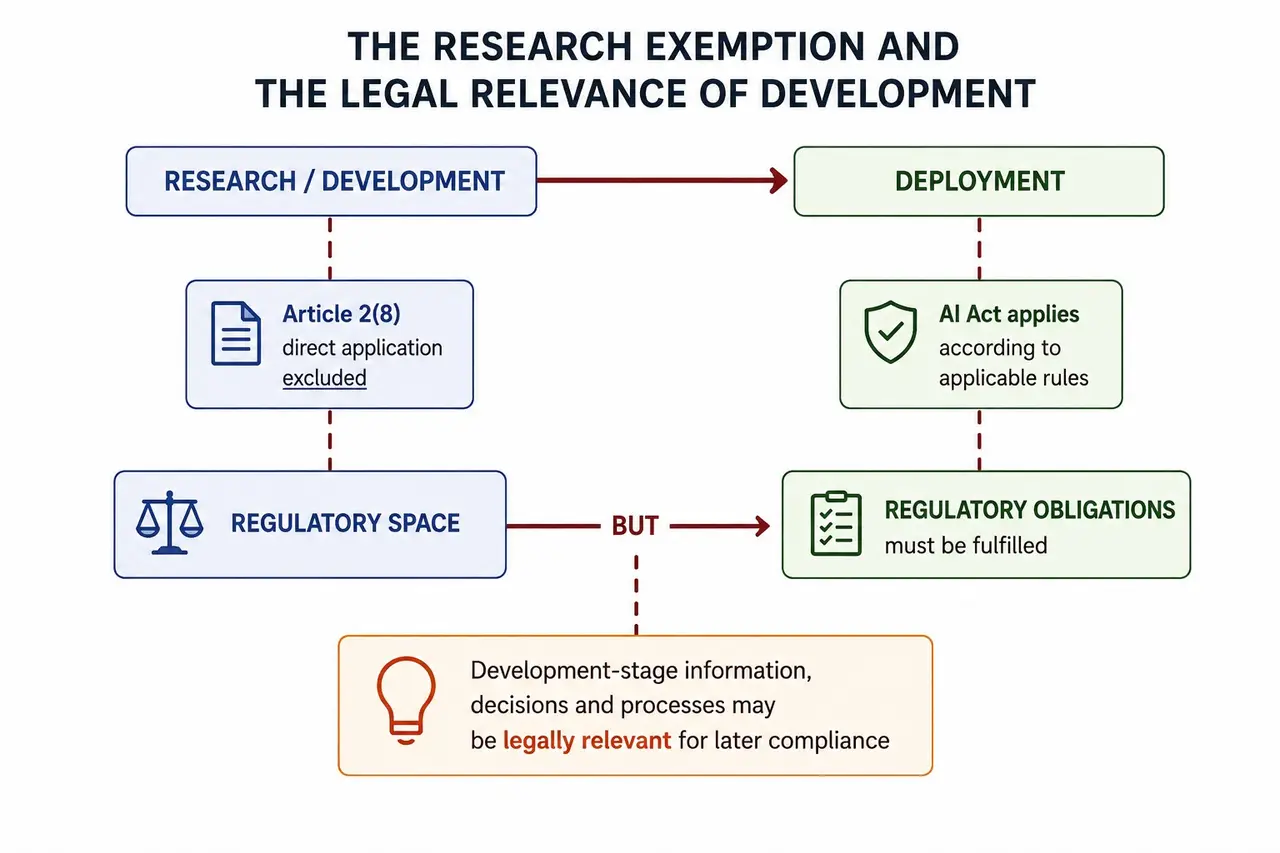
These provisions create systematic tension when interpreted strictly in relation to Article 2(8). On the one hand, the research exemption excludes qualifying research, testing, and development activities from direct application of the AI Act prior to their being placed on the market or put into service. On the other hand, several regulatory requirements presuppose that certain information, processes and assessments will already exist at the time of deployment. The systematic interpretationtherefore supports a distinction between the direct applicability of regulatory obligations and the legal significance of development-stage activities that may be relevant to subsequent compliance.
The teleological interpretation supports this differentiated approach. The purpose of the research exemption is to prevent innovation from being restricted by premature regulatory burdens. However, an interpretation that disregards all regulatory considerations until the moment of deployment could undermine the Regulation’s effectiveness where compliance at a later stage depends on information or processes that can only be meaningfully established during development.
Accordingly, the purpose of the exemption should not be understood as rendering development-stage activities legally irrelevant for the purposes of later regulatory requirements. Rather, it preserves flexibility while allowing development-stage activities relevant to future compliance to retain legal significance. This does not mean that requirements such as documentation, data governance and risk management must be fully completed during the research phase; their relevance may instead arise from the fact that effective fulfilment at deployment depends on processes or information generated during development.
The relevant distinction is therefore not between compliance and non-compliance during development. Rather, it concerns the relationship between the exclusion of qualifying activities from the direct application of the AI Act and the legal relevance of development-stage activities that may provide the basis for fulfilling regulatory requirements at a later stage.
2.2.2 The AI Lifecycle as an Interpretative Framework
The Regulation’s lifecycle-oriented approach further highlights the relevance of development-stage activities for the subsequent application of the AI Act, offering an additional interpretative perspective. Although the AI Act does not explicitly define the AI lifecycle, references to lifecycle or lifetime processes are evident throughout the Regulation, particularly in relation to high-risk AI systems (see e.g. Art. 9 and Art. 12).
The lifecycle approach is also reflected in broader international AI governance frameworks. The OECD AI Principles (OECD, 2022, p. 7), for example, have significantly influenced the development of international AI governance approaches and describe the AI lifecycle as encompassing different stages, from initial design and development to deployment and operation. Accordingly, the lifecycle perspective does not begin only once an AI system enters the market; it also and explicitly includes earlier development stages in which the system’s relevant characteristics are shaped (see also Finck, 2025, p. 904).
When applied to the interpretation of Article 2(8) of the AI Act, the lifecycle approach does not override the time-based limitations set out in the research exemption. It therefore does not make AI systems automatically subject to the full range of obligations applicable after deployment. Rather, it supports the conclusion that certain regulatory requirements cannot be meaningfully detached from activities in the development stage.
In particular, obligations concerning risk management, data governance, and technical documentation depend on information and decisions generated during the development process. Therefore, a lifecycle-oriented interpretation supports a differentiated understanding of the research exemption. While regulatory obligations generally do not apply during the exempted research and development phase, certain preparatory activities may be legally relevant because they may provide a basis for the fulfilment of deployment-related obligations later on.
2.3 Practical Legal Implications for AI Development Projects
The legal analysis has a practical consequence: where an AI system or AI model is intended for subsequent placing on the market or putting into service, legal considerations should be integrated into the development process at relevant stages and decision points. The purpose is not to subject qualifying research, testing or development activities to the full regulatory framework, but to identify where development-stage decisions, information or documentation may later become relevant to the applicable requirements of the AI Act.
In practice, this means that AI development projects may benefit from periodic legal assessment at significant stages of development, rather than legal involvement only immediately before placing the system on the market or putting it into service. Such assessments can help identify relevant regulatory implications as the system, its intended purpose, its data and its technical characteristics evolve. This approach allows researchers and developers to retain the regulatory space provided by Article 2(8), while reducing the risk that information or decisions relevant to later compliance have to be reconstructed retrospectively. Article 2(8) does not, moreover, displace other applicable Union law.
3. Conclusion
Article 2(8) provides a broad exclusion of qualifying research, testing and development activities from the direct application of the AI Act before an AI system or AI model is placed on the market or put into service. This exclusion has both an activity-related and a temporal dimension and remains subject to the limits expressly set out in Article 2(8), including the continued application of other applicable Union law and the exclusion of testing in real-world conditions.
At the same time, the systematic and teleological interpretation, as well as the lifecycle-oriented structure of the Regulation, indicate that development-stage activities cannot simply be regarded as legally irrelevant for all purposes. In particular, Articles 9 to 11, the latter in conjunction with Annex IV, illustrate that information, processes and decisions arising during the development of a high-risk AI system may be relevant to fulfilling regulatory requirements that become applicable at a later stage. The lifecycle orientation of the Regulation further supports an interpretation that takes account of the continuity between development and subsequent deployment, without transforming the exemption itself into a source of obligations during the exempted phase.
The resulting interpretation is therefore not one of full compliance during research, nor one of complete legal irrelevance. Rather, Article 2(8) preserves the regulatory space for qualifying research, testing and development activities while recognising that development-stage information and decisions may retain legal significance where they are relevant to subsequent regulatory requirements.
Thus, this interpretation preserves the innovation-promoting function of the research exclusion, while avoiding a disconnect between the exempted development phase and the regulatory requirements that may follow upon deployment.
References
Böning, F., & Schindler, S. (2026). Künstliche Intelligenz – KI-VO und Datenrecht. In C. L. Geminn & P. C. Johannes (Eds.), Europäisches Datenrecht: DA | DGA | DS-GVO | DMA | DSA | KI-VO (pp. 515–562). Nomos.
European Commission. (2021). Proposal for a regulation of the European Parliament and of the Council laying down harmonised rules on artificial intelligence (Artificial Intelligence Act) and amending certain Union legislative acts (COM(2021) 206 final).
Finck, M. (2025). In search of the lost research exemption: Reflections on the AI Act. GRUR International, 74(10), 903–904. https://doi.org/10.1093/grurint/ikaf100
Johannes, P. C. (2026). Forschung mit und an Daten. In C. L. Geminn & P. C. Johannes (Eds.), Europäisches Datenrecht: DA | DGA | DS-GVO | DMA | DSA | KI-VO (pp. 717–736). Nomos.
Mészáros, J., Huys, I., & Ioannidis, J. P. A. (2026). Challenges in applying the EU AI Act research exemptions to contemporary AI research. npj Digital Medicine, 9, Article 288. https://doi.org/10.1038/s41746-025-02263-0
OECD. (2022). OECD framework for the classification of AI systems. OECD Digital Economy Papers, No. 323. https://doi.org/10.1787/cb6d9eca-en
Pistillo, M. (2026, July 21). Internal deployment in the AI Act. Cambridge Commentary on EU General-Purpose AI Law. https://cambridge-commentary.ai/internal-deployment-in-the-ai-act/