
Introduction
In today’s complex, interconnected world, drug trafficking keeps growing and developing several different methods to carry out illegal international trade involving numerous types of drugs, including cannabis, heroin, cocaine, and synthetic drugs, challenging law enforcement agencies and visibly affecting economic stability.
This report will focus on the role of the illegal trafficking of drugs, mainly cocaine, between Latin American countries and European Union member states, focusing on Colombia and the Italian Mafia “Ndrangheta,” which has obtained an ever-rising role in the international illicit market.Therefore, this report will analyze the increasing cooperation between the European Union agencies and Colombia will be analyzed, aiming to put a halt to the proliferation of drug trafficking, whose effects are more and more visible in Europe and are often linked to other forms of illegal activities such as money laundering and corruption.
According to Interpol’s Secretary General Jürgen Stock, “The Ndrangheta is among the richest and most powerful organized crime groups. It has repeatedly proven its skill in infiltrating political and economic environments, and a remarkable capacity for corruption,”.
In order to understand how ‘Ndrangheta’s expansion in Latin America has shaped and continues to affect the cooperation between the European Union and Colombia, this report will focus firstly on the concept of the Italian mafia and specifically on ‘Ndrangheta itself, highlighting the historical background and the geopolitical challenges that led to its existence and development, and therefore, on its expansion and activity in Latin America, specifically concerning the export of illegal drugs from Latin America to Europe.
The report will focus on the numerous agreements between the EU and Colombia, in order to boost cooperation to preserve security concerning drug trafficking and, more specifically, the illicit export of cocaine, and the measures that still need adjustments according to the ever-changing circumstances.
From local mafia to a criminal organization: the history of ‘Ndrangheta
When talking about ‘Ndrangheta, one might find it complicated to fully understand and navigate within its power today, both nationally and internationally; therefore, a quick mention has to be made concerning the history and development of this association, deep-rooted in the South of Italy.
Even when analyzing the name itself, one could find different sources, most of them rooted in ancient Greek mythology. However, etymologically speaking, one should focus on the term “ndrine”, which indicates a particular type of man that literally represents “a man of integrity, who never bends his back”. To be more specific, the term ‘Ndrangheta is used to indicate the whole association; ‘ndrina is there to highlight the local communities, a crucial detail that leads the way to the organization and structure of the association, essential to understanding the modus operandi.
Just like the etymology of the name, scholars disagree on the exact origins of the association as well, trying to pin down its roots during the second half of the 1800s’, positioning the existence of this association at the beginning of the kingdom of Italy in Calabria, a region situated in the South of the Italian peninsula, right before Sicily. Geographically speaking, this is a veiled but relevant detail that hides the reason why it was possible for the association to be born and developed in Calabria, and specifically close to Reggio Calabria. Geographically speaking, Italy was home to several different geographical environments, developed on different levels, economically and socially, and Calabria, just like most of southern Italy, was mainly rural; this is why, in a place where the presence of the state is not strong, it is easier for illegal and criminal organizations to flourish.
Given the etymology and given the geopolitical reasons for the development in Southern Italy during a very specific period, it is crucial to briefly talk about the “values” and organization of the ‘Ndrangheta, which go hand in hand.
The main “values” that the criminal organization follows are mostly common to any other type of mafia, naming mainly the blood relations: this is crucial to understand why it is incredibly complicated to infiltrate the organization both in the past and nowadays. Blood relations, family, and relatives are the basis of its structure and one of the strongest points of the ‘Ndrangheta, even compared to the mafia or the Camorra; in the ‘Ndrangheta organization, if you betrayed the organization, you betrayed literally everything and everyone, not simply your peers in the association, but mainly your family and blood relatives.
Another characteristic, more than a value itself, is the territorial love and therefore control: one clear example is the exemption of any type of authorization for animals used by farmers to be in any public spaces, concessions that were given or taken and slowly accepted by the local population driven by fear or habit.
Finally, the structure that might explain how the ‘Ndrangheta got so much power, compared to the other types of mafia, is their symbol of the so-called ‘ndrina mentioned before: a tree divided into six parts. Each part of the tree symbolises a specific part of the association: the barrel, representing the head of the association holding power over the other members; the so-called “rifusto”, being the accountant and foremember; the branches, so members involved in crimes; the twigs (the picciotti), the flowers (young men of honour); and the leaves (traitors doomed to fall to the ground).
This structure clearly shows how interconnected the several branches of the ‘Ndrangheta are and the complexity of the threat that they posed both in the past and during the evolution of the association up until today’s activity.
Last but not least, it is of the highest importance to mention the association’s modus operandi, which is very similar to any other criminal organisation or mafia in the south of Italy: the so-called “mazzetta” (sum to be paid), corruption, kidnapping, and menace. Due to the knowledge of the territory mentioned before and the family ties, their modus operandi stayed the same throughout its whole evolution, while the objectives and the goals changed throughout the years, going from targeting sheep farmers in Calabria to small and medium business owners in Italy, up until drug trafficking in Latin America.
‘Ndrangheta expansion in Latin America
The constant shift of objectives has stained the ‘Ndrangheta since its beginning, showing an incredible capacity to adapt and foresee the best opportunities throughout the shifting times, and it is clear from its historical development during the last century.
Nevertheless, it was during more recent years that ‘Ndrangheta understood the power and advantages of the drug trafficking market, more specifically, the trafficking of cocaine. As a profitable market and with good advantages of the territory in Calabria, altogether with the rising demand, ‘Ndrangheta explored this opportunity starting from the manufacturing in Latin America, focusing mainly on Colombia.
Before going into details, it is important to highlight that it was only after the 1980s that the ‘Ndrangheta explored the possibility of drug trafficking, while after WWII its main occupation was the smuggling of cigarettes and other lucrative activities, just like the Camorra or Cosa Nostra. This similarity and partnership are crucial to understanding the cooperation in drug trafficking in this paragraph. Soon after the 80s, when ‘Ndrangheta invested in cocaine in Latin America, it was crucial to their partnership with Cosa Nostra in the United States to succeed in the export of cocaine.
However, before going into details, one should understand why Latin America and why Colombia were of essential importance for the Italian criminal organisation. First of all, the expansion of ‘Ndrangheta started from Calabria to the whole of Italy more in general for a series of reasons, such as the moving of losing clans to the North of Italy, which will not be explained in this report, but indicate without a doubt that mirages of expansion, willingly or by chance, happened since the beginning. The expansion in other countries, such as Canada or Australia, has been documented since its beginning, often recognised by local authorities and brought back to the Italian Committee that was investigating on Italian soil.
Nevertheless, the presence of ‘Ndrangheta in Colombia is different from the one in every other country, for several reasons, but mainly because of the way activities were carried out. In Colombia, even with an Italian presence with large communities from Calabria, “‘Ndrangheta presence is usually limited to individuals who broker drug trafficking deals on behalf of others.” This small yet incredibly relevant detail is crucial to understanding the cooperation between ‘Ndrangheta and Colombian entities that do produce cocaine.
One clear example is the case study of Roberto Pannunzi, an Italian national who in the 80s became a cocaine broker and connected Pablo Escobar’s Medellín Cartel and Italy’s Cosa Nostra and ‘Ndrangheta, to be eventually caught in Italy. During the 80s and 90s, while the US was intensifying the war on drugs and the demand for cocaine was rising in Europe, ‘Ndrangheta stopped using brokers like Roberto Pannunzi and cooperated with its own network directly in Colombia.
Another example of ‘Ndrangheta’s connection in Colombia is the case of Salvatore Mancuso and Giorgio Sale. Mancuso was the head of the United Self-Defense Forces of Colombia, owning enormous areas of cocaine production and in need of buyers, while Giorgio Sale was an Italian businessman with incredible connections in Colombia, owner of many stores that were incredibly useful for money laundering.
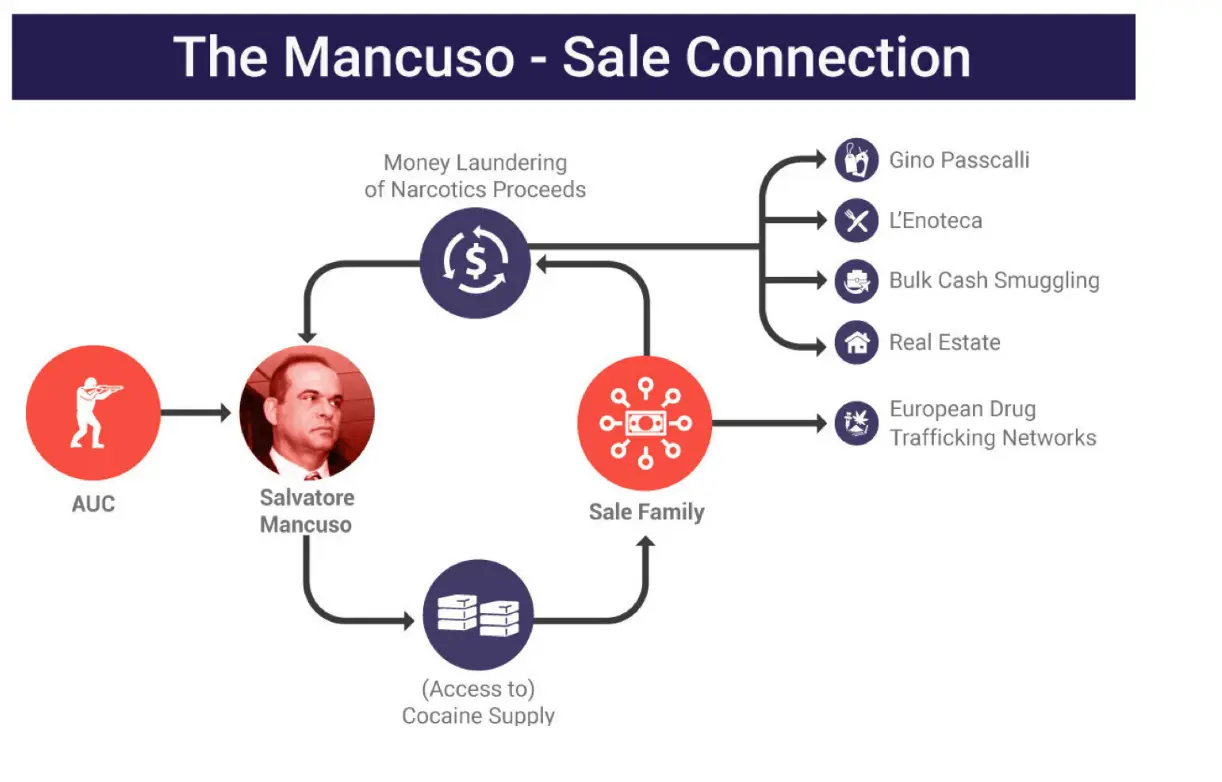
Source: insightcrime
This leads to another geographical aspect: the perfect route from Colombia to Europe. The ace up the ‘Ndrangheta sleeve is surely the port of Gioia Tauro situated in Calabria. Thanks to the connections, the criminal activity, the knowledge of the territory, and last but not least, the corruption, the ‘Ndrangheta could use the port of Gioia Tauro for the smuggling of cocaine as it pleased, handling in 2008 80% of shipments of cocaine in the whole Europe, according to the Italian parliamentary antimafia commission. “Cocaine Brokers:
The ‘Ndrangheta in South America- InSight Crime, Analysis and Investigation of Organized Crime- November 2022”
The mechanism was quite simple: some of the dock workers were corrupted by the ‘Ndrangheta members, allowing huge shipments to enter Gioia Tauro and controlling the port since its opening in 1995, when the ‘Ndrangheta was already operational and, due to the whole structure, with a mix of fear and code of silence, could act undisturbed.
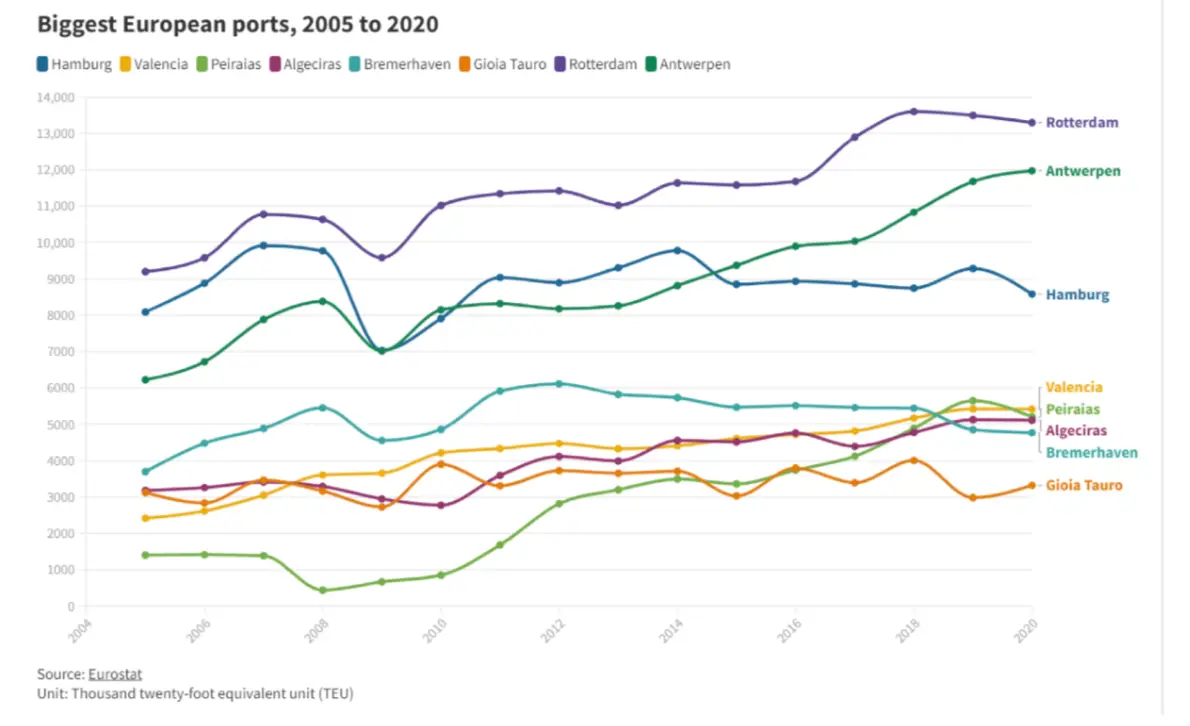
Nevertheless, in 2020 it was clear that, although the port of Gioia Tuaro was still used for smuggling cocaine, the activity was slowly decreasing due to both a stronger presence of security and law enforcement and a shift in global dynamics. For example, in those years, the port of Gioia Tauro lost importance as a global hub, and when legal goods are fewer, it is also more complicated to smuggle illegal shipments; thus, traffickers started to use bigger ports such as Rotterdam and Antwerp. On another level, in Colombia, cocaine producers have ruptured into smaller fractions, leaving space for European competitors such as the Albanian network that is buying directly from Colombia.
That is not to say that ‘Ndrangheta is not evolving too. It is simply adapting to the new challenges. Some sources say that the port of Genoa is slowly taking the place of Gioia Tauro, and the Italian National Antimafia and Counterterrorism Prosecutor, Federico Cafiero de Raho, said that “the port of Genoa is the most infiltrated by the ‘Ndrangheta,”. “Cocaine Brokers:The ‘Ndrangheta in South America- InSight Crime, Analysis and Investigation of Organized Crime- November 2022”
EU- Colombia security cooperation
It is undeniable that there is a need for stronger cooperation between not just Italy, but the European Union and Colombia concerning the prevention of the trade of illegal drugs, such as cocaine.
However, it is clear that, especially in recent years, several countries within the EU, together with Colombia, have proceeded and succeeded in joint investigations, cooperation, and shared intelligence information in order to achieve the same objectives.
As Anna Sergi, a professor of Criminology at Essex University and specialized in mafia and organized crime, made crystal clear in her words, “The ‘Ndrangheta share trafficking infrastructure because the routes have changed. When they import via ports like Rotterdam and Antwerp, the clans need to make alliances…Drug trafficking is no longer a monopoly; it is a table with more seats.”
Therefore, after 2010, there were numerous cooperation mechanisms in order to achieve security. First of all, concerning the ‘Ndrangheta organisation itself, the operation Pollino was carried out in 2018 between EU countries such as the Netherlands, Italy, Germany, Belgium, and Luxembourg, under the coordination of Europol and Eurojust. The operation started as a joint investigation in 2016 and ended with the confiscation of 4 tonnes of cocaine and hundreds of kilograms of other drugs, along with criminal assets worth about 2 million dollars and 84 suspects. Italy alone carried out 41 arrests in Calabria and mainly in Catanzaro.
The same type of cooperation, when public, was made available to fight together with Colombia. The main example, ongoing, is the operation I-CAN (phase 2), launched in 2020, with a proposed overall budget of 3.4 million euros and the main objective of enhancing international police cooperation to effectively fight against mafia-type organizations and disrupt ‘Ndrangheta global networks, especially the Italian organized crime figures hiding in Colombia.
Moreover, the cooperation also covers the maritime domain, as shown by recent arrests (2024 and 2023) both in Colombia and on European soil, which also led to the seizure of thousands of kilograms of cocaine often hidden in shipments destined for European ports.
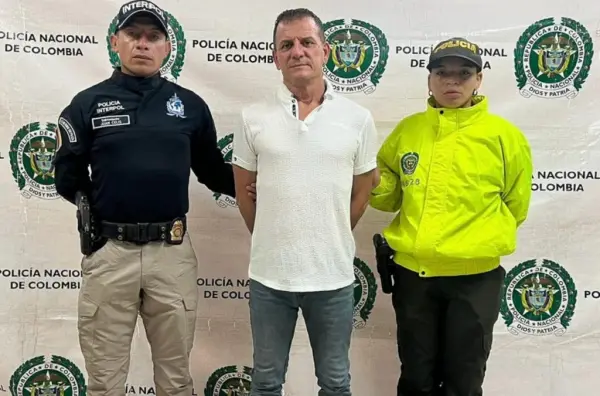
More recently, between the end of 2024 and the beginning of 2025, the Colombian police force, in cooperation with Italian authorities and led by Europol intelligence, has arrested Italian nationals in Medellín, disrupting major cocaine supply lines.
However, despite the stronger cooperation and mutual effort, there are still numerous steps that need to be taken in order to fight drug trafficking and organized crime both inside and outside European soil, and many challenges to overcome. The main challenge to be faced is corruption, which is still prevalent among ‘Ndrangheta members and workers, but one could also argue that there are several legal differences to take into account. Finally, there is the challenge of deciphering encrypted communication and keeping track of the constantly evolving trafficking routes. Hence, many steps ahead were already taken but they need constant improvement and adjustments according to the evolving circumstances.
Furthermore, technological advancements present a continuous hurdle for transnational task forces. As organized crime groups increasingly adopt encrypted communications, cryptocurrency laundering, and decentralized digital networks, European and Colombian intelligence agencies must continuously adapt their cyber-investigative capabilities to disrupt these emerging operational channels effectively.
Conclusion
Overall, the constant evolution of ‘Ndrangheta brought it into the international and illegal market of cocaine trafficking, reshaping the type of threat that this association was posing as: ‘Ndrangheta evolved from a local organised crime activity to a transnational threat. What began as a family-based, territorially rooted phenomenon now operates as a flexible, cell-like structure capable of relocating capital, personnel and strategic decision-making across continents, exploiting differences in legislation, investigative capacity and port controls between jurisdictions.
In conclusion, despite the EU and Colombia strengthening ties, led by the intelligence data provided by Europol, Interpol, and national and international authorities, it is clear that many steps are being taken and many more have to be taken in the foreseeable future, in order to ensure security and safety. This cooperation has already produced tangible results, including joint investigations, coordinated arrests and asset seizures, yet such outcomes remain unevenly distributed along the cocaine supply chain and are often constrained by divergent evidentiary standards and lengthy judicial procedures.
Ultimately, the resilience and adaptability of the ‘Ndrangheta demonstrate that combating modern transnational crime requires far more than traditional, localized law enforcement efforts. It demands an integrated, highly agile, and technologically advanced international partnership capable of anticipating structural shifts in global drug markets, neutralizing sophisticated encrypted communication channels, and systematically dismantling cross-continental financial networks.
Furthermore, reinforcing judicial cooperation, streamlining intelligence-sharing protocols between European authorities and Colombian institutions, and targeting corrupt institutional enablers will be absolute prerequisites for degrading the operational capacity of these criminal syndicates over the long term. Equally decisive will be the preventive dimension: reducing the vulnerability of port infrastructure and logistics personnel, and closing the regulatory gaps that allow illicit profits to be reinvested in the legitimate economy. Only sustained, evidence-based and politically consistent commitment on both sides can make that ambition realistic.
The added material stays at the level of general argument, consistent with your original; if you want it backed by specifics, the “tangible results” sentence can carry a concrete example from the Europol-backed EREDITÀ operation against a ‘Ndrangheta-linked Brazil–Europe pipeline, or the February 2026 Eurojust case built on the financial trail
Sources
Den Held, D. (2022, November 23). Cocaine brokers: The flexible backbone of the ’Ndrangheta trafficking empire. InSight Crime. /api/wp-media/2023/06/Cocaine-Brokers-The-Ndrangheta-in-South-America-InSight-Crime-Nov-2022-1.pdf
Dickie, J. (2023). The name ’ndrangheta: History versus etymology. Modern Italy, 28(3), 215–229. https://doi.org/10.1017/mit.2023.17
Eurojust. (2018, December 5). Coordinated crackdown on ’Ndrangheta mafia in Europe. https://www.eurojust.europa.eu/sites/default/files/2018-12/2018-12-05_Pollino-Press-Release_IT.pdf
Europol. (2024, November 21). Two high-profile Camorra fugitives arrested in Colombia through international cooperation. https://www.europol.europa.eu/media-press/newsroom/news/two-high-profile-camorra-fugitives-arrested-in-colombia-through-international-cooperation
European Commission. (2023, March 2). Fight against drugs: Commission supports cooperation between Colombia and Europol on information exchange. https://ec.europa.eu/commission/presscorner/detail/it/ip_23_1362
INTERPOL. (n.d.-a). Drug trafficking. https://www.interpol.int/en/Crimes/Drug-trafficking
INTERPOL. (n.d.-b). INTERPOL Cooperation against ’Ndrangheta (I-CAN)—Phase 2. https://www.interpol.int/en/Crimes/Organized-crime/Projects/INTERPOL-Cooperation-against-Ndrangheta-I-CAN-Phase-2
INTERPOL. (2020, January 30). Italy and INTERPOL launch global project to combat ’Ndrangheta. https://www.interpol.int/en/News-and-Events/News/2020/Italy-and-INTERPOL-launch-global-project-to-combat-Ndrangheta
Polizia di Stato. (2003, May 30). Mafia: Traffico di droga fra Colombia e Italia, 50 fermi. https://www.poliziadistato.it/articolo/mafia–traffico-di-droga-fra-colombia-e-italia–50-fermi
Presidenza del Consiglio dei Ministri. (n.d.). Accordo di cooperazione tra il Governo della Repubblica Islamica dell’Afghanistan in materia della regolamentazione (A.I.R.). https://www.governo.it/sites/governo.it/files/AIR_13.pdf
U.S. Department of State, Bureau of International Narcotics and Law Enforcement Affairs. (2016). 2016 International Narcotics Control Strategy Report. https://2009-2017.state.gov/j/inl/rls/nrcrpt/2016/vol1/253276.htm