



On August 29, the Icelandic people voted on a referendum whether to restart accession negotiations with the European Union. After a high turnout, the “No” camp won with 52.8% of the vote (Graham & Wright, 2026). Though the difference was only 13 000 votes (Ormiston, 2026), the result is clear: for the foreseeable future, Iceland will not join the European Union, with the prime minister of Iceland, Kristrún Frostadóttir, having stated that she will not return to the issue for the remainder of her current term in office (France 24, 2026). This brief will quickly summarise the domestic debate within Iceland and will then focus on the referendum’s implications for Iceland’s role within the Arctic’s security environment and the EU’s ambitions in the High North.
Fishing, not geopolitics
Before the referendum, Iceland’s prime minister Frostadóttir said that the timing was right because of the current geopolitical landscape and the EU’s increased focus on the Arctic (Frostadóttir, 2026). Yet, this frame is completely different from how the domestic debate actually played out. Instead of discussions about international security, it focused on economic issues and sovereignty. Especially concerns that EU membership would mean the dismantling of Iceland’s fishing quota system – whilst simultaneously opening its waters to foreign competition – were widespread. With fishing closely connected to the island’s culture and national identity, the no-campaign made this a key point in their objections against potential accession talks (Jäkel, 2026). Since fishing and related activities contribute to 15% of Icelandic GDP and around 40% of export revenue (Modern Diplomacy, 2026), it is perhaps not surprising that these arguments were central to the debate around restarting accession negotiations.
This was also reflected in the results of the vote: from a total of six constituencies, only two in central Reykjavik had a majority voting in favour of accession negotiations (CNN, 2026). In the north-west of Iceland, where communities rely upon farming and fishing, the margin was very clear. Here, almost 63% voted against (Jäkel, 2026). Seemingly, Iceland was content with its current status as a member of Schengen and the European Economic Area (EEA). Iceland’s ambassador to the UK, Thordis Gulfadóttir (2026), explains why the government’s arguments, centred around geopolitics and security, did not resonate with the general population. She stated that many Icelanders are “perplexed by America’s current foreign policy, yet treat it as a deviation from a norm that will eventually re-establish itself” (para. 20). After that, she also notes that most Icelanders are essentially in denial about the seriousness of recent geopolitical developments.
Iceland’s strategic value
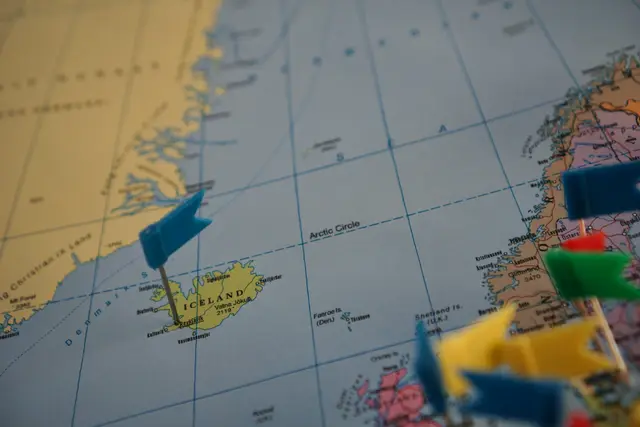
Despite the public’s indifference, Iceland’s strategic position in the Arctic remains important. Every two years, NATO holds its exercise called Northern Viking around Iceland. This is no coincidence: Iceland sits at the heart of the Greenland-Iceland-United Kingdom (GIUK) gap, a key transit route connecting the Atlantic to northern Europe. It is an important route for Russia’s Northern Fleet to get to the North Atlantic. Subsequently, NATO monitors this gap, ensuring that Russian activity remains limited (Butler, 2026). Despite this important position, Iceland has no military of its own, largely relying on its coast guard. For its security, it relies on a bilateral agreement with the US and NATO membership, with both agreements carrying defence obligations. Furthermore, Iceland also has security agreements with the EU and various Nordic states, though these do not have explicit defence obligations. Arguably, the defence of Iceland thus rests with NATO and the US in particular.
Yet, in a time when the US seems less and less committed to European security, this might be a risky situation. Recently, the Trump administration also informed European capitals about its plans to withdraw part of its troops and hardware currently stationed in Europe (Zaborowski & Nagy, 2026). President Trump and his administration have also frequently threatened Greenland, raising concerns about the stability of NATO. Despite the fact that Iceland itself has not been threatened, this fear played a role for some voters in the lead-up to the referendum (Ha & Melley, 2026).
The EU’s Arctic ambitions
Whereas the US is becoming a potential source of Arctic insecurity, the EU is increasingly focusing on improving Arctic security. In April 2026, it appointed Jyrki Katainen as a special advisor for EU-Arctic relations (European Commission, 2026a). Earlier, in March, the Commission also concluded a Security and Defence Partnership with Iceland (EEAS, 2026). This September, Commission President Ursula Von der Leyen announced a 200 million investment in Greenland (European Commission, 2026b). A few weeks later, EU leaders also held their first-ever European Arctic Summit in Rovaniemi, Finland (RTE, 2026). Most recently, the EU announced that Canada would gain the status of an associate member (Heath, 2026). Though details are not completely clear yet, this status does signal an increasing bond with this important Arctic state.
Further work to increase the EU’s footprint in the Arctic is still ongoing. Currently, the Commission is working on updating its 2021 Arctic Strategy. This strategy will likely focus more on the security aspects of Arctic governance, with Kaja Kallas, the EU’s representative for foreign affairs and security policy, stating that “it is time for a fresh EU Arctic Policy, one that reflects the times we live in and the world we want to see, including a secure Arctic” (EEAS, 2026b, para. 24). This strategy, as with all European initiatives in the Arctic, would be stronger with Iceland in the EU. Currently, only two of the EU’s members, Finland and Sweden, are Arctic states. Whilst Denmark is an EU member, Greenland, with its autonomous status, is not. Having Iceland in the EU would thus give the EU’s strategy more weight and legitimacy. This extra legitimacy would arguably also have strengthened the EU’s bid for full membership status on the Arctic Council. Brussels has been trying this since 2013, but its efforts stalled and have so far proven unsuccessful (Bendiek & Holste, 2026). With Iceland in the European Union, the EU’s credibility in Arctic affairs might grow, potentially making it easier to receive an upgrade from its observer seat in the Arctic Council.
There is one more way that the failed referendum provides another setback to the EU’s ambitions in the High North. Another Arctic nation, Norway, has slowly been moving closer to the EU (Ålander, 2025). Though far from overwhelmingly positive, domestic support for joining the EU has been growing slowly but steadily. This growing enthusiasm might now be muted in the wake of Iceland’s referendum, denying the EU another opportunity to increase its Arctic presence.
Takeaways
With all the work the EU has been doing to strengthen its position in the Arctic, the referendum’s result is a clear setback for the EU. Subsequently, the EU would do well to consider why Iceland said no. Iceland has, to some extent, already integrated economically with the EU. That raises an interesting question. How do you convince potential member states to join when they are already enjoying some of the EU’s benefits? Perhaps, as Iceland’s prime minister did, you point out the extra benefits received with membership in the European Union. Here, that would mean further political and security integration. However, this was unconvincing to the Icelandic people. As discussed, it could simply be that the Icelandic people did not feel this urgency. But it could also be the case that – and this would be more worrying for Brussels – the EU is simply seen as being unable to provide anything worthwhile in the sense of security or defence. In an Arctic marked by increasing tensions and conflict, and a US seemingly withdrawing from or even hostile to Europe, that would be a damning verdict.
Besides raising questions about the credibility of the EU’s hard power, the referendum’s result also casts a shadow over EU enlargement more generally. The last time a state joined the EU was 13 years ago. And while multiple states are currently preparing for or taking part in accession negotiations, progress remains marginal. Iceland’s accession – especially since many observers expected a quick process – would have given the process a much-needed boost.
For now, though a close partner, Iceland will remain outside of the EU. That means the EU will have to look for other ways to both revive its enlargement momentum and strengthen its position in the Arctic.
References
Ålander, M. (2025). To join or not to join? Norway is edging closer to the EU. Retrieved from https://www.chathamhouse.org/2025/04/join-or-not-join-norway-edging-closer-eu
Bendiek, A., & Holste, S. (2026). The EU’s new Arctic Strategy. Retrieved from https://www.swp-berlin.org/publikation/the-eus-new-arctic-strategy
Butler, R. (2026). Atlantic chokepoint, cognitive front: Russian influence operations and the GIUK gap. Retrieved from https://www.thearcticinstitute.org/atlantic-chokepoint-cognitive-front-russian-influence-operations-giuk-gap/
CNN. (2026). Iceland rejects EU membership plan in referendum held under the shadow of Trump’s Greenland threats. Retrieved from https://edition.cnn.com/2026/08/29/europe/iceland-eu-referendum-talks-votes-hnk-intl
EEAS. (2026). EU-Iceland: joint press release on the signature of the security and defence partnership. Retrieved from https://www.eeas.europa.eu/eeas/eu-iceland-joint-press-release-signature-security-and-defence-partnership_en
EEAS. (2026b). Arctic state of affairs: keynote speech by HR/VP Kaja Kallas at the 2026 Arctic frontiers conference. Retrieved from https://www.eeas.europa.eu/eeas/arctic-state-affairs-keynote-speech-hrvp-kaja-kallas-2026-arctic-frontiers-conference_en
European Commission. (2026). The European Commission designates special adviser for the EU-Arctic relations. Retrieved from https://ec.europa.eu/commission/presscorner/detail/en/ip_26_799
European Commission. (2026b). EU and Greenland strengthen partnership and engagement, backed by 200 million in EU investment. Retrieved from https://digital-strategy.ec.europa.eu/en/news/eu-and-greenland-strengthen-partnership-and-engagement-backed-eu200-million-eu-investment
France 24. (2026). Iceland votes ‘no’ to resuming EU talks. Retrieved from https://www.france24.com/en/live-news/20260830-iceland-votes-no-to-resuming-eu-talks
Frostadóttir, K. (2026, July 27). The vote that could reshape Iceland [podcast]. Retrieved from https://www.youtube.com/watch?v=dbRCjtCw4LM&t=471s
Graham, C., & Wright, G. (2026). Iceland votes against restarting EU membership talks. Retrieved from https://www.bbc.com/news/articles/c70le8ed1plo
Gulfadóttir, T. (2026). A no to the EU, not to Europe: What Icelanders actually voted on. Retrieved from https://ecfr.eu/article/a-no-to-the-eu-not-to-europe-what-icelanders-actually-voted-on/
Ha, K., & Melley, B. (2026). Trump Greenland threats cast a shadow on Iceland’s vote on whether to trigger EU membership talks. Retrieved from https://apnews.com/article/iceland-european-union-election-e08b367664056ba7d599e53e23dc2cf3
Heath, R. (2026). Friends with benefits: EU associate membership explained. Retrieved from https://www.politico.eu/article/friends-with-benefits-eu-associate-membership-explained/
Jäkel, L. (2026). The real reason Iceland rejected the EU. Retrieved from https://www.politico.eu/article/iceland-referendum-question-marks-no-camp-successful/
Modern Diplomacy. (2026). Iceland rejects EU membership talks in closely fought referendum. Retrieved from https://moderndiplomacy.eu/2026/08/30/iceland-rejects-eu-membership-talks-referendum/
Ormiston, S. (2026). Iceland: neck and neck referendum rejects EU membership talks. Retrieved from https://www.euronews.com/my-europe/2026/08/30/iceland-votes-no-to-further-eu-accession-talks-in-tight-result
RTE. (2026). European leaders to meet to set priorities for Arctic. Retrieved from https://www.rte.ie/news/europe/2026/0914/1591425-europe-leaders-arctic/
Zaborowski, M., & Nagy, T. (2026). Hollowing out the shield: US strategic force reductions and the implications for European security. Retrieved from https://www.globsec.org/what-we-do/commentaries/hollowing-out-shield-us-strategic-defence-equipment-reductions-and