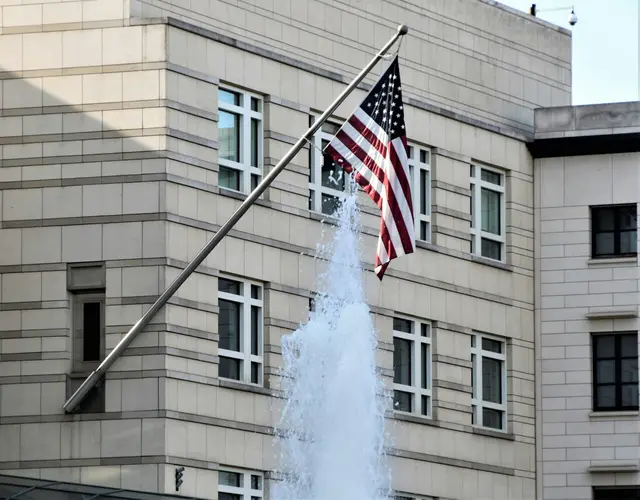



India's strategy is not to choose between competing geopolitical blocs, but to maximise strategic autonomy by engaging with each on its own terms.
EPIS THINK TANK | INDO-PACIFIC
Analytical Brief | June 2026
India Between Two Tables: Multi-Alignment Strategy and the Future of Indo-Pacific Order
How does India utilise multi-alignment diplomacy to maximise strategic autonomy in the Indo-Pacific?
Author: Alexandra Savva
Date: June 2026
Key Argument: India is not passively balancing between rival powers but is actively institutionalising a strategy of multi-alignment, leveraging strategic ambiguity and selective cooperation to position itself as an indispensable actor across competing geopolitical frameworks simultaneously.
1.1 The Non-Alignment Legacy
To understand India’s contemporary foreign policy, one must begin not in the marble conference rooms of New Delhi in 2026, but in the charged atmosphere of the late 1940s, when Jawaharlal Nehru was constructing a worldview for a newly independent civilisation-state. Emerging from two centuries of British colonial rule, India’s leadership was acutely suspicious of great-power entanglement. Nehru’s doctrine of non-alignment was not mere neutralism, it was, as he framed it, a ‘third way’ for postcolonial nations navigating a bipolar world without being consumed by it (Jaishankar, 2020). The 1955 Bandung Conference, which brought together twenty-nine Asian and African states, and the formal establishment of the Non-Aligned Movement (NAM) in 1961 in Belgrade, institutionalised this aspiration, with India as one of its principal architects (CIDOB, 2024).
Yet non-alignment was never the passive posture its critics in Washington sometimes assumed. India remained deeply engaged with both superpowers, purchasing Soviet arms, benefiting from American food aid under PL 480, and signing the 1971 Indo-Soviet Treaty of Peace, Friendship and Cooperation when strategic necessity demanded it. India nevertheless maintained a strong rhetorical commitment to non-alignment even when strategic realities required closer cooperation with one major power (Ganguly, 2017; Acharya, 2014). The lesson was clear from the outset: India’s foreign policy tradition prized the language of independence even when the substance was more complicated. This contradiction, between the rhetoric of autonomy and the pragmatic demands of national interest, would prove remarkably durable.
The 1962 Sino-Indian War marked a turning point in India’s foreign policy, exposing the limitations of Prime Minister Jawaharlal Nehru’s vision of India-China solidarity embodied in the slogan Hindi-Chini bhai-bhai and contributing to a more security-oriented strategic outlook (CIDOB, 2024). Border disputes in Arunachal Pradesh and Aksai Chin that emerged from the conflict remain unresolved, continuing to shape India-China relations in ways that resist simple categorisation as either rivalry or cooperation.
1.2 From Non-Alignment to Strategic Autonomy
The Cold War’s end did not make India’s balancing act easier; it made it more complex. The unipolar moment under American hegemony presented New Delhi with both new opportunities and new pressures. The 2005 Indo-US civilian nuclear deal, which effectively rewrote global non-proliferation norms to accommodate India’s exceptional status, marked a decisive westward turn. Yet India simultaneously deepened ties with Russia, continued purchasing Soviet-era defence equipment, and maintained its central role in postcolonial multilateral forums. From this period emerged a doctrine scholars now term ‘strategic autonomy’: the deliberate pursuit of independent foreign policy choices without overreliance on any single power or bloc (Ganguly, 2017; Acharya, 2014).
Strategic autonomy is non-alignment rebranded, but in a more active key. Non-alignment was primarily a negative concept, defined by what India refused to do (join blocs). Strategic autonomy is a more active, positive formulation, defined by what India chooses to do across multiple arenas simultaneously. As External Affairs Minister S. Jaishankar articulated in his influential 2020 book The India Way, Indian diplomacy must pursue the following ambition: to engage America, manage China, cultivate Europe, reassure Russia, bring Japan into play, draw neighbours in, extend the neighbourhood, and expand traditional constituencies of support (Jaishankar, 2020). This is not a passive stance. It is a carefully calibrated, multi-directional posture that treats competing great powers not as binary choices but as simultaneously available levers of influence.
Contemporary scholarship increasingly describes this evolution as India’s strategy of multi-alignment: a proactive approach that preserves strategic autonomy while engaging simultaneously with multiple, and at times competing, centres of power (CIDOB, 2024; Pant & Saha, 2021). Unlike Cold War non-alignment, which was primarily defined by avoiding formal bloc politics, multi-alignment is characterised by active participation across overlapping diplomatic, economic, and security frameworks. Where Nehru sought to avoid being caught between rival blocs, contemporary India seeks to remain engaged across them, deriving diplomatic and material benefits from each while retaining the freedom to pursue an independent foreign policy.
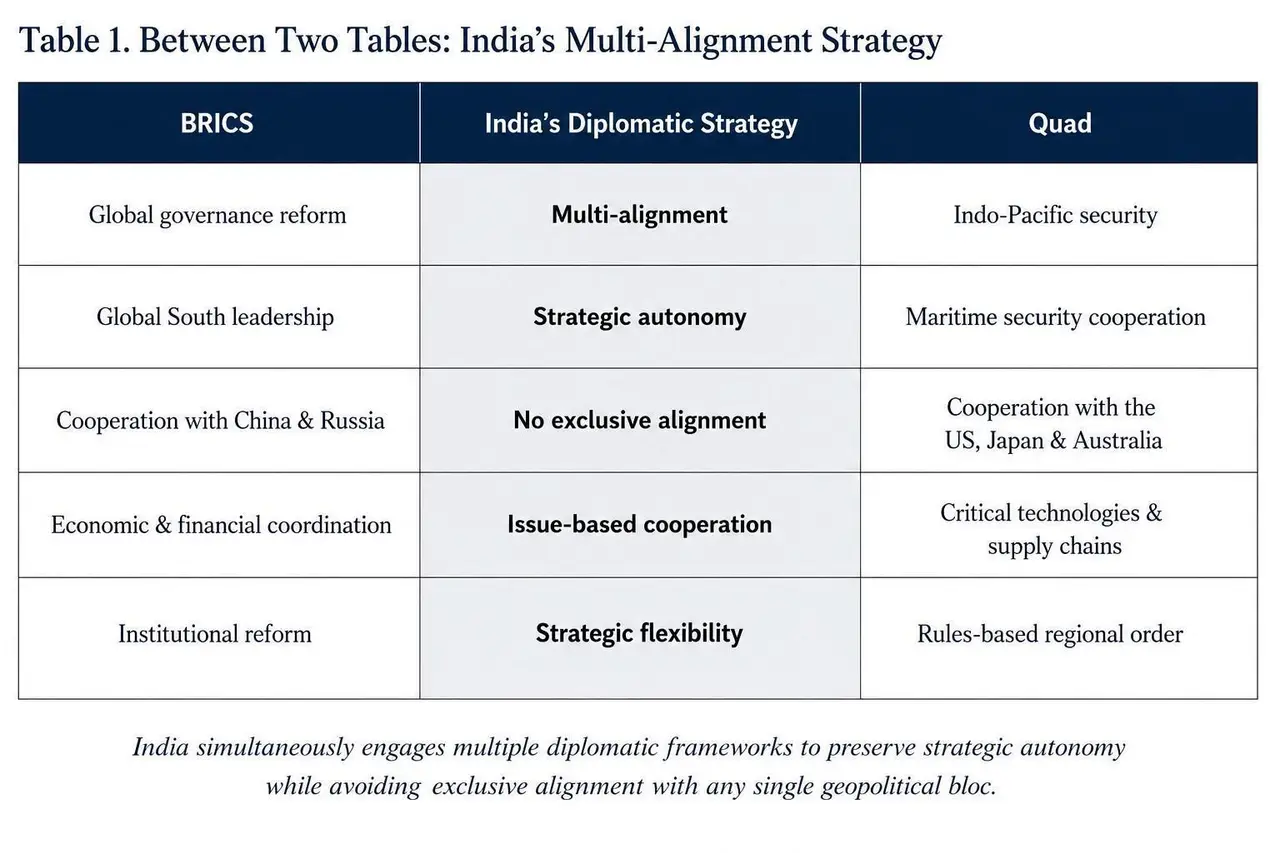
2.1 The May 2026 Moment: Two Tables, One Strategy
The diplomatic calendar of May 2026 offered the most vivid demonstration yet of India’s multi-alignment in action. Between 14 and 15 May, New Delhi hosted the BRICS Foreign Ministers’ Meeting under India’s chairmanship of the bloc, gathering representatives from Brazil, Russia, China, South Africa, and the grouping’s newer partner countries under the theme ‘Building for Resilience, Innovation, Cooperation and Sustainability’ (BRICS India, 2026; Ministry of External Affairs, 2026). Jaishankar chaired the sessions, holding bilateral meetings on the margins with counterparts from Russia, China, Brazil, Iran, Indonesia, Malaysia, and a dozen other states, using India’s BRICS chairship as a platform for intensive bilateral diplomacy rather than simply participating in the forum.
Less than two weeks later, on 26 May, New Delhi hosted the 11th Quad Foreign Ministers’ Meeting at Hyderabad House. US Secretary of State Marco Rubio, Australian Foreign Minister Penny Wong, and Japanese Foreign Minister Toshimitsu Motegi sat across from Jaishankar to issue a joint statement reaffirming the rule of law, sovereignty, and territorial integrity in the Indo-Pacific, while launching new initiatives on energy security, critical minerals, maritime surveillance, and undersea cable resilience (Stimson Center, 2026; Japanese Ministry of Foreign Affairs, 2026). The contrast could not be more deliberate: barely a fortnight separated India’s presiding over a forum that includes China and Russia from its hosting of a forum widely viewed as seeking to balance China’s growing regional influence.
This simultaneity was not accidental. India assumed the BRICS chairship on 1 January 2026, succeeding Brazil, and subsequently hosted the 11th Quad Foreign Ministers’ Meeting in New Delhi on 26 May 2026 (BRICS India, 2026; Ranjan, 2026; Ministry of External Affairs, 2026). The close sequencing of these engagements placed New Delhi at the center of two distinct diplomatic frameworks: one centred on reforming aspects of global governance through BRICS, and another focused on advancing cooperation among four major Indo-Pacific democracies through the Quad. Rather than treating these forums as mutually exclusive, India used both to reinforce its long-standing strategy of strategic autonomy, demonstrating that participation in one does not preclude active engagement in the other. In practical terms, India occupied a central role within both the Quad’s Indo-Pacific security framework and the BRICS grouping, reflecting its broader effort to maintain influence across multiple geopolitical platforms without committing exclusively to either.
2.2 The Quad: Security Without Alliance
India’s engagement with the Quadrilateral Security Dialogue is, in many respects, the most counterintuitive element of its multi-alignment strategy. The Quad, comprising India, the United States, Japan, and Australia, was originally proposed by Japan’s Shinzo Abe in 2007, lapsed into dormancy, and was revitalised in 2017 as China’s maritime assertiveness intensified. For many observers, it represents precisely the kind of security alignment that Nehruvian non-alignment was designed to avoid. Yet India has been a persistent, if cautious, participant.
The reason lies in a critical distinction that New Delhi draws with some care: the Quad is not an alliance. India has no treaty obligation to its Quad partners, no mutual defence guarantee, and no requirement to support military operations beyond its own sovereign decisions. Jaishankar has consistently emphasised this point, framing the Quad as a platform for issue-based cooperation, maritime domain awareness, critical minerals supply chain resilience, HADR frameworks, emerging technology governance, rather than a military bloc (Ministry of External Affairs, 2026). At the May 2026 meeting, Australian Foreign Minister Penny Wong articulated the same logic: ‘We are four sovereign nations, have our own histories and interests, but there is great alignment between our interests… each of us brings our unique perspective, experiences and strengths together’ (Australian Minister for Foreign Affairs, 2026).
For India, this framing is diplomatically essential: it allows participation in a US-led security architecture in the Indo-Pacific without foreclosing diplomatic space with China and Russia. India gains access to American defence technology, intelligence-sharing, and political validation as a key Indo-Pacific partner, while retaining the sovereign prerogative to decline any specific military commitments. The May 2026 bilateral between Jaishankar and Rubio, held at New Delhi ahead of the multilateral Quad gathering, reinforced cooperation on artificial intelligence, nuclear energy, pharmaceutical supply chains, and critical minerals, all domains where the US-India partnership generates concrete material benefits for New Delhi (Ministry of External Affairs, 2026; Stimson Center, 2026). The Quad is, in practice, a structured relationship of selective cooperation that India enters on its own terms rather than a conventional security alliance.
2.3 BRICS Engagement: Shaping an Alternative Institutional Order
BRICS represents India’s participation in an alternative institutional framework that advocates reforms to global governance, the forums seeking to reform, and in some cases replace, the institutions of that order. India’s approach to BRICS is equally nuanced, and arguably more diplomatically demanding, given that it requires sustained cooperation with China despite their unresolved border disputes and deep strategic rivalry.
At the May 2026 BRICS Foreign Ministers’ Meeting, Jaishankar emphasised themes that resonated across the Global South: the need for alternatives to Western-dominated financial institutions, the diversification of supply chains and markets, the resilience of energy and food security systems, and the reform of global governance structures (BRICS India, 2026; Ministry of External Affairs, 2026). He pointed to the New Development Bank and the Contingent Reserve Arrangement as evidence that BRICS could create ‘credible alternatives within the international financial system.’ This language is significant: India is actively shaping BRICS’s institutional agenda rather than participating as a reluctant member, advocating for consensus-based expansion and using its chairmanship to embed its priorities into the bloc’s five-year trajectory.
India’s BRICS engagement serves functions that its Quad participation cannot. BRICS gives New Delhi a leadership platform within the Global South, reinforcing its claim to represent the interests of developing nations without subordinating itself to either the Washington or Beijing consensus. It also provides a hedge against the possibility, increasingly real under the Trump administration’s erratic policy shifts, that the US-India partnership might prove less reliable than its rhetoric suggests. As GIS Reports noted, India’s multi-alignment approach ‘has helped it navigate the geopolitical and geoeconomic challenges stemming from the unpredictable policies’ of the Trump era (GIS Reports, 2025). Russian crude now accounts for an estimated 35-40% of India’s total energy imports, up from approximately 3% before the Ukraine war, a relationship that BRICS membership helps to legitimise diplomatically, even as Washington presses New Delhi to reduce its dependence on Moscow (GIS Reports, 2025).
2.4 EU Relations and the European Dimension
India’s multi-alignment extends beyond the US-Russia-China triangle. Prime Minister Modi’s five-nation European tour in May 2026, encompassing the United Arab Emirates, Netherlands, Sweden, Norway, and Italy, illustrated how India uses bilateral diplomacy to supplement its multilateral hedging (Open Magazine, 2026). In the Netherlands, the significance of a strategic partnership upgrade was direct: Amsterdam is a critical node in the global semiconductor supply chain, producing components essential to the chip fabrication technology that both Washington and Beijing are racing to control. In Norway, energy security diversification was the theme; in Sweden and Italy, high-technology and defence-industrial cooperation. These are not random selections. They reflect a deliberate effort to embed India into the supply chains and strategic relationships of the European Union at a moment when Europe itself is reconsidering its dependencies and seeking alternative partnerships.
India and the EU have been negotiating a free trade agreement on and off since 2007, with renewed momentum in recent years driven by shared concerns about Chinese market dominance and supply chain concentration. For New Delhi, a deepened EU relationship serves both economic and geopolitical purposes: it diversifies India’s trade and investment partnerships away from overreliance on any single great power, and it signals to both Washington and Beijing that India retains genuine alternatives. In this respect, European engagement is itself an instrument of multi-alignment.
2.5 Russia, China, and the Limits of Multi-Alignment
The two most structurally difficult relationships in India’s multi-alignment portfolio are, predictably, Russia and China. The Russia relationship is defined by deep historical institutionalisation, decades of defence procurement, diplomatic solidarity at the UN Security Council on Kashmir-related resolutions, and a partnership that scholars describe as driven not merely by geopolitics but by ‘affective politics’ rooted in Cold War solidarity (CIDOB, 2024). India has resisted Western pressure to condemn Russia’s invasion of Ukraine, abstaining consistently in relevant UN votes, while simultaneously ramping up Russian oil imports to take advantage of discounted prices. Jaishankar’s response to European criticism has been characteristically direct: India is pursuing its interests, as every country does (Britannica, 2026).
The China relationship is more fraught. Despite sharing BRICS and SCO membership, India and China have engaged in periodic military confrontations along their disputed Himalayan border, most seriously in the 2020 Galwan Valley clash. Modi’s first visit to China in seven years, attending the SCO Summit in Tianjin, was noted as a cautious diplomatic signal, reflecting the growing complexity of navigating US-China trade tensions while preserving Indian options on both sides (Ministry of External Affairs, 2026). India’s position is, in essence, that it can sit at the BRICS table with China without that implying strategic alignment, just as it can participate in the Quad without that implying an anti-China military alliance. Whether this position remains sustainable as great-power competition intensifies is one of the central questions of contemporary Indian foreign policy.
3.1 Weakening Rigid Bloc Formation
India’s multi-alignment strategy has significant systemic implications for the Indo-Pacific order. The most immediate is structural: India’s simultaneous presence in BRICS and the Quad makes it functionally impossible for either grouping to operate as a rigid, exclusive bloc in the Cold War sense. A bloc requires members to subordinate their bilateral relationships with the bloc’s adversaries to a common collective discipline. India simply refuses this logic. By maintaining deep cooperation with Russia within BRICS while simultaneously deepening security ties with the United States through the Quad, New Delhi ensures that neither forum can claim India as an unconditional supporter against the other. This creates what might be called a ‘bloc-diluting effect’: the more India deepens multi-alignment, the harder it becomes for either the US-led West or the China-Russia axis to credibly claim that the Indo-Pacific is dividing into two clean camps.
This matters enormously for the architecture of regional order. Much strategic discourse in Western capitals still tends toward a binary framing: a ‘free and open Indo-Pacific’ led by the Quad on one side, versus Chinese-led revisionism on the other. India’s behaviour consistently complicates this narrative. The HBS (2025) observes that India positions itself as ‘a crucial bridge builder and responsible actor committed to a more just, resilient and multipolar global order’. Whether this self-presentation is accurate is debatable; what is clear is that it has real effects on how other states calculate their own alignment choices.
3.2 The Rise of Flexible Alignment Structures
India’s success, or at least its persistence, in maintaining multi-alignment is contributing to a broader trend in the Indo-Pacific: the proliferation of flexible, issue-based partnerships that cut across the traditional alliance-bloc architecture. The Quad itself is not a formal alliance; neither is the I2U2 (India, Israel, UAE, United States) grouping, nor India’s various bilateral strategic partnerships with France, Japan, and Australia. What is emerging is a patchwork of overlapping, non-exclusive arrangements that scholars have begun to describe as ‘minilateralism’, smaller, issue-specific groupings that can move faster and more flexibly than large multilateral institutions (Pant & Saha, 2021).
This structural shift has implications beyond India. Indonesia, Brazil, Vietnam, South Africa, and Turkey are all, to varying degrees, pursuing their own versions of multi-alignment, seeking to profit from the competition between the US-led West and Chinese-led revisionism without being compelled to choose a side. India is the most sophisticated and historically rooted practitioner of this approach, which means that its success or failure will be closely watched as a template. If New Delhi demonstrates that multi-alignment is sustainable and profitable even under intense great-power pressure, it will embolden other middle powers to adopt similar postures. The systemic effect would be a further erosion of the rigid bipolarity that some analysts had predicted for the Indo-Pacific.
3.3 India as Stabilising or Complicating Actor?
The question of whether India’s multi-alignment strategy makes it a stabilising or complicating actor in regional diplomacy admits of no easy answer, and the ambiguity may be deliberate. From the perspective of the United States and its closest allies, India’s refusal to condemn Russia, its BRICS chairmanship, and its careful management of relations with China introduce an element of strategic uncertainty into the Quad framework. Rubio’s observation at the May 2026 meeting, that the Quad’s goal had been to transition ‘from a forum in which we meet and talk about problems to one where we actually do something about them’ (Washington Post, 2026; Ministry of External Affairs, 2026), implicitly acknowledged that India’s sovereignty-first approach places limits on how operationally integrated the grouping can become.
From the perspective of China and Russia, India’s Quad participation, its defence cooperation with the United States, and its role as a conduit for Western technology and investment into the Indo-Pacific represent a source of strategic frustration. China in particular has sought to contest India’s claims to Global South leadership, deploying its superior material resources through the
Belt and Road Initiative and related mechanisms to outbid Indian influence in Africa, Southeast Asia, and South Asia (Heinrich Böll Stiftung, 2025). The competition between New Delhi and Beijing for leadership of the Global South is real, and China has not been a passive observer of India’s multi-alignment strategy.
Yet there is a case, increasingly articulated in Indian strategic discourse, that multi-alignment is precisely what the Indo-Pacific’s fragile stability requires. In a region defined by unresolved territorial disputes, rapid military modernisation, and deeply asymmetric economic interdependencies, a rising power that refuses to lock itself into either bloc reduces the risk of miscalculation. India’s presence in multiple frameworks creates channels of communication and de-escalation that a more rigidly aligned India could not maintain. Jaishankar’s articulation of India’s purpose, to ‘manage relationships to national advantage’ while ‘respecting red lines’, is unapologetically realist, but its structural effect may be to keep diplomatic options open in a region where their closure could be catastrophic (Jaishankar, 2020).
The events of May 2026 in New Delhi were more than a busy diplomatic calendar. They were a public declaration of a foreign policy philosophy: that India intends to be present at multiple tables simultaneously, shaping the agenda of each without being bound by any. This strategy, historically rooted in Nehru’s non-alignment, intellectually refined through the concept of strategic autonomy, and now operationalised as multi-alignment, positions India as something distinctive in the Indo-Pacific order: a rising power that treats geopolitical fragmentation not as a threat to be managed but as a resource to be leveraged.
Whether multi-alignment is sustainable over the longer term remains uncertain. The pressures it faces is that an increasingly transactional Trump administration has placed India’s Russian energy imports and trade deficit in its crosshairs; China’s military modernisation continues to challenge India’s border security; and the structural logic of great-power competition may eventually demand more explicit commitments than New Delhi is currently willing to offer. Critics are right to note that there are limits to how long any state can simultaneously reassure Washington that it is a key Indo-Pacific partner, reassure Moscow that it remains a trusted friend, and reassure Beijing that BRICS membership signals no hostile intent.
But the limits of multi-alignment do not negate its achievements. For the foreseeable future, India’s refusal to choose between competing blocs complicates simplistic US-vs-China narratives of Indo-Pacific order, gives voice to the aspirations of the broader Global South for agency rather than alignment, and demonstrates that rising powers can leverage geopolitical competition as leverage, than suffering its consequences. India has not passively balanced between rival powers. It has institutionalised a strategy for thriving in a fragmented world, and the world, increasingly, is watching to see whether it works.
Acharya, A. (2014). The End of American World Order. Polity Press.
BRICS India. (2026). India’s BRICS Chairship 2026. Government of India. https://www.brics2026.gov.in/
Britannica. (2026). S. Jaishankar. Encyclopaedia Britannica. https://www.britannica.com/biography/S-Jaishankar
CIDOB (Cogo Morales, P.). (2024). India’s foreign policy reconfiguration: From non-alignment to
multi-alignment.https://www.cidob.org/en/publications/indias-foreign-policy-reconfiguration-non-alignment-multi-ali gnment
Foreign Policy (Panda, J.). (2025, November 26). India’s Strategic Autonomy Doesn’t Work in a Great Power
World.https://foreignpolicy.com/2025/11/26/india-end-strategic-autonomy/
Ganguly, S. (2017). India’s Foreign Policy: Retrospect and Prospect. Oxford University Press.
GIS Reports. (2025). India’s multi-alignment and rising geopolitical profile. https://www.gisreportsonline.com/r/india-strategic-autonomy/
Heinrich Böll Stiftung. (2025). India and its quest for leadership of the Global
South.https://in.boell.org/en/2025/10/06/india-and-its-quest-leadership-global-south
Hudson Institute (Pande, A.). India’s Multi-Alignment and Rising Geopolitical Profile. https://www.hudson.org/foreign-policy/indias-multi-alignment-rising-geopolitical-profile-aparna-pande Jaishankar, S. (2020). The India Way: Strategies for an Uncertain World. HarperCollins India.
Japanese Ministry of Foreign Affairs. (2026, May 26). Foreign Minister Motegi’s Attendance at the Japan-Australia-India-U.S. (Quad) Foreign Ministers’ Meeting. https://www.mofa.go.jp/fp/nsp/pageite_000001_00005.html
Ministry of External Affairs, Government of India. (2026, May 26). Quad Foreign Ministers’
Meeting.https://www.mea.gov.in/press-releases?dtl/41216/Quad_Foreign_Ministers_Meeting_May_26_2026=
Open Magazine. (2026, May 12). India’s Global Push in May 2026: BRICS Meet in New Delhi and PM Modi’s Five-Nation Diplomatic Tour. https://openthemagazine.com/india/indias-global-push-spotlight-on-brics-meet-and-pm-modis-five-nation-tour Pant, H. V., & Saha, P. (2021). India’s Emerging Strategic Posture. Observer Research Foundation.
Ranjan, A. (2026). India’s BRICS Chairmanship in 2026: Leadership in Times of Global Uncertainty. Institute of South Asian Studies, National University of Singapore. https://www.isas.nus.edu.sg/papers/indias-brics-chairmanship-in-2026-leadership-in-times-of-global-uncertainty/
Stimson Center. (2026). Takeaways from the Quad Foreign Ministers’ Meeting. https://www.stimson.org/2026/takeaways-from-the-quad-foreign-ministers-meeting/
Washington Post. (2026, May 26). Quad ministers announce new Indo-Pacific initiatives on maritime security and energy.https://www.washingtonpost.com/world/2026/05/26/india-quad-rubio/ca564ed8-58b7-11f1-8a9d-afb1148204e 1_story.html
About the Author
Alexandra Savva is a recent bachelor’s graduate in International Relations with academic and professional experience across Europe and the Indo-Pacific. Throughout her studies, she has held leadership and coordination roles in multiple organisations, humanitarian initiatives, and international projects, focusing on stakeholder engagement and cross-cultural collaboration. Her academic and professional interests centre on diplomatic strategy and international trade relations, with interest in how states navigate strategic competition through diplomacy and economic engagement.
About EPIS Think Tank
EPIS Think Tank is an independent, non-partisan research institution focused on international relations, global governance, and strategic affairs. This policy brief reflects the views of the author and not necessarily those of the institution.