


A poorly paved road
There are 65 state-based armed conflicts currently taking place, roughly double the number there were 15 years ago (UCDP/PRIO, 2026). In this new hazardous reality, overall military spending has increased sharply, especially in Europe. Since the Russian invasion of Ukraine, Europe has noticeably increased its military spending and focused on diminishing its defensive dependence on the United States. However, it has a major problem: the continent seems unable to allocate as much capital as it would like. EU defence spending reached 1.9% of GDP in 2024, the highest in three decades but still below the global average, which the IIF puts at 2.5% of GDP, or $2.7 trillion (Tiftik et al., 2026). As countries that provide many social benefits and implement austerity measures for their citizens, European countries face fiscal constraints in allocating more resources to their military buildup (Tiftik et al., 2026). With this hurdle in sight, Europe has turned to private markets for resources, but these markets have their own constraints.
The hurdles are less about appetite than about arithmetic. Companies in the defence sector sell almost exclusively to governments, making their client base small and their revenue concentrated among a few large clients. Take RENK, a publicly traded medium-sized German company that manufactures tank drivetrains, as an example. In its 2023 annual financial statements, RENK states explicitly that defence-based spending and government end markets are subject to political decision-making, which directly affects the Group’s operations (RENK Group, 2024). In August 2026, Rheinmetall, another company that provides military solutions, came under scrutiny after the German armed forces flagged two of its vehicle projects as lacking in quality (Schweppe, 2026). Although the equipment in question did not include parts provided by RENK, this did not matter, as it shared prices with several other defence companies that produce military vehicles.
Procurement timelines and contracts are built around military planning, not commercial cash flow. The result is a chronic lag between delivering the work and getting paid for it. Invoices may sit unsettled for months, and to a lender, that lag looks exactly like the kind of unpredictable, slow-moving revenue that conventional credit standards were built to avoid. Long receivable durations, which cannot be precisely measured due to the previously mentioned delays, and heavy working capital needs weaken conventional liquidity and leverage metrics (Tiftik et al., 2026). But beyond the caveats associated with government military contracts, the sector also faces an image hurdle that keeps investors away, even when the company offers more than just military supplies.
The IIF notes that many banks and funds still approach defence financing conservatively, citing reputational risk and the way ESG frameworks treat the sector (Tiftik et al., 2026). This caution is unintentionally allocated to companies that provide non-combat solutions. De Haas, while building datasets on military-sector lending, noticed that companies had no standard taxonomy to work from. His study had to construct its own classification from scratch, mapping export-control lists onto industry codes and then estimating the likelihood that a firm’s output could be used for military purposes, as roughly a hundred candidate sectors sit in a genuine grey zone between civilian and dual-use (De Haas et al., 2026). Additionally, if defining these companies required statistical estimation for academics working after the fact, it is likely no clearer to a bank or fund applying an ESG exclusion policy in real time. Therefore, the safer institutional response to an ambiguous classification is to treat the borrower as defence-adjacent.
Additionally, the time to gather private capital is now, as research spanning two centuries of sovereign lending finds that private cross-border capital reliably retreats during wars and financial crises, leaving governments and multilateral institutions to step in to fill the gap (Horn et al., 2026). If that pattern holds, European governments have reason to lock in private financing arrangements now, as that capital is likely to become scarce if a conflict were to break out, leaving the state to shoulder the burden alone anyway. To counter this, European countries are creating guarantees and structuring policies to help private lenders finance defence companies.
Reloading the industry
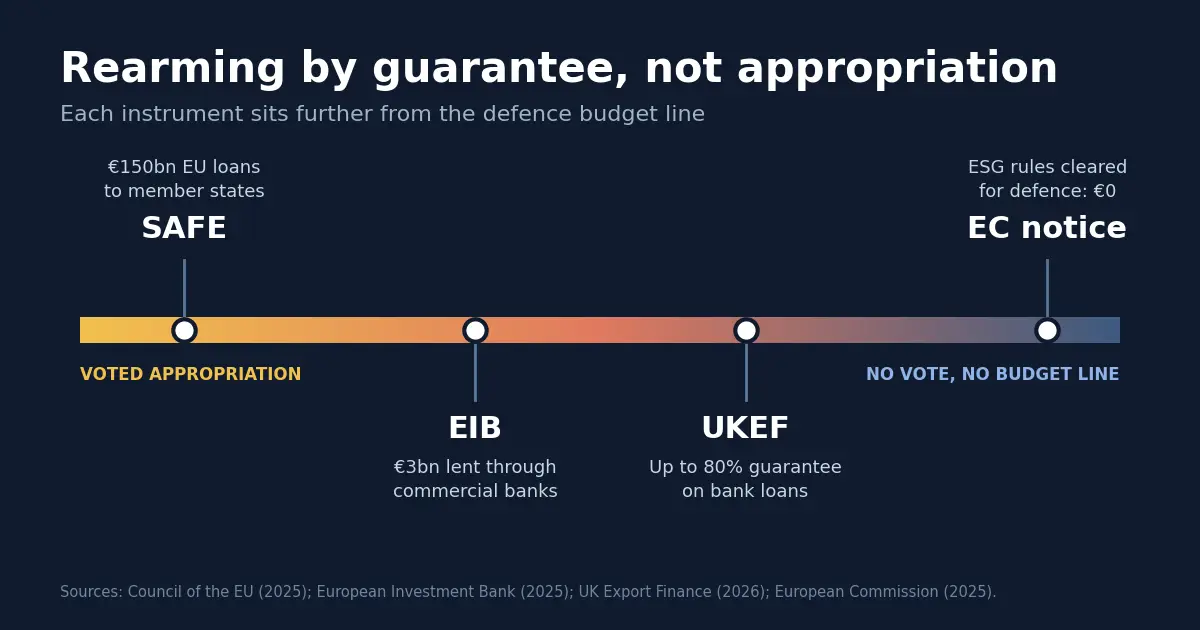
To drive their military modernisation, European countries have embarked on a myriad of different projects. At the continental level, a prime example is the European Union’s Security Action for Europe (SAFE). Rather than having each country borrow individually, the European Commission sets a €150 billion borrowing ceiling to raise capital in capital markets and re-lends it to member states as long-maturity, low-cost loans to fund defence investment plans (Council of the European Union, 2025). SAFE changes who bears the borrowing risk and at what price. By raising a single loan envelope under the EU’s own credit standing rather than leaving each state to negotiate its own terms, SAFE lets weaker-rated members borrow at lower rates because, for the market, lending to the EU is a safer bet than lending to Poland or Italy individually. It also spares member states the friction of negotiating bilaterally with investors on their own. And, under Article 122, which allows the Council to adopt the €150 billion instrument without the European Parliament, SAFE draws on the headroom under the EU’s own resources ceiling rather than an MFF heading (Council of the European Union, 2025). But though useful and well drawn, programs like this are not enough.
SAFE helps countries borrow money on more favourable terms and at lower interest rates, but it still occupies a measurable share of EU members’ national budgets and does not suffice for their needs. The IIF estimates that the EU needs roughly $115 billion in additional defence spending annually to reach the current global average and, for the region’s NATO members, as much as $630 billion annually to hit the alliance’s 5% of GDP target by 2035 (Tiftik et al., 2026). That is clear for these countries, as the SAFE initiative is just one of many initiatives addressing these demands. The central idea is not to rely on additional public borrowing, as it would only further strain countries’ budgets and diminish their creditworthiness, but to attract other parties to fund the defence sector. To attain this goal, governments have started projects aimed at absorbing the risk private lenders perceive in the defence industry.
Governments have three ways to make a less creditworthy sector more attractive: fund the lender, stand behind the loan, or remove the rules that kept the lender away. Europe is now doing all three. The first runs through direct state involvement, such as the European Investment Bank funding banks to finance defence projects. In December 2024, it approved a €1 billion envelope for the defence supply chain, and in June 2025, it tripled that to €3 billion. The money doesn’t go directly to defence firms. It goes to commercial banks, which lend it on. In the first deal, Deutsche Bank received €500 million to extend €1 billion in credit and working capital to smaller suppliers. That eases the liquidity problem caused by slow government payments, but, naturally, it doesn’t remove the credit risk, as the bank still chooses its borrowers and bears the loss if a borrower defaults (European Investment Bank, “EIB Triples Financing,” 2025). It also, like SAFE, still keeps the public sphere as a financier in the background, though it delegates capital allocation to private firms.
There is also the creation of collateral to support businesses to invest in new defence projects. In June 2026, UK Export Finance, the British state’s export credit agency, launched a £50 billion defence Export Fund, lifting its capacity to £130 billion (UK Export Finance, 2026). Part of that support comes in the form of guarantees on bank loans to exporters fulfilling contracts, so that, in the event the borrower defaults, the state pays the lender up to 80% of the amount defaulted (UK Export Finance, 2026). The lender is no longer fully exposed to a mid-sized supplier in a sector where large firms wait months to be paid. The concentration and payment risks don’t disappear as they are transferred to the country’s balance sheet. Nonetheless, the risk only materialises if the exporter fails its obligation.
The third approach costs nothing up front, as it just changes classifications and rules. This approach touches on regulations, image incentives, and endorsement policies aimed at restructuring categories and creating new guidelines that incentivise investment in defence. Alongside its June 2025 defence Readiness Omnibus, the European Commission issued a notice stating that EU sustainable finance rules are compatible with defence investment and impose no sector-specific limits (European Commission, 2025). The notice changes no law; what it removes is the regulatory cover for blanket exclusions, the same cover that made an ambiguous dual-use borrower easier to refuse than to assess. Each step sits further from the budget line. The EIB lends, UKEF pays only if the operation fails, and the Commission’s notice spends nothing at all. Together they show a continent rearming by guarantee rather than by appropriation, expanding its military-industrial base through instruments that never appear in a defence budget and rarely face a parliamentary vote.
Externalities and the new road ahead
A defence budget is voted on, and these instruments largely are not. SAFE’s €150 billion was adopted by the Council under Article 122, a legal basis that excludes the European Parliament. Under the rules of European statistics, a one-off guarantee is not a spending decision until the day it is called, at which point the choice has already been made and the money is already owed (European Union, 2013; Eurostat, 2019). This can lead to the desirable outcome: a fast, intense rebuild of Europe’s military capacity, made possible by faster, more assertive decision-making, new sources of income, and more companies gaining investor visibility and becoming creditworthy with lenders. However, there is an exchange of transparent and democratic procedures for agility and decisiveness.
The market will be the one actually playing the cards, while governments hand over part of their chips. The decisions that will determine which firms grow, which technologies get funded, and how much the national treasury is ultimately exposed to are now being made by credit and investment committees within banks rather than on the floor of a parliament. Although there are now incentives to invest and lend in the European defence sector, coverage ratios and eligibility are set by guarantee agreements and delegated acts rather than statutes. Private capital committees fund what is profitable. In this case, firms have signed contracts, receivables, and collateral. That favours incumbents and prime-contractor supply chains over riskier new technology.
In this instance, there needs to be a first motor to invest in these new ventures, and given the nature of the industry that has been discussed in this paper, governments, at times, will be the first ones to give these companies contracts so they will have track records and cash inflows to show to investors. Debt follows signed contracts, so it funds more of what already has a buyer. Equity follows, as evidenced by the security and resilience startups that raised a record $8.7 billion in 2025, with AI accounting for 44% of that total (Dealroom and NATO Innovation Fund, 2026). But the EIB still excludes weapons and ammunition (European Investment Bank, Excluded Activities, 2025), and a shell factory offers venture investors little upside.
These strategies did not erase the operational risks or the measurements investors and lenders will use to analyse these companies. What has changed is how the sector is presented, how risk is distributed, and who decides who gets the most funding. The market is not deaf to Europe’s security race, and it is surely profiting from it to some extent and will do so even more now. But it has now gained more authority to direct the course of this race, though it is still overpowered by states’ strategic decisions.
Works Cited
Council of the European Union. Regulation (EU) 2025/1106 Establishing the Security Action for Europe (SAFE) Instrument. Official Journal of the European Union, 2025.
Dealroom and NATO Innovation Fund. European Defence, Security and Resilience Report. Dealroom.co, Feb. 2026.
De Haas, Ralph, et al. “Violent Conflict and Cross-Border Lending.” BOFIT Discussion Papers, no. 2, Bank of Finland Institute for Emerging Economies, 20 May 2026.
European Commission. Commission Notice on the Application of the Sustainable Finance Framework and the Corporate Sustainability Due Diligence Directive to the Defence Sector. C(2025) 3800/3, Official Journal of the European Union, C/2025/4950, 30 Dec. 2025, eur-lex.europa.eu/legal-content/EN/TXT/?uri=OJ:C_202504950.
European Investment Bank. EIB Group Excluded Activities. European Investment Bank, 2025.
—. “EIB Triples Financing for Banks to Provide Liquidity to SMEs in the Supply Chain of Europe’s Defence Industry, Signs First Deal with Deutsche Bank.” European Investment Bank, 12 June 2025, www.eib.org/en/press/all/2025-236-eib-triples-financing-for-banks-to-provide-liquidity-to-smes-in-the-supply-chain-of-europe-s-defence-industry-signs-first-deal-with-deutsche-bank.
European Union. Regulation (EU) No 549/2013 on the European System of National and Regional Accounts (ESA 2010). Official Journal of the European Union, 2013.
Eurostat. Manual on Government Deficit and Debt: Implementation of ESA 2010. 2019 ed., Publications Office of the European Union, 2019.
Horn, Sebastian, et al. “States as Financiers: International Lending in War and Peace.” NBER Working Paper Series, no. 35225, National Bureau of Economic Research, May 2026.
RENK Group AG. Annual Report 2023. RENK Group AG, 2024
Schweppe, Christian. “Bundeswehr Faults Rheinmetall on Two Key Weapons Programs.” Capital, as reported by Defence Blog, 22 Aug. 2026, defence-blog.com/bundeswehr-faults-rheinmetall-on-two-key-weapons-programs/. .
Tiftik, Emre, et al. “Bridging the Defense Finance Gap.” IIF Global Policy and Markets Insight, Institute of International Finance, 8 Jan. 2026.
UK Export Finance. “Export Development Guarantee.” GOV.UK, www.gov.uk/guidance/export-development-guarantee.
—. “UKEF Launches £50 Billion Defence Export Fund to Back British Defence Industry.” GOV.UK, 30 June 2026, www.gov.uk/government/news/ukef-launches-50-billion-defence-export-fund-to-back-british-defence-industry.
Uppsala Conflict Data Program. UCDP/PRIO Armed Conflict Dataset. Uppsala University, 2026, ucdp.uu.se.

