
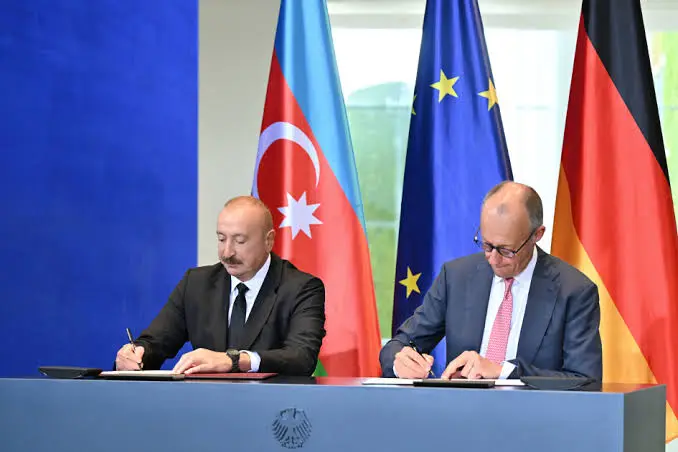

On 21 July 2026, Chancellor Friedrich Merz and President Ilham Aliyev signed a Joint Declaration on a Strategic Agenda for Bilateral Partnership in Berlin, thereby making Germany the second European state after Italy to place its relationship with Azerbaijan on a formally strategic footing. The package extended across energy, transport, infrastructure, trade, investment and science, and it was accompanied by a joint business council intended to give the commercial dimension of the relationship an institutional home (President of the Republic of Azerbaijan, 2026).
The timing reflects a broader European transition, as the EU closes the final chapter of a supply relationship that shaped its industrial economy for half a century. Since 2022, the Russian share of EU gas imports has fallen from roughly 45% to approximately 12%, and the remaining volumes are scheduled to exit the market entirely under the 2026 phase-out (European Commission, 2026). Because those volumes must be replaced from elsewhere, Azerbaijan has become one of the few producers that Brussels names with any consistency whenever the question of alternatives arises.
Yet at the press conference following the signing, President Aliyev raised a point that sat uneasily alongside the ceremony, observing that Azerbaijan could send considerably more gas westwards if European banks had not withdrawn from financing hydrocarbon projects (Brussels Signal, 2026). Although the remark passed with little commentary, it identifies a contradiction at the centre of European energy policy, and it is that contradiction, more than the declaration itself, which this brief examines.
The argument advanced here holds that the future reliability of European supply diversification will be determined by whether the capital required to expand production actually materialises, and that European financial policy is presently working against the very supply growth which European energy policy demands. Political agreements establish direction, whereas the volumes that eventually reach European markets depend on investment decisions made years in advance, and the widening gap between these two processes is where risk now accumulates.
The Demand Signal
The political architecture of the relationship is by now well developed. In July 2022, the European Union and Azerbaijan concluded a Memorandum of Understanding that set the objective of doubling deliveries through the Southern Gas Corridor from 10 to 20 billion cubic metres annually by 2027 (European Commission, 2022). Italy subsequently formalised its own strategic partnership with Baku, and Germany has now followed the same path, with its declaration explicitly calling for updated EU–Azerbaijan Partnership Priorities, a formulation which suggests that Berlin regards the bilateral track as advancing more rapidly than the multilateral one (President of the Republic of Azerbaijan, 2026).
The volumes involved in the German arrangement are nonetheless modest, since Azerbaijani gas began reaching Germany in 2026 under a ten-year contract with German companies covering approximately 1.5 billion cubic metres each year (Brussels Signal, 2026). Measured against national consumption of roughly 80 billion cubic metres, this is a small share of German demand, which suggests that the agreement was never conceived as a solution to Germany’s supply arithmetic. Its significance lies instead in market access, in cooperation on transport and investment, and in the political signal that Europe intends to build durable commercial relationships along its southeastern approaches.
For the European picture as a whole, however, the aggregate target carries considerably greater weight, because twenty billion cubic metres would constitute a meaningful contribution towards replacing Russian volumes. Achieving that figure depends on two conditions which no declaration can satisfy on its own, the first being additional production, requiring new upstream projects together with the expansion of fields already in operation, and the second being additional transport capacity, given that the Trans Adriatic Pipeline was constructed with an initial throughput of 10 billion cubic metres and its enlargement rests on compressor stations that must be financed and built before any incremental volume can move.
Four years after the memorandum was signed, neither condition has been fulfilled, and industry estimates accordingly place Azerbaijani export capacity to Europe nearer 13.5 billion cubic metres in 2027 (Caspian Policy Center, 2025). This shortfall reflects not a failure of political commitment in Baku or Brussels, but the absence of investment decisions that would have needed to be taken years earlier for the target to remain attainable.
The Financing Paradox
At this point, the argument turns towards the mechanism that explains the gap. European institutions have deliberately constructed a financial architecture designed to redirect capital away from fossil fuels, and its components have a considerable cumulative effect. The European Investment Bank ceased most lending to fossil fuel energy projects at the end of 2021 (European Investment Bank, 2019), while the EU taxonomy introduced disclosure obligations that raise both the administrative burden and the reputational cost associated with hydrocarbon exposure. Large commercial lenders, responding simultaneously to regulatory pressure and to their own net-zero commitments, have moreover tightened the conditions attached to upstream oil and gas financing across the sector.
Each of these measures is defensible when assessed against climate objectives, yet, taken together, they interact awkwardly with a separate and equally urgent policy goal: the rapid substitution of Russian gas with supply from partners such as Azerbaijan. Upstream gas development is capital-intensive and slow to mature, so bringing new volumes to market from fields such as Absheron or the deeper reservoirs of Azeri-Chirag-Gunashli requires investment commitments made between five and ten years before the first deliveries reach a European hub. Pipeline expansion follows a comparable rhythm; consequently, when the pool of willing lenders contracts, the projects that would have supplied Europe in 2029 and 2030 are those that quietly fail to reach a final investment decision in 2026.
The paradox at the centre of the relationship emerges from this sequence, since Europe asks its partners to expand supply while restricting the financial channels through which such expansion would ordinarily be funded. Brussels sets a volume target, member states conclude strategic partnerships to underscore their seriousness, and the capital markets that would translate those commitments into physical infrastructure have effectively been instructed to look elsewhere.
Europe’s own emergency conduct sharpens the contrast considerably, since when the crisis broke in 2022, Germany committed billions of euros in public funds within a matter of months to charter floating storage and regasification units and to construct import terminals along its northern coast, which demonstrates that capital can indeed be mobilised at speed once the political system treats a shortage as an emergency and the assets in question sit on national territory. Upstream investment abroad has attracted no comparable urgency, even though it determines whether there will be gas to import at all, so that Europe has in effect financed the receiving end of the supply chain while leaving the producing end to markets it has deliberately rendered cautious.
A further asymmetry compounds the difficulty: under the Union’s new provenance rules, exporters on the approved list may supply the European market without origin verification, whereas Azerbaijani deliveries remain subject to mandatory reporting and origin checks (European Commission, 2026). The requirement is understandable in enforcement terms, given persistent concerns regarding the relabelling of Russian volumes, although its commercial consequence is to add compliance costs and regulatory uncertainty for a supplier whom Europe is otherwise actively encouraging to invest, leaving Baku courted and audited at the same time.
Implications for the Future
The consequences of this arrangement extend well beyond a single bilateral relationship, and they fall under three headings.
The first concerns European energy security in its most direct sense, because volumes announced but never financed must still be sourced from somewhere, and in practice, that means liquefied natural gas priced on a global spot market. Such cargoes transmit Asian demand shocks straight into European industrial costs, whereas pipeline supply secured under a long-term contract offers a degree of price stability that spot purchasing cannot replicate. By under-financing the pipeline option, Europe is not reducing its hydrocarbon exposure so much as converting it into a more volatile form while retaining the same underlying dependence. Energy-intensive manufacturers feel this most acutely, as the winters of 2021 and 2022 demonstrated how rapidly a tight LNG market translates into industrial pain.
The second concerns the credibility of European economic statecraft, because a target announced in 2022 and left unfunded through 2026 conveys a durable lesson to suppliers about the weight that European commitments deserve. Producers allocate capital where offtake is contractually secure, so a partnership carrying political warmth without accompanying finance will encourage its holder to direct investment towards markets where the money is genuinely available, whether in Turkey, the Gulf or Asia. Repeated across several negotiations, this pattern gradually erodes the bargaining position Europe will require the next time it must secure supply at speed.
The third concerns the changing substance of what a strategic partnership actually contains. The Berlin declaration is instructive in this respect precisely because comparatively little of its text addresses gas, with transport corridors, infrastructure, investment facilitation and the joint business council occupying the greater part of the document. Understood in these terms, the agreement functions less as an energy contract than as a framework for connectivity between Europe and the Caspian, and that framework may ultimately prove the more consequential element, since Azerbaijan occupies a central position on the Middle Corridor and its long-term value to European economic relations may come to rest as much on what passes through its territory as on what it produces.
None of this lies beyond correction, since transitional finance categories, sovereign guarantees and dedicated European facilities for supply-critical infrastructure could unlock the capital that commercial lenders now avoid, particularly if conditionality were attached to emissions performance and to a clearly defined operating horizon. What is presently missing is not technical capacity but the political decision to reconcile two objectives that are still pursued in separate rooms.
Conclusion
The Azerbaijan–Germany Strategic Partnership represents a genuine development in European economic diplomacy and reflects serious intent on both sides, yet it should not be interpreted as a resolution of the supply question which prompted it. Declarations of this kind establish direction and create institutional channels through which cooperation can subsequently develop, although they neither build compressor stations nor sanction gas fields.
What emerges from Berlin is that European diversification has become a question of capital allocation. For as long as Europe requests volumes it simultaneously declines to finance, its energy security will rest on commitments that cannot be physically fulfilled, and its partners will price that inconsistency into their investment calculations accordingly. Aliyev’s observation about European banks was offered almost in passing while standing beside a chancellor at a signing ceremony, yet it described the binding constraint far more accurately than the document the two leaders had just concluded.
References
President of the Republic of Azerbaijan. (2026, July 21). Joint Declaration on a Strategic Agenda for the Bilateral Partnership between the Republic of Azerbaijan and the Federal Republic of Germany. https://president.az/en/articles/view/73037
Brussels Signal. (2026, July 21). Germany Turns to Azerbaijan for More Gas as Merz Signs Strategic Partnership. https://brusselssignal.eu/2026/07/germany-turns-to-azerbaijan-for-more-gas-as-merz-signs-strategic-partnership/
Reuters. (2026, July 21). Germany and Azerbaijan Sign Strategic Partnership Declaration in Berlin.
European Commission. (2022, July 18). Memorandum of Understanding on a Strategic Partnership in the Field of Energy between the European Union and the Republic of Azerbaijan. European Commission. https://energy.ec.europa.eu/topics/energy-security/diversification-gas-supply-sources-and-routes_en
European Commission. (2026, April 22). REPowerEU – 4 Years On: Progress on Ending the European Union’s Dependence on Russian Energy Imports. European Commission. https://energy.ec.europa.eu/strategy/repowereu-phase-out-russian-energy-imports/repowereu-4-years_en
European Investment Bank. (2019, November 15). EU Bank Launches Ambitious New Climate Strategy and Energy Lending Policy. European Investment Bank. https://www.eib.org/en/press/all/2019-313-eu-bank-launches-ambitious-new-climate-strategy-and-energy-lending-policy
Expert Analysis — Upstream Capacity
Caspian Policy Center. (2025, June 26). Trans-Caspian Gas: From Pipedream to Pipeline?. Caspian Policy Center – Energy Programme.