


From the point of view of Polish grand strategy, those conditions necessitate a strategic reorientation towards the north - a move which can be dubbed as the Baltic Pivot.
The Baltic Pivot: Poland’s Strategic Reorientation
By Radosław BinkiewiczEPIS Think Tank – Report Group: Security Policy and Defence
The article argues that Poland should respond to Russia’s military and hybrid threat, as well as the growing rift in Transatlantic relations, by making the Baltic Sea region a new central pillar of its grand strategy. Rather than relying primarily on either Washington or the EU, Poland should actively engage in building a regional security framework with the Nordic and Baltic states. The paper recommends three concrete measures: securing permanent participation in the NB8 format; establishing a strategic military partnership with Sweden focused on Baltic deterrence and operational planning; and reducing overreliance on US arms by expanding Poland’s own defence industry and cooperation with Sweden, Turkey and Ukraine. Together, these steps would strengthen deterrence against Russia, increase Poland’s strategic autonomy, and enhance the agency and geopolitical weight of the Baltic–Black Sea region as a whole.
Introduction
Poland is situated in the middle of the Great European Plain and with few natural barriers, it has always been an important transportation corridor on the west-east axis. Since its accession into the EU and NATO, Poland became the linchpin of NATO’s Eastern Flank. This position has only gained in importance after the start of the Russian full-scale invasion of Ukraine in 2022. As the only country which borders both Ukraine, Russia and Belarus, Poland simultaneously became a frontline state and one of the most crucial European logistics and transportation hubs. This is evident in the fact that more than 95% of all aid for Ukraine passes through Poland (Rozgon, 2025). Another aspect of Poland’s location is that the nation is situated not only on the crossroads between west and east, but also between north and south. It sits right in the middle of what some analysts dubbed the Baltic-Black Sea Bridge (Pomost bałtycko-czarnomorski). Envisioned as a separate geopolitical region between the Western European rimland and the Eurasian heartland, it connects Turkey and the Caucasus with Scandinavia (Dryblak, 2019; Bartosiak, 2020; Wójcik, 2021). Since Sweden and Finland joined NATO, the awareness of the importance of the north-south axis has been steadily increasing in Warsaw. As the European security environment undergoes its most profound transformation since the end of the Cold War, Poland might need to reorient itself more towards this vector, and especially towards its neighbours across the Baltic Sea.
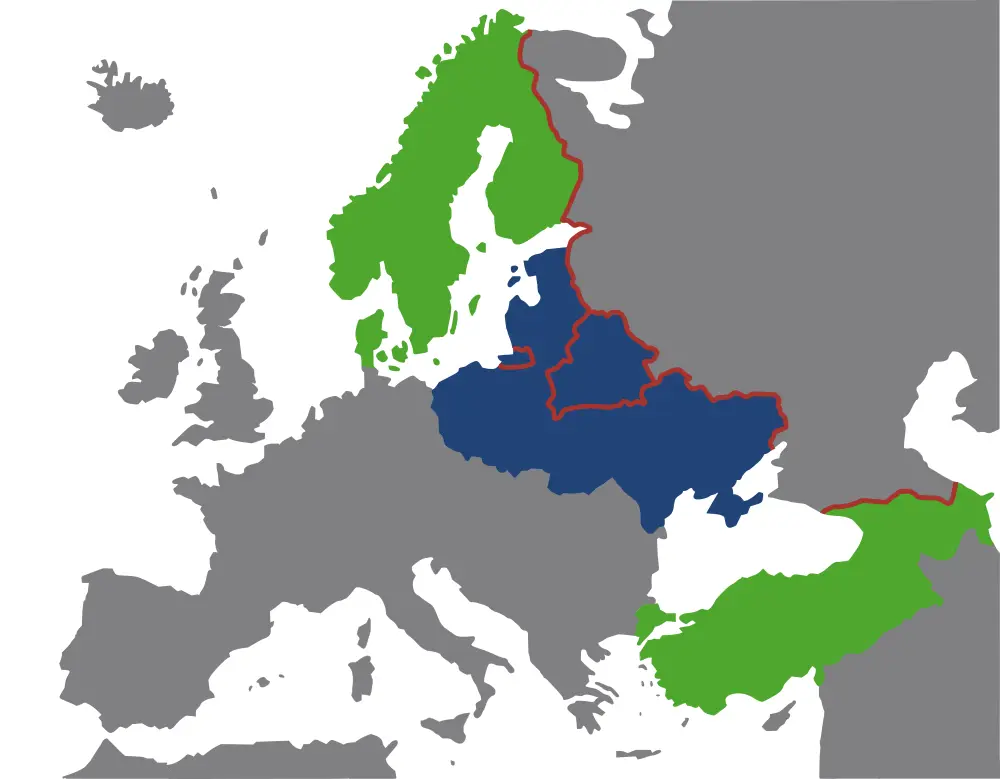
Figure 1: Map of the Baltic-Black Sea Bridge region (blue), connecting Scandinavia with Turkey-Caucasus (green), borders of Russia and Belarus marked in red (Source: Own Work).
Legacy of Historical Memory
The last time an active northern vector was present in Polish strategic thinking was more than 400 years ago, when Poland-Lithuania and Sweden battled for supremacy in the Baltic Sea region. Despite a series of eight brutal wars (1597-1721), neither side achieved ultimate victory. Instead, a third player joined in – Russia. In effect, the Polish-Swedish wars paved the way for centuries of Russian hegemony over Eastern Europe (Janicki, 2022). Prussia was another beneficiary. As a direct result of the Polish-Swedish Wars, it broke free of Polish overlordship in 1657, starting its road towards the formation of the German Empire. After that, the Baltic Sea was no longer perceived as a strategic space enabling power projection, regional integration or alliance-building. This is why, for a long time, Polish grand strategy neglected the north-south axis. Instead, the west-east axis gained absolute predominance. This spatial orientation is felt especially strongly in regional infrastructure. In the last two centuries, Central-Eastern Europe functioned as a space organised around external relations, rather than as a coherent region, and to this day, west-east infrastructure remains considerably more developed than north-south linkages. This is true not only about roads and railways, but also about pipelines, hindering regional energy security and facilitating energy dependence on Russia (Garding & Mix, 2025).
Such realities gave rise to two different conceptions of what the geopolitical objectives of an independent Polish State should look like (Kubera, 2016; Fiedorczuk & Parkasiewicz, 2024). The first one is known as the Piast Idea. Named after the Piast Dynasty, which was the first historical ruling house of Poland, the Piast Idea assumes that Poland should focus primarily on building a strong, cohesive and economically prosperous nation-state, closely integrated with Western Europe. The other conception is the so-called Jagiellonian Idea. It takes its name from the Jagiellonian Dynasty, which was responsible for the creation of the Polish-Lithuanian Commonwealth. It posits that Poland must assume a proactive role in Central and Eastern European politics because national security depends on actively shaping the situation in its eastern neighbourhood.
The End of History
Despite being often seen as contradictory, both the Piast and the Jagiellonian Ideas are in agreement at the fundamental level (Maj et al, 2023; Siemiątkowski, 2025). Overall, Poland’s strategic objectives are remarkably consistent, no matter the political faction currently at the helm of power. Those objectives are twofold: to anchor itself in the West, thus seeking to reduce economic, technological and institutional disparities vis-à-vis Western Europe; and to contain Russia, thus keeping it outside of the European economic, political and security system (Bartosiak, 2025). Both Ideas can be seen as two archetypal postures, which essentially share the same objectives, but prioritise them differently and focus on different ways to achieve said priorities. Historically, Poland oscillates between both, depending on the given geopolitical circumstances.
While the Second Polish Republic (1918-1939) was following a quintessentially Jagiellonian policy, the Third Polish Republic, born after the fall of the communist dictatorship in 1989, has been implementing a policy steeped in the Piast Idea. Entries into NATO (1999) and into the EU (2004) integrated Poland deeply with the West, resulting in massive economic, institutional and societal reforms. As a result, the Polish economy grew by approximately 170% since 2000, becoming the world’s 20th largest economy in 2025 (OECD, 2025). Simultaneously, the umbrella of NATO collective security and famously “ironclad” American guarantees gave room for a confidence in national safety not felt since at least the 18th century. Although some elements of the Jagiellonian Idea are also present in Polish foreign policy, the arrow of focus pointed decisively west, towards further internal development. The vision of Fukuyama’s End of History became the fulfilment of all the dreams of Polish political elites and proof of the ultimate success of the Piast Idea. The prosperous future of Poland was to rely solely on two pillars: a strong alliance with the hegemonic power of the United States, its principal security guarantor, and membership in the EU, which finally rejoined Poland with the European community. There was nothing more to be done – the correct course had already been set.
In Search of Deterrence
In recent years, this paradigm has started to rapidly collapse. The Russian invasion of Ukraine brought modern war to Poland’s doorstep while the nation continuously faces the threat of an ongoing hybrid warfare perpetrated by Russia and Belarus (Olech, 2026). Perhaps most worryingly, the twin pillars, upon which the last few decades of Polish policy rested, began to distance themselves from each other. During the second presidency of Donald Trump, it became obvious that Transatlantic ties between the EU and the US are breaking down. Despite the fact that the White House hails Poland as a model ally and Polish-American relations remain very close, the volatile actions of the Trump Administration resulted in a sharp drop in trust in US leadership (Bednarczyk, 2026). In May 2026, a surprise announcement made by US officials about a withdrawal of 4000 American troops from Poland caused bewilderment and confusion. Those feelings were hardly lifted even after Donald Trump publicly contradicted this policy a few days later, when he declared he would send an additional 5000 troops to Poland (Carlson & Cook, 2026). This reinforces concerns about deliberate weakening of American security guarantees. On the other hand, there are serious doubts regarding the stances, capabilities and credibility of many European allies as well. Especially frustrating for Poland is the constant and consistent disinterest of some Western European states, especially Germany and France, in formally repealing the 1997 NATO-Russia Founding Act. The Founding Act committed both sides to not see each other as adversaries, hold regular consultations, as well as restrain permanent deployments on the Eastern Flank. It is still officially in force, long after Russia stopped holding up its end of the bargain. From the point of view of Poland and other allies on NATO Eastern Flank, the Founding Act creates a structural security asymmetry between “old” and “new” NATO members (Dyner et al, 2022; Bienvenu et al, 2024).
All those factors put into question the feasibility of the previous format of Polish grand strategy. At the same time, a tangible deterioration of Polish security has made the search for new ways of deterrence a necessity. Perhaps the most striking example of this process can be found in Donald Tusk’s statements made in March 2025. In a speech to the Parliament, he said that Poland cannot restrict itself to conventional weapons and thus should look at gaining access to nuclear weapons. He also formulated a desire for the ongoing modernisation of Polish armed forces to lead to an army of 500,000 men (Cienski & Kość, 2025). Another sign pointing at the end of the “nuclear taboo” in Poland is the publication of the book titled “Our Bomb. Does Poland Need a Nuclear Strategy?” (Nasza bomba. Czy Polska potrzebuje strategii jądrowej?) by Albert Świdziński, which took place in February 2026 and was met with considerable interest. The same topic was also hinted at in the new “Strategy of Polish Foreign Policy 2026-2030”, officially published by the FMA in March 2026, for the first time in almost a decade. On page 11 of the document, it is said that “growing uncertainty regarding allied guarantees may encourage other countries to seek additional security, including nuclear capabilities”.
Looking North
Recognition of the fundamental importance of both European and Transatlantic cooperation remains one of the core principles of the new Polish Foreign Policy Strategy. A lot of its content, however, suggests a grand return of the Jagiellonian Idea. Russian aggression is directly named as the greatest threat to national security, while an active policy in Poland’s eastern neighbourhood is mentioned as necessary to confront and contain Russia. This format includes not only Ukraine, but also countries under heavy Russian influence, like Belarus and Moldova. Moreover, the document depicts a rising recognition of the north-south axis’ role. The Three Seas Initiative (3SI) is recognised as an important economic project aimed at strengthening the infrastructural interconnectivity of the region overlapping with the Baltic-Black Sea Bridge – and thus aimed at increased resilience of the eastern half of Europe and reduced disparities vis-à-vis the West. Forging of closer ties between the European Union and countries of the South Caucasus is also explicitly stated as one of the desirable policies, which could be seen as a flanking manoeuvre against Russia through the erosion of its sphere of influence.
At the same time, it’s the northern vector that holds a particular interest in Poland’s foreign policy. The Strategy clearly states that relations with the Nordic and Baltic states have a special place because those countries share with Poland a similar perception of the seriousness of the Russian threat. Both Finland and Sweden demonstrate considerable military capabilities. In addition, Sweden possesses one of the most robust and advanced military industries on the continent. Therefore, strengthening the region’s role in shaping the strategic policies of the EU and NATO is in Poland’s national interest. Geography, history, common geopolitical interests and cultural ties unify the Baltic Sea region, creating a fertile ground for increased military, political and economic cooperation. Although in the initial stages, some of this is already happening (Government Offices of Sweden, 2025). Such regionalisation would be a key factor for successful deterrence, containment and, in case of open war, victory over Russia in the east. From the point of view of Polish grand strategy, those conditions necessitate a strategic reorientation towards the north – a move which can be dubbed as the Baltic Pivot.
Policy Recommendations
Currently, Poland faces the prospect of continued deterioration of Euro-American relations, as well as a shift in American priorities away from NATO and multilateral alliances, towards bilateral relations with individual nations. This context presents to the Polish leadership three strategic possibilities.
The first one, clearly favoured by the camp around President Karol Nawrocki, is the prioritisation of a strategic alliance with the United States. The US remains the most capable Western military power. A close bilateral relationship with Washington offers access to advanced military technologies, intelligence sharing and possibly nuclear deterrence. This option is made easier by the fact that Poland is generally viewed in Washington as a reliable ally. On the other hand, the main weakness of this strategy lies in its dependence on factors beyond Polish control. Excessive reliance on the United States may create a significant strategic vulnerability if the White House reduces its military presence or political commitment. Dependence on American technology and equipment will also provide Washington with control over Polish escalation capabilities. This factor already played a detrimental role in the Ukrainian war effort and could become a dire problem if Polish perception begins to drastically differ from the American point of view. Furthermore, an overly Atlanticist posture risks alienating European partners and reducing Poland’s influence within the EU.
The second possibility, favoured by the government under Prime Minister Donald Tusk, means prioritisation of European cooperation. Ideally, this would allow Poland to shape the future of continental defence initiatives in its favour. The newly published Strategy of Polish Foreign Policy mentions the Weimar Triangle precisely in this context, ascribing to it a great significance, particularly in matters of security, key European policies and Transatlantic relations. There is even a suggestion of ambitious reform projects aimed at building resilience, strengthening the EU’s effectiveness and enhancing its geopolitical role. The main challenge is connected with existing doubts as to the feasibility of European replacement of American capabilities. A significant number of European countries, especially those located far from the Eastern Flank, still struggle to meet NATO military spending requirements. This strategic choice is also not free from the risks related to dependence on external factors. Threat perceptions vary significantly across Europe. This could be especially dangerous if political forces representing a more conciliatory approach towards Moscow were to take power in Western European capitals. Consequently, a strategy centred solely on European cooperation may leave Poland dependent on partners whose security priorities may not always align with those of Warsaw.
The third option is that of regionalisation and formation of a security-focused block around the Baltic Sea. Because of long-lasting neglect of the northern vector in Polish foreign policy, this is simultaneously the most innovative and the most difficult out of the three paths. To maximise profits and minimise risks, Poland should utilise the divided sympathies of its leadership to work with its Western European and American partners, without committing to a definite choice between the two. Simultaneously, a persistent effort must be made towards creating a third strategic pillar: the Baltic Sea regional cooperation framework, which could serve as an additional layer of security architecture. Poland, Sweden and Finland already treat military investment very seriously, and their citizens are among those most willing to actually fight for their countries (Andžāns, 2026). Because of the proximity and structural nature of the Russian threat, the risk that a change in government could bring about a drastic change in approach towards Moscow is also greatly reduced. Regionalisation, therefore, enables faster decision-making and military coordination, deeper defence-industrial integration and stronger resilience in key areas (cyber, energy and maritime security, hybrid threats response, critical infrastructure protection). At the same time, it guarantees greater geopolitical agency of the Baltic-Black Sea Bridge space.
From this, three main policy recommendations can be made:
Poland should seek permanent membership in the Nordic-Baltic Eight.
So far, the Council of the Baltic Sea States is the only organisation in which Poland participates together with the Scandinavians. Its priorities, however, lie not in defence and strategy but rather sustainable development, environment and cultural engagement. Because of that, the Nordic-Baltic Eight format is much more suited for current challenges. Poland is not a permanent member of this organisation, but has already engaged with it by attending ministerial meetings, political consultations and sectoral initiatives. Permanent participation of Poland in the NB8 format would be a logical geostrategic choice and a natural response to current geopolitical realities.
A close military cooperation with Sweden must be established.
Poland and Sweden are the two major military powers in the Baltic Sea region and naturally complement each other’s strengths on NATO’s Eastern Flank. They also project power into Belarus-Kaliningrad and the Arctic, respectively, checking Russia on other fronts. As such, there is a need to create a regular joint military exercises framework. Some Polish troops could be sent to help garrison the Swedish island of Gotland, which is a key strategic position in the middle of the Baltic Sea, while Swedish units could be sent to the Polish coast. Common military plans should be drawn up and discussed. They shouldn’t be purely defensive. One of the important lessons from the ongoing war in the Persian Gulf is that a conventionally weaker side can achieve great success, even when fighting a nuclear power, through the blockade and control over strategically located “chokehold” points, such as the Straits of Hormuz or the Straits of Malacca. This allows them to exert enormous leverage on the enemy. The Baltic Sea has three such chokehold points: the Kaliningrad Oblast, the Danish Straits and the Gulf of Finland. Kaliningrad will inevitably play a crucial role in the case of open war with Russia, and while Poland can blockade it from land and air, a sea blockade will need Swedish assistance.
Poland should reduce its overreliance on the US defence industry.
Contrary to a belief popular among some policymakers, arms purchases function neither as security guarantees nor as an insurance policy. Excessive dependence on the US creates strategic vulnerabilities by giving Americans significant influence over Poland’s escalation options. In a future conflict with Russia, Washington may attempt to limit Polish military actions against targets in Belarus or Kaliningrad out of concern for escalation, even if such actions were militarily advantageous from the Polish perspective. For this reason, Poland should place greater emphasis on domestic and regional defence-industrial cooperation. European suppliers offer the advantage of shorter and more secure supply chains, but the ultimate objective must be the development of an independent Polish defence-industrial base capable of sustaining wartime production. Of great importance is cooperation with Ukraine, especially in the fields of drone warfare and long-range missile systems, as well as with Sweden and Turkey. Both of them possess advanced defence industries and occupy strategically important positions on Russia’s northern and southern flanks. Such cooperation would increase Poland’s autonomy and utilise its central position on the north-south axis. At the same time, it would strengthen the broader network of states on the Baltic-Black Sea Bridge committed to containing Russian revisionism.
Conclusions
As the old international order breaks down, the rift between America and Europe deepens, and uncertain political developments hang over both sides of the Atlantic, the Baltic Sea becomes the most crucial geostrategic direction for Poland. Common interests and threat perception tie the region together. Cooperation in this format would increase the geopolitical agency of the entire Baltic-Black Sea Bridge and allow Warsaw to construct a third pillar of its security. In order to achieve that, Warsaw should take a more proactive role in its neighbourhood, establish a close military partnership with the Scandinavians and take serious long-term steps towards developing its own national military industry. This must include modern drone warfare technologies, long-range missile capabilities and full control over Poland’s escalation capabilities. Such a path offers the best way of deterring or repelling a possible Russian aggression, securing national interests, and thus Poland’s place in the new European security architecture.
References
Andžāns, M. (2026). Would You Fight For Your Country? The Most and Least Willing Among NATO Allies. Foreign Policy Research Institute. https://www.fpri.org/article/2026/03/would-you-fight-for-your-country-the-most-and-least-willing-among-nato-allies/.
Banka, A. (2022). NATO and the Schrödinger’s Cat. RUSI. https://www.rusi.org/explore-our-research/publications/commentary/nato-and-schrodingers-cat.
Bartosiak, J. (2020). Kim jesteśmy i gdzie nasze miejsce. Strategy&Future. https://patronite.pl/post/63471/sf-hero-kim-jestesmy-i-gdzie-nasze-miejsce.
Bartosiak, J. (2025). Oczy szeroko otwarte. Polska strategia na czas wojny światowej. Wydawnictwo Literackie. ISBN: 978-83-08-08720-6.
Bednarczyk, P. (2026). Will Washington Lose a Model Ally in Europe? GMF. https://www.gmfus.org/news/will-washington-lose-model-ally-europe.
Bienvenu, H., Hivert A. F., Hoorman, C., Jacque, P., Vincent, E. (2024). On NATO’s eastern flank, on the Russian border, the ‘pre-war era’ has begun. Le Monde. https://www.lemonde.fr/en/international/article/2024/07/11/on-nato-s-eastern-flank-on-the-russian-border-the-pre-war-era-has-begun_6680829_4.html.
Carlson, M. & Cook, L. (2026). NATO allies bewildered by Trump’s about-face on US troop moves in Europe. Associated Press. https://apnews.com/article/nato-trump-troops-europe-poland-confusion-5ee39c29238cdee76c1780233cb6fddc.
Cienski, J. & Kość, W. (2025). Poland seeks access to nuclear arms and looks to build half-million-man army. Politico. https://www.politico.eu/article/donald-tusk-plan-train-poland-men-military-service-russia/.
Dryblak, Ł. (2019). Geopolityka Jerzego Niezbrzyckiego, czyli rozwinięcie koncepcji pomostu bałtycko-czarnomorskiego. Teologia Polityczna. https://teologiapolityczna.pl/geopolityka-jerzego-niezbrzyckiego-czyli-rozwiniecie-koncepcji-pomostu-baltycko-czarnomorskiego-tpct-149-1.
Dyner, A. M., Kacprzyk, A., Lorenz, W. (2022). Konsekwencje rosyjskiej inwazji na Ukrainę dla porozumienia NATO-Rosja (NRFA) z 1997 r. PISM. https://www.pism.pl/publikacje/konsekwencje-rosyjskiej-inwazji-na-ukraine-dla-porozumienia-nato-rosja-nrfa-z-1997-r.
Fiedorczuk, J. & Parkasiewicz, M. (2024). Polska „jagiellońska” vs. Polska „piastowska”. Debata. Klub Jagielloński. https://klubjagiellonski.pl/2024/11/07/polska-jagiellonska-vs-polska-piastowska-debata/.
Garding, S. E. & Mix, D. E. (2025). The Three Seas Initiative. Congressional Research Service. https://www.congress.gov/crs_external_products/IF/PDF/IF11547/IF11547.4.pdf.
Government Offices of Sweden. (2025) Military-technical cooperation between Sweden and Poland. https://www.government.se/press-releases/2025/09/military-technical-cooperation-between-sweden-and-poland/.
Gromadziński, J. (2025). Poland in NB8? A chance to redefine Northern Policy and strengthen NATO’s North-Eastern Flank. Defence24. https://defence24.com/geopolitics/poland-in-nb8-a-chance-to-redefine-northern-policy-and-strengthen-natos-north-eastern-flank.
Janicki, A. (2022). Russian Expansion in the Baltic in the 18th Century. Studia Historica Gedanensia, Vol. 13. https://ejournals.eu/en/journal/studia-historica-gedanensia/article/russian-expansion-in-the-baltic-in-the-18th-century.
Kubera, J. (2016). Polska „piastowska” vs „jagiellońska”. Odmienność wizji relacji z Niemcami jako determinanta poglądów na polską politykę zagraniczną. Acta Politica Polonica. https://www.ceeol.com/search/article-detail?id=497887.
Magnuson, S. (2024). Sweden Brings Defense Industrial Might to NATO. National Defense. https://www.nationaldefensemagazine.org/articles/2024/7/1/sweden-brings-defense-industrial-might-to-nato.
Ministerstwo Spraw Zagranicznych. (2026). Strategia polskiej polityki zagranicznej na lata 2026 – 2030. https://www.gov.pl/web/dyplomacja/strategia-polskiej-polityki-zagranicznej-na-lata-2026–2030.
NATO. (1997). Founding Act on Mutual Relations, Cooperation and Security between NATO and the Russian Federation signed in Paris, France. https://www.nato.int/en/about-us/official-texts-and-resources/official-texts/1997/05/27/founding-act.
OEDC. (2025). OECD Economic Surveys: Poland 2025. https://www.oecd-ilibrary.org/content/dam/oecd/en/publications/reports/2025/02/oecd-economic-surveys-poland-2025_3d6f79bd/483d3bb9-en.pdf.
Olech, A. (2026). Report: Poland as a target of Russian hybrid attacks. Defence24. https://defence24.com/geopolitics/report-poland-as-a-target-of-russian-hybrid-attacks.
Rozgon, O. (2025). Ukraine’s defense is possible thanks to the efforts of Poles and the Rzeszów-Jasionka logistics hub – Nawrocki. Ukrainian National News. https://unn.ua/en/news/ukraines-defense-is-possible-thanks-to-the-efforts-of-poles-and-the-rzeszow-jasionka-logistics-hub-nawrocki.
Siemiątkowski, J. (2025). Idea piastowska czy Wielka Polska? Nowy Ład. https://nlad.pl/idea-piastowska-czy-wielka-polska/.
Świdziński, A. (2026). Nasza bomba. Czy Polska potrzebuje strategii jądrowej? Wydawnictwo Literackie. ISBN: 9788308085837.
Wójcik, P. (2021). Infrastrukturalna współpraca bałtycko-czarnomorska. Instytut Nowej Europy. ine.org.pl/infrastrukturalna-wspolpraca-baltycko-czarnomorska/.