
Since Russia launched its full-scale invasion of Ukraine in February 2022, the European Union has progressively expanded the scope and intensity of its restrictive measures against Russia. Successive sanctions packages have targeted financial flows, energy revenues, trade, advanced technologies, transport networks, and the Russian military-industrial complex (Immenkamp, 2024). As these restrictions became more comprehensive, however, their effectiveness increasingly depended on the EU’s ability to prevent circumvention through third countries, intermediaries, and alternative trade and transport networks. Consequently, sanctions enforcement became an increasingly important dimension of European sanctions policy.
The EU initially responded to this challenge primarily through targeted measures against individual companies, financial institutions, vessels, and other actors involved in facilitating circumvention. Over time, these measures expanded beyond individual transactions and increasingly addressed the wider networks through which Russia obtained restricted goods and services. Measures targeting Russia’s shadow fleet, third-country intermediaries, and contractual re-export arrangements illustrate this gradual externalisation of sanctions enforcement. A potentially significant further step occurred with the twentieth EU sanctions package adopted on 23 April 2026. For the first time since its introduction in 2023, the EU has activated the anti-circumvention instrument under Article 12f of Regulation (EU) No 833/2014. Following prior diplomatic engagement and an assessment of persistent diversion risks, the Council prohibited the export of selected machining centres and telecommunications equipment to Kyrgyzstan (Council Decision (CFSP) 2026/508; Council Regulation (EU) 2026/506). Unlike conventional individual listings, the restriction is not limited to specifically designated Kyrgyz companies. For the products in question, the destination country itself becomes relevant to the measure’s application.
This development raises a broader question about the evolution of EU sanctions policy. The Union has traditionally distinguished its own restrictive measures from US secondary sanctions and has emphasised the importance of maintaining a recognised jurisdictional connection between EU law and the regulated conduct (Council of the European Union, 2024a). At the same time, effective sanctions enforcement increasingly requires the EU to address economic activity and circumvention networks located beyond its borders. Against this background, this article asks: Does the first activation of the EU anti-circumvention instrument against Kyrgyzstan mark the emergence of a distinct European model of selective extraterritorial sanctions enforcement?
The article argues that the activation of Article 12f does not amount to the adoption of US-style secondary sanctions. It nevertheless represents a significant development in the external reach of EU sanctions enforcement. By moving from predominantly actor-specific restrictions to a mechanism that allows access to selected European goods to be restricted at the level of a third-country destination, Article 12f introduces a new form of conditionality into the EU sanctions regime. The Kyrgyz case should therefore be understood as an early indication of a more externalised European enforcement approach rather than evidence of a fully developed extraterritorial sanctions doctrine.
The article first establishes the jurisdictional foundations of EU sanctions and their traditional distinction from US secondary sanctions. It then traces the gradual shift from direct restrictions on Russia towards increasingly network-oriented anti-circumvention measures, culminating in the first activation of Article 12f. Finally, it assesses the extent to which this development constitutes an emerging European approach to external sanctions enforcement and where important differences from the US model remain.
The Jurisdictional Foundations of EU Sanctions and the Secondary-Sanctions Benchmark
For the purposes of this article, sanctions are understood as restrictive measures adopted to pursue foreign-policy objectives by influencing or constraining the behaviour of a target (Lohmann, 2016, p. 933; Marinov, 2005, p. 566; Morgan et al., 2009, p. 94; Weber & Schneider, 2020). The relevant distinction for the present analysis is not primarily between unilateral and multilateral sanctions (Tsouloufas & Rochat, 2023), but between measures that remain tied to the sender’s jurisdiction and measures designed to influence economic activity beyond it. This distinction is particularly important when comparing the European Union’s traditional approach with US secondary sanctions.
EU sanctions are adopted through a two-stage legal process. The Council first adopts a decision under Article 29 of the Treaty on European Union within the framework of the Common Foreign and Security Policy (Immenkamp, 2024; Weber & Schneider, 2020). Where the measures interrupt or restrict economic and financial relations, they are subsequently implemented through a Council regulation pursuant to Article 215 of the Treaty on the Functioning of the European Union. Such regulations are binding in their entirety, directly applicable throughout the Union, and subject to judicial review by the EU courts. Their practical enforcement, including the investigation and penalisation of infringements, remains primarily the responsibility of the Member States (Immenkamp, 2024). The jurisdictional reach of the EU’s Russia sanctions is codified in Article 13 of Regulation (EU) No 833/2014. The Regulation applies within the territory of the Union, on board aircraft and vessels under the jurisdiction of a Member State, to nationals of Member States wherever they are located, to companies and other legal entities incorporated under the law of a Member State, including when they operate outside the Union, and to any legal person, entity, or body in respect of business conducted wholly or partly within the Union. EU sanctions, therefore, extend beyond territorial jurisdiction in the narrow sense. An EU national or EU-incorporated company may remain subject to the Regulation while operating abroad, while a non-EU company may fall within its scope where the relevant business is conducted, at least partly, within the Union.
Despite this comparatively broad reach, EU restrictive measures have traditionally remained anchored in a legally recognised connection with the Union. The Council’s Sanctions Guidelines explicitly state that restrictive measures should apply only where such links with the EU exist, including territory, nationality, incorporation under Member State law, or business conducted wholly or partly within the Union (Council of the European Union, 2024a). The same Guidelines state that the EU will refrain from adopting legislative instruments with extraterritorial application where this would breach international law (Council of the European Union, 2024a).
This approach has historically distinguished EU sanctions from US secondary sanctions. Secondary sanctions seek to influence third-country actors by attaching consequences to their dealings with sanctioned states, entities, or individuals, even when the underlying transaction occurs outside conventional US jurisdiction (Beaucillon, 2024). Their effectiveness is closely linked to access to the US market and financial system. The traditional EU approach, by contrast, has not generally sought to prohibit a company established exclusively in a third country from engaging in an otherwise external transaction solely because that transaction conflicts with an EU foreign-policy objective (de Galbert, 2016). The EU’s longstanding scepticism towards broad claims of extraterritorial jurisdiction is also reflected in its Blocking Statute, Council Regulation (EC) No 2271/96. The instrument was introduced to protect EU operators against the effects of specified third-country legislation applied extraterritorially and, subject to certain exceptions, restricts compliance with such measures. Its existence illustrates the political and legal sensitivity surrounding attempts by one jurisdiction to regulate economic conduct taking place under another (Council Regulation (EC) No 2271/96). At the same time, the EU’s jurisdictional approach does not permit EU operators to use controlled companies abroad as instruments of circumvention; the Council Guidelines make clear that an EU-incorporated entity may not use a company it controls to evade prohibitions binding upon it (Council of the European Union, 2024a).
This distinction between jurisdiction and effects is essential for assessing the subsequent evolution of EU anti-circumvention policy. Even conventionally territorial sanctions inevitably produce economic consequences abroad. Foreign companies may lose European customers, access to EU-origin goods, or the ability to use European financial and logistical services. Such external effects do not in themselves amount to extraterritorial legal application. The more difficult question is whether newer measures merely intensify those effects or alter the underlying jurisdictional logic by making access to the European market conditional upon conduct undertaken in third countries. To assess the implications of the anti-circumvention instrument, Article 12f, it is not necessary to determine whether it affects actors outside the Union; EU sanctions have always done so, but the question is whether it represents a shift from regulating EU-connected persons and transactions towards using that jurisdictional authority to impose more systematic behavioural conditions on third-country jurisdictions. The distinction provides the conceptual basis for determining whether the EU is retaining its established territorial and personal connecting factors, or developing a selective form of sanctions enforcement that increasingly resembles the functional logic of secondary sanctions.
From Restriction to Enforcement: The Externalisation of EU Sanctions and Article 12f
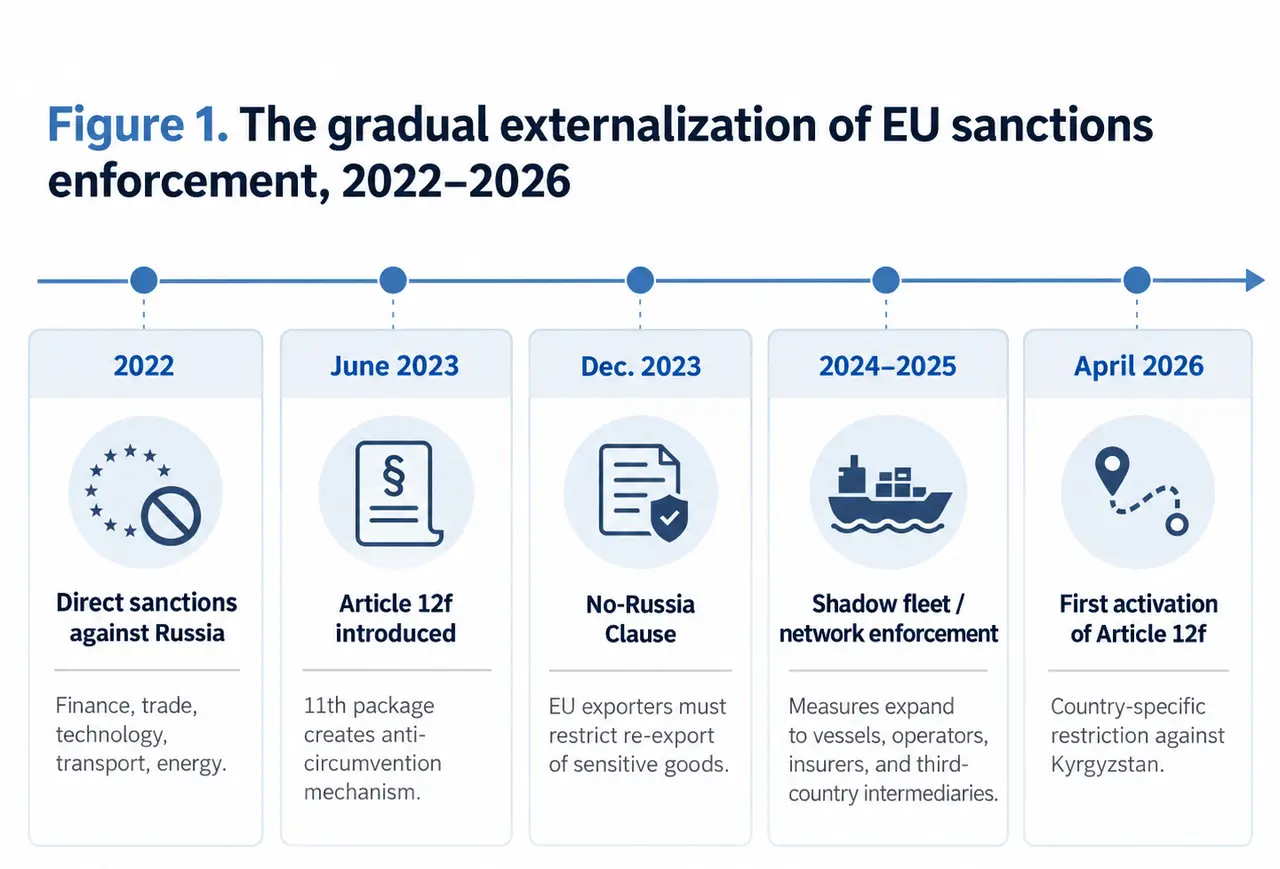
The evolution of EU sanctions against Russia since February 2022 reflects a gradual shift in both the scope and logic of restrictive measures. The initial sanctions packages focused predominantly on imposing direct economic costs on Russia and constraining its ability to finance and sustain the war. Financial restrictions were rapidly complemented by extensive export controls on dual-use goods and advanced technologies, limitations on transport and services, and increasingly far-reaching measures targeting Russia’s energy revenues and military-industrial complex (Stengl, 2025). By the end of 2022, the EU sanctions regime had developed into a broad architecture covering finance, trade, technology, transport, and energy. The introduction of the oil price cap further linked access to European maritime, insurance, and financial services to compliance with sanctions restrictions (Stengl, 2025). As these direct restrictions became more comprehensive, however, circumvention increasingly emerged as a central challenge (Council Regulation (EU) 2023/1214). Russia sought to replace restricted European suppliers and services through third-country intermediaries, alternative transport routes, and re-export networks. The focus of EU policy, therefore, gradually shifted from adopting additional prohibitions on direct EU–Russia transactions to enforcing existing restrictions beyond the immediate bilateral relationship.
The eleventh sanctions package of June 2023 marked an important institutional step in this transformation. Alongside additional restrictions on third-country entities supplying Russia’s military-industrial complex, the EU established a dedicated anti-circumvention mechanism that was subsequently incorporated into Article 12f of Regulation (EU) No 833/2014 (Council of the European Union, 2023a; Council Regulation (EU) 2023/1214). The instrument was deliberately conceived as a measure of last resort. The EU would first pursue diplomatic engagement and technical cooperation with the third country concerned and, where appropriate, impose targeted restrictions on individual operators facilitating circumvention (Hilgenstock, 2025). Only where individual measures and further engagement proved insufficient, and the volume, type or systemic nature of circumvention demonstrated a continuing and particularly high risk, could the EU resort to country-specific restrictions (Council of the European Union, 2023a).
This created a legal possibility that went beyond conventional individual listings. Nevertheless, Article 12f remained unused for almost three years. Instead, subsequent packages progressively strengthened less far-reaching forms of external enforcement. The twelfth sanctions package, for instance, introduced the so-called “No-Russia Clause”, requiring EU exporters of certain sensitive goods to contractually prohibit their re-export to Russia. It also strengthened enforcement of the oil price cap and introduced notification requirements for the sale of tankers to third countries (Council of the European Union, 2023b). These measures extended the practical reach of EU sanctions into commercial relationships beyond the Union without directly regulating third-country actors as such.
The gradual shift towards network-oriented enforcement became particularly visible in measures against Russia’s shadow fleet. From the fourteenth sanctions package onwards, the EU increasingly targeted not only Russian transactions but also the vessels and services enabling them. Subsequent packages expanded restrictions to shipowners, operators, insurers, traders, and other actors, facilitating circumvention (Stengl, 2025). By the seventeenth package, the Council explicitly referred to the targeting of the broader “shadow fleet ecosystem”, including companies established in third countries (Council of the European Union, 2024b, 2025). The relevant object of sanctions policy was therefore no longer confined to the Russian state or direct EU–Russia transactions; it increasingly encompassed the transnational infrastructure through which Russia adapted to sanctions.
Yet these measures remained predominantly actor- or infrastructure-specific. Particular vessels, companies, banks, or service providers were targeted because of their identifiable role in sanctions circumvention. The first activation of Article 12f in the twentieth sanctions package of 23 April 2026, therefore, represents a qualitatively different step.
For the first time, the Council added both a third-country jurisdiction, the Kyrgyz Republic, and specific product categories to Annex XXXIII of Regulation No 833/2014. Council Regulation (EU) 2026/506 prohibits the sale, supply, transfer, or export to Kyrgyzstan of selected machining centres and telecommunications equipment. Crucially, the restriction is not limited to previously designated Kyrgyz companies. For the goods concerned, the destination itself becomes the relevant regulatory criterion (Council Regulation (EU) 2026/506; Council Decision (EU) 2026/508). The Council justified the measure by pointing to substantial changes in trade flows. According to Regulation 2026/506, Kyrgyz imports of EU-origin Common High-Priority items during the first ten months of 2025 were almost 800 percent higher than before Russia’s full-scale invasion, while Kyrgyz exports of such goods to Russia had increased by approximately 1,200 percent. The selected machining centres can be used to manufacture high-precision components relevant to military production, while the telecommunications equipment concerned may serve military communications and drone-related applications (Council Regulation (EU) 2026/506). Importantly, activation was not based solely on trade diversion. The Regulation records prior diplomatic engagement, including discussions with the EU International Special Envoy for the Implementation of EU Sanctions and repeated efforts to secure stronger Kyrgyz controls on re-exports. The Council ultimately concluded that the measures adopted by Kyrgyzstan had been insufficient to prevent systematic diversion of sensitive EU-origin goods to Russia (Council Regulation (EU) 2026/506). The first application thus followed the escalation logic envisaged when Article 12f was created. Diplomatic engagement and targeted measures precede a country-specific restriction.
Source: Author’s compilation based on Council of the European Union (2023a, 2023b, 2024, 2025) and Council Regulation (EU) 2026/506.
Assessment: An Emerging European Model of External Sanctions Enforcement?
The first activation of Article 12f represents a significant development in EU sanctions enforcement, but it should not be equated with the adoption of US-style secondary sanctions. Its significance lies instead in the way the EU increasingly uses access to European goods as leverage against sanctions circumvention occurring through third countries. The measure, therefore, points towards a more externalised form of enforcement while remaining narrower in scope and design than the US model.
The principal innovation concerns the level at which circumvention is addressed. Earlier measures predominantly targeted identifiable actors or infrastructures involved in sanctions evasion, such as companies, banks, vessels, or service providers. Article 12f allows the EU to respond where circumvention is no longer treated primarily as the conduct of individual intermediaries but as a broader problem associated with a particular destination. In the Kyrgyz case, access to selected EU-origin goods was restricted because the Council considered the existing measures insufficient to prevent their continued diversion to Russia (Council Regulation (EU) 2026/506). The importance of the instrument, therefore, lies not primarily in the economic weight of the products concerned, but in the fact that the destination country itself becomes relevant to the enforcement decision. This does not mean that the EU has abandoned its traditional jurisdictional approach. The prohibition continues to apply under EU law and covers the sale, supply, transfer, or export of specified goods by actors within the scope of Regulation No 833/2014. Article 12f does not generally prohibit Kyrgyz companies from trading with Russia, nor does it automatically impose EU sanctions obligations on third-country firms because of their independent commercial activities. This remains an important distinction from US secondary sanctions, which may impose adverse consequences on third-country actors for transactions with sanctioned entities, even when the underlying activity occurs outside conventional US jurisdiction (Beaucillon, 2024). Nevertheless, the functional logic of the two approaches has come closer together. Both respond to the same structural problem: sanctions lose effectiveness when third-country actors or jurisdictions provide alternative channels through which prohibited goods, services, or financial relationships can be maintained. Both, therefore, seek to influence behaviour outside the sender’s immediate territory by using access to economically valuable markets, goods, or financial systems as leverage. In this sense, Article 12f introduces an element of conditionality into EU sanctions enforcement. Continued access to selected European goods becomes dependent, at least indirectly, on whether the destination country takes sufficient measures to prevent their diversion to Russia.
The difference lies in the degree and design of this conditionality. US secondary sanctions may directly confront a third-country company with the choice between maintaining certain transactions with a sanctioned actor and preserving access to the US market or financial system. Article 12f is considerably narrower. It is limited to specified products and specified jurisdictions and was designed as an exceptional measure following diplomatic engagement and more targeted responses (Council Regulation (EU) 2026/506). The instrument, therefore, does not establish a general requirement that third countries align themselves with the EU sanctions policy. Rather, it creates a mechanism by which the EU can restrict access to particular goods when circumvention in a given jurisdiction is considered persistent and insufficiently addressed. This narrower design is politically significant. The EU has traditionally emphasised that its restrictive measures should be linked to the Union and has criticised certain forms of extraterritorial sanctions imposed by third countries (Council of the European Union, 2024a). Article 12f allows the Union to strengthen the external effectiveness of its sanctions without simply replicating the US model. The instrument can therefore be interpreted as an attempt to reconcile two competing objectives: maintaining the effectiveness of sanctions in an increasingly interconnected trading environment while preserving a more limited and targeted approach to their external application.
At the same time, the Kyrgyz case reveals potential limitations. Country-specific restrictions may reduce circumvention through one jurisdiction while redirecting trade towards another. If alternative transit routes remain available, the effect may be displacement rather than prevention. The effectiveness of Article 12f will therefore depend not only on whether exports to the targeted jurisdiction decline, but also on whether the underlying flow of sensitive goods to Russia is actually reduced. A further challenge concerns proportionality. If the instrument were applied too broadly or too frequently, it could become increasingly difficult to distinguish targeted anti-circumvention measures from broader attempts to pressure third countries to align with EU foreign-policy preferences. For this reason, the first activation of Article 12f should be understood as the emergence of a possible European model rather than evidence of a fully developed doctrine. One case involving a limited number of product categories does not yet establish a systematic policy of extraterritorial sanctions enforcement. Its importance lies in the precedent it creates. The Council has demonstrated that, where individual listings, contractual safeguards, and diplomatic engagement are considered insufficient, it is prepared to move from actor-specific restrictions towards a country-specific limitation on access to selected EU goods.
The answer to the article’s central question should therefore remain qualified. The activation of Article 12f does not make the EU a secondary-sanctions actor in the US sense. It does, however, indicate a broader transformation in how the Union seeks to protect the effectiveness of its sanctions. The EU is increasingly prepared to use its economic weight not only to regulate transactions connected to its own jurisdiction, but also to influence the conditions under which third countries facilitate access to sanctioned markets. Whether this develops into a distinct European model will depend on future practice: how often Article 12f is activated, how narrowly the affected goods and jurisdictions are defined, and whether the instrument remains a measure of last resort. For now, the Kyrgyz case is best understood as a carefully circumscribed extension of EU sanctions enforcement beyond the traditional bilateral relationship with the primary target.
References
Council of the European Union. (2023a, June 23). Russia’s war of aggression against Ukraine: EU adopts 11th package of economic and individual sanctions [Press release].
Council of the European Union. (2023b, December 18). Russia’s war of aggression against Ukraine: EU adopts 12th package of economic and individual sanctions [Press release].
Council of the European Union. (2024a, July 2). Guidelines on implementation and evaluation of restrictive measures (sanctions) in the framework of the EU Common Foreign and Security Policy (Council Document 11618/24). https://data.consilium.europa.eu/doc/document/ST-11618-2024-INIT/en/pdf
Council of the European Union. (2024b, June 24). Russia’s war of aggression against Ukraine: Comprehensive EU’s 14th package of sanctions cracks down on circumvention and adopts energy measures [Press release].
Council of the European Union. (2025, May 20). Russia’s war of aggression against Ukraine: EU agrees 17th package of sanctions [Press release].
Council Decision (CFSP) 2026/508 of 23 April 2026 amending Decision 2014/512/CFSP concerning restrictive measures in view of Russia’s actions destabilising the situation in Ukraine, Official Journal of the European Union (2026). http://data.europa.eu/eli/dec/2026/508/oj
Council Regulation (EU) 2026/506 of 23 April 2026 amending Regulation (EU) No 833/2014 concerning restrictive measures in view of Russia’s actions destabilising the situation in Ukraine, Official Journal of the European Union(2026). http://data.europa.eu/eli/reg/2026/506/oj
Council Regulation (EU) 2023/1214 of 23 June 2023 amending Regulation (EU) No 833/2014 concerning restrictive measures in view of Russia’s actions destabilising the situation in Ukraine. Official Journal of the European Union, L 159I, 1–329. http://data.europa.eu/eli/reg/2023/1214/oj
Council Regulation (EU) No 833/2014 of 31 July 2014 concerning restrictive measures in view of Russia’s actions destabilising the situation in Ukraine, Official Journal of the European Union, L229/1, (2026). http://data.europa.eu/eli/reg/2014/833/oj
Council Regulation (EC) No 2271/96 of 22 November 1996 protecting against the effects of the extra-territorial application of legislation adopted by a third country, and actions based thereon or resulting therefrom, Official Journal of the European Union (1996). http://data.europa.eu/eli/reg/1996/2271/oj
Beaucillon, C. (2024). ‘Secondary sanctions’: What’s in a name? In T. Ruys, C. Ryngaert, & F. Rodríguez Silvestre (Eds.), The Cambridge handbook of secondary sanctions and international law (pp. 13–36). Cambridge University Press. https://doi.org/10.1017/9781009365840.003
de Galbert, S. (2016). Transatlantic Economic Statecraft: The challenge to building a balanced transatlantic sanctions policy between the United States and the European Union. Center for a New American Security. https://www.jstor.org/stable/resrep06272
Hilgenstock, B. (2025, November). Why Europe must develop extraterritorial sanctions. KSE Institute.https://sanctions.kse.ua/wpcontent/uploads/2025/11/Extraterritorial_Sanctions_for_KSE-1.pdf
Immenkamp, B. (2024). EU sanctions: A key foreign and security policy instrument. (EPRS Briefing PE 760.416). European Parliamentary Research Service. https://www.europarl.europa.eu/thinktank/en/document/EPRS_BRI(2024)760416
Lohmann, S. (2016). The convergence of transatlantic sanction policy against Iran. Cambridge Review of International Affairs, 29(3), 930 –951.
https://doi.org/10.1080/09557571.2016.1166479
Marinov, N. (2005). Do economic sanctions destabilize country leaders? American Journal of Political Science, 49(3), 564 –576. https://doi.org/10.1111/j.1540-5907.2005.00142.x
Morgan, T. C., Bapat, N., & Krustev, V. (2009). The threat and imposition of economic sanctions, 1971–2000. Conflict Management and Peace Science, 26(1), 92 –110. https://doi.org/10.1177/0738894208097668
Stengl, L. (2025). Transatlantic sanctions coherence in the Russia–Ukraine War: A comparative analysis of EU and U.S. sanction regimes [Bachelor’s thesis, Ludwig-Maximilians-Universität München]. 10.5282/ubm/epub.132027
Tsouloufas, G., & Rochat, M. (2023). Revisiting the effectiveness of economic sanctions in the context of Russia’s invasion of Ukraine. Canadian Foreign Policy Journal, 29(3), 285 –300. https://doi.org/10.1080/11926422.2023.2198247
Weber, P. M., & Schneider, G. (2020). How many hands to make sanctions work? Comparing EU and US sanctioning efforts. European Economic Review, 130(4), 2 –23. https://doi.org/10.1016/j.euroecorev.2020.103595