

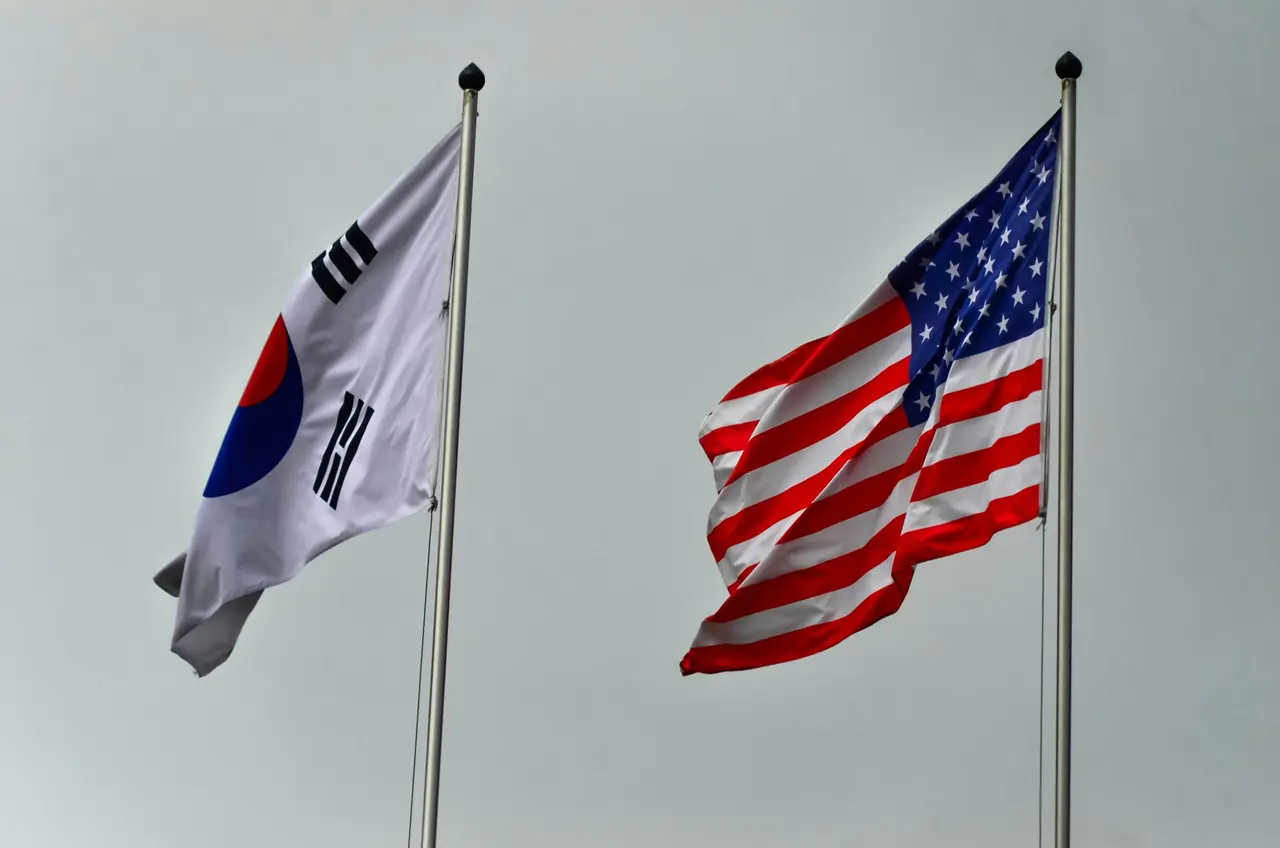

In June 2026, American and South Korean officials met in Seoul for the sixth session of the Nuclear Consultative Group (NCG), established by the 2023 Washington Declaration.[1] The purpose behind the NCG was to make American extended deterrence a working system rather than a rhetorical promise, and 3 years in, it is serving its exact purpose. The question the South Korean government faces is not whether the alliance’s ‘nuclear umbrella’ is credible, but whether the country’s own political class, the left in particular, actually believes that anymore.
What the Washington Declaration Actually Built
The Washington Declaration, signed by then-President Biden and Yoon in April 2023, was a response to North Korea’s rapid advances in its nuclear and missile capabilities. Thus, South Korean confidence in the U.S. nuclear umbrella was eroding, and eventually, open talk of an independent South Korean nuclear weapon was moving into the political mainstream.[2] Rather than redeploying U.S. tactical nuclear weapons to the Korean Peninsula or replicating NATO’s nuclear-sharing arrangement, Washington and Seoul built a bilateral consultation mechanism modelled on NATO’s Nuclear Planning Group, institutionalising nuclear consultation without forward-deployed nuclear weapons.[3] The declaration states that South Korea “has full confidence in U.S. extended deterrence commitments,” while mandating that Washington consult with Seoul on any potential nuclear-related decision that will affect the peninsula.[4] The NCG gives South Korea a seat at the table in U.S. nuclear planning, joint exercises for nuclear contingencies, expanded visibility into the U.S.’s strategic assets, and a framework for South Korean conventional forces to support American nuclear operations in the event of a crisis.[5] In December 2023, the two sides created joint guidelines on Conventional-Nuclear Integration.[6] This has more meaning than just a simple symbolic action, as it is the alliance building an actual joint machinery for the worst-case scenario.
An independent weapons program is not a serious alternative. Withdrawing from the NPT would trigger the same sanctions the world has been applying to Pyongyang for decades, but this time against Seoul, and give China and Russia a propaganda win and an escalation pretext. This statistic makes the strongest case: South Korea’s trade-to-GDP ratio is around 88%, and semiconductors, its top export, have grown even more concentrated, from 16.8% of exports in 2023 to around 24% in 2025, on a supply chain built on U.S. and allied technology licensing.[7][8] China and the U.S. together cover around 35% of South Korean exports in 2025[9], meaning the two countries that are most able and motivated to sanction a nuclear-armed Seoul are its two biggest customers. Even those in favour of nuclear armament admit that leaving the NPT would set off sanctions under the U.S. nonproliferation law and put Seoul’s civilian nuclear export business at risk.[10] Nuclearisation would give away the very trading partners South Korea depends on for its economy, the power to punish it.
The Left’s Nuclear Hedging Isn’t About Peace. It’s About Not Trusting the U.S.
Conventionally, people would believe that conservatives want the bomb and progressives don’t. However, polling suggests otherwise. 76.2% of South Koreans now support developing an independent nuclear weapons capability, according to the Asan Institute’s 2025 survey. This is the highest figure recorded since polling on the question began in 2010, and it is something both the left and the right agree on.[11] But the reasoning differs by camp, and that difference is the real deal. Conservative nuclear advocates argue that North Korea’s advancing weapons require an in-kind response.[12] Progressive support for nuclear hedging and enrichment capability, on the other hand, is driven less by the North Korean threat itself than by a desire for ‘strategic autonomy’, which is a wish to reduce or completely eliminate the dependence on the United States as a security guarantor, even as progressive administrations have stopped short of weaponisation in favour of preserving the technical option.[13] That position aligns with the progressive party’s record: pushing to accelerate wartime OPCON (Operational Control) transfer away from the Combined Forces Command led by the United States, treating American military presence as a bargaining chip rather than a commitment, and aiming for a foreign policy that maintains the balance between Washington and Beijing rather than anchoring in the alliance.
This is the deeper problem. An alliance only works if both sides want it to be the answer. Everything the U.S. offers South Korea, from the nuclear umbrella to U.S. troops on the ground, depends on the country’s political leadership treating the American commitment as the final solution rather than a stepping stone to going it alone. When one side of Seoul’s political spectrum pursues nuclear hedging against the alliance itself rather than against Pyongyang, it undermines the very trust on which the NCG was built, even if the same party continues to participate in meetings and issue joint statements.
Seoul Has Tried This Before
This debate treats an independent South Korean nuclear program as an untested idea. However, Seoul has already run this experiment, and the results are instructive.
In 1972, President Park Chung-hee launched a secret weapons program known as ‘Project 890’, driven by the Nixon Doctrine’s troop drawdowns, the U.S’s chaotic withdrawal from Vietnam, and a fear that Washington’s security guarantee could not be completely relied upon.[14] Since they could not produce plutonium domestically, Park’s government tried to import a reprocessing plant from France and a heavy-water reactor from Canada, which is the classic dual-use route to a bomb.[15] Washington learned of the program in 1974 and responded with an immediate ultimatum: continue, or the alliance would be at risk. Under U.S. pressure, Park cancelled the French reprocessing deal in January 1976 and formally suspended the weapons program that December, though declassified CIA records showed covert activity for two more years before the program was completely shut down in 1978.[16]
The program did more harm than good to South Korea. It produced years of diplomatic friction with Washington, a temporarily strained alliance, and a lasting reputational cost as an unreliable nonproliferation partner, for a project that never came close to developing an actual weapon.[17] Scholars who have reviewed the record are blunt about the lesson: Park’s failed nuclear program made South Korea an ‘unpredictable and even dangerous client’ in American eyes, and it is difficult to identify anything the program achieved that Seoul’s conventional buildup and alliance diplomacy could not have delivered at a fraction of the cost.[18] Nowadays, the same doubts about U.S. staying power that drove Park to gamble in 1972 are cited by hedging advocates now, but the end result of that gamble was not a more secure Korea. It was a decade, or even more, lost to an unrealised program and a damaged alliance, at the end of which Seoul still had no bomb.
Anticipating the Rebuttal: ‘The US Won’t Trade New York for Seoul’
The objection to everything mentioned above is not new. It is a newer version of the question Charles de Gaulle put to John F. Kennedy in 1961: Would Washington really trade New York for Paris? Today’s version carries more weight now that North Korea has an ICBM that can reach the American mainland, and now that “America First” policies have pushed Washington toward a more transactional position overseas. It is the strongest argument hedging advocates have, and it deserves a real answer rather than a dismissal.
The rebuttal for this works in two separate layers.
Layer one: whether a U.S. intervention will take place at all. In this case, the alliance’s architecture does the real work. About 28,500 U.S. troops remain on the Korean Peninsula so that a North Korean attack kills Americans before any politician has to weigh an abstract amount of “sacrifice” decision.[19] This is Schelling’s logic, and it is backed by political scientists. Small symbolic deployments don’t reliably deter, but a force big enough to change the local military balance does. The light U.S. military presence before 1950 failed to stop Pyongyang’s invasion, but now the substantial postwar buildup, with South Korea’s own military, has held for seventy years.[20] The NCG shares the same logic here: joint tabletop exercises, pre-agreed Conventional-Nuclear Integration guidelines, and consultation mechanisms mean that whether Washington acts is no longer a single president’s decision, but rather a structure built years before that makes inaction costly.[21]
Layer two: whether that response will lead to nuclear use. This is a completely different question, since the first layer was left unresolved due to the lack of a consultation mechanism, which the NCG has since fixed. The second layer, on the other land, is left unsolved on purpose, and no mechanism is supposed to close it. No American president will issue a binding guarantee of nuclear retaliation on another country’s behalf, for South Korea or any other ally. However, that uncertainty is the very deterrence, not a flaw. An adversary that cannot rule out an escalation has to plan for it. The attempt to eliminate that ambiguity would make the guarantee less credible, if not more so, by allowing North Korea to test the limits.
So the fair version of the rebuttal survives, but far narrower than its advocates claim: Washington’s nuclear response can never be fully guaranteed. What the NCG covers is everything up to the final decision, which ultimately governs day-to-day deterrence. An independent bomb does not solve both layers either; it just shifts the uncertainty from Washington’s decision-making to Seoul’s, at the additional cost of the NPT and Seoul’s trading relationships, and is going to end up being a repeat of the Park Chung-hee experience. The choice will never be between a guaranteed alliance and a guaranteed independent deterrent. Instead, it’s between an alliance with a functioning consultation architecture that has held for more than seventy years and an alternative Seoul already tried once, which produced no weapons and real alliance damage.
The Verdict
Set the hedging language aside, and this is what the left’s position actually is: using North Korea’s threat as leverage to renegotiate the terms of dependence on Washington, through OPCON transfer and troop-presence bargaining, while still showing up to NCG meetings and calling the alliance ironclad. That is not a peace strategy. It is a strategic autonomy strategy pretending to be a nonproliferation policy, and it asks Washington to keep building a trust-dependent architecture with a partner that treats the relationship as an option. While an alliance can survive policy disagreements, it definitely cannot survive one side quietly hiding from the alliance’s existence.
None of this means that the current arrangement is finished. Three things should follow:
- Institutionalise the NCG beyond any single administration: Crisis communication and joint-exercise work streams should become treaty-anchored commitments, not a simple agenda item that a change of government on either side can deprioritise.
- Make U.S. strategic asset visibility routine: Submarine and bomber visits should change from ad hoc signalling to an operating rhythm, closing the gap between the ironclad promise Washington makes verbally and its actual implementation on the ground.
- Force a public reckoning with the OPCON and hedging questions together: Seoul’s progressive leadership should not be allowed to pursue a wartime OPCON transfer and preserve nuclear breakout capacity on parallel tracks, since both are strategic autonomy moves; thus, treating them as completely separate issues lets the alliance-hedging problem go untouched.
The Nuclear Consultative Group proves that extended deterrence can be made concrete, rather than rhetorical. The choice Seoul has to make is to pursue it consistently, with no intention of exiting.
References
Bulletin of the Atomic Scientists. (2026, April 8). Three-quarters of South Koreans want nuclear weapons. One variable could decide the rest. https://thebulletin.org/2026/04/three-quarters-of-south-koreans-want-nuclear-weapons-one-variable-could-decide-the-rest/
CSIS. (2025, April 7). Will South Korea’s nuclear ambitions subside in the next five years? Center for Strategic and International Studies. https://www.csis.org/analysis/will-south-koreas-nuclear-ambitions-subside-next-five-years
North Atlantic Treaty Organization. (2022, February 4). NATO’s Nuclear Sharing Arrangements (Factsheet). https://www.nato.int/content/dam/nato/legacy-wcm/media_pdf/2022/2/pdf/220204-factsheet-nuclear-sharing-arrangements_en.pdf
U.S. Department of State. (2025, January 10). The United States of America–Republic of Korea Nuclear Consultative Group (NCG) Fact Sheet. https://2021-2025.state.gov/office-of-the-spokesperson/releases/2025/01/the-united-states-of-america-republic-of-korea-nuclear-consultative-group-ncg/
U.S. Embassy & Consulate in the Republic of Korea. (2023, April 27). Washington Declaration.https://kr.usembassy.gov/042723-washington-declaration/
U.S. Department of War. (2026, June 12). Joint Press Statement on the Sixth Nuclear Consultative Group Meeting.https://www.war.gov/News/Releases/Release/Article/4515266/joint-press-statement-on-the-sixth-nuclear-consultative-group-meeting/
GlobalSecurity.org. (2024, February 14). Readout of U.S., South Korea Nuclear Consultative Group Framework Signing.https://www.globalsecurity.org/wmd/library/news/rok/2024/rok-240214-dod01.htm
Geopolitical Monitor. (2025, April 15). The Secret History of South Korea’s Nuclear Weapons Program.https://www.geopoliticalmonitor.com/the-secret-history-of-south-koreas-nuclear-weapons-program/
National Interest. (2025, May 19). South Korea’s Nuclear Weapons Debate: A Third Way Forward?https://nationalinterest.org/feature/south-koreas-nuclear-weapons-debate-third-way-forward-212637
Seoul Vision 2030. (2026, March 22). Trade Tracker — South Korea Export, Import, and Trade Balance Dashboard.https://seoulvision2030.com/dashboards/trade-tracker/
Trading Economics. (2025). South Korea — Trade (% of GDP). World Bank data. https://tradingeconomics.com/south-korea/trade-percent-of-gdp-wb-data.html
World’s Top Exports. (2026). South Korea’s Top Trading Partners 2025. Data compiled from CIA World Factbook and International Trade Centre Trade Map. https://www.worldstopexports.com/south-koreas-top-import-partners/
38 North. (2023, January 22). The Disastrous Downsides of South Korea Building Nuclear Weapons.https://www.38north.org/2023/01/the-disastrous-downsides-of-south-korea-building-nuclear-weapons/
International Interactions. (2024). South Korean Cost Sensitivity and Support for Nuclear Weapons, Vol. 50, No. 3. https://www.tandfonline.com/doi/full/10.1080/03050629.2024.2348063
The Diplomat. (2023, February 21). South Korea’s First Attempt at Going Nuclear.https://thediplomat.com/2023/02/south-koreas-first-attempt-at-going-nuclear/
National Security Archive. (2017, March 22). Stopping Korea from Going Nuclear, Part I. George Washington University. https://nsarchive.gwu.edu/briefing-book/henry-kissinger-nuclear-vault/2017-03-22/stopping-korea-going-nuclear-part-i
Hayes, P., & Moon, C. (2011, September 23). Park Chung Hee, the CIA, and the Bomb. Nautilus Institute for Security and Sustainability / Global Asia. https://nautilus.org/napsnet/napsnet-special-reports/park-chung-hee-the-cia-and-the-bomb/
East Asia Forum. (2011, October 17). Park Chung-hee, the CIA and the bomb. https://eastasiaforum.org/2011/10/17/park-chung-hee-the-cia-and-the-bomb/
Georgetown Security Studies Review. (2025, August 7). Parity On the Peninsula: The Case for a Nuclear South Korea.https://gssr.georgetown.edu/the-forum/regions/asia/parity-on-the-peninsula-the-case-for-a-nuclear-south-korea/
Reiter, D., & Poast, P. (2021, June 2). The Truth About Tripwires: Why Small Force Deployments Do Not Deter Aggression. Texas National Security Review. https://tnsr.org/2021/06/the-truth-about-tripwires-why-small-force-deployments-do-not-deter-aggression/
U.S. Department of State. (2025, January 10). The United States of America–Republic of Korea Nuclear Consultative Group (NCG) Fact Sheet. https://2021-2025.state.gov/office-of-the-spokesperson/releases/2025/01/the-united-states-of-america-republic-of-korea-nuclear-consultative-group-ncg/
[1] U.S. Department of War. (2026, June 12). Joint Press Statement on the Sixth Nuclear Consultative Group Meeting.https://www.war.gov/News/Releases/Release/Article/4515266/joint-press-statement-on-the-sixth-nuclear-consultative-group-meeting/
[2] National Interest. (2025, May 19). South Korea’s Nuclear Weapons Debate: A Third Way Forward?https://nationalinterest.org/feature/south-koreas-nuclear-weapons-debate-third-way-forward-212637
[3] North Atlantic Treaty Organization. (2022, February 4). NATO’s Nuclear Sharing Arrangements (Factsheet). https://www.nato.int/content/dam/nato/legacy-wcm/media_pdf/2022/2/pdf/220204-factsheet-nuclear-sharing-arrangements_en.pdf
[4] U.S. Embassy & Consulate in the Republic of Korea. (2023, April 27). Washington Declaration.https://kr.usembassy.gov/042723-washington-declaration/
[5] U.S. Department of State. (2025, January 10). The United States of America–Republic of Korea Nuclear Consultative Group (NCG) Fact Sheet. https://2021-2025.state.gov/office-of-the-spokesperson/releases/2025/01/the-united-states-of-america-republic-of-korea-nuclear-consultative-group-ncg/
[6] GlobalSecurity.org. (2024, February 14). Readout of U.S., South Korea Nuclear Consultative Group Framework Signing. https://www.globalsecurity.org/wmd/library/news/rok/2024/rok-240214-dod01.htm
[7] Trading Economics. (2025). South Korea — Trade (% of GDP). World Bank data. https://tradingeconomics.com/south-korea/trade-percent-of-gdp-wb-data.html; Seoul Vision 2030. (2026, March 22). Trade Tracker. https://seoulvision2030.com/dashboards/trade-tracker/
[8] Seoul Vision 2030. (2026, March 22). Trade Tracker — South Korea Export, Import, and Trade Balance Dashboard.https://seoulvision2030.com/dashboards/trade-tracker/
[9] World’s Top Exports. (2026). South Korea’s Top Trading Partners 2025. Data compiled from CIA World Factbook and International Trade Centre Trade Map. https://www.worldstopexports.com/south-koreas-top-import-partners/
[10] 38 North. (2023, January 22). The Disastrous Downsides of South Korea Building Nuclear Weapons.https://www.38north.org/2023/01/the-disastrous-downsides-of-south-korea-building-nuclear-weapons/
[11] International Interactions. (2024). South Korean Cost Sensitivity and Support for Nuclear Weapons, Vol. 50, No. 3. https://www.tandfonline.com/doi/full/10.1080/03050629.2024.2348063
[12] Bulletin of the Atomic Scientists. (2026, April 8). Three-quarters of South Koreans want nuclear weapons. One variable could decide the rest. https://thebulletin.org/2026/04/three-quarters-of-south-koreans-want-nuclear-weapons-one-variable-could-decide-the-rest/
[13] CSIS. (2025, April 7). Will South Korea’s nuclear ambitions subside in the next five years? Center for Strategic and International Studies. https://www.csis.org/analysis/will-south-koreas-nuclear-ambitions-subside-next-five-years
[14] CSIS. (2025, April 7). Will South Korea’s nuclear ambitions subside in the next five years? Center for Strategic and International Studies. https://www.csis.org/analysis/will-south-koreas-nuclear-ambitions-subside-next-five-years
[15] The Diplomat. (2023, February 21). South Korea’s First Attempt at Going Nuclear.https://thediplomat.com/2023/02/south-koreas-first-attempt-at-going-nuclear/
[16] Geopolitical Monitor. (2025, April 15). The Secret History of South Korea’s Nuclear Weapons Program.https://www.geopoliticalmonitor.com/the-secret-history-of-south-koreas-nuclear-weapons-program/
[17] National Security Archive. (2017, March 22). Stopping Korea from Going Nuclear, Part I. George Washington University. https://nsarchive.gwu.edu/briefing-book/henry-kissinger-nuclear-vault/2017-03-22/stopping-korea-going-nuclear-part-i; Hayes, P., & Moon, C. (2011, September 23). Park Chung Hee, the CIA, and the Bomb. Nautilus Institute. https://nautilus.org/napsnet/napsnet-special-reports/park-chung-hee-the-cia-and-the-bomb/
[18] Hayes, P., & Moon, C. (2011, September 23). Park Chung Hee, the CIA, and the Bomb. Nautilus Institute. https://nautilus.org/napsnet/napsnet-special-reports/park-chung-hee-the-cia-and-the-bomb/
[19] Georgetown Security Studies Review. (2025, August 7). Parity On the Peninsula: The Case for a Nuclear South Korea. https://gssr.georgetown.edu/the-forum/regions/asia/parity-on-the-peninsula-the-case-for-a-nuclear-south-korea/
[20] Reiter, D., & Poast, P. (2021, June 2). The Truth About Tripwires: Why Small Force Deployments Do Not Deter Aggression. Texas National Security Review. https://tnsr.org/2021/06/the-truth-about-tripwires-why-small-force-deployments-do-not-deter-aggression/
[21] U.S. Department of State. (2025, January 10). The United States of America–Republic of Korea Nuclear Consultative Group (NCG) Fact Sheet. https://2021-2025.state.gov/office-of-the-spokesperson/releases/2025/01/the-united-states-of-america-republic-of-korea-nuclear-consultative-group-ncg/