Presidential Powers and Trump’s Tariff Measures
Under Article I, Section 8 of the US Constitution, the authority to regulate foreign commerce is conferred on Congress. Although the President has no independent constitutional authority to set tariff rates, Congress has delegated specific powers to do so through legislation (Zirpoli, 2026). Trump made extensive use of these statutory powers, pursuing a strategy that evolved across his two terms (Alschner et al., 2025). To implement his tariff measures, he primarily relied on Section 232 of the Trade Expansion Act of 1962, which authorises tariffs on national security grounds, as well as Sections 301 and 122 of the Trade Act of 1974, the former permitting trade restrictions in response to unfair foreign trade practices and the latter allowing temporary import surcharges to address serious balance-of-payments problems (Zirpoli, 2026).
First Mandate (2017–2021)
During his first administration, Trump imposed duties on specific industries and trading partners, aiming to shield US producers from foreign competition and to leverage trade policy to protect domestic interests (Schwarzenberg, 2020).To this end, he invoked Section 232 in 2018 to impose 25% tariffs on steel and 10% tariffs on aluminium imports from most trading partners (Zirpoli, 2026). In parallel, Section 301 became central to his China strategy, leading to additional tariffs in 2019 in response to policies related to intellectual property rights and forced technology transfers (Schwarzenberg, 2020).
Second Mandate (2025–2026)
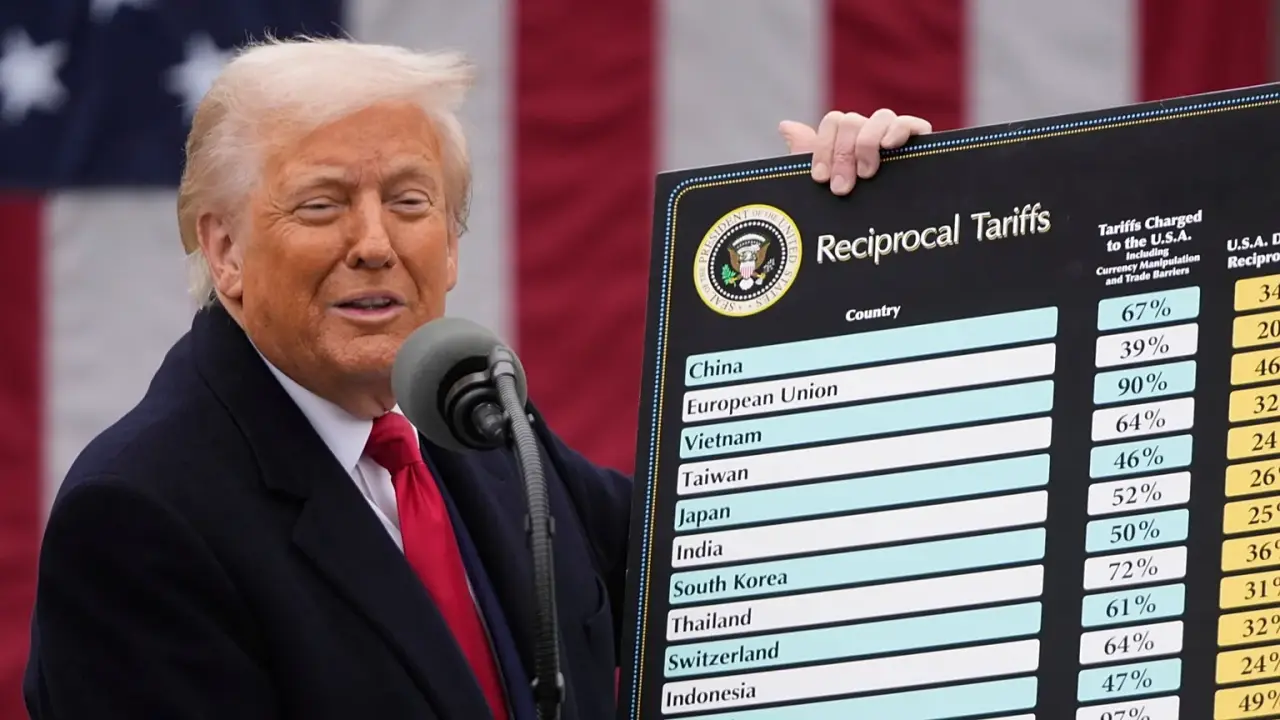
During his second term, Trump expanded his earlier trade measures and adopted a more universal approach to address the persistent US trade deficit and strengthen the country’s position in international trade negotiations (Alschner et al., 2025). In February 2025, acting pursuant to Section 232, he reinstated the full 25% tariff on steel imports and raised aluminium duties to 25%, subsequently increasing both rates to 50% in June 2025 (Burkhart & Hammond, 2026). Under Section 301, the administration also announced fees on Chinese vessels in April 2025 (Burkhart & Hammond, 2026) and applied additional 25% duties on Brazilian products in July 2026 (Burkhart, 2026). Beyond these actions, on 2 April 2025, Trump introduced the Liberation Day tariffs under the International Emergency Economic Powers Act, applying an additional 10% duty to most imported goods (Burkhart & Hammond, 2026). However, in February 2026, the Supreme Court ruled that IEEPA did not provide a valid legal basis for imposing tariffs (Zirpoli, 2026). Consequently, to maintain its trade agenda, the administration adopted a temporary 10% Section 122 surcharge and launched a Section 301 investigation in March 2026 into forced-labour import restrictions in 60 economies, resulting in additional duties of 10% or 12.5% in July 2026 (Burkhart, 2026).
Trump’s Tariff Measures under WTO Scrutiny
The World Trade Organisation regulates multilateral trade relations through a framework of international trade agreements. As a founding member, the United States is bound by the obligations established under this system (WTO, n.d.-b). Despite these commitments, Trump’s tariffs have faced repeated challenges from other WTO members since 2017, with questions raised about their compatibility with WTO law through committee discussions and formal dispute settlement proceedings. The following sections therefore examine the main legal issues arising from these disputes, the justifications advanced by the United States, and the subsequent outcomes of the controversies.
Tariffs under GATT Article XXI
Several WTO challenges arose from tariffs enacted under Section 232, which the United States defended under Article XXI of the GATT 1994. This provision allows members to adopt restrictions deemed necessary to protect essential security interests during war or other international emergencies (WTO, 2022). These measures first faced criticism in 2018, when several WTO members lodged complaints against the steel tariffs, claiming violations of rules on equal treatment and tariff commitments due to exemptions granted to certain trading partners. Four disputes subsequently reached the panel stage, during which the US advanced a defence under Article XXI, contending that they were necessary to protect domestic industrial capacity. In December 2022, the panels ultimately found a breach of Articles I:1 and II:1 of the GATT and rejected this justification, ruling that concerns over the impact of global overproduction did not constitute an emergency in international relations (WTO, 2022). Consequently, the US appealed all four reports in January 2023, leaving the cases unresolved (WTO, 2023). Despite these findings, Trump continued to invoke national security considerations in support of Section 232 measures throughout his second term. In 2025, Canada initiated two WTO proceedings over tariffs on steel and automobiles, arguing that both exceeded WTO obligations. Washington reiterated its defence under Article XXI, asserting that the measures were necessary to reduce dependence on foreign manufacturing and strengthen critical supply chains; however, both cases failed to progress past consultations. Beyond Section 232, the US also relied on this security clause to justify the tariffs on Liberation Day. Following their introduction, China requested WTO consultations on 4 April 2025, alleging discriminatory treatment of Chinese imports and their failure to administer the measures impartially and reasonably (WTO, n.d.-c). Washington countered by maintaining that persistent trade deficits raised security concerns by weakening industries essential to national defence (WTO, 2025a). Nevertheless, this case likewise remained stalled at the initial stage (WTO, n.d.-c).
Tariffs under GATT Articles I:1 and II:1 and DSU Article 23
Another area of WTO scrutiny concerned tariffs imposed under Section 301 to respond to unfair foreign trade practices. These policies raised concerns about their compatibility with Articles I:1 and II:1 of the GATT 1994, which prohibit discrimination between trading partners and duties exceeding agreed limits, and with Article 23 of the Dispute Settlement Understanding, which requires members to address potential contraventions through dispute settlement proceedings rather than unilateral sanctions (Rasman & Risnain, 2026). China first raised these concerns in 2018, requesting consultations over Section 301 measures and claiming infringement of these provisions. In response, the United States invoked Article XX of the GATT, arguing that the duties were necessary to protect public morals against Chinese IP practices. In September 2020, however, the panel found violations of Articles I:1 and II:1 and rejected this argument, concluding that Washington had failed to demonstrate how the tariffs addressed the contested practices and why they were necessary. Nevertheless, the United States appealed the ruling in October 2020, preventing the report’s adoption (WTO, 2020). The renewed use of Section 301 during Trump’s second term prompted further criticism of the WTO. At the Council for Trade in Goods meeting in July 2025, China challenged US trade restrictions targeting its maritime and technology sectors, describing them as unilateral and protectionist. In response, Washington defended these policies, contending that Chinese practices distorted competition in the US market and posed security risks (WTO, 2025b). Besides China, Brazil also requested WTO consultations in July 2026 over additional US tariffs applied following investigations into Brazilian trade practices and forced labour. On that occasion, Brazil maintained that these trade barriers breached Articles I:1 and II:1 of the GATT and Article 23 of the DSU, holding that the measures violated US undertakings and bypassed WTO dispute settlement procedures. Although the United States agreed to consultations on 6 August 2026, the controversy has not progressed to the panel stage (WTO, n.d.-a).
Tariffs under GATT Article XII
Finally, WTO members questioned the tariffs introduced under Section 122, which the United States notified to the Committee on Balance-of-Payments Restrictions in March 2026, invoking Article XII of the GATT 1994 as their legal justification (WTO, 2026b). This provision permits import restrictions to address serious external financial difficulties, particularly those affecting monetary reserves, and provides for their review by the BOP Committee (Siegel, 2026). During consultations held on 5 May and 22 June 2026, several WTO members disputed whether these conditions were met, arguing that the US financial situation was not sufficiently severe to warrant the surcharge and that exemptions granted to certain countries and products were inconsistent with the measure’s purpose (WTO, 2026b). Following the surcharge’s expiry in July 2026, the Committee concluded its examination in October and finalised a report for submission to the WTO General Council (WTO, 2026a).
Consideration
Despite repeated challenges to the compatibility of US policies with WTO obligations, the organisation’s oversight mechanisms have proved largely ineffective at securing compliance, thereby enabling Washington to pursue its tariff strategy without significant restrictions. This weakness is reflected in two trends. First, WTO members have increasingly relied on dialogue within councils rather than formal proceedings to contest US duties. Second, several cases have either failed to progress beyond consultations or been rendered unenforceable following US appeals against panel reports. Both developments can be linked to the paralysis of the Appellate Body following the US blockade of appointments, which since December 2019 has allowed WTO members to “appeal into the void”, preventing the adoption of contested panel reports. (Hopewell, 2025). This institutional deadlock has contributed to a significant decline in WTO dispute settlement proceedings, with the number of new disputes falling to approximately one-third of their previous level (Hopewell, 2025). These findings reinforce Hopewell’s warning that erosion of WTO enforcement mechanisms may encourage non-compliance and undermine the credibility of the multilateral trading system, risking its transformation into an institutional “zombie”, whose rules remain formally in place but lack effective enforcement.
References
Alschner, W., Elsig, M., Francois, J., & Manchin, M. (2025). Introduction: Tariff turbulence: The new US trade policy and its impact on the global trading system. World Trade Review, 24(4), 427–429. https://doi.org/10.1017/S1474745625101031
Burkhart, W. F. (2026, October 8). Active presidential tariff actions in 2026: Fact sheet. Congressional Research Service. https://www.everycrsreport.com/reports/R49481.html
Burkhart, W. F., & Hammond, K. E. (2026, January 12). Presidential 2025 tariff actions: Timeline and status. Congressional Research Service. https://www.congress.gov/crs-product/R48549
Hopewell, K. (2025). Unravelling of the trade legal order: Enforcement, defection and the crisis of the WTO dispute settlement system. International Affairs, 101(3), 1103–1117. https://doi.org/10.1093/ia/iiaf055
Office of the United States Trade Representative. (2026). 2026 trade policy agenda and 2025 annual report of the President of the United States on the trade agreements program. https://ustr.gov/sites/default/files/files/Press/Releases/2026/2026%20Trade%20Policy%20Agenda%202025%20Annual%20Report.pdf
Rasman, K., & Risnain, M. (2026). A study of unilateral retaliation in international trade law: An analysis of the United States vs China dispute. Mataram Journal of International Law, 4(1). https://doi.org/10.29303/fde5p795
Schwarzenberg, A. B. (2020). Section 301 of the Trade Act of 1974: Origin, evolution, and use. Congressional Research Service. https://www.everycrsreport.com/reports/R46604.html
Siegel, D. (2026, July 22). US tariffs and the balance of payments deficit: Challenges under domestic and international law. American Society of International Law. https://asil.org/insights/volume-30-issue-7/
World Trade Organization. (n.d.-a). United States—Additional duties on certain products from Brazil (DS646). https://www.wto.org/english/tratop_e/dispu_e/cases_e/ds646_e.htm
World Trade Organization. (n.d.-b). United States of America and the WTO. https://www.wto.org/english/thewto_e/countries_e/usa_e.htm
World Trade Organization. (n.d.-c). United States—Universal and country-specific additional duties on imports from China (DS638). https://www.wto.org/english/tratop_e/dispu_e/cases_e/ds638_e.htm
World Trade Organization. (2020, October 26). Members grant EU authorization to impose countermeasures against US in Boeing dispute. https://www.wto.org/english/news_e/news20_e/dsb_26oct20_e.htm
World Trade Organization. (2022, December 9). United States—Certain measures on steel and aluminium products: Report of the panel (WT/DS552/R). https://docs.wto.org/dol2fe/Pages/SS/directdoc2.aspx?filename=q%3a%2fWT%2fDS%2f552R.pdf&Open=True
World Trade Organization. (2023, January 30). United States appeals panel reports regarding US duties on steel and aluminium products. https://www.wto.org/english/news_e/news23_e/ds544_552_556_564apl_30jan23_e.htm
World Trade Organization. (2025a, April 11). Goods Council addresses trade concerns and future work, elects new Chair. https://www.wto.org/english/news_e/news25_e/good_11apr25_e.htm
World Trade Organization. (2025b, July 31). Minutes of the meeting of the Council for Trade in Goods, 7–8 July 2025 (G/C/M/152). https://docs.wto.org/dol2fe/Pages/SS/directdoc2.aspx?filename=Q%3a%2fG%2fC%2fM152.pdf&Open=True
World Trade Organization. (2026a, October 12). WTO members conclude review of US import surcharges following removal of measure. https://www.wto.org/english/news_e/news26_e/bop_12oct26_521_e.htm
World Trade Organization. (2026b, June 22). WTO members review temporary US import surcharges. https://www.wto.org/english/news_e/news26_e/bop_22jun26_423_e.htm
Zirpoli, C. T. (2026, March 19). Congressional and presidential authority to impose import tariffs. Congressional Research Service. https://www.everycrsreport.com/files/2026-03-19_R48435_07874e72e733b24e9ec63017382823c891c79611.pdf