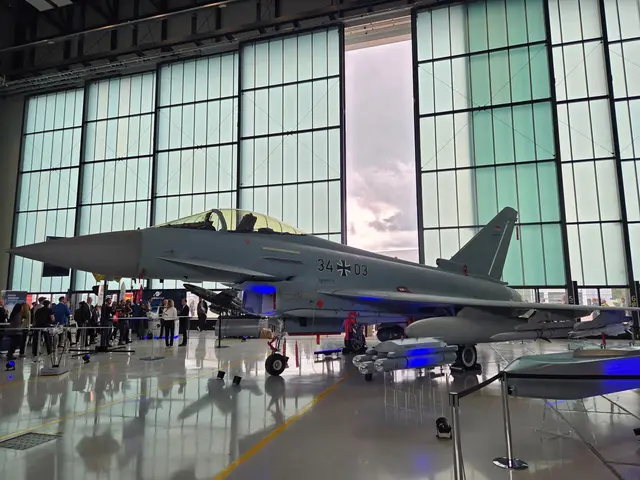
Technological advancements have impacted our societies immensely, from our daily lives to complex political issues; technology is taking a prominent role and changing the way we operate in a number of areas. War is one of them. Indeed, war is becoming increasingly tech-oriented, and developments are giving rise to new methods and means of warfare (ICRC, n.d.).
The conflict in Ukraine has demonstrated how quickly the contemporary battlefield is evolving. Military confrontations are increasingly being determined by algorithms, drone swarms, precision systems and artificial intelligence. The European Union is determined to step up its efforts to adapt to the evolving technological framework of warfare. The European Council is pushing for quicker, more adaptable innovation to address a new era of security risks by expediting the transition from research labs to real-world deployment. With this goal in mind, the European Commission developed a proposal for a Programme for Agile and Rapid Defence Innovation (AGILE) (Heinz & Batista Cabanas, 2026; European Commission, 2026). When looking into this new ambitious programme, a question arises: Can an EU funding instrument close the gap between prototype and actionable capability without binding procurement commitments?
Background: What is AGILE?
On 6 October 2026, the European Parliament approved AGILE, following the European Commission’s first proposal in March 2026. AGILE is a €115 million instrument, based on the EU Defence Industry Transformation Roadmap, designed to provide rapid, agile and targeted financial support to small and medium-sized enterprises (SMEs) working to develop emerging and disruptive defence technologies starting in January 2027. The core goal is to ensure that innovative defence technologies developed by new defence players reach end users faster in both EU Member States and associate countries, including Ukraine and EEA/EFTA countries. AGILE will fund advanced initiatives, with an emphasis on technologies that the armed forces can test, validate, and utilise within a maximum of three years. For example, mission-driven AI systems for autonomous systems, situational awareness, military decision-making, or quantum computing initiatives and projects involving drones and robotics (European Parliament, 2026; European Commission, 2026).
The impact on the current framework
European institutions expect AGILE to have a significant impact. For instance, both the technical development stage and the shift to practical, real-world application will be funded by the EU, and the whole financing process will be expedited, with a time-to-grant of only four months (European Commission, 2026). However, one of the greatest obstacles for SMEs is not usually funding but obtaining national procurement contracts. Indeed, SMEs may find it difficult to grow due to difficulty obtaining contracts, complex regulations, and challenges in integrating into well-established defence supply chains (Tessari, 2026; European Parliament, 2026). The project should be followed by the EU throughout the whole process, not just at the financing stage. This would allow the EU to track progress and ease interventions if startups encounter roadblocks, especially in the later stages of development, when scientific breakthroughs need to be operationalised.
To a degree, AGILE attempts to address the challenge of integrating SMEs into the broader framework of established defence companies by providing a dedicated matchmaking mechanism between SMEs and major defence companies to increase uptake of AGILE-supported products. As a matter of fact, a major issue at the moment is that despite an increase in startups, actual procurement is still concentrated on well-established military systems and major defence firms, particularly within EU Member States. Matchmaking could, on the one hand, address the existing gap by enabling SMEs to access procurement opportunities alongside other firms, but it should also provide mechanisms to avoid excessive dependencies (European Parliament, 2026; Kapstein et al., 2026; Tessari, 2026). A solution for this issue could be adding safeguards on intellectual property and creating instruments to avoid dependence.
An essential factor to keep in mind when exploring how SMEs can operationalise European scientific breakthroughs is that more than 80% of EU defence procurement is conducted at the national level, according to data from late 2024 (European Defence Agency, n.d.). The EU is creating measures to foster collaborative procurement and investment in defence technologies (European Defence Agency, n.d.). Brussels should, therefore, keep focusing on incentivising EU Member States to go down the route of joint procurement, as this supports integration, cooperation and research and development at the same time, tackling more than one issue simultaneously.
Policy Recommendations
The following recommendations can be derived from the above analysis to ensure proper access to the market for SMEs.
- The EU should follow projects from start to finish, not solely at the financing stage. In this manner the EU could not only track progress and observe how its funds are being employed, but also intervene in case SMEs find roadblocks at the later stages of development.
- Since the most difficult steps for SMEs occur in the final stages of the process, regulated, privileged access to procurement and guidance through the bureaucratic process would ease these tricky passages.
- To avoid big defence manufacturers to obscure the involvement of SMEs in projects safeguards on intellectual property should be provided. On a similar note, the EU should help SMEs in their path towards product development and procurement, to ensure they are supported by bigger defence companies and not entirely dependent on them to launch their products on the market and secure contracts with member states.
- To support integration and encourage member states to look beyond the usual pool of large defence companies, the EU should increase its support for joint procurement.
Conclusion
AGILE is a valuable instrument that will help shorten the path to a final, valid prototype by creating easier routes for small and medium-sized enterprises in the financing stages. However, in the absence of a binding demand-side relationship, it risks replicating the pattern that the Parliament itself condemned in the European Defence Fund, meaning that initiatives are financed adequately, but they fail to secure clients because of further roadblocks and unaddressed issues companies encounter along the way. Therefore, AGILE is necessary because it allows SMEs to access the defence development framework easily, allowing the EU to integrate rapidly emerging technologies faster and lessons learned from active conflicts. However, it is not enough, as it is unable, by nature, to tackle the issue of national procurements, as it does not provide for obligations or incentives for member states to contract with small and medium-sized enterprises. It is a good instrument, but it should be simply the first of many measures aimed at easing integration, cooperation and a common defence framework.
References
European Commission (2026). €115 million Programme for agile and rapid defence innovation (AGILE). European Commission, Defence Industry and Space. https://defence-industry-space.ec.europa.eu/eu115-million-programme-agile-and-rapid-defence-innovation-agile-2026-03-26_en
European Defence Agency (n.d.). Joint Procurement. EDA. https://eda.europa.eu/news-and-events/spotlight/spotlight-of-the-month/buying-military-equipment-together
European Parliament (2026). New AGILE defence innovation programmeme approved by Parliament. European Parliament Press Releases. https://www.europarl.europa.eu/news/en/press-room/20261002IPR47892/new-agile-defence-innovation-programmeme-approved-by-parliament
ICRC (n.d.). New technologies and warfare. ICRC Law & Policy. https://www.icrc.org/en/law-and-policy/new-technologies-and-warfare
Heinz, E. & Batista Cabanas, L. (2026). AI, drones, quantum: the EU’s new AGILE plan targets future warfare. EuroNews. https://www.euronews.com/2026/04/07/ai-drones-quantum-the-eus-new-agile-plan-targets-future-warfare
Kapstein, E., Ospital, J. & Wolff, G. B. (2026). Reforming European defence procurement to boost military innovation and startups. Bruegel. https://www.bruegel.org/policy-brief/reforming-european-defence-procurement-boost-military-innovation-and-startups
Tessari, F. (2026). Europe’s defence innovators are stuck in two ‘valleys of death’. EU Perspectives. https://euperspectives.eu/2026/09/europes-defence-innovators-are-stuck-in-two-valleys-of-death/