
When the G7 and the European Union introduced ‘unprecedented sanctions’ against Russia (European External Action Service, 2026) following its full-scale invasion of Ukraine in 2022, the restrictions were designed not only to constrain Moscow’s access to Western markets but also to reduce the revenues financing its war effort. One of the most important measures was the G7 oil price cap (OPC) on Russian seaborne crude oil, which sought to leverage the coalition’s dominant position in maritime insurance, shipping and other services (U.S. Department of the Treasury, 2022).
Rather than accepting the price-cap restrictions, Russia increasingly developed an alternative ecosystem of vessels, insurers and other maritime-service providers operating outside the Western sanctions architecture (Brunila, 2026; Polemis & Likas, 2026b, p. 18). This network, commonly referred to as the shadow fleet, has allowed Russia to maintain oil exports – accounting for an estimated €193 billion in annual revenues and making oil exports one of the country’s most important sources of revenue (Oestreich et al., 2026) – while reducing its dependence on Western maritime services (U.S. Department of the Treasury, 2022).
Yet this adaptation has created a problem that extends beyond sanctions enforcement. The vessels that enable Russia to circumvent Western restrictions must still physically move through the global maritime system. This means operating in European waters and around strategically important maritime chokepoints (Edwards, 2025; Gözübenli, 2025), where commercial shipping routes, energy infrastructure, undersea cables and military operations overlap. The security relevance arises not simply from their presence, but from the interaction between an opaque maritime network and environments in which identifying vessels, attributing activities and responding to suspicious behaviour are difficult (Polemis & Likas, 2026a, 2026b; Brunila, 2026). The shadow fleet therefore creates a paradox: measures designed to impose economic costs on Russia have also generated externalities for the states that imposed them, by increasing the monitoring, enforcement and security burden within the Euro-Atlantic maritime space.
This raises an important question: How has Russia’s shadow fleet evolved as an instrument of sanctions evasion, and what does its growing presence in European waters, especially around strategic maritime chokepoints, mean for Euro-Atlantic security?
This article argues that Russia’s shadow fleet has evolved from a mechanism primarily intended to circumvent Western economic sanctions into a broader maritime-security challenge. Its strategic significance derives from the combination of opaque ownership, frequent reflagging – including the use of flags of convenience – questionable insurance arrangements and operational practices that complicate monitoring, attribution and enforcement (Polemis & Likas, 2026a, 2026b; Brunila, 2026). When the shadow fleet operates in strategically relevant waters, it creates additional demands for European states and NATO to distinguish between ordinary commercial activity, sanctions evasion, unsafe maritime behaviour and potentially hostile activity. Its strategic significance therefore increasingly depends on where these vessels operate.
From sanctions evasion to an alternative maritime ecosystem
The emergence of Russia’s shadow fleet needs to be understood as a consequence of the structure of Western sanctions. The G7 price-cap mechanism was deliberately designed around Russia’s dependence on Western maritime services to transport its oil. By conditioning access to these services on compliance with the OPC, the coalition sought to reduce Russian oil revenues without removing Russian oil from global markets altogether (U.S. Department of the Treasury, 2022, 2024).
This created a strong incentive for Moscow to adapt and develop an alternative maritime infrastructure. By 2023, US officials were observing increasing Russian investment in ships, insurers and other providers with opaque ownership structures, creating what became known as the shadow fleet (U.S. Department of the Treasury, 2023).
Consequently, the term shadow fleet does not refer simply to a collection of Russian-owned tankers. Rather, it describes an ecosystem built to circumvent sanctions along the maritime route: vessels, shipowners and managers, flag states and registries, insurers, payment providers, shipbrokers, ports, ship-to-ship transfer facilities and other service providers. That network can rely on opaque ownership, frequent reflagging and flags of convenience, limited or questionable insurance, changes in registration, ship-to-ship transfers and manipulation of vessel-tracking data, including AIS spoofing (Brunila, 2026; Polemis & Likas, 2026a; Rychlik, 2026). Effective enforcement therefore requires establishing not simply whether a tanker carries Russian oil, but what the vessel is, who controls it, what cargo and services are involved, and which actors enable its voyage.
The Russian adaptation has shifted enforcement from individual shipments towards the ecosystem surrounding maritime oil transportation. The EU’s 20th sanctions package of April 2026 marked a potential paradigm shift beyond sanctioning individual vessels and the existing price-cap model: it established the basis for a future ‘full maritime-services ban’ on Russian crude oil and petroleum products. Rather than conditioning access to European maritime services on OPC compliance, the proposed approach would prohibit European providers from facilitating the seaborne transport of Russian oil irrespective of the price at which it is sold (Council of the European Union, 2026a, 2026c). By July 2026, the EU had designated around 670 vessels and other actors linked to Russia’s shadow fleet, subjecting them to port-access and maritime-service restrictions (ibid.; Council of the European Union, 2026b).
From economic instrument to maritime-security challenge
The shadow fleet’s purpose remains economic: transporting Russian oil and protecting revenues. But the sanctions-evasion ecosystem also produces security externalities: older vessels, opaque ownership, reflagging, weak insurance and manipulated AIS make maritime activity harder to monitor, attribute and regulate (Brunila, 2026; Polemis & Likas, 2026a, 2026b). The G7 links such practices to risks for trade, the environment and maritime safety (G7, 2025).
This matters because European maritime space contains dense commercial traffic alongside critical energy and communications infrastructure. In 2024, EU short-sea shipping transported 1.65 billion tonnes of goods; the North Sea accounted for 472 million tonnes and the Baltic Sea for another 294 million tonnes. Liquid bulk, including oil, accounted for 640 million tonnes (European Commission, 2026). The presence of shadow-fleet vessels in such environments therefore introduces uncertainty into maritime systems on which European trade and energy security depend.
The security problem becomes more acute where shadow-fleet activity intersects with potential hybrid activity. The December 2024 Eagle S incident illustrates the problem. The tanker, which Finnish authorities associated with Russia’s shadow fleet, was suspected of damaging five submarine cables in the Gulf of Finland after dragging its anchor (Finnish Prosecution Service, 2025). Finnish investigators subsequently recommended charges, while the Helsinki District Court later dismissed the case because Finnish criminal law could not be applied, illustrating both the potential infrastructure consequences and the jurisdictional difficulties surrounding such incidents.
A further complication is the growing presence of Russian naval escorts. In July 2026, the Royal Navy reported that the Russian frigate Neustrashimy had repeatedly escorted shadow-fleet tankers through UK areas of responsibility, including the tanker Vulkan through the Dover Strait. The Royal Navy stated that monitoring this activity required repeated deployments of British vessels and aircraft; during July alone, Royal Navy warships and aircraft spent 21 days monitoring Russian activity in UK waters and the North Atlantic, 25% more than during the same period a year earlier (Royal Navy, 2026b).
This creates a qualitatively different operational environment. A tanker that might otherwise be treated primarily as a sanctions-enforcement or maritime-safety issue may operate alongside a Russian naval asset, thereby complicating both the legal basis and the escalation calculus of any attempted intervention.
This is where grey-zone coercion becomes relevant. Grey-zone coercion describes efforts to impose costs or influence an opponent below the threshold of open armed conflict, often exploiting ambiguity over the actor, the nature of the activity or the appropriate response. The shadow fleet’s opacity, ability to operate in sensitive maritime areas and interaction with Russian security assets can create enabling conditions for activities with potential coercive or hybrid effects, even where deliberate involvement cannot be established.
Why maritime chokepoints matter
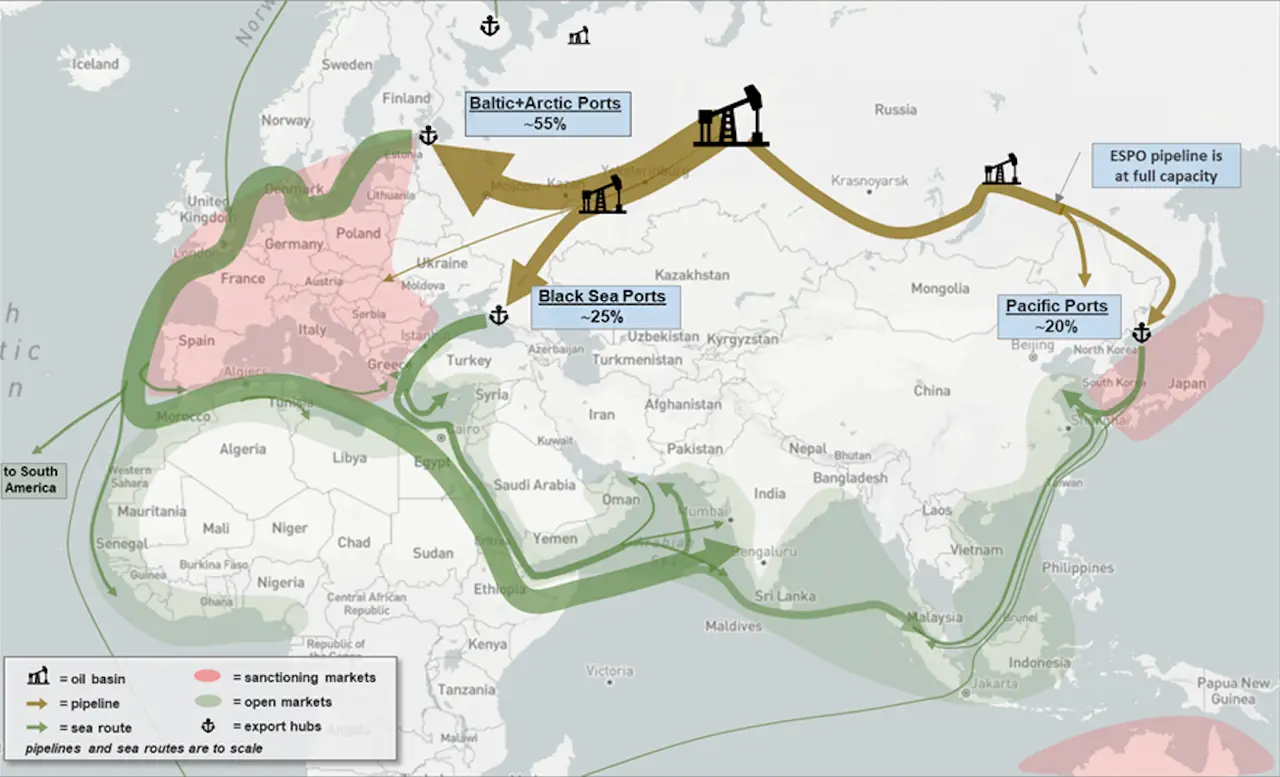
Maritime chokepoints concentrate large volumes of international trade and energy transportation within geographically constrained spaces. The strategic concern is therefore not simply that shadow-fleet vessels pass through them, but that their presence can turn these strategically concentrated maritime spaces into arenas of grey-zone activity, where opaque vessels operate in ways that increase uncertainty and potentially raise the costs of protecting the infrastructure and commercial flows concentrated there (Pawlak, 2026).
Figure 1. Russian oil export routes since 2023 across key maritime chokepoints
(Source: Kennedy, 2025)
The Danish Straits, connecting the Baltic Sea with the North Sea, provide an important example. Russian Baltic ports such as Primorsk and Ust-Luga depend on these waterways to reach global markets. The Danish Straits are simultaneously major international shipping routes: approximately 27,000 commercial ships transit the Great Belt each year, while more than 8,000 completed the full Skagen–Bornholm transit in 2023; around half of this traffic consists of oil tankers or gas carriers (OCIMF, 2026). The U.S. Energy Information Administration estimates that approximately 4.9 million barrels per day of crude oil, condensate and petroleum products passed through the Danish Straits in the first half of 2025, equivalent to around 6% of global maritime trade (EIA, 2026).
The Baltic Sea combines dense commercial traffic with critical undersea infrastructure and NATO military activity, giving the shadow fleet’s presence operational significance. In August 2026, the tanker Fenor, identified by Ukraine as involved in Russian oil exports, was observed transiting the Øresund with protective drone nets over parts of the vessel. Danish reporting indicated it was then selected for additional inspection on arrival at Ust-Luga (Lesager, 2026). The episode illustrates the ambiguity: the vessel was engaged in commercial transport, yet its protective measures and the wider security context left unclear what threats it anticipated and what its presence implied for Danish waters.
The resulting security environment necessitates an approach where shadow-fleet movements are increasingly monitored not only as sanctions-related activity but as part of a broader maritime-domain-awareness problem involving critical infrastructure and potential hybrid threats. Consequently, NATO launched Baltic Sentry in January 2025, combining frigates, maritime patrol aircraft, including P-8A Poseidon, naval drones and national surveillance assets to improve protection of critical infrastructure and respond to destabilising activity (NATO, 2025).
The North Sea and English Channel present a similar dynamic. In February 2026, the sanctioned tankers Rigel, Hyperion and Kousai were tracked through the Channel after loading at Russian Baltic ports. In June 2026, British forces boarded and detained the sanctioned tanker Smyrtos in the Channel in the first UK-led operation of its kind (Royal Navy, 2026a). These cases demonstrate both the importance of the route for Russian maritime trade and the increasing operational burden placed on European states to monitor and enforce sanctions in heavily trafficked waters.
The Turkish Straits illustrate the jurisdictional complexity of the problem. The Bosphorus and Dardanelles connect the Black Sea with the Mediterranean, linking Russian energy exports to global markets. Their governance is distinct from that of the Baltic and North Sea: Türkiye exercises a central role under the Montreux Convention, while vessels may be foreign-flagged and cargoes may be subject to EU or G7 sanctions. The resulting fragmentation of flag-state, coastal-state and sanctions jurisdiction demonstrates the difficulty of coordinated enforcement.
The Black Sea shows how context changes shadow-fleet significance. Since 2022 it has become a maritime theatre of the war, placing commercial shipping, Russian oil exports and military operations in proximity (Patalano & Hallett, 2025). In May 2026, three sanctioned tankers were reportedly hit by drones off Türkiye; attribution remains contested (Associated Press, 2026).
Implications for Euro-Atlantic security
Taken together, these cases illustrate four broader challenges that the shadow fleet poses to Euro-Atlantic maritime security.
The first implication of the shadow fleet’s presence in strategically important maritime chokepoints is a growing requirement for maritime domain awareness. Shadow-fleet practices such as opaque ownership, reflagging and manipulation of vessel-tracking information make it difficult to establish a reliable recognised maritime picture. NATO’s Baltic Sentry operation illustrates the resulting shift towards more persistent maritime surveillance and coordination of national and Allied capabilities. The challenge is therefore not simply to detect a vessel, but to maintain continuous awareness of maritime activity and identify which movements warrant further attention.
The second implication is legal and operational constraint. Under UNCLOS, ships on the high seas are generally subject to the exclusive jurisdiction of their flag state (UNCLOS, Art. 92). Article 110 establishes a limited right of visit, allowing a warship to board a foreign vessel in specified circumstances, including reasonable grounds for suspecting piracy, slave trading, unauthorised broadcasting, lack of nationality or false flagging. Outside these circumstances, suspicion of sanctions evasion alone does not automatically create a right to board a foreign-flagged vessel on the high seas. In territorial waters, coastal states possess broader powers, but these remain subject to the law of the sea.
The third implication is resource allocation. Maritime chokepoints can make surveillance more geographically concentrated, but they are also where commercial shipping, Russian vessels, NATO forces and critical infrastructure converge. Persistent surveillance is therefore required where the density of activity and the potential consequences of incidents are highest. The Royal Navy’s reported increase in activations to monitor Russian activity in 2026 illustrates how shadow-fleet activity can generate additional demands on already finite naval and air assets (Royal Navy, 2026b).
The fourth implication is escalation management. The combination of opaque ownership, ambiguous activity, contested jurisdiction and Russian naval protection creates a high degree of uncertainty around intervention. A European state considering interception must assess not only whether a vessel is violating sanctions or maritime regulations, but also the evidentiary threshold required for action, the applicable jurisdiction, the potential reaction of the flag state and crew members and the possibility that a Russian naval escort could become involved. The result is an operational dilemma: the very characteristics that make the shadow fleet difficult to monitor also increase the political and military costs of decisive intervention.
The shadow fleet matters because these factors interact. Curbing its revenues takes sanctions and financial measures; managing its presence and potential hybrid use takes maritime-domain awareness, infrastructure protection and coordination among NATO, the EU, coastal and flag states. The real difficulty is not spotting these vessels but establishing what they are doing, on what authority, and at what escalation cost.
Conclusion
Russia’s shadow fleet emerged primarily as an adaptation to Western sanctions. By developing an alternative network of ships, insurers and maritime-service providers, Moscow reduced its dependence on the Western infrastructure underpinning the G7 price-cap regime and preserved access to global energy markets.
Its significance, however, increasingly extends beyond sanctions evasion. The ecosystem’s opaque ownership, reflagging and limited transparency complicate monitoring and enforcement. As the fleet has expanded into strategically important European waters, it has intersected with broader maritime-security concerns: its weight lies not in individual vessels but in where opaque networks operate.
This creates a paradox at the centre of the shadow-fleet problem. Measures designed to impose economic costs on Russia have contributed to the emergence of an alternative maritime ecosystem whose physical presence generates additional surveillance, legal and security requirements for the states enforcing those measures. The more opaque the network, the more difficult attribution becomes; the more strategically sensitive the operating environment, the greater the consequences of uncertainty; and the presence of Russian military protection can raise the escalation costs of intervention. For European states and NATO, the challenge is therefore no longer limited to identifying sanctions violations. It also involves maintaining maritime-domain awareness, establishing the legal basis for intervention, allocating sufficient surveillance and enforcement resources, and managing the escalation risks associated with Russian military involvement.
The shadow fleet should therefore no longer be understood solely as a mechanism for circumventing sanctions. Recent boardings by European states, including the UK’s detention of the Smyrtos and the joint French-Belgian operation involving the Ethera (Le Monde, 2026), indicate that European capitals are increasingly treating the shadow fleet not only as a sanctions-enforcement problem but also as a maritime-security concern. Yet the European response remains uneven. Given that a substantial share of Russia’s seaborne oil exports, and consequently shadow-fleet traffic, passes through the Baltic Sea, states such as Germany are particularly well placed to coordinate with neighbouring and Allied states to strengthen monitoring and enforcement. Such efforts require not only a shared assessment of the security implications of the shadow fleet among national authorities, but also clarity over the respective roles of law-enforcement, coastguard and military authorities. This is particularly important as European states seek to safeguard the resilience of trade and energy flows amid a more uncertain global security environment. A more coordinated European response would strengthen the capacity to identify and manage these risks while signalling to Moscow that opaque maritime networks operating in strategically sensitive waters will face collective scrutiny.
Bibliography
Associated Press. (2026, May 28). Drones hit 3 ‘shadow fleet’ oil tankers off Turkey’s Black Sea coast. Associated Press.
Brunila, M. (2026). “Flags of Deceit:” Re-Flagging Trends among Sanctioned Ships in the Russian Shadow Fleet. AGILE: GIScience Series, 7, 1–11. https://doi.org/10.5194/agile-giss-7-21-2026
Castrogiovanni, A. (2026). Hybrid coercion and maritime deterrence in the Baltic Sea: Critical undersea infrastructure and narrative contestation. Security and Defence Quarterly, 54(2). https://doi.org/10.35467/sdq/221580
Council of the European Union. (2026a, April 23). Russia’s war of aggression against Ukraine: 20th round of stern EU sanctions hits energy revenues, military-industrial complex, trade and financial services, including crypto.
Council of the European Union. (2026b, July 23). 21st package of sanctions: EU hits Russian energy, financial services and crypto hard. Council of the European Union.
Council of the European Union. (2026c). Timeline – EU sanctions against Russia.
European Commission. (2026). Maritime transport. EU Blue Economy Observatory. Retrieved from: https://blue-economy-observatory.ec.europa.eu/eu-blue-economy-sectors/maritime-transport_en
European Union External Action Service. (2026, February 9). EU sanctions against Russia. European Union External Action Service.
Edwards, C. (2025). The Scale of Russian Sabotage Operations Against Europe’s Critical Infrastructure. 1–17. https://doi.org/10.7910/DVN/TQ0FMQ
International – U.S. Energy Information Administration (EIA). (2026, March 3). World oil transit Chokepoints. U.S. Energy Transformation Administration.
Finnish Prosecution Service. (2025, August 11). Charges have been brought in the case concerning the cutting of submarine cables in the Gulf of Finland during Christmas 2024. Press Release. Finnish Government.
G7. (2025, March 14). G7 Foreign Ministers’ Declaration on Maritime Security and Prosperity. Media Note. United States Department of State.
Gözübenli, A. S. (2025). The shadow fleet: navigating the nexus of ecological peril and geopolitical strife. Eurasia Review.
Kennedy, C. (2025, May 7). Moscow’s Fading Shadow Fleet: Russian Oil Revenues are More Vulnerable than Ever. Navigating Russia.
Lesager, J. (2026, September 10). Russian shadow fleet ships sail Danish waters under drone protection. Defence Nordic.
Le Monde with AFP. (2026, March 1). Belgium, with France’s assistance, seizes suspected Russian ‘shadow fleet’ tanker. Le Monde.
Morgado, N., & Varga, E. (2025). Geopolitical continuity? An analysis of the Turkish Straits and Russian ambitions. Southeast European and Black Sea Studies, 1–17. https://doi.org/10.1080/14683857.2025.2515731
Mrozek, J., & Gawliczek, P. (2026). Russia’s ‘Shadow Fleet’ as a Military, Economic and Environmental Threat to the Black Sea. Journal of Scientific Papers “Social Development and Security,” 16(3), 49–62. https://doi.org/10.33445/sds.2026.16.3.4
NATO. (2025, January 14). NATO launches “Baltic Sentry” to increase critical infrastructure security. (2025, January 14). North Atlantic Treaty Organization (NATO).
OCIMF. (2026). Guidelines for large ships transiting the Danish Straits through the Great Belt. Oil Companies International Marine Forum.
Oestreich, T., Macias, J. M., III, & Jensen, B. (2026, September 23). The Melting Arctic Lifeline for Russia’s Shadow Fleet. Center for International & Strategic Studies.
Patalano, A., & Hallett, D. (2025). The Strategic Significance of the Maritime Theatre in the Russia–Ukraine War. The RUSI Journal, 170(3), 12–26. https://doi.org/10.1080/03071847.2025.2491887
Pawlak, J. (2026). Measures against the “Russian shadow fleet”: Only a systematic approach can ensure effectiveness and security. Stiftung Wissenschaft und Politik. https://doi.org/10.18449/2026C20
Polemis, D., & Likas, K. (2026a). Characteristics of the shadow fleet phenomenon in crude oil shipping: A quantitative analysis of vessel characteristics, governance attributes, and sanctions-risk classification. Transportation Research Interdisciplinary Perspectives, 38, 102098. https://doi.org/10.1016/j.trip.2026.102098
Polemis, D., & Likas, K. (2026b). From sanctions evasion to latent sea power: The shadow fleet as a distributed naval auxiliary infrastructure. Journal of Conflict and Security Law, krag014. https://doi.org/10.1093/jcsl/krag014
Royal Navy. (2026a, June 15). Royal Navy leads interdiction of shadow fleet tanker in the English Channel.
Royal Navy. (2026b, August 8). Royal Navy steps up monitoring of increased Russian activity in UK waters.
Rychlik, Roland. (2026). A model for the verification of maritime vessels in the context of the shadow fleet and sanctions and security risks in international maritime trade in energy commodities. Wiedza Obronna, 296(2). https://doi.org/10.34752/TKG21841
Saiz Erausquin, G. (2025a, March 4). RUSI Maritime Sanctions Taskforce: Second meeting report. Royal United Services Institute. RUSI
Saiz Erausquin, G. (2025b, June 18). RUSI Maritime Sanctions Taskforce: Insurance and flag states. Royal United Services Institute. RUSI
Stupnicki, W. (2026, May 22). Russia’s shadow fleet presents a sustained hybrid war threat at sea. Armed Conflict Location & Event Data (ACLED). ACLED
United Nations. (1982). United Nations Convention on the Law of the Sea (UNCLOS).
U.S. Department of The Treasury. (2022, December 2). Fact Sheet: Limiting Kremlin Revenues and Stabilizing Global Energy Supply with a Price Cap on Russian Oil. U.S. Department of The Treasury.
U.S. Department of the Treasury. (2023, October 16). Remarks by Acting Assistant Secretary for Economic Policy Eric Van Nostrand on the second phase of the price cap on Russian oil at the Brookings Institution. U.S. Department of the Treasury
U.S. Department of the Treasury. (2024, February 23). Phase two of the price cap on Russian oil: Two years after Putin’s invasion. U.S. Department of the Treasury