
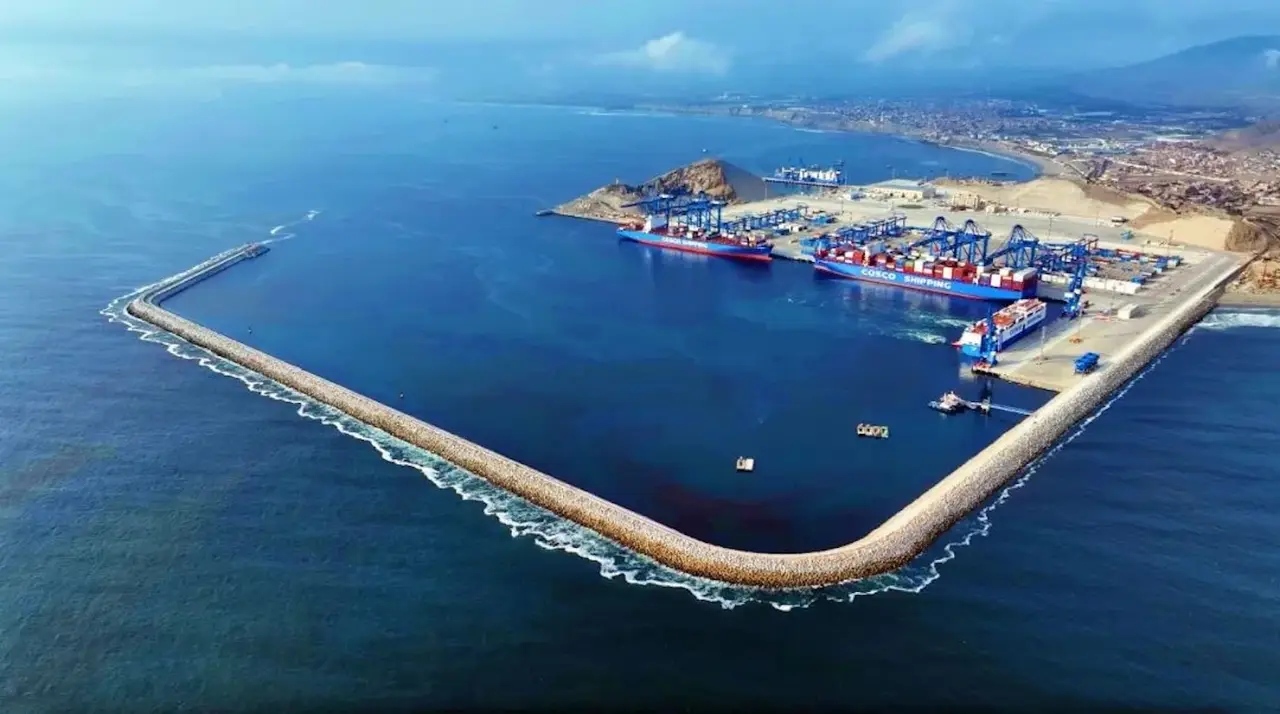

The development of the Chancay Multipurpose Port Terminal represents one of the most ambitious and geostrategic infrastructure projects in the recent history of South America. Located 75 kilometres north of Lima, this mega-port requires a projected investment of more than US$3.5 billion and has the potential to reduce maritime transit between the South American coast and Shanghai to only 23 days (Infobae, 2026a). Beyond its logistical efficiency, the project has triggered an institutional controversy in the country, the outcome of which has not yet been completely resolved.
The core of the conflict pits the operating consortium against the Peruvian State, specifically the Supervisory Agency for Investment in Public Transport Infrastructure (OSITRAN). The dispute revolves around a fundamental question: to what extent should a strategic foreign direct investment, financed entirely with private capital, be subject to the receiving State’s ordinary regulatory powers when it provides a public utility service. The answer will determine the room for manoeuvre that large transnational capital will have when investing in essential infrastructure in the region going forward
This report analyses how the institutional fragmentation of the Peruvian State facilitated a crisis of regulatory jurisdiction, the mechanisms employed by the private actor to attempt to establish a regulatory enclave, and the institutional response aimed at reaffirming regulatory sovereignty over essential infrastructure for foreign trade.
The tension between strategic investment and regulation: a theoretical approach
To objectively dissect the controversy, it is useful to establish a theoretical framework that organises the power dynamics between the State and transnational capital. To this end, we first address regulatory capacity, which goes beyond the mere formal existence of laws. According to Bach and Newman (2007), it is the actual ability of a jurisdiction to formulate, monitor, and enforce rules on economic actors operating within its territory. In Chancay, the tension lies in the gap between the legal mandate that legitimises OSITRAN to supervise and the effective resistance that a transnational corporation can mount to limit it (Bach and Newman, 2007); this capacity is measured not only by the existence of the regulatory body, but by its ability to obtain reliable information, apply enforceable sanctions, and sustain its decisions in the face of prolonged litigation.
Institutional fragmentation, developed by Lodge and Wegrich (2014), provides insights into understanding the origin of the crisis: it occurs when regulatory powers are distributed among multiple state agencies, generating overlaps, regulatory gaps, and coordination problems (Lodge and Wegrich, 2014). Peruvian port governance is divided among technical development authorities, competition agencies, and tariff-setting bodies; this dispersion was fertile ground for challenging state powers, since each entity could, at different times, offer the investor a favourable regulatory interpretation.
Finally, corporate resistance to regulation can be conceptualised as a regulatory enclave. Adapting Sidaway’s (2007) geographical definitions, an enclave of this nature emerges when an economic activity causes the ordinary application of the State’s regulatory powers to differ, become restricted, or be challenged, without any formal loss of territorial sovereignty (Sidaway, 2007). Given that the legal debate driven by the operator sought, in practice, to legally isolate the infrastructure from the tariff burdens applicable to its competitors.
Corporate and institutional architecture: the origin of the friction
To understand the magnitude of the controversy, it is necessary to identify the actors involved. The project is operated by Cosco Shipping Ports Chancay Perú S. A., an entity that reflects the convergence of Asian state interests and international corporate capital.
The initial shareholding structure consisted of COSCO Shipping Ports Limited, a Chinese state-owned entity holding 60% of the shares and projecting Chancay as a logistics hub of the Belt and Road Initiative, and a Peruvian company holding the remaining 40%, originally under Glencore’s control. This architecture has not remained static: in mid-2024, Glencore sold its stake to Transition Metals, linked to Integra Capital, following the spin-off of Volcan’s port assets into Inversiones Portuarias Chancay S. A. A. (IPCH) (Bolsa de Valores de Lima [BVL], 2024). These movements reveal a dynamic financial network that further complicates the identification of those responsible before the regulator.
Against this structure, the Peruvian State exercises its capacity for control through Law No. 27943, the National Port System Law (LSPN), which classifies ports by ownership of their works—public or private—and by their intended use—public or exclusive (Law No. 27943, 1998). Chancay is classified as infrastructure that is entirely privately owned, without state co-financing or a concession, yet undeniably of public use, as it provides logistics services to third parties (Universidad del Pacífico, n.d.). This duality triggered institutional fragmentation by involving three entities with different mandates: the National Port Authority (APN), responsible for development and technical authorizations, which granted the port authorization and exclusivity of services to the consortium (APN, 2021); OSITRAN, with a mandate for supervision and tariff regulation pursuant to Law No. 27332 (2000), which asserts its jurisdiction arguing that public service subordinates the origin of capital (RPP Noticias, 2026); and INDECOPI, responsible for competition, which determined that there is no effective competition against Callao, enabling OSITRAN to set tariffs (INDECOPI, 2024).
The divergence became evident early on. Cosco Shipping argued that OSITRAN’s powers were designed exclusively for public infrastructure under concession, and that subjecting a 100% private facility to tariff caps violated freedom of enterprise and property rights (Cosco Shipping Ports Chancay Perú, 2024). In contrast, OSITRAN President Verónica Zambrano maintained that, in Peru, a natural monopoly is prohibited outside state supervision, since the lack of oversight would create control gaps in a 180-hectare facility that would affect the country’s economic sovereignty (OSITRAN, 2026).
The legislative controversy: the debate over exclusivity
The first front of the crisis emerged in the dispute over the exclusivity of essential services. In February 2021, the APN issued Board Resolution No. 0008-2021-APN-DIR, which approved the port authorisation and formally granted Cosco Shipping exclusivity to operate the terminal’s services (APN, 2021).
This guarantee provided financial certainty to the consortium; however, in 2024 the Attorney General’s Office of the Ministry of Transport and Communications (MTC) challenged the agreement in court (APAM Perú, 2026a), arguing that the LSPN, in its current wording, only allowed exclusivity to be granted to investors under public-private concessions, without express authorisation for entirely private initiatives.
The challenge raised concerns about the country’s legal certainty, prompting corrective action by Congress. In June 2024, Law No. 32049 was approved, amending the LSPN to expressly and retroactively legitimise private port owners’ exclusivity over essential services (Law No. 32049, 2024). Although the law mitigated the operator’s immediate financial risk, it showed how the absence of a cohesive regulatory framework forces the State to resort to ex post legislative patches in response to investments of geopolitical scale (La Cámara, 2024).
Economic regulation and competitive analysis
Once the exclusivity issue was addressed, the dispute shifted to economic regulation: determining whether Chancay would exercise a geographic monopoly or face sufficient competitive pressure for the market to self-regulate prices. At OSITRAN’s request, INDECOPI evaluated competitive conditions in services such as container loading and unloading, vessel services, and transhipment and mooring (INDECOPI, 2024).
INDECOPI’s Commission for the Defense of Free Competition concluded that Chancay would not face sufficient effective competition from the Port of Callao, operated by DP World and APM Terminals (Infobae, 2026a). This determination provided OSITRAN with the legal basis to initiate a maximum-tariff-setting procedure to protect intermediate users from abuses of a dominant position.
The report sparked intense academic debate. Experts such as Bonifaz and Aguirre pointed out methodological shortcomings: INDECOPI allegedly evaluated Chancay as a geographically isolated market, overlooking the fact that it shares the same hinterland with the Callao terminals (China las Américas, 2026). Their prospective modelling estimated that Chancay’s gradual entry would reduce DP World’s share from 58% to 38% by 2029, prompting APM Terminals to adjust its strategies. Cosco Shipping, for its part, rejected price caps, arguing that the direct connection to Shanghai alone should discipline the market without state intervention.
Despite the objections, the Judiciary dismissed an early constitutional action against INDECOPI, validating its technical actions (El Comercio, 2026a). OSITRAN then projected a one-year timetable for formulating the tariff structure, warning of the operator’s reluctance to provide reliable cost data
to formulate the tariff structure, warning about the operator’s reluctance to provide reliable cost data (APAM Perú, 2026b).
The constitutional route: the struggle to prevent the enclave
The definitive confrontation took place in the constitutional jurisdiction. Cosco Shipping Ports Chancay Perú filed an amparo action to challenge OSITRAN’s supervisory, regulatory, and sanctioning powers, alleging an imminent threat to its private operating model (Cosco Shipping Ports Chancay Perú, 2024).
The first instance represented a severe fracture in Peru’s administrative doctrine: the judge upheld the amparo action, determining that the legal regime governing a port financed exclusively by private capital differed irreconcilably from that of state infrastructure (Infobae, 2026b). The ruling stripped OSITRAN of its supervisory and sanctioning powers, establishing, strictly speaking, a temporary regulatory enclave in which the State declined to verify the quality, access, and safety conditions applicable to any public-utility infrastructure.
Nevertheless, the institutional apparatus managed to rearticulate itself. In July 2026, the Second Constitutional Chamber of the Superior Court of Justice of Lima overturned the first-instance ruling, declaring Cosco’s action inadmissible (OSITRAN, 2026). The judges held that the private nature of the financing does not extinguish the public interest of the service, and that OSITRAN’s actions fall within its legal powers, reserving amparo only for manifest violations of fundamental rights (La República, 2026a).
The outcome is now before the jurisdiction of Peru’s Constitutional Court: following the setback in the superior court, the consortium filed a Constitutional Grievance Appeal (RAC), which was admitted for substantive review (La República, 2026b). The highest interpreter of the Constitution will have to establish the jurisprudence that balances freedom of enterprise with the State’s non-waivable powers to oversee natural monopolies.
Conclusions
The Chancay case demonstrates that the central challenge posed by strategic private infrastructure is not the presence of foreign investment itself, but the State’s ability to maintain a coherent regulatory framework when public-interest functions are performed by privately financed projects. The institutional gaps revealed by the dispute allowed competing interpretations of regulatory authority to emerge, while the subsequent judicial and regulatory response showed the importance of institutional coordination in resolving them.
Ultimately, the case suggests that the sustainability of large-scale strategic investment depends not only on legal certainty for investorsbut also on clear and enforceable rules that define the limits of private autonomy when infrastructure serves a public function. The pending Constitutional Court decision may therefore help clarify this balance for future strategic infrastructure projects in Peru.
Ultimately, the case suggests that the sustainability of large-scale strategic investment depends not only on legal certainty for investors but also on clear and enforceable rules that define the limits of private autonomy when infrastructure serves a public function. The pending Constitutional Court decision may therefore help clarify this balance for future strategic infrastructure projects in Peru.
References
APAM Perú. (2026a). Port authority requested the annulment of the exclusivity granted to Cosco Shipping at the Chancay mega-port. https://apam-peru.com/autoridad-portuaria-solicito-anular-la-exclusividad-otorgada-a-cosco-shipping-en-el-megapuerto-de-chancay/
APAM Perú. (2026b). OSITRAN will conduct a new study on the Port of Chancay: Its tariffs will be regulated. https://apam-peru.com/ositran-hara-nuevo-estudio-sobre-el-puerto-de-chancay-se-regularan-sus-tarifas/
Bach, D., & Newman, A. L. (2007). The European regulatory state and global public policy: Micro-institutions, macro-influence. Journal of European Public Policy, 14(6), 827–846. https://doi.org/10.1080/13501760701497659
Bolsa de Valores de Lima. (2024). Valuation report of Inversiones Portuarias Chancay S. A. A. https://documents.bvl.com.pe/empresas/alertas/Informe%20valorizacion%20IPCHAC1%2026dic2024.pdf
Centro de Competencia. (2026). Competencia ignorada: Informe de INDECOPI sobre el Puerto de Chancay. https://centrocompetencia.com/competencia-ignorada-informe-indecopi-puerto-chancay/
China las Américas. (2026). Technical report questions INDECOPI’s criterion in its competition analysis of the Port of Chancay. https://chinalasamericas.com/analysis/informe-tecnico-cuestiona-criterio-de-indecopi-en-analisis-de-competencia-sobre-puerto-de-chancay
Cosco Shipping Ports Chancay Perú. (2024). Amparo action by Cosco Shipping Ports Chancay Perú against OSITRAN. Scribd. https://es.scribd.com/document/790547232/Accion-de-amparo-de-Cosco-Shipping-Ports-Chancay-Peru-contra-Ositran
El Comercio. (2026a). Judiciary upholds INDECOPI’s powers in the Chancay mega-port case. https://elcomercio.pe/economia/peru/poder-judicial-ratifica-facultades-de-indecopi-en-el-caso-del-megapuerto-de-chancay-y-desestima-demanda-de-amparo-de-cosco-shipping-l-ultimas-noticia/
INDECOPI. (2024). INDECOPI will evaluate competitive conditions for Chancay port services. Gobierno del Perú. https://www.gob.pe/institucion/indecopi/noticias/1068070
Infobae. (2026a, July 6). Cosco Shipping takes the dispute over the Port of Chancay to the Constitutional Court. https://www.infobae.com/peru/2026/07/06/cosco-shipping-lleva-la-disputa-por-el-puerto-de-chancay-al-tribunal-constitucional/
Infobae. (2026b, February 6). Port of Chancay may not be supervised or fined by OSITRAN following court ruling. https://www.infobae.com/peru/2026/02/06/puerto-de-chancay-no-podra-ser-supervisado-ni-multado-por-ositran-tras-fallo-del-pj-quien-queda-a-cargo-del-terminal/
La Cámara. (2024). Repositorio de normas legales: Junio 2024. https://lacamara.pe/repositorio-normas-legales-junio-2024/
La República. (2026a, August 4). Port of Chancay: Judiciary admits Cosco’s appeal and dispute with OSITRAN will reach the Constitutional Court. https://larepublica.pe/economia/2026/08/04/puerto-de-chancay-poder-judicial-admite-recurso-de-cosco-y-disputa-con-ositran-llegara-al-tribunal-constitucional-hnews-300624
La República. (2026b, July 1). Chancay mega-port: Judiciary declares Cosco Shipping’s action inadmissible and upholds OSITRAN’s powers. https://larepublica.pe/economia/2026/07/01/megapuerto-de-chancay-pj-declara-improcedente-demanda-de-cosco-shipping-y-respalda-competencias-de-ositran-hnews-29126
Lodge, M., & Wegrich, K. (Eds.). (2014). The problem-solving capacity of the modern state: Governance challenges and administrative capacities. Oxford University Press. https://doi.org/10.1093/acprof:oso/9780198716365.001.0001
National Port Authority. (2021). Board Resolution No. 0008-2021-APN-DIR. Gobierno del Perú. https://www.gob.pe/institucion/apn/normas-legales/1670745-0008-2021-apn-dir
Law No. 27332, Framework Law on Regulatory Bodies for Private Investment in Public Services. (2000). Congress of the Republic of Peru. https://www.gob.pe/institucion/ositran/normas-legales/8409507-27332
Law No. 27943, National Port System Law. (1998). Congress of the Republic of Peru. /api/wp-media/filebase/senace-normativa/NAS4-11-01-LEY-27943.pdf
Law No. 32049, Law amending Law No. 27943, National Port System Law. (2024). Congress of the Republic of Peru. https://www.gob.pe/institucion/mtc/normas-legales/5644790-32049
OSITRAN. (2026). Second Constitutional Chamber upholds OSITRAN’s authority to supervise the Chancay port terminal. Gobierno del Perú. https://www.gob.pe/institucion/ositran/noticias/1413559
RPP Noticias. (2026). OSITRAN President Verónica Zambrano stated that the court ruling only confirms… [Facebook post]. https://www.facebook.com/rppnoticias/posts/1097540535935339109754053
Sidaway, J. D. (2007). Enclave space: A new metageography of development? Area, 39(3), 331–339. https://doi.org/10.1111/j.1475-4762.2007.00757.x