

One month after the double earthquake that struck Venezuela on 24 June 2026, Venezuelans are still bracing to recover the bodies of their loved ones. This tragedy, which has plunged the entire country into mourning, comes at a moment of already fragile economic and political conditions. Since the capture in January of Venezuela’s strongman, Nicolás Maduro, the US-backed government of Delcy Rodríguez has done everything possible to maintain its grip on power, even as its slow and inadequate response to the earthquake has further eroded what little popular support it had. Meanwhile, the oil revenues promised to fund Venezuela’s recovery under US oversight have yet to reach ordinary Venezuelans, who continue to face the same hardships as before, after over a decade of economic and humanitarian collapse. In this context, how long can a government with no popular support survive on US backing alone?
The human drama in Venezuela
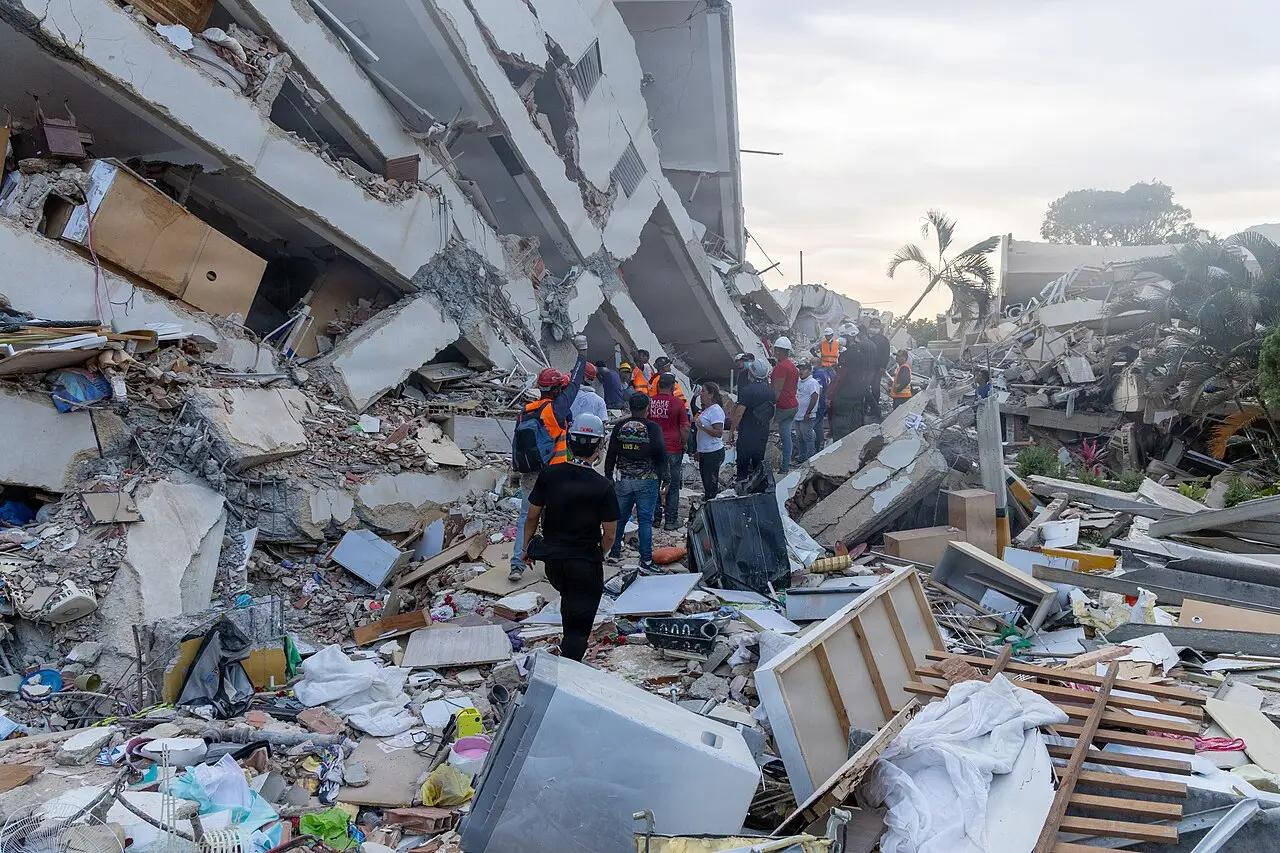
Any account of Venezuela’s crisis has to start with the scale of the human tragedy experienced by its people. Two earthquakes, of magnitude 7.2 and 7.5 struck the country’s densely populated northern coast, collapsing dozens of residential buildings. The official death toll already exceeds 5,500 with 16,700 injured, while civil society groups put the number of people still missing at over 18,000.
This disaster lands on a country already suffering one of the biggest economic collapses in history. Over the past decade, Venezuela lost more than two-thirds of its GDP, saw more than 7.8 million citizens emigrate and watched basic public services including water, healthcare, education and electricity, fall apart. At the centre of this collapse was Nicolás Maduro, Venezuela’s authoritarian president since the death of his predecessor in 2013, the charismatic socialist leader Hugo Chávez and the corruption and mismanagement that defined both of their governments.
An empty state
The consequences of 27 years of Chavist rule — the last decade of which drove the country’s economic collapse — were obvious in the response to the double earthquake. For more than 36 hours, the Venezuelan government was not capable to mobilise a relevant amount of help to the areas affected by the disaster, even though most of the damage occurred in La Guaira, a city just 45 minutes from the capital city, Caracas. Emergency services lacked the equipment to reach disaster zones in significant numbers, after years of a government more interested in using Venezuela’s shrinking income to strengthen its repressive apparatus than its emergency response capacity.
In the face of government inaction, ordinary Venezuelans were the first to respond. For days, citizens from the affected areas and nearby cities gathered around collapsed buildings, working without adequate equipment or coordination, using picks, shovels and whatever heavy machinery they could find to pull their neighbours and loved ones from the rubble. It was only after international aid arrived from dozens of countries, including El Salvador, the United States, Qatar, Switzerland and Mexico, that the Venezuelan government managed to put any real response in place.
Most Venezuelans have reacted with anger against the government. Delcy Rodríguez’s interim government, installed after the US operation that captured Maduro, has struggled with low popularity from the start. As a longtime member of the Chavista elite herself, Rodríguez is widely seen as a continuation of the Maduro government, forced to operate under US tutelage. When she first visited the disaster area survivors greeted her with shouts of “get out”, showing the levels of frustration among the population to the government response.
An humiliated army
Rodríguez’s government currently rests on an uneasy alliance between herself and her brother, the President of the National Assembly Jorge Rodríguez, who represent the interests of the business elite that grew around Maduro’s regime and Interior Minister Diosdado Cabello, who controls the state’s repressive apparatus including police, intelligence services and the pro-government paramilitary groups known as “colectivos”.
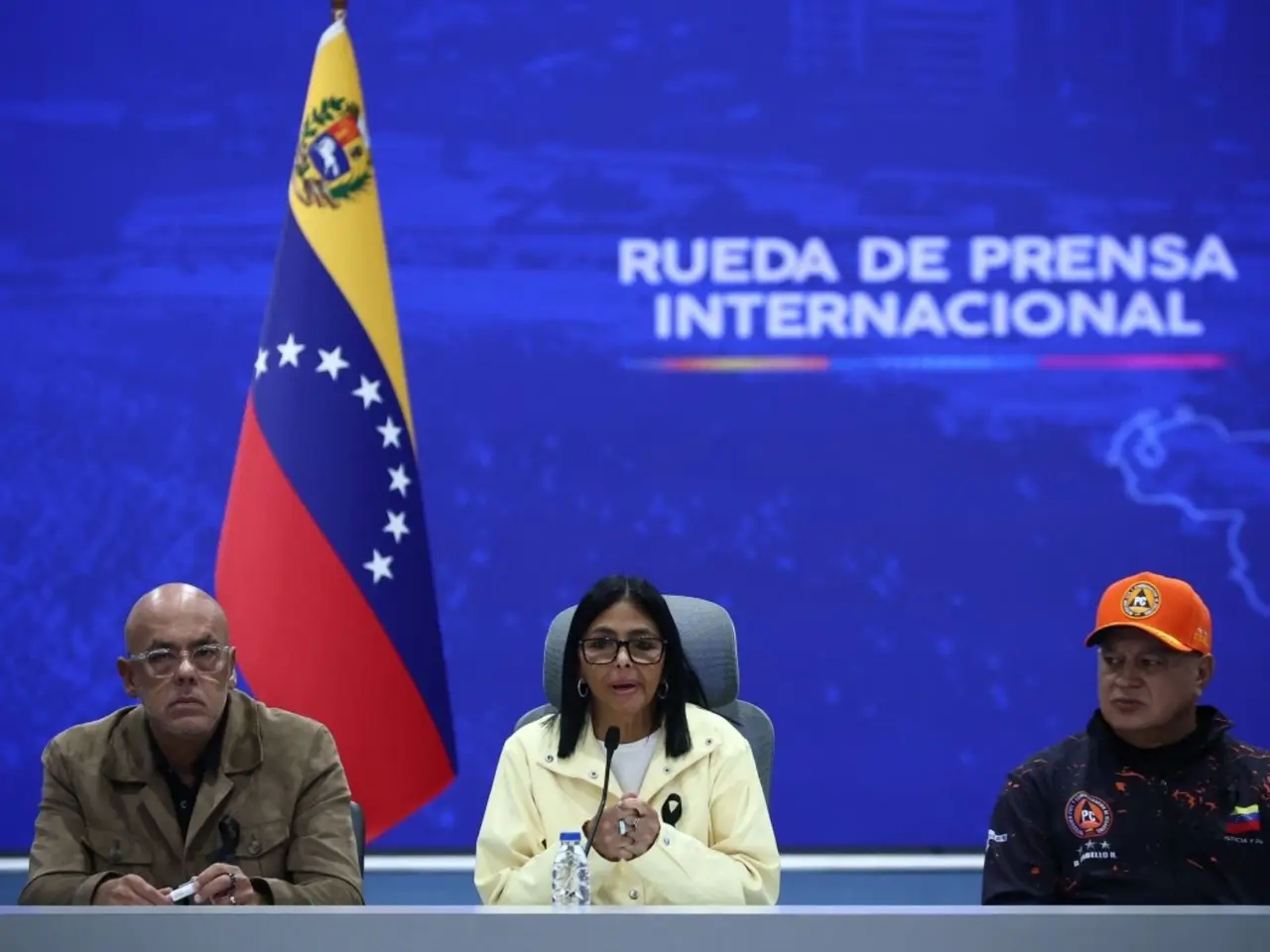
This triumvirate has one notable absence: the armed forces. The military’s position was already fragile after years of deprofessionalisation, culminating in the humiliation of Maduro’s own capture. Even though most Venezuelans believe the operation was coordinated with the country’s new authorities, the sight of US forces entering without resistance erased whatever prestige remained for the institution. The long-serving Defense Minister Vladimir Padrino López was ousted in one of the first moves of the new Rodríguez government.
The double earthquake has only deepened this situation for the Venezuela army. Even once the government managed to coordinate a relief operation with international support, the military was unable to play any significant role in it. Videos instead circulated widely among Venezuelans showing soldiers blocking volunteers from reaching disaster sites, standing by without helping during rescue operations or in some cases looting the collapsed buildings themselves.
This image of a helpless military, unable to use its own equipment or training to help its population, stood in stark contrast to the US response. Immediately after the earthquake, the United States deployed hundreds of soldiers who took on a range of roles: from repairing the country’s main airport runway to receive humanitarian aid, to working alongside Venezuelan and international teams to pull people from the rubble. In several cases, US soldiers were even seen riding in Venezuelan police vehicles.
Trump’s plan for Venezuela
The triumvirate’s growing unpopularity, its failure to mount a meaningful earthquake response and the hollowing-out of Venezuela’s state institutions have combined to make US political support the government’s single most important asset.
Since Maduro’s capture, the US has openly acted as tutor to the Rodríguez government, guiding it to implement the Trump administration’s preferred policies. Washington’s central goal is to create the conditions for Venezuelan oil to be extracted and exported by US companies. This has already led to a reform of Venezuela’s oil law that significantly curtails the power of the state oil company, PDVSA, in favour of private investors alongside other reforms guaranteeing international investment, long-term contracts and private ownership of oil infrastructure inside the country. In return, the Rodríguez government has earned consistent praise from Trump himself.
The result has been a remarkably frictionless relationship between the two governments, visible in the constant contact between Secretary of State Marco Rubio and Rodríguez, reportedly including selfies and casual exchanges over WhatsApp. Washington’s official position is that a real transition to democracy with free and competitive elections, can only happen once Venezuela has first been stabilised and its economy improved.
This stance has alarmed parts of the opposition, including the Nobel Peace Prize winner and leading opposition figure María Corina Machado. Many in the opposition had expected US intervention to quickly deliver a democratic transition, enabling elections and allowing Machado to return to the country after months in exile. Instead, the Trump administration has blocked her attempts to return, viewing Machado as a destabilising presence in the current political climate
Even long-time Machado allies such as Marco Rubio, who for years championed her in the US Senate as Venezuela’s legitimate leader, have been unwilling to support her return today. For them, larger strategic interests now take precedence: her presence in the country, demanding elections and mobilising the population, would severely affect the capacity of a fragile government like Rodríguez’s to keep control and guarantee conditions for private investment. Additionally, figures like the previous Trump’s special envoy to Latin America, Mauricio Claver Carone, and the republican donor Harry Sargeant have also advocated for Rodríguez stay in power focusing on the short-term economic benefits that US dominance over Venezuela can bring.
This situation benefits Rodríguez government. The Financial Times estimates the revenue generated from Venezuelan oil sales since January 2026 at $13 billion. These funds have been deposited into a US-controlled account in New York with no transparency on the transfers made to the Venezuelan government. Additionally, the US administration has supported Venezuela’s reintegration into the international financial system, promising to ease sanctions imposed by the first Trump administration and backing the country’s return to the International Monetary Fund as well as the restructuring of its debt, estimated at $240 billion.
Finally, the US has organised a new round of negotiations between the Venezuelan government and a separate opposition faction: members of the 2015 National Assembly, the last opposition-controlled legislature, whose members were persecuted by Maduro’s courts. Machado, whose faction represents the majority of the opposition, was excluded from this process entirely. She has said she will not obstruct it, but will monitor its progress closely, hoping it eventually produces a concrete timetable for free elections.
What is next for Venezuela?
The current political situation is unsustainable in the long run. The double earthquake that struck Venezuela laid bare the government lack of real capacity, as well as the population’s rejection of interim president Delcy Rodríguez. Even with support from the United States (which has pledged $300 million for Venezuela’s reconstruction) the level of institutional destruction will require years of sustained effort to be reversed.
The Trump administration operates on the premise that economic recovery and institutional stabilisation will eventually allow for, at best, elections, or at worst, a government functional enough to protect US private capital interests in the country. This stance suits the Venezuelan government just fine, since its own main goal is simply to remain in power.
For Rodríguez, the immediate objective is simple: stay in office long enough for Trump to lose interest in a democratic transition, or to be succeeded by an administration less inclined toward direct intervention. Every day she remains in power brings her closer to that goal. But the illegitimacy of Rodríguez’s government, sustained solely by a foreign power and the remnants of Maduro’s repressive apparatus, is too obvious to ignore.
For months now, every actor in the country has been quietly accumulating strength for what comes next. Machado’s own political organisation, sidelined from the US-backed negotiations but not from the streets, has used the space opened up by the US intervention to rebuild party structures fractured by Maduro’s final wave of repression after the stolen 2024 election. Local leaders and organisers are touring the country town by town, laying the groundwork for her eventual return.
Rodríguez has been doing something similar from within the state. Maduro loyalists have been quietly sidelined and replaced by people close to her and her brother, in a race to secure enough institutional control to withstand a future political confrontation. Where Chávez relied on party loyalty and the military, and Maduro on the repressive apparatus he built, Rodríguez has neither and must consolidate a power base of her own.
The eventual return of María Corina Machado could represent a turning point. Her mere presence in Venezuela, free to tour the country, would be enough to reignite a political struggle that has stayed dormant since Maduro’s capture. But even if Washington succeeds in keeping her out of the country indefinitely, the double earthquake has shown that the underlying conflict has not gone away, it has simply lost its main character for now. Whether through elections or a new wave of protests, government and opposition will eventually face off again. When that moment comes, the United States will have to choose between the power it has built in Rodríguez and the democratic demand it has spent months trying to contain.
Bibliography
Albe, I., & Millán-Mejía, E. (2026, 20 de enero). Three charts that show the long shadow of Maduro’s economic disaster in Venezuela. Atlantic Council. https://www.atlanticcouncil.org/dispatches/three-charts-that-show-the-long-shadow-of-maduros-economic-disaster-in-venezuela/
AtlasIntel, & Bloomberg. (2026, abril). Latam Pulse: Venezuela, abril 2026 [Encuesta]. AtlasIntel. https://cdn.atlasintel.org/c0dd083b-008e-4f55-8fe8-8f65cf8f848a.pdf
Caputo, M. (2026, 8 de julio). How a top State Dept. official “went rogue” over Machado’s Venezuela plans. Axios. https://www.axios.com/2026/07/08/state-department-official-machado-venezuela
Dyer, G., Rodríguez Brazón, A., & Daniels, J. (2026, 3 de julio). Donald Trump doubles down on support for Venezuela’s Delcy Rodríguez. Financial Times. https://www.ft.com/content/25ede586-fee0-415c-b13a-60b0bf4d61a0
Dyer, G., Cook, C., & Rodríguez Brazón, A. (2026, 21 de julio). The US has collected about $13bn of Venezuela’s oil money. Where is it? Financial Times. https://www.ft.com/content/0e562e03-106e-4729-83d7-675c27eb8c4d
Erickson, B., & Holland, S. (2026, 24 de julio). Trump says Venezuela is not ready for elections, but has made progress. Reuters. https://www.reuters.com/world/americas/trump-says-venezuela-is-not-ready-elections-has-made-progress-2026-07-24/
International Organization for Migration. (s.f.). About the regional Venezuela situation. https://respuestavenezolanos.iom.int/en/about-regional-venezuela-situation
Maturana, J. (2026, 25 de julio). Venezuela’s twin earthquakes: The toll one month later. Euronews. https://www.euronews.com/2026/07/25/the-toll-of-the-tragedy-one-month-after-venezuelas-double-earthquake
Pager, T., & Kurmanaev, A. (2026, 11 de julio). How Marco Rubio is running Venezuela from afar. The New York Times. https://www.nytimes.com/2026/07/11/us/politics/how-marco-rubio-runs-venezuela.html
Reuters. (2026, 18 de julio). Delayed orders, confusion slowed Venezuelan military’s response to quakes, sources say. https://www.reuters.com/business/environment/delayed-orders-confusion-slowed-venezuelan-militarys-response-quakes-sources-say-2026-07-18/
Rodríguez Brazón, A., & Daniels, J. (2026, 9 de julio). How Venezuela’s ‘Hugo Chávez City’ collapsed. Financial Times. https://www.ft.com/content/54b8153a-301d-41d4-9802-e1b52d42f1af
Romero, S. (2026, 6 de julio). With $8 billion in Venezuelan oil money, U.S. gives $300 million in quake aid. The New York Times. https://www.nytimes.com/2026/07/06/world/americas/earthquake-venezuela-haiti-us-aid.html
Singer, F. (2026, 27 de julio). Del fraude electoral de 2024 a una nueva negociación: La crisis política de Venezuela entra en otra encrucijada. El País. https://english.elpais.com/international/2026-07-27/from-the-2024-election-fraud-to-a-new-negotiation-venezuelas-political-crisis-enters-another-crossroads.html
Smyth, J., Gara, A., & Daniels, J. (2026, 13 de junio). Investment firms join Donald Trump’s $100bn race for Venezuelan oil. Financial Times. https://www.ft.com/content/6982febe-5d1b-4e16-9505-fbee84ca60ab
Taladrid, S. (2026, 20 de julio). María Corina Machado’s opposition in exile. The New Yorker. https://www.newyorker.com/magazine/2026/07/27/maria-corina-machados-opposition-in-exile
Turkewitz, J. (2026, 7 de julio). Venezuelans criticize own government response after twin earthquakes. The New York Times. https://www.nytimes.com/2026/07/07/world/americas/venezuela-earthquakes-delcy-rodriguez-trump.html
U.S. Department of War. (2026, 1 de julio). U.S. military supports Venezuela earthquake response. https://www.war.gov/News/News-Stories/Article/Article/4531605/us-military-supports-venezuela-earthquake-response/