
Home/Working Groups/International Relations & Diplomacy/Beijing Seeks Greater Influence in the Gulf Region

Beijing Seeks Greater Influence in the Gulf Region

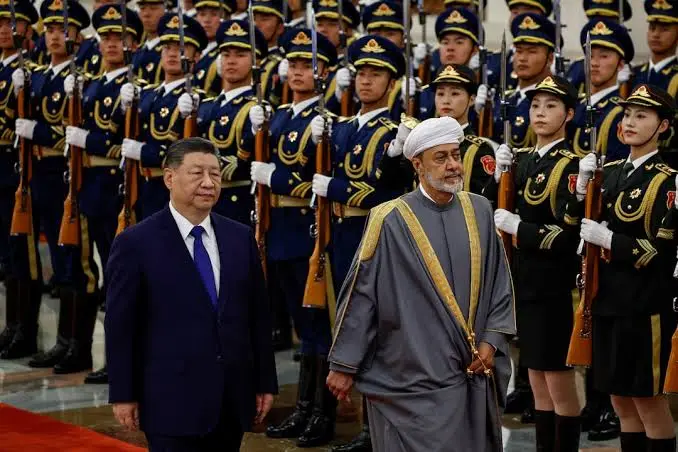
Xi Jinping meets Oman's Sultan Haitham as Beijing seeks a greater diplomatic role in the Gulf.

Chinese President Xi Jinping (left) and Omani Sultan Haitham bin Tariq al-Said (right).
Chinese President Xi Jinping (left) and Omani Sultan Haitham bin Tariq al-Said (right).Haitham is the first Omani head ⁠of state, visiting China, since the countries established ties in 1978.
Key Insights

China’s ability to translate its ambitions into concrete diplomatic successes remains limited, as it is not prepared to assume a direct security role in the region.

/PDF
2 min read
Follow us on Google

Beijing Steps Up Its Gulf Diplomacy

During Omani Sultan Haitham bin Tariq al-Said’s visit to Beijing, Chinese President Xi Jinping stated that “the Middle East Gulf region should not become an arena of great-power rivalry”. He further emphasised China’s commitment to regional peace, which is intended to continue contributing to resolving the “regional security dilemma”. In this context, the Chinese Foreign Ministry announced that its Special Envoy to the Middle East, Zhai Jun, would visit Iran, Oman and Saudi Arabia later this month. Beijing further expressed its intention to deepen coordination with the Gulf Cooperation Council states. Oman, which counts China as its largest trading partner, plays a key diplomatic role, as it maintains relations with all parties to the conflict.

The Challenges of China’s Middle East Strategy

Historically, China’s influence in the Middle East has been limited, particularly compared to that of the United States. However, this is gradually changing. Beijing’s growing diplomatic ambitions are filling the gaps created by the instability and uncertainty in the region, triggered by the US-Israeli war on Iran. China’s commercial and energy interests remain central to these efforts. Nevertheless, China’s ability to translate its ambitions into concrete diplomatic successes remains limited, as it is not prepared to assume a direct security role in the region. Furthermore, Beijing faces a delicate balancing act in building good relations with the Gulf monarchies, which have traditionally maintained close ties with Washington, while preserving its strategic partnership with Iran.
Linus Rieger Linus is in his third semester of a Bachelor’s degree in International Relations at Karlshochschule in Karlsruhe, Germany, specialising in International Security. As co-host of the German-language podcast Ordnungsruf! – Ordnung im Chaos der Politik, he speaks with experts and politicians every two weeks about security, defence, and geopolitics.

Cite this brief
Rieger, L. (2026). Beijing Seeks Greater Influence in the Gulf Region. EPIS Insight · International Relations & Diplomacy.
© 2026 EPIS · Independent · Non-partisan · Funded by the EPIS FellowsImprint · Privacy · · RSS

Privacy preference centre

When you visit a website, it may store or read information in your browser, mostly in the form of cookies. Choose below which categories we may use. Your choice is kept for 12 months, and you can change it here at any time. Privacy Policy

Manage consent preferences

Always active