
Introduction
Roxham Road was the unofficial border crossing used by asylum seekers travelling from the United States to Canada, until it was completely closed in 2023. Since 2017, 113,000 people have walked along this road to enter Quebec. Then, with the Canada-U.S. agreement, migrants must apply for refugee status in the first of the two countries they enter, and can no longer cross illegal checkpoints for claiming asylum in Canada (The Canadian Press, 2023). On the southern border, on January 20, 2025, at the foot of the international bridge that crosses from Juarez, Mexico, to El Paso, Texas, many existing appointments, scheduled with the phone application that allows migrants to seek asylum in the U.S., were cancelled. Some are waiting months in Mexico, applying for the chance to cross the border legally in order to make a new life in the United States (Peralta & Schapitl, 2025).
North America has always been a transit region, with waves of migrant communities looking for better conditions and new opportunities each year in its land. According to the World Migration Report, the number of international migrants in North America has increased sharply, growing from approximately 27.5 million in 1990 to over 61 million in 2024. The United States remains the world’s most popular destination for international migrants, with the majority being from Latin America and the Caribbean, followed by Asia and Europe. Over the past 30 years, the number of migrants in North America has more than doubled, with many arriving as migrant workers, international students or through family reunification programmes, as well as through refugee resettlement (McAuliffe & Ceriani Cernadas, 2026, p. 69).
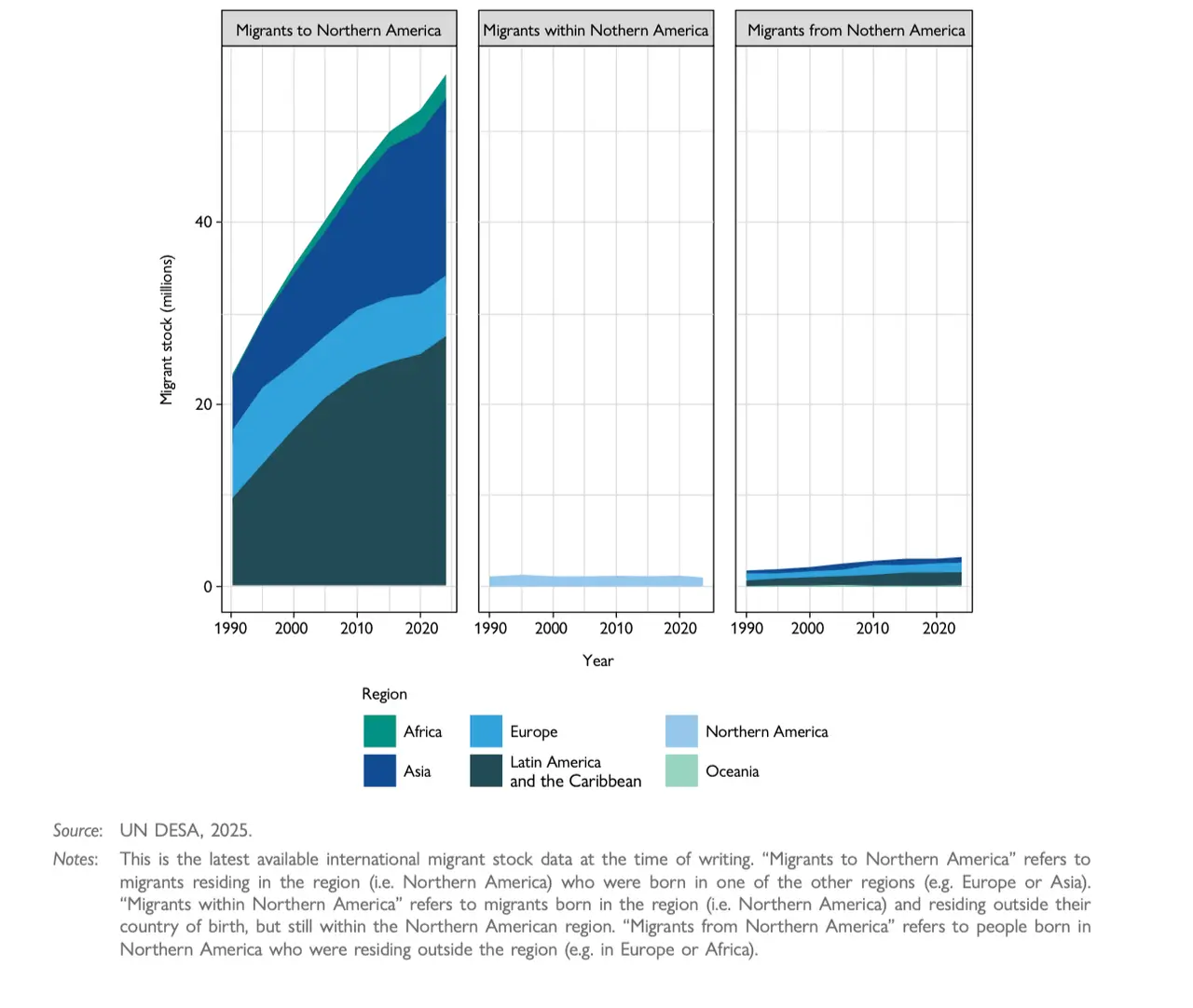
Migration does not seem to stop, neither immediately, nor in the following years. Thus, a proper management is essential for an agreeable environment to exist. In the National Security Strategy document of November 2025, Trump’s willingness is very clear: to ensure the stable preeminence of the U.S. in the Western Hemisphere against transnational criminal organisations and hostile foreign incursion. Throughout, a stronger Coast Guard and Navy presence to control the sea lanes, to stop unwanted migrants from entering the country (The White House, 2025, p. 16).
Washington’s neighbours are not untouched by the shift of U.S. policies. Mexico is more often becoming a “waiting room” place, because of bad functioning of appointments applications, and pressure coming from the United States. In 2019, Trump warned of increasing tariffs on all exports from Mexico unless the country reduced migrant influxes on U.S. soil (Adame, 2026, p. 43). Even Canada, although it maintains an immigration system based on its own criteria and programs, like the Seasonal Agricultural Worker Program, it has been tightening its borders as well. Contemporary migration dynamics in North America seems to have been transformed into a unilateralist action, not governed by each state alone, but shaped by Washington’s priorities.
What Is a Border Today?
A border is often defined as an agreed line that separates one country from another, a recognised boundary marking where one country’s government or territory ends and another begins. However, borders are always represented in different ways by the media or the public and, most of the time, they are strictly connected with the nature and meaning of security.
“By uttering “security” a state-representative moves a particular development into a specific area, and thereby claims a special right to use whatever means are necessary to block it.”
– Wæver, 1995, as cited in Williams, 2003, p. 513.
In this view, security is not an objective condition but the outcome of a social process, in which an issue becomes a security matter by being successfully represented as one. Therefore, in practice any “securitising actor” can make socially effective claims about threats that can be recognised and accepted as convincing by the relevant audience. (Williams, 2003, p. 514).
Migration in North America seems to perfectly fit this process. The securitising actors are primarily the political leaders. The U.S. President Donald Trump said on Truth Social that his administration will work to “permanently pause migration from all Third World countries to allow the U.S. system to fully recover” (Reuters, 2025). These declarations aim to arouse the sentiment of sovereignty and national identity into the electorate. This narrative portrays North America as being invaded by migrations waves, which are the cause of crisis at the borders, and national emergency. Furthermore, the clearest example is the enforcement of Immigration and Customs Enforcement (ICE). The Big Beautiful Bill Act granted ICE an additional $75 billion in funding, providing an unprecedented resource to bolster its efforts to arrest and deport undocumented immigrants living in the US. The act allocates tens of billions of dollars for various immigration-related enforcement measures, including those along the US-Mexico border (Montoya-Galvez, 2025). More than $46 billion has been allocated to Customs and Border Protection for the construction of walls, barriers and related projects along the border. The agency has also received an additional $12 billion to fund Border Patrol agent vehicles, facilities, training, recruitment and bonuses (Montoya-Galvez, 2025).
According to Williams (2003), securitisation theory itself invites a critical question. If security is not an objective condition, but rather the result of effective communication, then the aforementioned measures may reveal more about how migration is portrayed than the actual threat it poses. As Williams (2003, p. 514) reminds us, security issues “cannot be reduced to the existence of objective possibilities of harm.”
Do the realities at the border, the role of migrants in the economy and the lived experience of communities affected by enforcement measures justify a permanent state of emergency? The following sections address this question by examining how this security logic has extended beyond the border, its impact on the policies of Mexico and Canada, and the responses of migrant communities.
Historical Background
On January 1st, 1994, the North America Free Trade Agreement (NAFTA) went into effect, with the main purpose of facilitating trade and open markets. The treaty paid little attention to worker mobility which made labour central to the broader process of market integration. The U.S. backers insisted on the unilateral right to prevent Mexican workers from migrating through restrictive border policies (Fernández-Kelly & Massey, 2007, p. 99). The result was a process of development in North America in which rising investment south of the border coincided with repressive efforts to limit the cross-border movement of Mexicans. The combination of continued pressures for emigration and increasingly restrictive border policies had a profound effect on patterns and processes of Mexico-U.S. migration. NAFTA represented an attempt for deeper economic integration without political integration. The agriculture deregulation brought by this agreement, including the selling of land to foreigners, the withdrawal of farm subsidies and the opening of Mexico’s food, seed, and feed markets to competition from Canada and the United States led to the migration of many labours, unable to compete with mechanised grain exports once Mexican agricultural protection was broken down (Fernández-Kelly & Massey, 2007, p. 105).
Moreover, in this context the major shift happened in the outlook to immigration as a matter of national security rather than labour regulation. The dismantling of the Immigration and Naturalisation Service (INS) and the transfer of its powers to the Office of Homeland Security led to a reframing of immigrants as risks to the integrity of the United States, regardless of their provenance. The change escalated when Homeland Security was established with a clear mandate to protect the nation from terrorist threats, but its principal effect has been to terrorise immigrant workers from Mexico and Central America, many of whom were displaced by NAFTA itself (Fernández-Kelly & Massey, 2007, p. 108).
One consequence appears to have been the rise of anti-immigrant sentiment, exploited by opportunistic politicians. As Mexican agricultural workers had few alternatives other than to emigrate to the north, their arrivals could be seen as a threat rather than as an outcome of economic policy, providing a justification for increasingly repressive measures.
Indeed, the budget for border enforcement increased by 600 per cent between 1993 and 2006, enabling the Border Patrol to increase its number of agents from around 4,000 to 12,350 during this period (FitzGerald, 2008)
After 9/11, unauthorised immigrants from Mexico were paying up to $2,800 to enter the United States. Yet Washington did not stop to consider the contradiction of militarising the border with a country that posed no strategic threat and was instead an ally and major trading partner. The dense social networks between Mexicans and Americans, together with deeper economic integration, made it extremely difficult to seal the border selectively. Restrictive border policies thus proved not only ineffective, but also counterproductive. Rather than deterring Mexicans from moving to the neighbouring country, they led to a faster growth in the undocumented population (Fernández-Kelly & Massey, 2007, p. 111).
Who Controls North America’s Borders? This evidence highlights that the management of immigration policies and dynamics is largely in the hands of the US, which is becoming increasingly unilateral towards Mexico and Canada. This is because neighbouring countries feel pressured to secure their borders for business reasons. This creates an asymmetric interdependence whereby all three North American countries benefit from close economic ties, but Mexico and Canada are more dependent on the US for trade than vice versa. This makes them much more vulnerable to disruptions in cross-border commercial flows and gives Washington greater policy influence (Andreas, 2003, p. 9). In 2025, Donald Trump stretched the boundaries of existing trade law, introducing emergency sanctions to justify imposing 25 percent tariffs on imports from Canada and Mexico, in an attempt to curb the flow of fentanyl and illegal immigration into the United States (Lawder, 2025). The executive order justifying these tariffs framed migration explicitly as a national emergency:
“I, Donald J. Trump, President of the United States of America, find that the sustained influx of illegal aliens and illicit opioids and other drugs has profound consequences on our Nation, endangering lives and putting a severe strain on our healthcare system, public services, communities, and schools.”
Exec. Order No. 14194, 2025
The order made the removal of tariffs conditional on Mexico’s behaviour, as judged by Washington alone: it was up to the U.S. Secretary of Homeland Security to assess whether Mexico has addressed the illegal migration and illicit drug crises with the necessary measures. The President would have to make a determination that sufficient action had been taken before tariffs could be removed (Exec. Order No. 14194, 2025, Sec. 3(a)).
Do restrictive policies actually reduce migration? Their consequences suggest that, rather than stopping it, they simply shift it elsewhere. In Mexico, U.S. tariff pressure led to the deployment of 10,000 National Guard members (CBS News, 2025). In the first half of 2025, the number of undocumented foreigners registered in the country fell by 83% (UNHCR et al., 2025). However, migrants have not disappeared: for the first time, more respondents cited Mexico (43%) rather than the United States (14%) as their final destination, and 53% experienced at least one incident along the way (UNHCR et al., 2025). The same pattern can be observed in the north. When the Trump administration sought to revoke Temporary Protected Status for approximately 500,000 Haitians, asylum applications at the Canadian border crossing at Saint-Bernard-de-Lacolle doubled between March and April 2025, quadrupling compared to the previous year (The Canadian Press, 2025b). Many of the applicants were Haitians fleeing the United States before losing their status (The Canadian Press, 2025a). The Canadian government responded by introducing the Strong Borders Act, which renders asylum claims filed more than one year after arrival inadmissible, a rule that, according to critics, mirrors that of the United States (CBC News, 2025) regarding their acceptance in the country and the integration following it. In this sense, restrictive policies do not eliminate the need to migrate, but rather shift it from one country to another, prompting the United States’ neighbors to align themselves with the American model.
Restrictive immigration policies also have a direct impact on the communities that receive migrants. In the United States and Canada, immigration is the main driver of population growth: migrants account for about 15% of the U.S. population and 22% of the Canadian population, and without immigration, the U.S. population in 2054 would be 13% smaller (McAuliffe & Ceriani Cernadas, 2026, p. 70). Precisely for this reason, domestic enforcement also affects those who are not migrants: According to an analysis by the Brookings Institution, ICE operations have cost the U.S. economy approximately 668,000 jobs, up to 297,000 of which were held by U.S.-born workers, primarily in the construction, hospitality, and restaurant industries (Munis, 2026) where there is an easier integration.
If security is not limited to “objective possibilities of harm” (Williams, 2003, p. 514), the North American case shows just how far the perception of a threat can diverge from the facts. In fiscal year 2026, the number of encounters at the southwestern border fell to fewer than 140,000, down from nearly 2.5 million in 2023 (U.S. Customs and Border Protection [CBP], 2026), yet the rhetoric of emergency and the extraordinary measures have not subsided. As Massey and Pren (2012) note, the political response tends to intensify “independently of the actual number of illegal entries” (p. 13). Migration poses concrete challenges, ranging from reception capacity to the costs borne by communities, but securitisation has transformed these challenges into a logic of permanent emergency, extending from the United States to Mexico and Canada. Williams points to a possible way forward: “de-securitisation,” that is, bringing an issue back into the realm of ordinary politics (2003, p. 523). For North America, this would mean treating migration as a matter of labor, rights, and regional cooperation, rather than as an existential threat.
Conclusion
In contemporary North America, migration is no longer governed solely at the physical border. The border has been externalised to the south, with Mexico increasingly tasked with enforcing U.S. priorities, and internalised, through an unprecedented enforcement apparatus. At the heart of this system lies an asymmetry that originated with NAFTA, which the United States has transformed in recent years into an explicit tool for exerting pressure on Mexico and Canada. Restrictive policies reduce visible crossings but do not eliminate the need to migrate: they shift migration flows toward Mexico and Canada, make the journeys more dangerous, and impose costs on communities. Much of the data for 2025-2026 is recent or preliminary, and academic research on this period is still limited; for this reason, the analysis is based in part on journalistic and institutional sources. The future of the region remains uncertain. In July 2026, the United States refused to renew the USMCA in its current form, opting instead for separate bilateral negotiations with its two neighbors (IISD, 2026): a sign that the asymmetry described in this paper could widen further.
Williams points to a possible way forward: “desecuritisation,” that is, bringing an issue back into the realm of ordinary politics (2003, p. 523). For North America, this would mean treating migration as a matter of labor, rights, and regional cooperation, rather than as an existential threat.
Bibliography:
Adame, V. (2026). A comparative analysis of U.S. and Mexico’s migration policy from 2009 to 2025: How their approaches shape and constrain each other’s policy choices [Senior thesis, Fordham University]. Fordham Research Commons. https://research.library.fordham.edu/cgi/viewcontent.cgi?article=1187&context=international_senior
Andreas, P. (2003). A tale of two borders: The U.S.-Mexico and U.S.-Canada lines after 9-11 (Working Paper No. 77). Center for Comparative Immigration Studies, University of California, San Diego. https://escholarship.org/uc/item/6d09j0n2
CBC News. (2025, June 5). Experts warn of Bill C-2 as ‘anti-refugee’ and ‘anti-immigrant’ giving Canada ‘unchecked powers’ like the U.S. https://www.cbc.ca/lite/story/1.7553167
CBS News. (2025, February 3). Trump pauses tariffs on Mexico for 1 month after Sheinbaum agrees to send troops to border. https://kioncentralcoast.com/news/2025/02/03/trump-pauses-tariffs-on-mexico-for-1-month-after-sheinbaum-agrees-to-send-troops-to-border/
Exec. Order No. 14194, Imposing duties to address the situation at our southern border (2025, February 1). The White House. https://www.whitehouse.gov/presidential-actions/2025/02/imposing-duties-to-address-the-situation-at-our-southern-border/
Fernández-Kelly, P., & Massey, D. S. (2007). Borders for Whom? The Role of NAFTA in Mexico-U.S. Migration. The Annals of the American Academy of Political and Social Science, 610, 98–118. http://www.jstor.org/stable/25097891
FitzGerald, D. (2008, August 1). Irregular migration. Bundeszentrale für politische Bildung. https://www.bpb.de/themen/migration-integration/regionalprofile/english-version-country-profiles/58451/irregular-migration/
International Institute for Sustainable Development. (2026, September 9). United States declines to renew USMCA at first joint review, triggering annual reviews. Investment Treaty News. https://www.iisd.org/itn/2026/09/09/united-states-declines-to-renew-usmca-at-first-joint-review-triggering-annual-reviews/
Lawder, D. (2025, February 3). Trump stretches trade law boundaries with Canada, Mexico, China tariffs. Reuters. https://www.rnz.co.nz/news/top/540689/trump-stretches-trade-law-boundaries-with-canada-mexico-china-tariffs
Massey, D. S., & Pren, K. A. (2012). Unintended consequences of US immigration policy: Explaining the post-1965 surge from Latin America. Population and Development Review, 38(1), 1–29. https://spia.princeton.edu/sites/default/files/content/docs/news/Unintended-Consequences.pdf
McAuliffe, M., & Ceriani Cernadas, P. (Eds.). (2026). World migration report 2026. International Organisation for Migration. https://worldmigrationreport.iom.int/
Montoya-Galvez, C. (2025, July 10). Trump’s “big, beautiful bill” gives ICE unprecedented funds to ramp up mass deportation campaign. CBS News. https://www.cbsnews.com/news/ice-funding-big-beautiful-bill-trump-deportations/
Munis, J. (2026, June 5). Trump promised deportations would protect American jobs. Brookings said ICE raids have cost the economy over 668,000 of them. Fortune. https://fortune.com/2026/06/05/trump-immigration-crackdown-americans-jobs-brookings-30-jobs-lost-per-arrest
Peralta, E., & Schapitl, L. (2025, January 20). Migrants left in despair at the border as asylum system shuts down. NPR. https://www.npr.org/2025/01/20/g-s1-43855/trump-inauguration-border-asylum-app-cbpone
The Canadian Press. (2025b, May 7). Asylum claims at Quebec border crossing doubled between March and April. CFJC Today. https://cfjctoday.com/2025/05/07/asylum-claims-at-quebec-border-crossing-doubled-between-march-and-april/
The Canadian Press. (2023, September 25). RCMP demolish last structure at Quebec’s Roxham Road migrant crossing. CTV News. https://www.ctvnews.ca/montreal/article/rcmp-demolish-last-structure-at-quebecs-roxham-road-migrant-crossing/
The Canadian Press. (2025a, April 8). Rise in asylum seekers to Canada as migrants’ protected status set to expire in U.S. CTV News. https://www.ctvnews.ca/montreal/article/rise-in-asylum-seekers-to-canada-as-migrants-protected-status-set-to-expire-in-us/
The White House. (2025). National security strategy of the United States of America. /api/wp-media/2025/12/2025-National-Security-Strategy.pdf
UNHCR, WFP, & UNICEF. (2025). Mixed movements monitoring: Quarter 2 2025. https://data.unhcr.org/en/documents/download/118404
U.S. Customs and Border Protection. (2026). Southwest land border encounters. Retrieved November 7, 2026, from https://www.cbp.gov/newsroom/stats/southwest-land-border-encounters
Yahoo News. (2025, November 28). Trump says US will “permanently pause migration” from “third world countries”. https://www.yahoo.com/news/articles/trump-says-us-permanently-pause-044129232.html
Williams, M. C. (2003). Words, Images, Enemies: Securitisation and International Politics. International Studies Quarterly, 47(4), 511–531. http://www.jstor.org/stable/3693634