Oil Wealth and Foreign Dependence
Guyana’s oil industry has driven rapid economic transformation, but rising production has raised questions about the extent of the state’s control over its energy future. Oil production exceeded 900,000 barrels per day in 2025, while real GDP grew by 19.3% last year (King). According to the International Monetary Fund’s October 2026 assessment, both oil and non-oil activity contributed to this growth (IMF Executive Board).
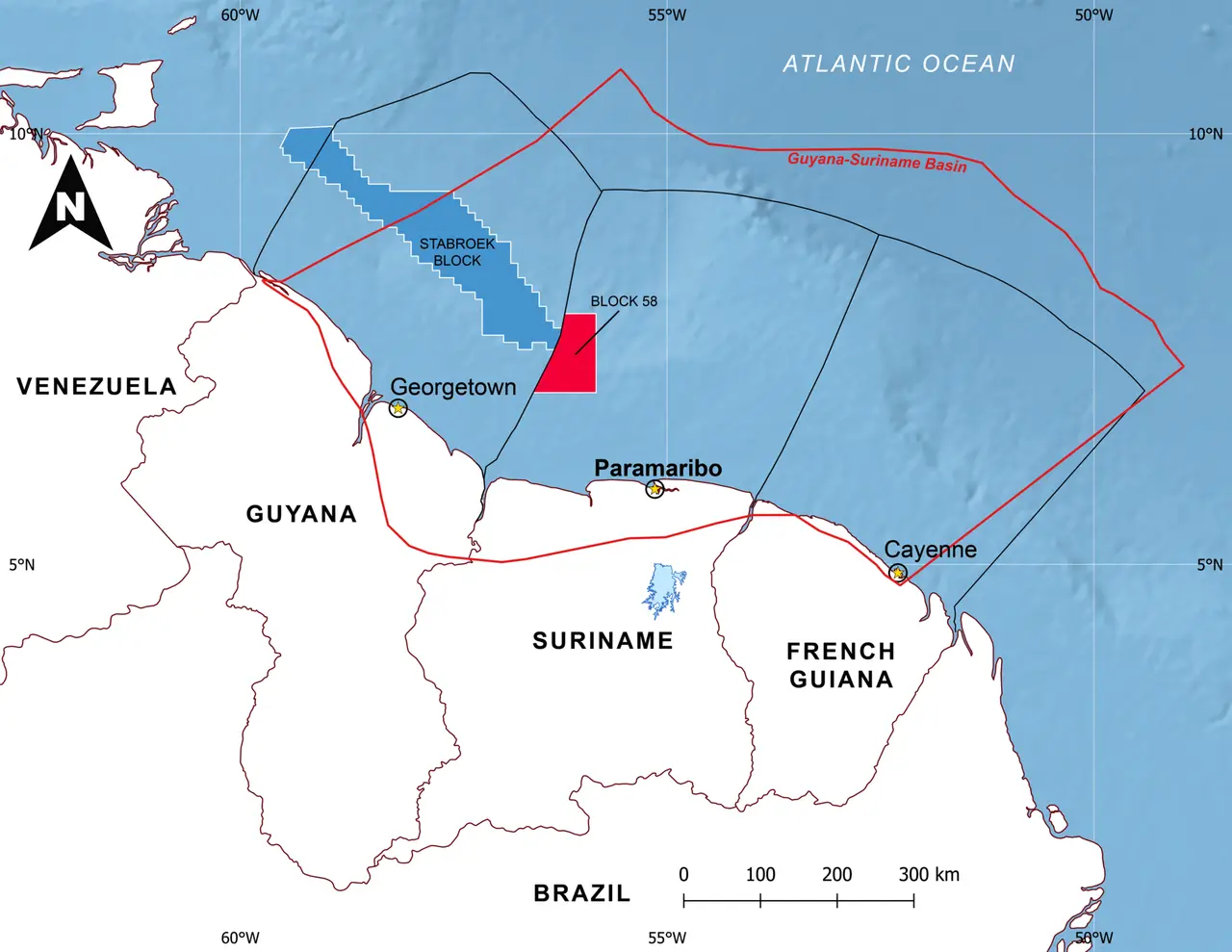
The Stabroek Block illustrates Guyana’s reliance on foreign investment. ExxonMobil operates the block alongside its partners, Hess and China National Offshore Oil Corporation (CNOOC), under a production-sharing agreement signed in 2016 (Offshore Industry). The agreement allows companies to recover eligible costs from oil production before the remaining profit oil is divided between Guyana and the consortium. This arrangement brought large-scale production to a country that lacked the capital and technical capacity to develop its offshore reserves independently. However, the terms also affect how much revenue Guyana receives and how much influence it has over the sector.
For Guyana, the challenge is not simply to increase oil production, but to ensure that foreign investment strengthens its ability to manage its own resources. The government wants to use its hydrocarbon resources to reduce domestic energy costs, foster local industry and decrease dependence on imported fuel. However, these priorities may differ from international operators’ commercial incentives, particularly ExxonMobil. The main question is whether Guyana can use foreign investment to build the domestic expertise, infrastructure and economic capacity needed to exercise greater control over its energy future. This depends on three connected developments: the government’s ability to oversee foreign operators and expand local participation, its capacity to direct natural gas toward domestic priorities, and its management of oil revenue to support economic diversification.
1. Foreign Investment and the Production-Sharing Agreement
The 2016 Stabroek Block agreement was designed to attract the investment needed to develop Guyana’s offshore reserves. Offshore production requires substantial capital, specialised equipment and technical expertise that Guyana could not easily supply alone. Foreign companies provided these resources, allowing the country to earn revenue from reserves that had remained commercially undeveloped. Under the agreement, the government receives a 2% royalty, while the consortium can recover eligible costs from up to 75% of monthly production, with the remaining profit oil divided equally between the two parties (Ministry of Natural Resources).
However, the cost-recovery system affects how much oil revenue reaches the government. The more costs companies recover, the less production remains as profit oil to be shared. In August 2026, the government reported that its share of Stabroek Block production had risen to about 39.8% as cost recovery declined (Department of Public Information, Guyana). This figure includes the effect of the production-sharing formula and is distinct from Guyana’s 50% share of profit oil. Because the state’s share depends on the costs claimed, the government must be able to verify the figures operators submit. In May 2025, it reported that it had disputed roughly US $214 million in costs submitted by the consortium following an audit covering 1999–2017, and the parties agreed to use the agreement’s dispute-resolution process (Ministry of Natural Resources).
This illustrates that Guyana’s ability to capture greater economic value depends not only on the terms of its agreements, but also on its capacity to oversee the companies extracting its resources. Local content is one way to build that capacity while keeping more oil-related spending within the country. News Room Guyana reported in February 2026 that more than 1,200 local businesses were involved in the oil sector and nearly 7,000 Guyanese had been trained or employed, with approximately US$2 billion in procurement opportunities available under the framework (News Room Guyana). Local suppliers can earn revenue from contracts, while workers gain skills that may remain useful beyond individual oil projects. A stronger domestic supplier base could also reduce the need to import services.
Yet local participation does not necessarily mean that Guyanese businesses have gained the expertise needed to manage more complex parts of the industry. Companies may participate in procurement without acquiring the technology or technical knowledge required to operate major offshore projects. If local firms remain concentrated in lower-value services, the industry may generate employment without significantly reducing Guyana’s dependence on foreign expertise. The challenge is therefore to move beyond participation towards developing the technical capabilities that would give Guyana greater influence over its own oil industry.
2. Natural Gas and the Limits of Guyana’s Energy Strategy
Guyana’s reliance on foreign operators also affects its ability to direct natural gas toward domestic priorities. The government wants to use gas to generate electricity, lower energy costs, and support industrial development. However, the amount available for domestic use depends on the production requirements of the companies operating the fields.
In October 2026, Reuters reported that ExxonMobil and its partners expected to require approximately two billion cubic feet of gas per day for reinjection into their oilfields (Williams and Parraga). Reinjection helps maintain reservoir pressure and supports crude oil production. The projected requirement could leave less gas available for a proposed liquefied natural gas (LNG) export facility and other industrial projects. The government was considering reducing the facility’s planned capacity from six million tonnes per year to as little as three million tonnes, although no final decision had been announced yet. This creates a conflict between maintaining oil production and making more gas available for other parts of the economy.
The proposed Gas-to-Energy project forms part of the government’s response to this constraint. By using offshore gas for power generation, Guyana could reduce its reliance on imported fuel and lower domestic energy costs. More reliable and affordable electricity could also strengthen conditions for businesses outside the oil sector (Mexico Guyana Chamber of Commerce). This aligns with the IMF’s 2026 assessment, which identifies infrastructure investment and diversification as important elements of the country’s development strategy (IMF Executive Board).
Domestic energy development, however, requires more than the presence of gas reserves. It depends on transparent information about available supply, transportation costs, project timelines and allocation between competing uses. Without clear commitments on these issues, the government cannot fully plan electricity generation and industrial development around national priorities. Foreign operators provide the capital and expertise needed to develop offshore resources, but their production requirements also influence which options are available to Guyana. Greater energy independence will depend on the government’s ability to negotiate arrangements that account for domestic energy needs as well as the commercial requirements of oil production.
3. Oil Revenue, the Natural Resource Fund and Economic Diversification
Guyana’s Natural Resource Fund (NRF) provides a way to turn oil production into longer-term economic benefits. The fund allows the government to manage petroleum income while financing national development. Its purpose is to manage revenue from a finite resource in a way that supports sustainable development, stabilises public spending, and ensures that future generations benefit from the country’s natural resource wealth (International Forum of Sovereign Wealth Funds).
The IMF reported that the NRF held approximately US $3.3 billion, equivalent to more than 12% of GDP, at the end of 2025. Strong oil revenues helped reduce the overall fiscal deficit to 5.5% of GDP that year, even as the government continued large public investments. The IMF also noted that investment in physical and human capital had supported growth in the non-oil economy (IMF Executive Board). This demonstrates how revenue generated through foreign investment can support economic activity beyond petroleum, allowing Guyana an opportunity to reduce its dependence on a single industry.
However, diversification is not guaranteed by rising revenue alone. If public spending depends heavily on oil income, changes in production, prices or global demand could affect the government’s ability to maintain investment. A rapidly expanding oil sector may also draw labour and capital towards activities connected to petroleum, making it harder for other industries to compete. The IMF has therefore recommended stronger spending oversight, a clearer medium- and long-term fiscal strategy, and continued investment in productivity and diversification.
The NRF can help Guyana manage oil revenue, but it cannot by itself create a more diversified economy. That requires investment in productive sectors that can generate income and employment without relying directly on petroleum. The fund’s contribution to economic independence will ultimately depend on whether oil revenue builds industries and capabilities that remain productive beyond the life of the country’s oil reserves.
Conclusion
The evidence suggests that Guyana’s dependence on foreign investment is not necessarily a challenge to economic independence. Without foreign capital, equipment and expertise, the country would have faced significant barriers to developing its offshore oil reserves. Foreign investment has therefore created the production and revenue needed to support national development. However, the ability to generate wealth from oil is not the same as having control over how that wealth and the underlying resources are used.
The production-sharing agreement demonstrates the importance of contract oversight and technical expertise in determining how much revenue Guyana captures. Local content can help develop domestic businesses and workers, but its long-term contribution depends on whether they gain the skills needed to take on more complex activities. The natural gas issue similarly shows that owning resources does not guarantee the ability to allocate them according to domestic priorities. Meanwhile, the Natural Resource Fund provides an opportunity to invest oil revenue in infrastructure and industries beyond petroleum, although diversification requires continued investment and effective spending oversight.
Guyana does not need to remove foreign companies from its oil industry to strengthen its economic independence. Rather, it needs to ensure that foreign participation builds the domestic capabilities required to manage its resources and negotiate from a stronger position. If foreign investment helps develop technical expertise, stronger domestic suppliers, reliable energy infrastructure and a more diverse economy, it can become a mechanism of economic independence. If the country continues to rely on foreign operators for technical knowledge and key production decisions, it may become a wealthier oil producer without gaining equivalent control over its energy future.
References
Department of Public Information, Guyana. (2026, August 19). Guyana’s share of Stabroek Block oil increases to 39.8 per cent as cost recovery declines. https://dpi.gov.gy/guyanas-share-of-stabroek-block-oil-increases-to-39-8-per-cent-as-cost-recovery-declines/
International Forum of Sovereign Wealth Funds. (n.d.). Natural Resource Fund. https://www.ifswf.org/members/natural-resource-fund
International Monetary Fund. (2026, October 8). IMF Executive Board Concludes 2026 Article IV Consultation with Guyana. https://www.imf.org/en/news/articles/2026/10/08/pr26330-guyana-article-iv
King, K. (2026, January 26). Guyana economy set to grow 16.2% in 2026, oil sector still main driver, finance minister says. Reuters. https://www.reuters.com/world/africa/guyanas-economy-expanded-193-2025-despite-cooling-oil-sector-growth-2026-01-26/
Mexico Guyana Chamber of Commerce. (2026, October 16). Guyana Gas-to-Energy Project 2026: Why more competitive power could transform business. https://mexicoguyana.org/2026/10/16/guyana-gas-to-energy-project-2026-why-more-competitive-power-could-transform-business/
Ministry of Natural Resources. (2025, May 21). Update on Status of Stabroek Block Cost Recovery and Verification of Profit Oil Audits. Petroleum Management Programme – Ministry of Natural Resources. https://petroleum.gov.gy/article/update-on-status-of-stabroek-block-cost-recovery-and-verification-of-profit-oil-audits/
Ministry of Natural Resources. (n.d.). Petroleum Agreement – Stabroek Block. Petroleum Management Programme – Ministry of Natural Resources. https://petroleum.gov.gy/docs-and-pubs/petroleum-agreement-stabroek-block/
News Room Guyana. (2026, February 20). 1,200 local businesses now participating in oil sector as nearly 7,000 Guyanese trained – Bharrat. https://newsroom.gy/2026/02/20/1200-local-businesses-now-participating-in-oil-sector-as-nearly-7000-guyanese-trained-bharrat/
Offshore Industry. (2026, July 21). Guyana’s Stabroek Block: How ExxonMobil, Hess, and CNOOC Transformed a Small Nation’s Economic Future. https://offshoreindustry.co.uk/guyanas-stabroek-block-how-exxonmobil-hess-and-cnooc-transformed-a-small-nations-economic-future/
Williams, C., & Parraga, M. (2026, October 13). Guyana may scale back LNG plans as Exxon needs more gas for its wells, sources say. Reuters. https://www.reuters.com/business/energy/guyana-may-scale-back-lng-plans-exxon-needs-more-gas-its-wells-sources-say-2026-10-13