


Trump’s second term has wrought untold chaos like the world has not seen in decades, but China has not exploited that chaos in the way an emerging realist might.
Introduction
The international order is being rapidly destabilised by US actions under Trump. The kidnapping of Nicolás Maduro, the open threats against Greenland and the US-Israeli attacks on Iran have caused tremendous shockwaves in the international rules-based order.
For China, this upheaval presents both challenges and opportunities. Beijing has long sought to erode US dominance over East Asian-Pacific security and the global financial system (Nye, 2023). As the unipolar world order visibly fractures into a multipolar one, understanding Chinese ambitions becomes increasingly urgent.
This article analyses Chinese reactions to US aggression toward Venezuela, Greenland and Iran, drawing on official Chinese communications, statements and state-run media, supplemented by secondary sources for strategic analysis. Due to the recency of events, reliance on academic sources will be limited. Most of the underlying and resulting conclusions will be drawn from the construction of logical arguments based on concrete occurrences. This presents a limitation to the academic validity of this article, but it also gives it heightened operational utility.
The article examines two dimensions of Chinese foreign policy: its ‘forward-facing diplomacy’, meaning statements by government officials and positions at international fora, and the strategic implications which might be understood as either ‘between the lines’, or drawn from operational reactions to analysed events. An example of a diplomatic reaction might be, for instance, a condemnation or diplomatic protest at the UN level, while an operational reaction might, hypothetically, consist of more assertive posturing toward Taiwan or efforts to strengthen alternative financial networks like BRICS.
The central research question is: what implications do recent actions and statements by the United States have for China? To understand this, it will be necessary to interpret Chinese reactions to these events. There is, undoubtedly, a high degree of uncertainty, but several analysts and commentators have provided a range of possibilities to be analysed.
Contextualising China’s geopolitical situation
Unlike the United States, whose foreign policy under Trump has taken on an increasingly global and unilateral character (Böller & Wiedekind, 2025), China’s strategic priorities remain anchored in the Indo-Pacific. The Question of Taiwan sits at the top of Beijing’s agenda, driven by a combination of economic imperatives, power-projection logic, and ideological conviction. Taiwan hosts the world’s most advanced semiconductor manufacturing facilities, controls critical access points along the first island chain, and represents, in Beijing’s view, an unresolved wound to Chinese national unity (Chen, 2022). In the South China Sea, the PRC is engaged in complex geopolitics often dominated by both tension and economic dependency. In this vein, it holds several maritime disputes, particularly with the Philippines and Vietnam (Amer & Li, 2018; Zhang, 2018). Its international political friction with Japan is permanently present given the Senkaku/Diaoyudao Islands disputes as well as its fierce opposition to the country’s remilitarisation (Sato, 2019), and finally, its odd (though now cooled down) contestations with India at the Himalayas (Verma, 2024).
This regional preoccupation provides an important context for understanding how Beijing has responded to US aggression in Venezuela, Greenland, and Iran. Each of these theatres is geographically remote from China’s core security perimeter, yet each touches on interests that matter deeply to Beijing: the prevention of regime changes favourable to American interests, the integrity of the global rules-based order that China increasingly invokes in its own favour (Williams, 2020), and the long-term contest for influence across the Global South (Murphy, 2024). Beijing may therefore calibrate its responses not primarily around the immediate crises themselves, but around the broader signal each sends about American behaviour, and the opportunities that behaviour creates for Beijing to present itself as a more reliable and law-abiding alternative to US leadership.
Summarising recent American belligerency
Following Donald Trump’s reelection as President of the USA in 2025, US foreign relations and policy became unpredictable and rash (Böller & Wiedekind, 2025), testing the structural strength of the international order based on rules.
In early January 2026, the US military conducted a lightning operation to remove Venezuelan President Nicolás Maduro from his residence and transport him to the US to stand trial for alleged organised narcotraffic crime accusations (Curtis, 2026). Experts have deemed this move to be a sharp break in the status-quo of a rules-based international order (Nasrat, 2026; Ahmed, 2026; Okplewu, 2026) positing that such acts hold no legal legitimacy and could set an example for other countries to act on. In an interview, US head of policy Stephen Miller claimed he accepted a new world order based on strength and power (Rogers, 2026), echoing the jingoism of the 19th century.
Following the attack on Venezuela, the Trump administration went on to press its own allies further on the Question of Greenland. In 2025, Trump repeatedly stated the US required Greenland for its own security, saying the island nation was a crucial strategic location for Arctic defence against Russia and China (Fitzgerald, 2026). European allies remained assertive on Greenland’s right to self-determination, as well as its status as an extension or dominion of the Kingdom of Denmark (Jack, 2026). Eventually, and after many unsuccessful attempts at wooing the Greenlandic and Danish governments into conceding, negotiations between head of NATO Mark Rutte and the Trump administration were held so that NATO recognised the US’s right to access Greenlandic resources, station troops and develop defence systems there (id.). Later, during the Munich Conference, US Secretary of State Marco Rubio addressed European allies with softer rhetoric, speaking about common roots and ideology, signifying a possible effort of reconciliation (Lee et al., 2026).
Starting in 2025, and in support of the Israeli Air Force, the US launched precision strikes on Iranian strategic and symbolic targets, including military and government infrastructure, causing the deaths of over 200 people (Al-Jazeera, 2026b). Later, in February 2026 and following mass protests in Iran, Trump threatened the country with military action if it cracked down violently on protestors (Wilson, 2026). The Iranian government repressed manifestations violently, allegedly leading to a death toll in the tens of thousands and hundreds of thousands injured (UNHROHC, 2026). On the 28th of February, the US launched Operation Epic Fury, beginning the first-ever direct conflict between it and Iran; shortly after, the Israeli military, in one of its many strikes on Tehran, assassinated the country’s Supreme Leader, Ali Khamenei (Burke, 2026).
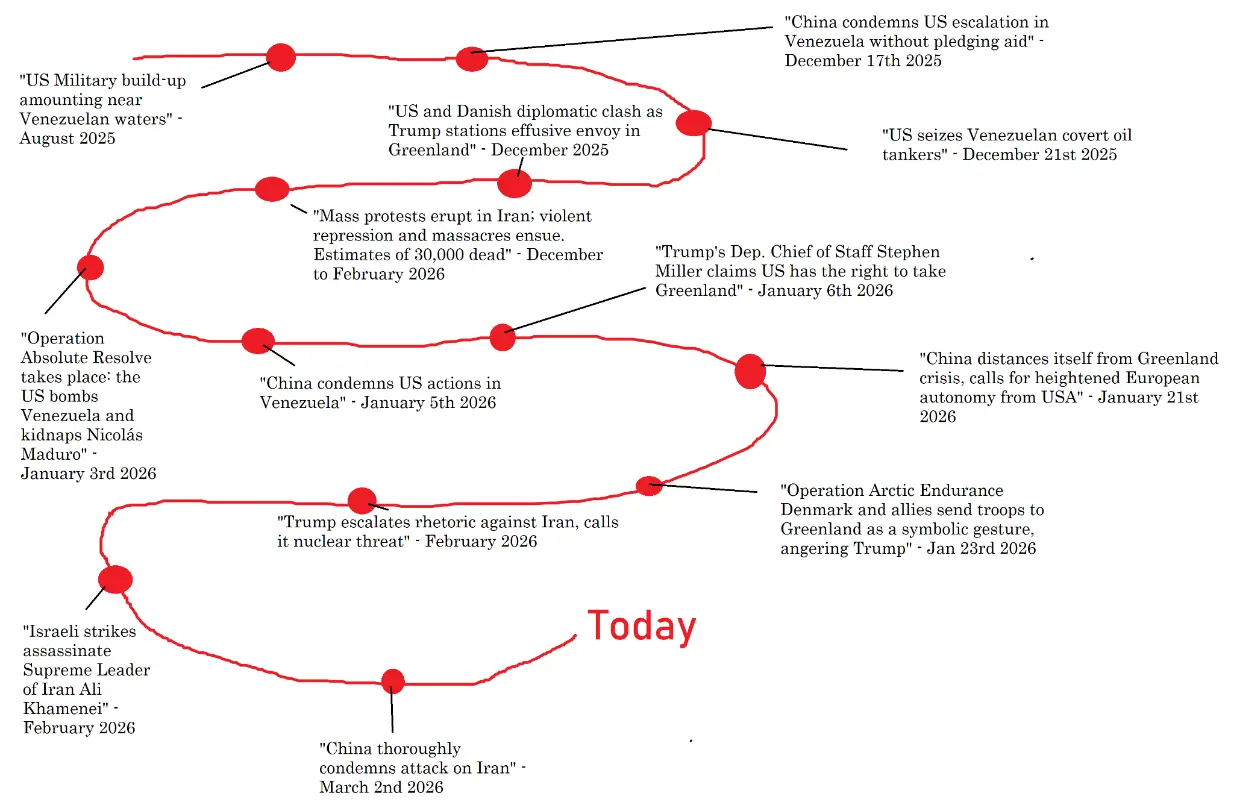
Figure 1: Timeline of US actions in Venezuela, Greenland and Iran, and Chinese Reactions
Reactions by the People’s Republic of China to American operations in Venezuela
To understand Beijing’s reaction to the US seizure of Nicolás Maduro, it is first necessary to situate China within the broader bilateral relationship. Venezuela and the PRC have maintained diplomatic relations since 1974, but these ties deepened dramatically following Hugo Chávez’s election in 1999. Chinese policy banks loaned more to Venezuela than any other Latin American country; at least $10 billion in Chinese bank loans is outstanding (Federici et al., 2026). Beyond financial assistance, the relationship rests primarily on oil. Chinese imports of Venezuelan crude allegedly reached more than 150,000 barrels per day in 2024, representing roughly 3 percent of China’s total seaborne crude imports (Downs & Palacios, 2026).
Against this backdrop, China’s reaction to the US operation was swift and sharp in tone. Within hours of Trump’s announcement that Maduro and his wife had been “flown out of the country, Beijing issued its first formal statement. A Chinese Foreign Ministry spokesperson declared that China was “deeply shocked by and strongly condemns the US’s blatant use of force against a sovereign state and action against its president” (Global Times, 2026), adding that such “hegemonic acts seriously violate international law and Venezuela’s sovereignty, and threaten peace and security in Latin America and the Caribbean region” (id.).
A follow-up statement the next day by Lin Jian of the Chinese Foreign Ministry called on Washington to “ensure the personal safety of Maduro and his wife, release them at once, stop toppling the government of Venezuela, and resolve issues through dialogue and negotiation” (PRCMFA, 2026a). The rapidity of the dual-statement response is notable. By contrast, Chinese Foreign Minister Wang Yi’s remarks, delivered during a visit to Pakistan, reinforced the rhetorical offensive: Wang stated that China “never believed that any country can play the role of world policeman,” adding that no country had the right to “claim itself to be an international judge” (PRC, 2026).
PRC Reactions to US Rhetoric on Greenland
Even considering the severity of the capture of another nation’s head of state, Beijing’s response to the Greenland crisis was notably more measured than its reaction to the seizure of Maduro. This reflected a key asymmetry: while China has deep material and strategic stakes in Venezuela, its relationship with Greenland is primarily one of economic aspiration rather than established interest. China has, since 2018, officially designated itself a “near-Arctic state,” integrating the region into its Belt and Road Initiative under the banner of a “Polar Silk Road,” and becoming involved in resource extraction ventures (Descamps, 2019).
Trump’s repeated framing of Greenland as a bulwark against Chinese and Russian encroachment drew swift but carefully worded rebukes from the Foreign Ministry. Spokesperson Mao Ning stated that China’s Arctic activities “are aimed at promoting peace, stability, and sustainable development in the region and are in accordance with international law,” and that “the United States should not pursue its own interests by using other countries as a pretext” (PRCMFA, 2026b).
PRC Reactions to US attacks on Iran
China and Iran’s relationship rests on a formal “comprehensive strategic partnership” established in 2021 (Ayres et al., 2026) and deepened through a 25-year cooperation agreement signed in 2021, covering economic, security, and technological collaboration. The relationship is structurally asymmetric: Iran depends on China far more than China depends on Iran (García-Herrero, 2026), not least because Beijing maintains parallel commercial ties with Saudi Arabia and the UAE, each accounting for roughly $108 billion with each country in two-way trade in 2025, compared to $41.2 billion with Iran (Ayres et al., 2026). This asymmetry goes some way toward explaining Beijing’s mellow response when US and Israeli forces launched Operation Epic Fury on 28th of February 2026.
China’s initial reaction was notably hesitant and restrained (Ghiselli, 2026). Two days into the war, during a regular Foreign Ministry press conference, business continued as normal, as though the US and Israel had not just attacked one of China’s comprehensive strategic partners. Only when an Iranian journalist protested directly did the ministry spokesperson reluctantly issue a condemnation (Yang, 2026). Foreign Minister Wang Yi stated that the “blatant attack and killing of a leader of a sovereign state and incitement to regime change are unacceptable” (Reuters, 2026a), and that the strikes, launched while US-Iran negotiations were ongoing, violated international law. Wang also told his Israeli counterpart directly that China “opposes any military strikes launched by Israel and the US against Iran” and that “force cannot truly solve problems” (Reuters, 2026b). On March 2, the Foreign Ministry issued its first explicit condemnation in relation to the killing of Ali Khamenei, stating it “firmly opposes and strongly condemns” the attack (PRCMFA, 2026c).
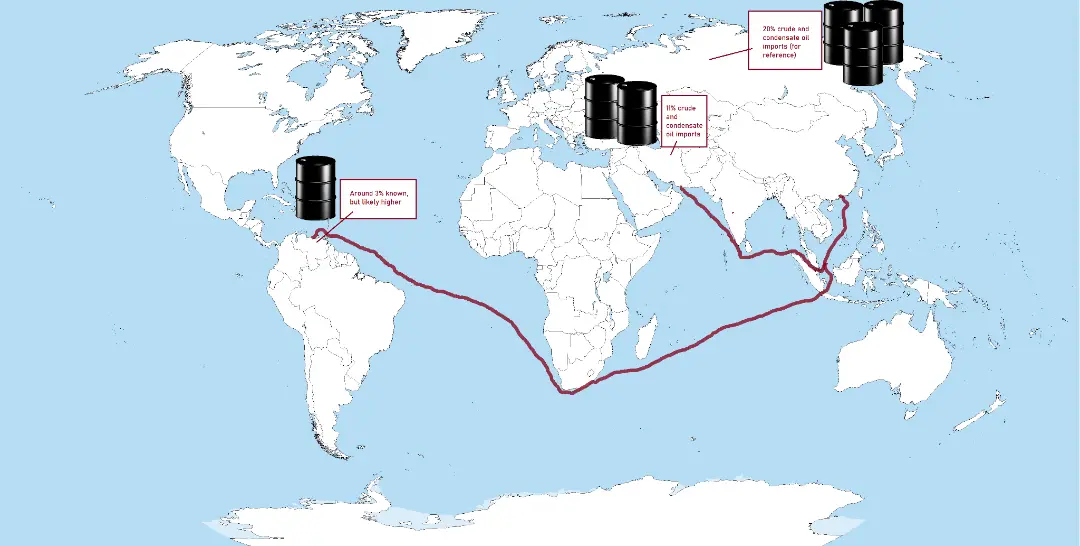
Figure 2: Percentage of Chinese crude oil imports from Venezuela and Iran. Russia for reference. Numbers likely lower than reality due to undeclared trade, source: https://www.visualcapitalist.com/mapped-where-china-gets-its-oil/
Chinese Strategic Reactions: Beneath the Surface
On Venezuela
For all the vigour of Beijing’s rhetoric, analysts were largely in agreement that China’s response would remain confined to the diplomatic domain. China Market Research Group founder Shaun Rein told Al Jazeera that Beijing is “deeply alarmed but constrained,” noting that China “doesn’t have the military power” to act beyond proclamations, maintains only two overseas military bases compared to America’s approximately 800, and is “historically not warlike” (Al-Jazeera, 2026a). Scholarly analysis points to a more calculating dimension behind the public condemnations. Experts cited by NBC News argued that Beijing was less concerned about any direct parallel to Taiwan and more focused on exploiting the episode to undermine US global leadership (Frayer & Jett, 2026), casting itself as the authentic champion of the rules-based international order at a moment when Washington was visibly dismantling it. The Soufan Centre noted that Beijing would likely continue to frame US actions in Venezuela as proof that the Western ‘rules-based order’ serves only American interests, using this narrative to consolidate political support across the Global South (Soufan Center, 2026). Carnegie Endowment scholar Tong Zhao, meanwhile, offered a more sobering reading of China’s internal calculus: Chinese analysts were drawing the lesson that “the United States may often appear a paper tiger, but its fangs can still bite” (Zhao, 2026), noting that “in a world where major powers more openly operate on the principle that might makes right, China must further prioritise the accumulation and readiness of hard power” (id.).
On Greenland:
What is analytically significant about China’s Greenland response is what it reveals about Beijing’s broader posture amid US aggression. Rather than issuing the kind of sharp, multi-statement condemnation reserved for Venezuela, China treated the Greenland crisis primarily as an opportunity to reinforce its image as a defender of international law and sovereignty norms, while allowing the fractures within NATO to deepen on their own.
On Iran:
The gap between rhetoric and action is impossible to ignore. China called for restraint (Khaliq, 2026), evacuated its 3,000 citizens from Iranian territory (Y. Zhao, 2026), but undertook no action that would disrupt the United States’ ability to operate militarily in Iran. MERICS analyst Claus Soong noted that China’s geopolitical and economic stakes in Iran “are simply not high enough for Beijing to risk jeopardising manageable relations with Washington and Gulf states,” adding that Beijing’s muted response shows “the limits of its influence and ideological convictions in the face of its economic and geopolitical calculations” (MERICS, 2026). The timing of the now rescheduled Trump-Xi summit in Beijing (Macao News, 2026), might have provided an additional structural disincentive to escalation.
On the nuclear dimension, Beijing’s position reflects a longstanding tension. Chinese officials publicly oppose Iran acquiring nuclear weapons, viewing a nuclear-armed Iran as a potential trigger for regional war that would risk blocking vital shipping lanes and threatening Gulf states where China’s commercial interests far outweigh its ties with Tehran (Ayres et al., 2026). This concern had pre-existing institutional expression: China had supported the JCPOA framework and, alongside Russia, resisted the snapback of UN sanctions triggered by France, Germany, and the UK in August 2025 over Iran’s non-compliance (Loft & Mills, 2025), arguing the mechanism had not been legally activated. The strikes thus placed Beijing in the uncomfortable position of defending a partner whose nuclear behaviour it privately found destabilising.
What the US’s military ventures mean strategically for China
The cumulative picture that emerges from China’s reactions to Venezuela, Greenland, and Iran is one of a power that has chosen patience over provocation and narrative over action. Each episode of US belligerence has handed Beijing a ready-made argument: that Washington is an unreliable, law-breaking hegemon, while China offers a stable and principled alternative. The more consistently the US acts unilaterally, the more credibly China can position itself as the defender of the multilateral order it once viewed with suspicion.
Scholars have posited that, amid the chaos, Beijing may try to position itself as a trusty mediator, as it did during disputes between Iran and Saudi Arabia, or Cambodia and Thailand. As the US pushes towards chaos and unpredictability, China accelerates its domestic strength through technology, industry and military investment (Miller & Clark, 2026). Further, there has been a noticeable shift in the relations between Europe and China, which, although not by any means amiable, have seen considerable improvements; the US’s belligerence under Trump is undoubtedly doing much to push Europe towards China as a more reliable superpower partner (Wei, 2026).
This is not simply the case for Europe, either. As Washington embraces a jingoist approach to International Politics, its image as a reliable pillar of international peace is fading. China is now closer than ever to a US which is only rich enough to hold the international markets and supply chains away from collapse, but too unstable and unreliable to truly prevent China’s consolidation as a major player – and perhaps the major player – on the international stage (Zongyuan, 2026).
Conclusion
To some, China’s reactions to the recent belligerency of the United States might come as a surprise. After all, Beijing has no shortage of diplomatic points of tension on its own turf, so it would make sense to expect a country typically opposed to the Western-led international order to capitalise more sharply on its collapse. However, the exact opposite seems to be taking place. Instead of utilising the smoke and confusion caused by the US’s unpredictable foreign policy under Donald Trump, the PRC has instead chosen to remain loyal to restraint and diplomacy. Despite experts’ predictions that a Chinese invasion of Taiwan has been imminent for years, it has kept relatively ‘still’ as the US has conducted offensive after offensive since Trump took office.
The likely assumption to be drawn from China’s analysed reactions in this paper is that it hopes to replace Washington as the world leader in diplomacy and trade. Undoubtedly, American efforts will hardly help in making friends. The US has shown itself to be erratic and unreliable, not necessarily and simply because of Trump, but because its promises can turn out to mean very little every four years. This is not to say the ‘Middle Kingdom’ will have it easy from here on out: after all, the US has struck some of its most valuable partners regarding energy and fuel trade. As the world moves towards battery-powered energy sources, which require many of the rare earth minerals profusely found in China, only time will decidedly tell whether recent American efforts will destabilise China or crown it as the new leader of the peace-desiring world.
Reference List
Ahmed, M. (2026). The Politics of Kidnapping: U.S. Intervention and the Detention of Venezuela’s President Nicolás Maduro-Implications for International Law and State Sovereignty. SSRN Electronic Journal. https://doi.org/10.2139/ssrn.6036036
Amer, R., & Li, J. (2018, November 30). Xi’s Visit to the Philippines: Implications for China-Philippine Relations. China-US Focus: Foreign Policy. https://www.chinausfocus.com/foreign-policy/xis-visit-to-the-philippines–implications-for-china-philippine-relations
Al-Jazeera. (2026a, January 4). China urges US to ‘stop toppling’ Venezuelan government, release Maduro. https://www.aljazeera.com/news/2026/1/4/china-urges-us-to-stop-toppling-venezuelan-government-release-maduro
Al-Jazeera.. (2026b, February 28). US, Israel bomb Iran: A timeline of talks and threats leading up to attacks. Al-Jazeera. https://www.aljazeera.com/news/2026/2/28/us-israel-bomb-iran-a-timeline-of-talks-and-threats-leading-up-to-attacks
Ayres, G., Federici, J., Morgret, N., Burton, R., & Tsering, L. (2026). China-Iran Fact Sheet: A Short Primer on the Relationship. USCC. https://www.uscc.gov/sites/default/files/2026-03/China-Iran_Fact_Sheet_A_Short_Primer_on_the_Relationship.pdf
Böller, F., & Wiedekind, J. (2025a). The Declining Reliability of U.S. Foreign Policy and its Domestic Sources Under Trump II. Zeitschrift Für Außen- Und Sicherheitspolitik, 18(4), 577–587. https://doi.org/10.1007/s12399-025-01075-0
Böller, F., & Wiedekind, J. (2025b). The Declining Reliability of U.S. Foreign Policy and its Domestic Sources Under Trump II. Zeitschrift Für Außen- Und Sicherheitspolitik, 18(4), 577–587. https://doi.org/10.1007/s12399-025-01075-0
Burke, J. (2026, March 1). ‘Sixty seconds, that’s all it took’: The clinical Israeli-US operation to kill Ali Khamenei. The Guardian. https://www.theguardian.com/world/2026/mar/01/how-israeli-sleight-and-us-might-led-to-the-assassination-of-ali-khamenei
Chen, Y.-J. (2022). “One China” Contention in China–Taiwan Relations: Law, Politics and Identity. The China Quarterly, 252, 1025–1044. https://doi.org/10.1017/S0305741022001333
Curtis, J. (2026). The US capture of Nicolás Maduro. UK Parliament. https://commonslibrary.parliament.uk/research-briefings/cbp-10452/
Descamps, M. (2019, February). The Ice Silk Road: Is China a “Near-Arctic-State”? Institute for Security & Development Policy. https://www.isdp.eu/publication/the-ice-silk-road-is-china-a-near-artic-state/
Downs, E., & Palacios, L. (2026, January 7). US Action Threatens Venezuela-China Oil Flows, Debt Repayment, and Investments. https://www.energypolicy.columbia.edu/venezuela-china-oil-ties-severely-impacted-by-us-action/
Federici, J., Morgret, N., Gordon, B., & Ayres, G. (2026). China-Venezuela Fact Sheet: A Short Primer on the Relationship. https://www.uscc.gov/sites/default/files/2026-01/China_Venezuela_Fact_Sheet_A_Short_Primer_0.pdf
Fitzgerald, J. (2026, January 22). Why does Trump want Greenland and what could it mean for Nato and the EU? BBC News. https://www.bbc.com/news/articles/c74x4m71pmjo
Frayer, J. M., & Jett, J. (2026, January 5). China condemns Maduro capture, but some see it as a chance to assert its global position. https://www.nbcnews.com/world/asia/china-maduro-capture-venezuela-taiwan-global-power-rcna252283
García-Herrero, A. (2026). What the war in Iran means for China. Analysis 2026. https://doi.org/10.64153/KOIY6053
Ghiselli, A. (2026, March 25). Regime Survival and International Implications: China’s Perspective on the Iran Crisis. The ChinaMed Project. https://chinaglobalsouth.com/analysis/china-stance-iran-war-analysis/
Global Times. (2026, January 3). China is deeply shocked by and strongly condemns the US’ blatant use of force against a sovereign state and action against its president: Chinese FM Spokesperson [Video recording]. https://www.globaltimes.cn/page/202601/1352147.shtml
Jack, V. (2026, February 13). NATO stronger than ever after Greenland crisis, Rutte says. Politico. https://www.politico.eu/article/nato-stronger-than-ever-after-greenland-crisis-abates-mark-rutte-says/
Khaliq, R. ul. (2026, February 26). China urges restraint, dialogue between US, Iran. https://www.aa.com.tr/en/asia-pacific/china-urges-restraint-dialogue-between-us-iran/3840692
Lee, M., Burrows, E., & Moulson, G. (2026, February 14). Rubio’s speech to European allies takes a softer tone but sticks to Trump’s firm stance. Associated Press News. https://apnews.com/article/munich-security-conference-rubio-4a26cfa8ebb54643be98405e896433d1
Loft, P., & Mills, C. (2025). The E3 triggers snapback sanctions against Iran 2025. UK Parliament. https://commonslibrary.parliament.uk/research-briefings/cbp-10330/
Macao News. (2026, March 26). Trump-Xi Beijing summit pushed to May amid Iran war. https://macaonews.org/news/politics/trump-xi-summit-delay-iran-war/
MERICS. (2026, March 12). China and the war in Iran + The new Five-Year Plan + NPC outcomes. MERICS Briefs: China Essentials. https://merics.org/en/merics-briefs/china-and-war-iran-new-five-year-plan-npc-outcomes
Miller, A. P., & Clark, M. (2026, April 17). The Iran War Is a Win for China. https://www.foreignaffairs.com/united-states/iran-war-win-china
Murphy, D. (2024). China’s rise in the Global South: The Middle East, Africa, and Beijing’s alternative world order (First paperback printing). Stanford University Press.
Nasrat, K. (Qaisar). (2026). THE US CAPTURE OF MADURO IN VENEZUELA: AN ASSESSMENT UNDER INTERNATIONAL LAW. Selcuk Universitesi Hukuk Fakultesi Dergisi, 34(1), 247–272. https://doi.org/10.15337/suhfd.1877771
Nye, J. S. (2023). Soft Power and Great-Power Competition: Shifting Sands in the Balance of Power Between the United States and China. Springer.
Okplewu, I. (2026). Head of State Immunity at the Mercy of Political Recognition? The Capture of Nicolás Maduro and the Limits of Non-recognition in International Law. SSRN. https://doi.org/10.2139/ssrn.6116006
PRC. (2026, January 4). Chinese FM on Venezuela situation: China always opposes imposing one country’s will on another. https://english.www.gov.cn/news/202601/05/content_WS695b1e77c6d00ca5f9a0868d.html
PRCMFA. (2026a, January 5). Foreign Ministry Spokesperson Lin Jian’s Regular Press Conference on January 5, 2026. https://ma.china-embassy.gov.cn/eng/fyrth/202601/t20260105_11806736.htm
PRCMFA. (2026b, January 12). Foreign Ministry Spokesperson Mao Ning’s Regular Press Conference on January 12, 2026. https://ir.china-embassy.gov.cn/eng/fyrth/202601/t20260112_11811345.htm
PRCMFA. (2026c, March 1). Foreign Ministry Spokesperson’s Remarks on the Killing of Iran’s Supreme Leader Ayatollah Ali Khamenei. https://www.fmprc.gov.cn/eng/xw/fyrbt/202603/t20260301_11866722.html
Reuters. (2026a, March 1). China condemns attacks on Iran, urges ceasefire and talks. https://www.reuters.com/world/asia-pacific/china-urges-immediate-ceasefire-after-us-israel-strike-iran-2026-03-01/
Reuters. (2026b, March 3). China’s foreign minister tells Israeli counterpart that attacks on Iran must end. https://www.reuters.com/world/china/chinas-foreign-minister-tells-israeli-counterpart-that-attacks-iran-must-end-2026-03-03/
Rogers, K. (2026, January 6). Stephen Miller Offers a Strongman’s View of the World. The New York Times. https://www.nytimes.com/2026/01/06/us/politics/stephen-miller-foreign-policy.html
Sato, K. (2019). The Senkaku Islands Dispute: Four Reasons of the Chinese Offensive – A Japanese View. Journal of Contemporary East Asia Studies, 8(1), 50–82. https://doi.org/10.1080/24761028.2019.1626567
Soufan Center. (2026, January 16). Venezuela’s Impact on Beijing’s Global Ambitions. https://thesoufancenter.org/intelbrief-2026-january-16/
UNHROHC. (2026, February 20). Iran: UN experts demand transparency and accountability following nationwide protests. https://www.ohchr.org/en/press-releases/2026/02/iran-un-experts-demand-transparency-and-accountability-following-nationwide
Verma, R. (2024). India–China rivalry, border dispute, border standoffs, and crises. India Review, 23(5), 397–408. https://doi.org/10.1080/14736489.2024.2423996
Wei, D. (2026, April 17). Europe Still Needs China. https://www.foreignaffairs.com/china/europe-still-needs-china
Williams, R. D. (2020). INTERNATIONAL LAW WITH CHINESE CHARACTERISTICS: BEIJING AND THE “RULES-BASED” GLOBAL ORDER. Global China. /api/wp-media/2020/10/FP_20201012_international_law_china_williams.pdf
Wilson, T. (2026, January 30). Trump tells Iran to drop nuclear aims and stop killing protesters to avoid military action. BBC News. https://www.bbc.com/news/articles/c394ymdpjwvo
Yang, X. (2026, March 19). China’s silence on Iran reveals its true priorities. https://www.aljazeera.com/opinions/2026/3/19/chinas-silence-on-iran-reveals-its-true-priorities
Zhang, F. (2018). Is Southeast Asia Really Balancing against China? The Washington Quarterly, 41(3), 191–204. https://doi.org/10.1080/0163660X.2018.1520573
Zhao, T. (2026, January 7). The U.S. Venezuela Operation Will Harden China’s Security Calculation. Carnegie Endowment. https://carnegieendowment.org/emissary/2026/01/china-venezuela-taiwan-trump-security
Zhao, Y. (2026, March 3). Majority of Chinese citizens have evacuated from Iran: Local Chinese association. https://www.globaltimes.cn/page/202603/1356185.shtml
Zongyuan, Z. L. (2026, March 30). What the Iran War Means for China. https://www.foreignaffairs.com/china/what-iran-war-means-china


