
Key Takeaways:
- DPPA’s repeated failure to meet its own funding target shows that voluntary financing leaves preventive diplomacy structurally more exposed than reactive diplomacy, and that assessing military and peacekeeping spending is difficult.
- The modest shortfalls have consequences, constraining mediation deployment and liaison presence in active crises such as Sudan and Ukraine, despite the department’s budget being a fraction of individual national defense line items.
- A Department Understrain
The Department of Political and Peacebuilding Affairs (DPPA) is the United Nations body most directly responsible for preventive diplomacy, mediation and early warning of conflict. Unlike peacekeeping operations, which have fixed budgets funded through mandatory assessed contributions billed to member states, DPPA relies on the voluntary Multi-Year Appeal (MYA) to fund its core conflict prevention and rapid-response infrastructure (UN DPPA, 2026). This difference matters. Assessed contributions are predictable, whereas voluntary pledges depend on donors’ willingness to give and the timing of their decisions. The MYA was established to bypass the delays of the regular budget and respond quickly to emerging political crises. In principle, this allows the department to deploy mediators and early warning capacity as a situation deteriorates, rather than waiting for the next budget cycle. Yet the design carries a clear tension. A mechanism intended for speed depends on funding that is not guaranteed, so the flexibility that makes it useful also makes it vulnerable. The evidence points to this vulnerability. The MYA has missed its own target in each of the last two years for which data are available. Such a pattern suggests a structural feature of voluntary financing rather than a one-off event. Shortfalls of this kind would constrain the infrastructure DPPA can maintain in advance, reducing its capacity to act when early intervention is most valuable.
In 2023, DPPA appealed for $41 million and received $31.1 million, a shortfall of 24%. In 2024, the appeal rose to $42 million, but receipts fell to $28.9 million from 35 partners. That was 8% less than in 2023 and again well below target (UN DPPA, 2026). The appeal now stands at $43 million, so the gap between what DPPA seeks and what it receives has not yet closed.
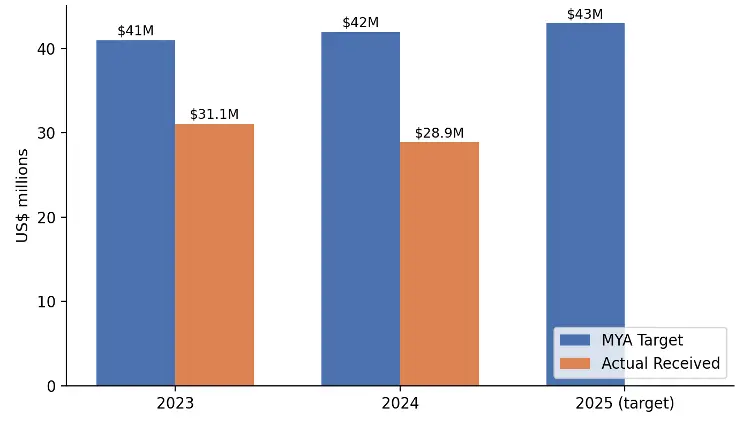
Figure 1: DPPA Multi-Year Appeal target versus actual funding received in 2023-2025.
To put the sums in perspective, consider the 2024 shortfall of roughly $13 million. That figure is less than the flyaway cost of a single F-35A fighter jet, which runs at approximately $82.5 million before its engine is added (Air & Space Forces Magazine, 2025). The comparison shows the scale of the problem. DPPA’s entire annual appeal is a rounding error set against individual line items in the national defence budget. On these numbers, the size of the appeal alone does not explain the gap. Yet the department has missed its own modest target in back-to-back years. The question this raises is therefore not whether the sums could be found, but why a relatively small target has proved difficult to meet twice in succession. Put differently, the obstacle is unlikely to be one of affordability. It is more plausibly one of priority, and of the way contributions to prevention are decided. A funding model that depends on member states choosing, year after year, to contribute is exposed to every shift in their domestic agendas. Small sums are also easy to postpone, because no single contributor needs to feel responsible for the gap as a whole. The 2024 figures illustrate this. Receipts of $28.9 million came from 35 partners, which means the shortfall was not the result of one donor withdrawing, but of many contributions that together fell short. A gap of this kind has no obvious owner, and that is precisely what makes it so persistent.
These shortfalls are real and factual, and their consequences are concrete. When funding falls short, the effects reach the field directly: diplomatic deployments are cancelled, the recruitment of thematic experts is delayed, and the operational scope of the regional political mission is constrained (UN DPPA, 2026). These effects compound one another, because each cancelled deployment or unfilled post reduces the capacity available for the next task. The result is not a single dramatic failure but a gradual erosion of readiness. A deployment that does not take place today may mean that the relationships and local knowledge needed for the next crisis are never built. A thematic expert who is not recruited cannot be called upon when a request arrives. In this sense, the cost of a shortfall is not limited to the year in which it occurs; it is carried forward into the following years in the form of capacity that was never developed.
Each of these effects may appear minor when viewed in isolation. A cancelled trip or a vacancy left open for a few months rarely attracts attention outside the department itself. Taken together, however, they shape what the UN is able to do when a political crisis begins to unfold. Preventive diplomacy depends on being present early, on knowing whom to call and on having the expertise ready to support a process before positions harden. It is exactly this kind of groundwork that is most easily cut when funds run short, and exactly this groundwork that is hardest to replace at short notice.
The strain on shared capacity is visible in the work of DPPA’s Standby Team of Senior Mediation Advisers. This team, which can deploy within 72 hours, carried out 148 operational support assignments in 2024 alone. That workload depletes MYA resources precisely when they are needed most (United Nations Peacemaker, 2026). Support given to one assignment is therefore support unavailable for another. The figure of 148 assignments also says something about how the department works. Much of its value lies in being able to respond at short notice, sending experienced advisers to support negotiations or political processes as they unfold. That kind of responsiveness depends on resources being available before a request arrives, not raised afterwards. When the same pool of funding must cover a growing number of assignments, each new request competes with the others, and the department risks being pushed towards choosing which processes to support rather than responding to all that ask.
Demand, meanwhile, is rising faster than funding. In 2024, DPPA received 28 new requests for technical electoral assistance, a 75% increase over 2023, even as the money available to meet that demand fell (UN DPPA, 2026). Growing need set against shrinking resources explains why these shortfalls amount to a structural constraint on the mission’s work rather than a temporary inconvenience. A temporary inconvenience can be absorbed by postponing activities until funds arrive. A structural constraint cannot, because the demand does not wait. Electoral timetables, ceasefire talks and political transitions follow their own calendars, and support that arrives late may arrive too late to matter. For a department whose purpose is to act early, that difference is decisive.
Not just a budget line, but a Mismatch in priorities
Global military expenditure reached an estimated $2.9 trillion in 2025, its eleventh consecutive year of growth (Stockholm International Peace Research Institute (SIPRI), 2025). Over the same period, funding for the UN body most directly responsible for preventing conflict before it starts has declined. Taken on its own, this trend is not evidence that preventive diplomacy has failed, nor that underfunding it is the cause of rising global instability. That would be a harder causal claim than the evidence supports. The more precise conclusion is that the two trends point to a mismatch in how the international community allocates its resources. Reactive spending is treated as a non-negotiable national priority. Military budgets are defended in legislatures, protected in fiscal planning and renewed year after year as a matter of course. Preventive spending, by contrast, is commonly regarded as discretionary and voluntary, so it is the first to be trimmed when budgets tighten. This asymmetry matters because the costs of inaction are delayed and diffuse, whereas the benefits of prevention are, by definition, largely invisible: a crisis that never occurs leaves no record of its own. Institutions that work well are rarely credited for the disasters they avert, which makes them difficult to justify in budget debates. Recognising this bias is the first step towards correcting it. The question is therefore not simply how much the international community spends, but how it chooses where that spending goes, and whether those choices reflect a realistic assessment of where security is most cheaply secured.
The comparison with military spending is not meant to suggest that the two should be weighed directly against each other, or that resources should simply be moved from one to the other. Defence and diplomacy serve different purposes, and both have a place in a realistic security policy. The point is narrower: what states are willing to commit when security is framed as defence stands in sharp contrast with what they are willing to commit when it is framed as prevention. Against expenditure measured in trillions, the sums needed to meet DPPA’s target are marginal, and it is precisely this contrast that makes the repeated shortfall so revealing.
The same asymmetry is visible within the UN system itself. Peacekeeping operations are financed through mandatory assessed contributions, which member states are billed for and which give missions a predictable budget. DPPA’s core conflict prevention work, by contrast, depends on voluntary pledges to the MYA. The organisation therefore funds the management of conflicts that have already broken out on a firmer basis than the work intended to stop them from breaking out in the first place. This is not necessarily the result of a deliberate choice, but it reflects the same pattern: what is reactive is treated as an obligation, while what is preventive is treated as optional.
Two more examples illustrate what that mismatch costs in practice. In Kyiv, DPPA’s liaison office has fed field assessment directly into more than 100 Security Council briefing papers in a single year, showing how on-the-ground analysis can reach the Council when staff are in place to gather and transmit it. Such analysis matters because Council members rarely have their own independent view of developments in the field, and decisions taken in New York are only as good as the information on which they are based. The situation in Sudan shows the cost of losing that capacity. When the UN Integrated Transition Assistance Mission (UNITAMS) closed abruptly in 2023, MYA funding enabled the Secretary-General’s Special Envoy to retain staffing and analytical capacity to continue mediating between factions. The alternative was a complete withdrawal of the UN’s political presence from an active crisis, so funding determined not merely how efficiently the UN worked but whether it remained engaged at all. Flexibility is what allows such decisions to be made quickly. Around 70% of MYA funding is unearmarked, which gives DPPA the freedom to redirect resources to wherever a crisis emerges next (UN DPPA, 2026). Because unearmarked money cannot be assigned in advance to a single mission, it can follow priorities as they change. That freedom is easy to overlook when funds are plentiful, yet it is precisely what makes a rapid response possible. The implication is straightforward: as the funding pool shrinks, so does that flexibility, leaving less room to respond to emerging crises. Earmarked contributions still have value, but they tie resources to purposes defined in advance by donors. When the overall pool contracts, the share that can be moved freely is the part the department can least afford to lose.
Both cases point to the same lesson: political presence, once lost, is difficult to rebuild. Staff who understand the actors, the history and the dynamics of a conflict represent an investment that cannot easily be replaced once they are withdrawn. Maintaining that presence through periods of uncertainty is therefore not a secondary administrative matter but a precondition for the UN to play any role at all when an opening for mediation appears. Seen this way, flexible funding is not a luxury but the mechanism that allows the department to stay engaged where it matters, and for as long as it matters.
A realistic critique deserves serious attention. Successful diplomacy often produces an absence of events, and a crisis that never escalates leaves little visible evidence of the work that prevented it. For that reason, the return on investment in preventive diplomacy is inherently hard to demonstrate. The critique goes further: the effectiveness of DPPA is in any case bounded by Security Council consensus, and no amount of funding can buy political space that a veto-wielding power is unwilling to grant. Money cannot substitute for political will among those who hold the decisive votes. This objection is well founded and should not be dismissed. A well-funded department working without political backing will still struggle to influence the course of a conflict, and additional resources cannot resolve divisions among the permanent members of the Security Council.
Yet this limitation applies mainly to the political dimension of the work, not to its economic rationale. Set against the critique is the joint study Pathways for Peace by the World Bank and the United Nations, which estimates that a coordinated global increase in preventive diplomacy could save $5-70 billion per year in post-conflict clean-up, humanitarian response and reconstruction costs (United Nations & World Bank, 2018). The range is wide, and its precision should be treated with caution, but even its lower bound points in one direction: the cost of prevention is small when compared with the sums that follow when conflicts become entrenched. Whatever the political limits on DPPA’s effectiveness at the margins, the financial case for funding its core work is not seriously in dispute. Recognising both points allows a more honest debate, one focused less on whether prevention pays than on how political constraints can be navigated so that funding is converted into results. The two arguments should therefore not be played off against each other. The political limits on prevention are a reason to use resources carefully and strategically, not a reason to withhold them. Even the lower end of the Pathways for Peace estimate, at $5 billion per year, is more than a hundred times larger than DPPA’s current appeal of $43 million. Seen against that ratio, the debate over whether the department should receive its full target appears less like a question of affordability and more like one of political attention.
A Shrinking Space for Diplomacy
In his 2025 UN80 progress briefing, Secretary-General António Guterres warned that the rising number of conflicts, deepening geopolitical divisions, and growing impunity for violations of international law are narrowing the political space available for mediation and diplomacy (United Nations Secretary-General, 2026). The 2026 Global Peace Index gives that warning a number: global peacefulness declined for a twelfth consecutive year, with more active interstate wars underway than at any point since the Second World War, and the number of countries involved in at least one external conflict rising from 59 in 2008 to 103 today (Institute for Economics and Peace, 2026).
These trends cut in two directions. On the one hand, a more crowded and more polarised conflict landscape increases the need for mediation, early warning and sustained political engagement. On the other hand, it makes that work harder, as divisions among major powers reduce the room for agreement in multilateral forums. The result is a period in which preventive diplomacy is both more necessary and more difficult to conduct. Under such conditions, the margin for error narrows, and a department that must first secure its own funding before it can respond is placed at a further disadvantage. It is, in effect, asked to respond to a growing problem with a shrinking set of tools.
Political frameworks such as the Pact for the Future (United Nations, 2024) and Security Council Resolution 2788 (United Nations Security Council, 2025) commit member states, in principle, to strengthening mediation and preventive diplomacy. Such commitments set shared priorities, but a priority is only as strong as the resources behind it. Mediation and preventive work depend on skilled staff and sustained attention, which cannot be assembled quickly once a crisis has begun. The open question is therefore whether those commitments translate into funding that DPPA can actually plan around, rather than a target it misses year after year. Predictable financing would let the department build capacity in advance, whereas a repeatedly missed target suggests that political language has not yet been matched by budgetary decisions. The gap between the two is, in this sense, a measure of how seriously the commitments are meant.
There are several ways in which this gap could be narrowed without new institutions. Multi-year pledges, rather than annual ones, would give the department greater certainty about the resources available over time. A larger share of unearmarked funding would preserve the flexibility on which rapid response depends. And a broader base of contributors would reduce the extent to which the appeal rises or falls with the decisions of a small number of donors. None of these measures would resolve the political constraints described above, but each would make it easier for DPPA to plan, staff and deploy in advance rather than in response.
Conclusion
The funding shortfall at the Department of Political and Peacebuilding Affairs (DPPA) is a small case study with a larger implication. In 2023 it fell roughly a quarter short of its funding target, and the gap widened in 2024. The international community’s stated commitment to preventive diplomacy is not yet matched by how it pays for that work. The difficulty is structural. Diplomatic success means wars that never happened, which rarely make headlines and are hard to price. Invisible benefits are easily underfunded, while visible crises demand money urgently, often after the cheaper option has been lost. The DPPA figures make this concrete: three consecutive appeals, rising from $41 million to $43 million, with receipts short each year for which data are available.
This reasoning does not require a sweeping claim about the value of prevention in general, which would be difficult to test. A narrower and more testable claim is available. DPPA is small, its funding is transparent, and it is heavily used when demand for its work is rising. Because its budget is open to scrutiny, the gap between target and actual funding can be measured directly, year by year, rather than inferred from general impressions. Because demand for its services tends to grow during periods of tension, the relationship between need and resources can also be examined against the evidence. In this sense, DPPA offers something close to a test case. If a department of its size, with documented activity and rising demand, cannot secure a modest and transparent target, the explanation is unlikely to lie in the scale of what it asks for. It points instead to the way prevention is valued, or undervalued, in the decisions that shape international budgets. The question is therefore less whether prevention works in principle than whether the international community is prepared to finance the instruments it has already created for that purpose.
Closing this specific gap would be a modest step. The sums involved are small relative to the broader international budget, and the measure would not require new institutions or contested political bargains. It would simply require the community to fund what it has already agreed, on paper, to fund. Critics may argue that budgets are finite and that every shortfall involves trade-offs. That objection deserves a serious answer, but it does not weaken the core point: where a commitment has been made and the cost of meeting it is low, the failure to do so is difficult to justify. For an international community that has repeatedly affirmed the importance of preventing conflict, meeting this target would be a credible first signal that those commitments are meant to be kept.
References
Air & Space Forces Magazine. (2025). New F-35 engine contract puts fighter’s price around $100 million. Air & Space Forces Magazine. https://www.airandspaceforces.com/new-f-35-engine-contract-puts-fighters-price-tag-over-100m/
Institute for Economics and Peace. (2026). Global Peace Index 2026: Measuring peace in a complex world. Institute for Economics and Peace (IEP). https://www.visionofhumanity.org/maps/
Stockholm International Peace Research Institute (SIPRI). (2025). Trends in world military expenditure, 2025 (SIPRI Fact Sheets). Stockholm International Peace Research Institute. https://www.sipri.org/publications/2026/sipri-fact-sheets/trends-world-military-expenditure-2025
United Nations. (2024). Pact for the future: World leaders adopt landmark blueprint for multilateral cooperation (UN Doc. A/RES/79/1). United Nations. https://www.un.org/en/summit-of-the-future/pact-for-the-future
United Nations Department of Political and Peacebuilding Affairs (UN DPPA). (2026). Multi-Year Appeal 2025 Annual Report. United Nations. https://unsco.unmissions.org/sites/default/files/2026-06/MYA%20Annual%20Report%202025.pdf
United Nations Peacemaker. (2026). Standby Team of Senior Mediation Advisers. United Nations. https://peacemaker.un.org/en/mediation-support-unit/standby-team-of-senior-mediation-advisers
United Nations Secretary-General. (2026). UN80 Initiative progress briefing to the Security Council, May 2026. United Nations. https://www.un.org/un80-initiative/en/media/629
United Nations Security Council. (2025). Resolution 2788 (2025) on strengthening mechanisms for the peaceful settlement of disputes (UN Doc. S/RES/2788). United Nations. https://unscr.com/en/resolutions/2788/
United Nations & World Bank. (2018). Pathways for peace: Inclusive approaches to preventing violent conflict. World Bank.