
1. Key Takeaways
- Operation Barkhane demonstrated to the wider international community the importance of legitimacy for foreign interventions to achieve their aims.
- Barkhane’s withdrawal revealed the limitations of military superiority to produce sustainable peace in the Sahel.
- There has been a clear shift in international peacekeeping approaches with the emergence of multipolar security partnerships.
2. From Intervention to Withdrawal
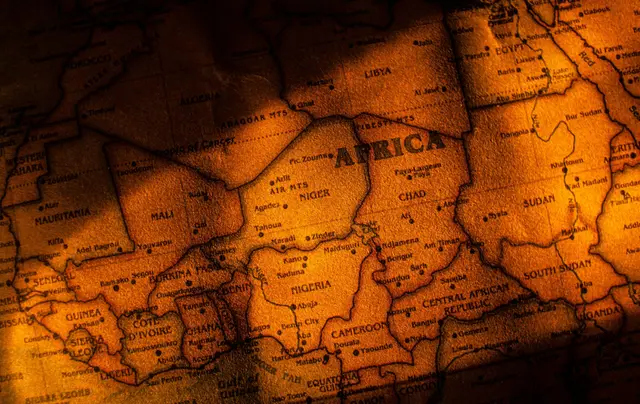
Operation Barkhane (2014–2022) was the largest overseas French military operation, comprising over 5,000 troops across the Sahel Region, including Mali, Niger, Chad, Burkina Faso, and Mauritania, often known as the G5 Sahel. The Operation aimed to neutralise “the terrorist environment present in the Sahel region”, targeting Al-Qaeda structures in the Islamic Maghreb (Olech, 2023, p 1). The scale of the deployment reflected the scale of the ambition: rather than defending a single capital or a single front line, the operation set out to counter armed groups across a vast area of desert, borderlands and weakly governed territory. The French military initially intervened in Mali in 2013 during Operation Serval: Mali’s former interim president Dioncounda Traoré requested French assistance against a coalition of al-Qaeda extremists that had captured key cities in the north such as Konna and advanced on the capital city, Bamako (Flood, 2013). France deployed 4,500 combat troops, successfully repelling the advance. In 2014, owing to the success of Operation Serval, François Hollande, then-President of France, transformed the intervention into a “regional and open-ended military initiative called Operation Barkhane” (Erforth & Tull, 2022).
The transition from Serval to Barkhane was more than a change of name. Serval had been a limited intervention with a clear request from the Malian authorities and an immediate objective: stopping the advance on Bamako. Barkhane, by contrast, extended the French presence across five states and gave it no fixed end point. What had begun as a response to an urgent call for help became a permanent feature of the regional security landscape. This shift would later prove significant, because the basis on which the intervention had first been accepted was not the same as the basis on which it was expected to continue.
Operation Barkhane wasn’t the only mission launched; several other international missions launched in the Sahel soon after including the United Nations Multidimensional Integrated Stabilisation Mission in Mali (MINUSMA), The European Union training missions (EUTM Mali, EUCAP Sahel), as well as the G5 Sahel Joint Force, all of which sought to support the Malian Armed Forces, and further beyond in Burkina Faso, Chad, Mali, Mauritania, and Niger to combat terrorism and cross-border crime (Chikhachev, 2025, p. 385-386; Erforth & Tull, 2022; Sandnes, 2021, p. 2).
The result was a layered model of international engagement. French forces focused on counterterrorism operations, the UN on stabilisation and the protection of civilians, the EU on training and advising national security forces, and the G5 Sahel Joint Force on regional cooperation between the states themselves. In principle, these missions were meant to complement one another. In practice, their mandates overlapped, their priorities did not always align, and the sheer number of external actors made the Sahel one of the most crowded intervention theatres in the world. Even the G5 Sahel Joint Force, conceived as a regional answer to regional threats, remained heavily dependent on external funding and support, which limited its ability to act as a genuinely independent pillar of security. For local populations, the distinctions between these missions were often far less visible than they were in the capitals that designed them.
However, as underscored by Chikhachev (2025, p. 386), it was France that “assumed a pivotal role as the ‘backbone, the supporting structure’ of any military presence in the Sahel and West Africa”. Operation Barkhane eventually concluded in November of 2022 when French troops withdrew from Mali and Burkina Faso. The end of this decade-long operation ushered in a new era in international peacekeeping, shifting away from long-term, large-scale interventions towards regionally driven, diversified security partnerships, with its conclusion marking the failure of Western powers to curb jihadist groups in Africa and inviting the Wagner Group to the forefront of security in the Sahel (Chikhachev, 2025, p. 388, 392; Erforth & Tull, 2022). The arrival of the Wagner Group marked a particularly sharp break with the previous model. Where Barkhane had been embedded, at least formally, in a framework of multilateral cooperation and public accountability, the new arrangements were largely bilateral and far less transparent, raising questions about oversight and the protection of civilians that the previous model, for all its shortcomings, had at least claimed to address.
France’s central role also created a structural dependency. Other international missions relied, directly or indirectly, on French capabilities, intelligence and logistics, which meant that the wider architecture of international engagement rested to a large extent on a single actor. When that actor lost its standing, the entire model was weakened with it.
This article therefore asks what the end of Operation Barkhane reveals about broader changes in international peacekeeping. It argues that the withdrawal was not simply the end of one national mission, but a turning point in three respects: it exposed the importance of political legitimacy for foreign interventions, it revealed the limits of military superiority in producing sustainable peace, and it opened the way for a more fragmented, multipolar security order in the Sahel. Each of these is examined in turn below, before drawing broader conclusions.
3. The Decline in Political Legitimacy
Initially, France pursued a policy of internationalising the intervention, claiming collaboration and French leadership simultaneously. This served both to share the burden and legitimise intervention, working through the UN (MINUSMA), the EU (EUTM, EUCAP Sahel), and bilateral European partners. (Erforth & Tull, 2022). But as Chikhachev (2025) argues, Barkhane increasingly faced rejection because it was seen as “preserving the Françafrique order” (p. 388). Françafrique has come to be known as a pejorative term to describe France’s sphere of influence over its former colonies, particularly in Sub-Saharan Africa (Bovcon, 2013, p. 5). The term matters because it shaped how French actions were interpreted. A foreign military presence in a former colony is rarely judged only by its stated objectives; it is also read against a long history of political, economic and military influence. Each setback, each civilian casualty and each perceived interference in domestic politics could therefore be absorbed into an existing narrative, regardless of the intentions behind it. These neocolonist accusations lost the French “support on the ground”, and with the French position weakening, non-Western players had the opportunity to expand into the Sahel (Chikhachev, 2025, p. 388, 392).
The French experience illustrates that legitimacy operates on two levels. Internationalisation secured legitimacy among partners abroad: it brought UN mandates, European participation and diplomatic support. It did far less to secure legitimacy among the populations and governments in whose territory the intervention took place. An operation can be fully authorised in international forums and still be rejected at home, and it is the second form of legitimacy that ultimately determines whether an intervention can be sustained.
Time also played a role. An intervention that is welcomed as a response to an emergency is judged differently once it has lasted for years without bringing the expected improvement in security. As Barkhane continued, the initial sense of rescue gave way to growing questions about why a foreign military presence was still needed, what it had achieved and whose interests it ultimately served. The open-ended character of the operation, which had been intended to provide flexibility, thus made it increasingly vulnerable to these questions.
This legitimacy crisis was reinforced by French military conduct, especially the Bounti airstrike in Mali, which killed 19 civilians, alongside 3 members of al-Qaeda-linked Katiba Serma. French authorities’ denial of civilian casualties despite MINUSMA verification deepened distrust of French intervention (Staff and agencies in Bamako, 2021). The incident shows that legitimacy depends not only on avoiding harm, but also on how harm is acknowledged when it occurs. Denial in the face of independent verification suggested that accountability applied unevenly, which undermined the very principles of protection and rule of law that international engagement claimed to promote. It also affected international organisations such as MINUSMA, which faced violent protests in 2022 and was increasingly framed as a “vestige of colonial occupation”, allowing Russia and the Wagner Group to portray themselves as alternative security partners (Cope, 2024). This was a striking development, because MINUSMA operated under a distinct UN mandate and was composed largely of contingents from countries outside Europe. That it was nonetheless associated with the colonial past shows how far the crisis of legitimacy had spread beyond France itself. Once international engagement as a whole was seen through this lens, the line between a French operation and a multilateral mission became increasingly blurred in public perception. New partners were able to present themselves as free of this history, offering security assistance framed as respect for sovereignty rather than as external tutelage. Russia, in return, blocked UN resolutions aimed at investigating human rights abuses by Malian security forces and Wagner operatives (United Nations, 2023).
The contest over legitimacy thus became part of a wider geopolitical competition. Once international missions were portrayed as extensions of Western influence, the mechanisms meant to hold all security actors accountable were themselves drawn into that competition. The consequence was not only a loss of trust in France, but a weakening of the multilateral framework through which abuses by any actor could be investigated.
4. The Shift Towards Multipolar Security
Despite significant success through the elimination of Islamic militant leaders Abdelmalek Droukdel in 2020 and Adnan Abu Walid al-Sahrawi in 2021 (Marot, 2020; Ahmed, 2022), political violence persisted across the Sahel (Alexander, 2024). These operations demonstrated considerable military capability, yet they did not translate into lasting security. Armed groups were able to replace their leaders and adapt their structures, and the conditions that allowed them to recruit remained largely in place. Tactical success, in other words, did not amount to strategic success. Military coups seized the Sahel region, including Mali, Burkina Faso, Chad, Guinea, and Niger, and without parallel institutional reforms guaranteeing legitimate governance, external security alone could not secure the region (Muvunyi, 2023; Usman, 2023).
The coups are significant for the argument of this article because they show that the central problem in the region was not only one of security, but of governance. Where state institutions lacked credibility, external military support could not substitute for it. In several cases, the new military governments were also able to draw on growing frustration with the French presence, turning the question of foreign intervention into a question of national sovereignty.
While Barkhane disrupted terrorist networks, this proved to be a temporary solution to systematic governance failures, including corruption and high unemployment, ultimately exacerbating conflict, with fatalities reaching the tens of thousands and 2.5 million people displaced (Alexander, 2024).
These figures point to the central limitation of a primarily military approach. Counterterrorism operations can disrupt armed groups, but they cannot by themselves address the grievances that sustain them. Where corruption, unemployment and the absence of state services persist, the space for armed groups to operate remains, and military pressure in one area may simply displace violence to another. A sustainable response would have required security operations to be matched by investment in governance, justice and economic opportunity, areas in which the international presence was far less visible and, in the eyes of many residents, far less effective. This imbalance between military and civilian engagement helped to reinforce the perception that the intervention served external priorities rather than local needs.
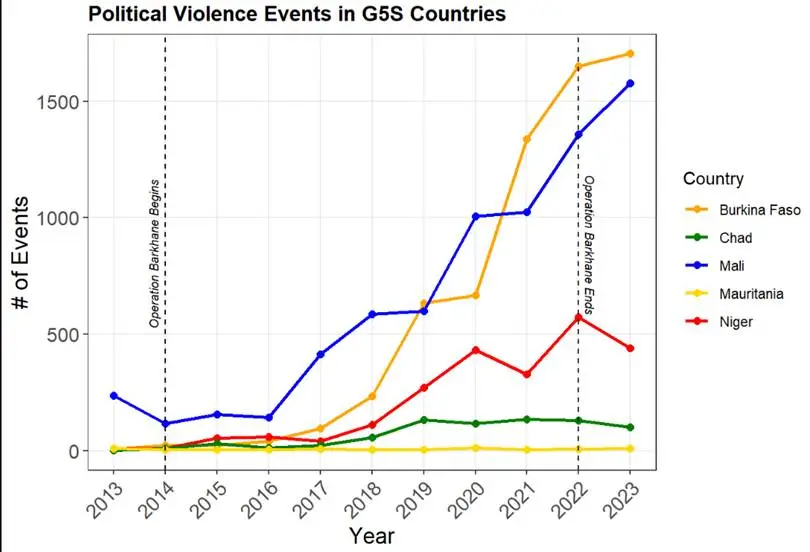
Figure 1. Increasing trend of political violence in the G5S states (Burkina Faso, Chad, Mali, Mauritania, and Niger), 2013–2023. Note. Reproduced from The French War on Terror in Africa, Alexander, T. (2024, February 26), Onero Institute.
The trend shown in Figure 1 is striking because the increase in political violence took place during the period in which international engagement in the Sahel was at its most intensive. This does not establish that international missions caused the rise in violence, but it does indicate that their presence was not sufficient to reverse it.
As Chikhachev (2025, p. 391) concluded, “Operation Barkhane had undermined France’s principal asset in the Sahara-Sahel region and in Africa as a whole — its role as an efficient security guarantor”. The judgement is significant because France’s influence in the region had long rested on its ability to provide security when partner governments requested it. Once that ability was called into question, the political justification for its presence weakened as well. Operation Barkhane’s years of intervention have made the region more violent and less stable. In February of 2022, Mali ordered French troops to leave, ending Barkhane’s presence. MINUSMA’s withdrawal followed soon after, leading to regional governments diversifying their security arrangements with various global actors, including Russia, Turkey, Iran, and China (Alexander, 2024; Cope, 2024; Chikhachev, 2025, p. 388, 392; Wilén, 2025).
The departure of both French forces and the UN mission left a gap that regional governments sought to fill on their own terms. Rather than relying on a single dominant partner, they turned to a range of external actors, each offering different forms of support. For the governments concerned, this diversification was presented as an expression of sovereignty: the freedom to choose partners rather than to accept those inherited from the past.
Peacekeeping in the Sahel shifted from a French-led intervention model to a sovereignty-first, multipolar security order. The old model of international peacekeeping that had consisted of Western-led actors has come to an end. In the sovereignty-first model, host governments set the terms of external support themselves, choosing which partners to work with and on what conditions. External actors are no longer expected to define the objectives of an intervention, but to support goals determined by the governments they work with. The new partners also differ considerably from one another in their interests and methods, which means that the post-Barkhane order is not a single alternative model, but a patchwork of bilateral arrangements. The Post-Barkhane peacekeeping model instead sees the Wagner Group and the Alliance of Sahel States (AES), a tripartite confederation between Mali, Burkina Faso, and Niger, fragmenting the landscape of international security (Osuchukwu et al., 2025, p. 28).
Whether this new order will prove more effective remains an open question. Replacing one external security provider with several does not in itself address the governance failures that allowed armed groups to expand. A more fragmented landscape may also make coordination more difficult and accountability harder to secure, particularly where some partners show little interest in transparency or in the protection of civilians. The humanitarian consequences of continued insecurity, reflected in the scale of displacement across the region, make these questions all the more pressing. At the same time, the emergence of the AES reflects a genuine demand among regional governments for greater control over their own security. The challenge for the international community is therefore not to restore the old model, but to find forms of engagement that respect this demand without abandoning the principles of accountability and civilian protection.
5. Conclusion
To conclude, the end of Barkhane encapsulated a broader change in international peacekeeping approaches. Previously, international support utilised long mandates and foreign intervention in the assumption that once the region was stabilised, governance would thrive. However, as Barkhane illustrated, international actors are no longer willing or able to sustain the costs of unilateral campaigns when intervention is seen as part of the problem. The assumption that stabilisation would naturally lead to good governance did not hold. Security gains remained fragile because they were not accompanied by credible political institutions, and the longer the intervention lasted, the more it became associated with the very problems it was meant to solve.
The three developments examined in this article are closely connected. The decline in political legitimacy weakened the foundation on which Barkhane rested; the limits of military superiority meant that tactical successes could not compensate for that loss; and the resulting vacuum opened the way for new actors and a multipolar security order. Together, they mark the end of a model in which a single Western power, supported by multilateral missions, served as the guarantor of security in the region.
Several lessons follow for future international engagement. First, legitimacy must be built and maintained among the populations and governments directly affected, not only secured through international mandates. Second, military operations can create space for political solutions, but they cannot replace them; security efforts that are not matched by progress on governance, accountability and economic opportunity risk being temporary at best. Third, the way in which harm is acknowledged and addressed is itself part of an intervention’s credibility. Finally, international actors will increasingly need to act as partners supporting regionally owned approaches rather than as leaders defining the terms of engagement.
This has implications for the multilateral missions that remain active elsewhere. The experience of MINUSMA shows that even a UN mission with a distinct mandate can lose its standing when it becomes associated with an external power that has lost local support. Future missions will need to demonstrate their independence and value to host populations more clearly, to communicate openly about their objectives and limitations, and to show that they are accountable for their own conduct. Without this, the shift away from large-scale interventions may not be followed by more effective forms of engagement, but by a retreat from engagement altogether.
The post-Barkhane Sahel thus raises a question that extends well beyond the region: whether the rise of the Alliance of Sahel States represents greater African ownership of security, or a fragmentation of regional cooperation. The answer will shape not only the future of the Sahel, but also the future of international peacekeeping more broadly. It will depend, above all, on whether security arrangements in the region can earn the legitimacy that Barkhane ultimately lost.
References
Ahmed, B. (2022, August 8). French drone strike in Mali killed civilians, rights group says. AP News. Retrieved from https://apnews.com/article/islamic-state-group-france-drone-strike-59ffbe4c309ec38d5851fb43d2b7c3f4
Alexander, T. (2024, February 26). The French war on terror in Africa. Onero Institute. Retrieved from https://www.oneroinstitute.org/research/french-war-on-terror-africa
Bovcon, M. (2013). Françafrique and regime theory. European Journal of International Relations, 19(1), 5–26. doi: 10.1177/1354066111413309
Chikhachev, A. Y. (2025). France’s Policy in the Sahara-Sahel Region: The End of Operation Barkhane and the Quest for a New Approach. Vestnik RUDN. International Relations, 25(3), 382-393. doi: 10.22363/2313-0660-2025-25-3-382-393
Cope, S. (2024, January 29). The end of MINUSMA: Russia competes with the UN for global influence. Georgetown Security Studies Review. Retrieved from https://gssr.georgetown.edu/the-forum/regions/africa/the-end-of-minusma-russia-competes-with-the-un-for-global-influence/
Erforth, B., & Tull, D. M. (2022, September 5). The failure of French Sahel policy: An opportunity for European cooperation? Stiftung Wissenschaft und Politik (SWP). Retrieved from https://www.swp-berlin.org/en/publication/mta-spotlight-13-the-failure-of-french-sahel-policy
Flood, D. H. (2013, May). A review of the French-led military campaign in northern Mali. Combating Terrorism Center at West Point. Retrieved from https://ctc.westpoint.edu/a-review-of-the-french-led-military-campaign-in-northern-mali/
Marot, J. (2020, June 8). How AQIM leader Abdelmalek Droukdel was killed in Mali. The Africa Report. Retrieved from https://www.theafricareport.com/29482/how-aqim-leader-abdelmalek-droukdel-was-killed-in-mali/
Muvunyi, F. (2023, July 29). Africa’s coups: Why the military is taking power again. The New York Times. Retrieved from https://www.nytimes.com/2023/07/29/world/africa/africa-coups-niger.html
Olech, A. (2023). French Operation Barkhane in Africa – success or failure? Stosunki Międzynarodowe – International Relations, 3, 17. doi: 10.12688/stomiedintrelat.17737.1
Osuchukwu, C. N., Iteke, W. C., & Emesiani, I. G. (2025). The Alliance of Sahel States and the future of West African regional integration. Direct Research Journal of Social Science and Educational Studies, 13(1), 27–38. doi: 10.26765/DRJSSES869029840
Sandnes, M. (2021). The G5 Sahel Joint Force: Operationalisation and dependency on external actors (PRIO Policy Brief No. 5). Peace Research Institute Oslo (PRIO). Retrieved from https://www.prio.org/publications/12761
Staff and agencies in Bamako. (2021, January 5). Wedding guests killed in Mali airstrike, local sources say. The Guardian. Retrieved from https://www.theguardian.com/world/2021/jan/05/people-at-wedding-party-in-mali-killed-in-airstrike-local-sources-say
United Nations. (2023, August 30). Veto by Russian Federation results in Security Council’s failure to renew travel ban, asset freeze against those obstructing Mali Peace Agreement (SC/15399). United Nations Meetings Coverage and Press Releases. Retrieved from https://press.un.org/en/2023/sc15399.doc.htm
Usman, A. (2023, September 28). France has become the common denominator behind Africa’s recent coups. Africa at LSE. Retrieved from https://blogs.lse.ac.uk/africaatlse/2023/09/28/france-has-become-the-common-denominator-behind-africas-recent-coups/
Wilén, N. (2025). Stepping up engagement in the Sahel: Russia, China, Turkey and the Gulf States. Egmont Institute. 1-8