

Introduction
Artificial intelligence has stirred up a longstanding debate over economic coordination. Market-driven systems mainly depend on decentralised choices, competition, and prices, whereas centrally planned systems use political objectives and administrative direction to guide production and investment. These are ideal types, not accurate representations of real economies. State and market each play a role in coordination. Market systems involve government intervention through infrastructure provision and regulation of strategically important sectors. At the same time, state-controlled economies also rely extensively on firms, markets, and prices. The main issue is whether AI leads to one pure type prevailing over the other or alters the relative advantages of centralised versus decentralised coordination.
The ability to collect and process data on a very large scale, which early planners could not even imagine, is one of AI’s strongest capabilities. Besides gathering and processing information, AI excels at detecting patterns, predicting demand, optimising logistics, and supporting decisions. This seems to challenge the longstanding claim that economic knowledge is so widely dispersed that it precludes central control. On the other hand, AI can also empower decentralised decision-makers, enabling individuals and companies to analyse information affordably, obtain advice, and experiment with different approaches. This literature-based article addresses two questions: first, whether AI provides a greater net benefit to centrally planned or market systems; and second, whether it poses a risk to the future of market-driven societies. It argues that AI enables central coordination of a larger number of activities, especially when objectives are clearly measurable and operating conditions relatively stable.
However, market systems are not free from AI’s influence. Economies of scale in computing infrastructure, data, and technical capabilities can favour larger firms and contribute to market concentration (Brynjolfsson & Hitzig, 2025). Furthermore, if many decision-makers rely on similar models or information sources, their recommendations can become increasingly aligned, reducing diversity in decision-making (Burton et al., 2024). AI may also facilitate information manipulation. The likely outcome is not the disappearance of markets but the emergence of hybrid systems combining AI-supported planning and decentralised experimentation.
Foundations of Economic Coordination
The classical debate concerns more than a government’s ability to process information. Mises argued that comprehensive socialist planning creates an economic calculation problem. If capital goods are not traded on markets, their prices cannot be established through exchange, leaving planners without a way to compare alternative uses of scarce resources. Greater computational power can improve arithmetic but cannot itself produce the value judgements that emerge through market exchange (Mises, 1920). Lange argued that a socialist economy could retain consumer demand and use administrative prices. By raising prices when supply falls short and lowering them when supply exceeds demand, a central planning authority could approach market equilibrium through trial and error (Lange, 1938). Lange’s model is particularly relevant to AI because machine learning could speed up feedback and allow adjustments across more variables than human administrators could handle.
Hayek’s position was broader than Mises’ or Lange’s arguments. Economically significant information, such as local changes in demand, available inventories, specific production capacities, temporary shortages, or local consumer preferences, is scattered among many people and often relates to a particular time or place. Market prices reflect the scarcity of resources, enabling people to make production decisions without knowing the entire economy or understanding every shortage or surplus. As such, competition is not only a means of finding solutions but also a process of discovery through which knowledge, preferences, and opportunities are revealed (Hayek, 1945).
Even a very powerful computer, such as an AI system with access to vast amounts of recorded history, cannot be assumed to discover everything that decentralised actors might uncover. An AI system may identify previously unknown patterns or relationships within existing data, but this is different from generating new economic knowledge through experimentation and interaction. When comparing planning systems, four dimensions need to be distinguished: (1) the extent to which they can be supplied with and process information; (2) the incentives to disclose information honestly and act efficiently; (3) the degree to which they can adapt to changing circumstances and discover new possibilities; and (4) the way political and economic power is distributed.
Artificial intelligence is most directly likely to increase the effectiveness of the first dimension because gathering data, identifying patterns, and processing large quantities of information are among its core technical capabilities. The remaining three dimensions depend not only on computational capacity, but also on incentives, experimentation, institutional feedback, and the distribution of authority. AI can influence these factors, but it does not automatically improve them (Hayek, 1945; Zou, 2025).
Artificial Intelligence as a Tool of Economic Coordination
Generative AI drastically reduces the cost of turning large volumes of data into forecasts, classifications, recommendations, and content. It can also centralise organisational decision-making by enabling a smaller number of managers to analyse information and make decisions across a wider span of a business. AI-generated insights have become more affordable as advanced analytical capabilities are made available to more people. Sourav et al. (2025) identify data inequality, employment losses, and weak regulation as potential obstacles to inclusive growth. They also report cross-country links between AI and growth, but these links do not prove that AI alone causes economic growth (Sourav et al., 2025). Brynjolfsson and Hitzig (2025) suggest that AI can help knowledge to be shared across organisations, enabling central management to make efficient decisions even when dealing with very large teams. The result could favour larger companies, increase industry concentration, and reduce the authority of line managers.
Similarly, AI might improve collective intelligence by giving individuals better access to information and analytical support (Burton et al., 2024). Yet, if not managed carefully and equitably, it may threaten employment, while data inequality and weak governance remain obstacles to inclusive growth (Sourav et al., 2025).
AI should not be understood as a neutral economic tool. The quality and direction of AI-generated decisions are influenced by factors such as the dataset, measurement system, model design, objectives assigned to it, and the human choices behind these elements. Data reflect what was recorded previously and, as history shows, may be incomplete, biased, outdated, or deliberately manipulated to serve particular interests. As AI learns from past records to make predictions about the future, the use of historical data to predict outcomes is conceptually different from identifying genuinely new products, preferences, or production methods. Zou (2025) therefore distinguishes data from knowledge, prediction from discovery, and prices simulated by a model from real market prices.
AI’s ability to produce very large volumes of output at the same time is a major advantage, but it is also a risk because errors and insights can both be amplified. When many decision-makers rely on a single model, their recommendations tend to become highly aligned, leading to a reduction in diversity of thought. Large language models (LLMs) could improve individuals’ abilities, yet they might also increase uniformity in how people think, encourage reliance on automation, or lead people to agree before the underlying questions have been properly examined (Burton et al., 2024). In this way, AI redefines the capabilities of planning and markets. Economic outcomes depend particularly on three factors: who manages these systems, which goals they are designed to achieve, and whether their decisions can be reviewed and challenged.
Figure 1 summarises the different information-processing logic underlying market coordination and AI-assisted planning. In markets, local knowledge enters the coordination process through individual decisions, exchange, prices, and profit-and-loss feedback, allowing dispersed actors to adjust independently. AI-assisted planning instead channels economic data through centralised collection, model-based analysis, administrative decisions, and reported outcomes. The figure therefore illustrates the central argument of this paper: AI can substantially strengthen centralised information processing, but it does not remove the importance of how information is generated, communicated, and corrected within the underlying institutional system (Hayek, 1945; Brynjolfsson & Hitzig, 2025; Zou, 2025).
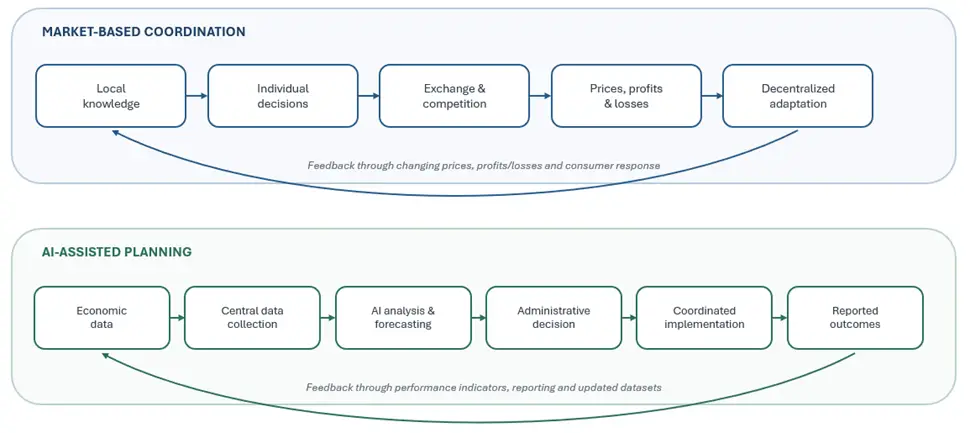
Figure 1. Information Processing in Market-Based and AI-Assisted Planning Systems. Based on Hayek (1945), Burton et al. (2024), Brynjolfsson & Hitzig (2025), and Zou (2025).
Opportunities and Risks for Centrally Planned Systems
AI can address one of central planning’s greatest historical weaknesses: its limited capacity to gather, update, and interpret information. Governments can pool data on production, transport, energy, trade, and consumption, identify bottlenecks, and update policies more quickly. AI may be particularly useful where targets are clear, but interdependencies are high, such as electricity distribution networks, transport infrastructure, emergency logistics, or long-term industrial investment. By coordinating these projects across different sectors, governments can avoid duplication, ensure that resources are used efficiently, and help separate initiatives support each other.
China’s 2017 New Generation Artificial Intelligence Development Plan illustrates how AI can form part of a national strategy. It identifies implications for economic competitiveness, national security, industrial development, and governance, and sets goals through 2030 (State Council of the PRC, 2017). AI could also make Lange-style adjustments faster and more responsive by detecting shortages in real time and updating administrative targets.
Non-democratic planning in the era of AI can have advantages, but this does not mean that it is necessarily justified or that it improves people’s well-being. AI cannot determine whose interests to prioritise when defining social welfare or how growth should be balanced against equality, privacy, or environmental protection. These issues are questions of political choice, not ones that can be solved simply through technical optimisation. Furthermore, data supplied to central authorities can be manipulated if officials and organisations are rewarded by the government for meeting quotas. A model trained on faulty indicators could make such manipulation more systematic, while an error in a central model might end up affecting the whole economy (Zou, 2025).
Large concentrations of data, processing power, and surveillance capabilities can also result in greater state control. Chinese facial-recognition development not only serves government needs but also fuels private-sector innovation in advanced monitoring technology. This creates an “AI-tocracy” loop (Beraja et al., 2021). Planning does not logically require autocratic government. Nevertheless, centralised planning combined with AI-based surveillance can amplify the power of organisations that determine targets and evaluate compliance. AI might therefore help governments implement decisions efficiently without giving citizens more power to question them.
At the same time, we cannot ignore that the world economy is characterised by substantial interdependence. A country’s ability to access the latest chips, cloud computing infrastructure, data storage, and highly skilled workers is increasingly part of geopolitical competition. Consequently, even governments seeking greater planning capacity may remain dependent on a small number of private firms and foreign suppliers (Wasi et al., 2025). Moreover, cooperation between governments and large corporations can make lines of accountability less clear. When power and responsibility are distributed across public and private institutions, citizens may find it more difficult to determine which actor is responsible for particular decisions (Csernatoni et al., 2025).
Opportunities and Risks for Market-Based Systems
AI also supports the decentralised advantages of market economies. Individuals and firms can use it to explore markets, develop products, write code, conduct research, and experiment with ideas at lower cost. Rather than replacing local expertise, AI can assist the “person on the spot” by providing information and tools where decisions are made. Competition enables different actors to use models in their own ways, compare outcomes, and discard unprofitable approaches. Failures can remain local instead of affecting the entire system.
The impact on collective intelligence is likely to be beneficial when AI improves individual competence and groups maintain diverse information and alternatives (Burton et al., 2024). Under radical uncertainty, decentralised experimentation becomes especially valuable if relevant options and preferences are initially unknown. AI can reduce experimentation costs, but markets still provide feedback through voluntary exchange, allowing different interpretations to be tested. However, market economies cannot be equated with decentralised control. Frontier AI requires major investments in computing infrastructure, data, and technical skills.
These economies of scale and scope can lead to market dominance, centralised decision-making within firms, and less autonomy for employees and smaller competitors (Brynjolfsson & Hitzig, 2025). Technology firms are increasingly influential in critical infrastructure, communication channels, and platforms, prompting governments to pursue new forms of tech diplomacy (Cotroneo & Csernatoni, 2025). This may resemble market-based planning, with a few corporations rather than the state controlling key information and economic opportunities.
AI may also weaken the independence and diversity of individual decision-making when personalised recommendation systems and generated content systematically influence the information consumers encounter. The concern is not that decision quality can be reduced to a single measurable indicator, but that individuals may make choices within an increasingly curated and potentially manipulated information environment. Generative AI lowers the barrier to producing credible disinformation and may facilitate electoral interference, mass-persuasion campaigns, and digital authoritarianism. Meanwhile, the extraordinary market dominance of large platforms gives private firms considerable power over democratic deliberation (Csernatoni, 2024).
Consumer sovereignty within digital markets weakens when available choices and the information surrounding them become opaque and curated by platforms. Lastly, uneven access to data and AI-enabled applications could widen differences in productivity and income, while automation could threaten specific types of employment (Sourav et al., 2025). Market mechanisms might enable entrepreneurial adoption of AI while making markets less competitive, less pluralistic, and less individualistic in practice.
Comparative Assessment
AI’s relative advantage depends on the nature of the task to which it is applied. Central coordination will probably be most useful where outcomes can be measured, objectives are shared, the necessary data are available in one place, and activities need to be synchronised.
Figure 2 translates this distinction into a task-based framework. AI-assisted planning can offer relative advantages for activities with a high need for coordination but comparatively limited uncertainty, while decentralised market coordination retains advantages where uncertainty and the need for discovery are high. Where both coordination requirements and uncertainty are substantial, the figure points to a hybrid approach that combines public coordination with decentralised experimentation. The key implication is that AI does not create a general advantage for one economic system; its effect depends on the characteristics of the economic problem being addressed.
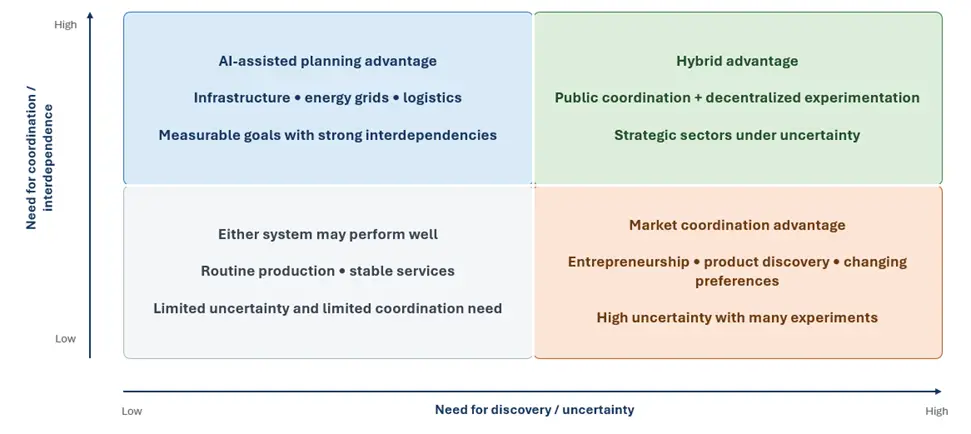
Figure 2. Relative Advantages of AI-Assisted Planning and Market Coordination by Task Characteristics. Based on Hayek (1945), Zou (2025), and Brynjolfsson & Hitzig (2025).
Infrastructure networks, inventories, logistics, and some aspects of industrial policy illustrate this logic. AI can increase the speed and scope of planning in these fields.
Decentralised coordination retains its relative strengths where demand, technology, or local conditions change rapidly; expertise is highly specialised and difficult to transfer; stakeholders have conflicting goals; and innovation results from many individual experiments. Markets do more than process a fixed set of information. Prices and competition also motivate people to reveal information, discover alternatives, take risks, and face the consequences of their decisions. AI may facilitate this process but cannot eliminate the need for institutional feedback, incentives, and contestability (Hayek, 1945; Zou, 2025).
The marginal benefit of AI may be especially visible in planned systems because it alleviates a longstanding technical constraint: the limited ability of a central authority to gather, update, and process large volumes of dispersed economic information. This does not mean that their overall performance will exceed that of market economies. Market actors also adopt AI, often rapidly, and can combine it with decentralised experimentation. Market concentration may allow a few corporations to capture much of the benefit, while a central state may coordinate strategically but suppress inconvenient information.
The greatest net advantage is therefore likely to accrue neither to a purely planned economy nor to an unregulated market. It is more likely to arise in systems that combine capable public coordination with competitive discovery: governments can establish infrastructure, rules, and long-term objectives, while independent firms and individuals retain the freedom to experiment and challenge existing models. Importantly, public coordination and regulation do not necessarily eliminate experimentation; the relevant question is whether institutions leave independent actors sufficient room to test alternative approaches and challenge existing solutions. The decisive institutional properties are not simply “state” or “market”, but diversity, accountability, adaptability, and the possibility of correcting errors.
Discussion
Artificial intelligence is unlikely to cause the collapse of market-driven, individualistic societies. Even so, it weakens the claim that large-scale coordination must necessarily be crude. AI enables governments and large corporations to monitor and manage more operations, at least in certain settings. Lange’s (1938) iterative method is now more technically plausible because feedback can be processed continuously.
This development is not sufficient to dismiss or resolve all of Mises’ or Hayek’s objections. A computer’s ability to reproduce capital prices meaningfully depends on authentic transactions actually taking place. Moreover, the knowledge behind a decision to buy or sell is not merely data that has been collected and stored; much of it is created through people’s choices, negotiations, creativity, and reactions to results (Mises, 1920; Hayek, 1945). Besides, efficiency itself cannot be disentangled from the question of who actually controls the goals of an AI system and who has the right to challenge them.
Market societies should be concerned about what AI might bring. If data, computing, and information resources are controlled by a few actors, AI could reconcentrate economic authority even without formal state planning. This could undermine the independent judgement and diversity of views that both free markets and democracy rely on. The conflict today is not merely between an all-knowing state and a free individual; it is also about which systems of algorithmic coordination can be challenged and which cannot.
In the end, a combination of different systems is the most probable outcome: AI-supported public planning in areas or industries requiring large amounts of capital and infrastructure, potentially extensive planning within firms, and market-based experimentation especially where consumer preferences and technology remain uncertain because these conditions provide room for innovation and development. Whether freedom and prosperity can be ensured under such an arrangement will largely depend on competitiveness, public transparency, privacy protection, legal frameworks that keep different actors in check, and access to AI. Because much of the literature is recent and partly conceptual, any conclusion remains provisional. Nevertheless, the evidence considered here suggests that AI shifts the boundary between planning and markets rather than eliminating either. Its greatest effect may be to increase the value—and the danger—of concentrated coordination while making the preservation of decentralised discovery and democratic accountability more important.
References
Beraja, M., Kao, A., Yang, D. Y., & Yuchtman, N. (2021). AI-tocracy (NBER Working Paper No. 29466). National Bureau of Economic Research. doi:10.3386/w29466
Brynjolfsson, E., & Hitzig, Z. (2025). AI’s use of knowledge in society. In A. K. Agrawal, E. Brynjolfsson, & A. Korinek (Eds.), The economics of transformative AI (pp. 301–330). National Bureau of Economic Research.
Burton, J. W., Lopez-Lopez, E., Hechtlinger, S., Rahwan, Z., Aeschbach, S., Bakker, M. A., Becker, J. A., Berditchevskaia, A., Berger, J., Brinkmann, L., Flek, L., Herzog, S. M., Huang, S., Kapoor, S., Narayanan, A., Nussberger, A.-M., Yasseri, T., Nickl, P., Almaatouq, A., . . . Hertwig, R. (2024). How large language models can reshape collective intelligence. Nature Human Behaviour, 8(9), 1643–1655. doi:10.1038/s41562-024-01959-9
Cotroneo, C., & Csernatoni, R. (2025). Tech diplomacy 2.0: Examining the intersections between industry and governments in international relations. International Journal of Cyber Diplomacy, 6, 3–18. doi:10.54852/ijcd.v6y202501
Csernatoni, R. (2024, December 18). Can democracy survive the disruptive power of AI? Carnegie Endowment for International Peace.
Csernatoni, R., Broeders, D., Andersen, L. H., Hoijtink, M., Bode, I., Lindsay, J. R., & Schwarz, E. (2025). Myth, power, and agency: Rethinking artificial intelligence, geopolitics and war. Minds and Machines, 35(3), Article 37. doi:10.1007/s11023-025-09741-0
Hayek, F. A. (1945). The use of knowledge in society. The American Economic Review, 35(4), 519–530.
Lange, O. (1938). On the economic theory of socialism. In B. E. Lippincott (Ed.), On the economic theory of socialism (pp. 55–143). University of Minnesota Press.
von Mises, L. (1920). Economic calculation in the socialist commonwealth. Ludwig von Mises Institute.
Sourav, M. S. A., Asha, N. B., & Reza, J. (2025). Generative AI in business analytics: Opportunities and risks for national economic growth. Journal of Computer Science and Technology Studies, 7(11), 224–247. doi:10.32996/jcsts.2025.7.11.22
State Council of the People’s Republic of China. (2017). New generation artificial intelligence development plan (G. Webster, R. Creemers, E. Kania, & P. Triolo, Trans.). DigiChina.
Wasi, A. T., Eram, E. H., Mitu, S. A., & Ahsan, M. M. (2025). Generative AI as a geopolitical factor in Industry 5.0: Sovereignty, access, and control [Preprint]. arXiv.
Zou, H.-F. (2025). AI, central planning, and Hayek’s knowledge problem: Why “The use of knowledge in society” survives the age of artificial intelligence (CEMA Working Paper No. 808). China Economics and Management Academy, Central University of Finance and Economics.