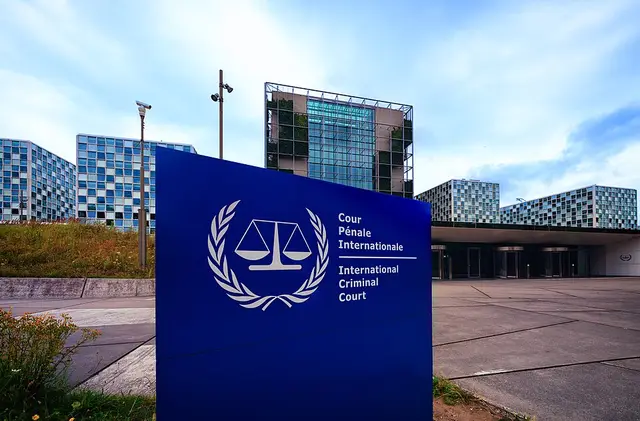

On 14 April 2026, during my time in Brussels with EuroMed Rights, we co-organised a press conference on shielding the ICC and civil society from US sanctions. While the conference previewed the Coalition for the International Criminal Court’s findings and focused on US-sanctioned Al-Haq, Al Mezan and the Palestinian Centre for Human Rights in the context of the ICC’s arrest warrants for Israeli officials, what stayed with me was how judicial independence depends on access to ordinary services (Press Club Brussels Europe, 2026; Coalition for the International Criminal Court [CICC], 2026, pp. 10, 84).
More recently on 9 October 2026, the United States placed the International Criminal Court (ICC) itself on its sanctions list (Office of Foreign Assets Control [OFAC], 2026).
That day, Denmark, France, Germany, Italy, and the Netherlands joined the UK, Canada, Japan and Australia in opposing the sanctions (Foreign, Commonwealth & Development Office, 2026). While judges cannot pay their bills with declarations of solidarity, these states can do more. The path is already paved: the EU signatories should press for the extension of the Blocking Statute.
Europe’s commitment to justice should mean that those who uphold it can continue their work.
A European Tool Waiting to Be Used
Europe created the Blocking Statute, Council Regulation (EC) No 2271/96, in 1996 to counter extraterritorial US measures concerning Cuba, Iran, and Libya. Its protection depends on a list of foreign measures in an annex, currently covering US measures related to Cuba and Iran. ICC sanctions remain outside it (European Commission, n.d.).
Now, the Commission should add Executive Order 14203 of 6 February 2025, “Imposing Sanctions on the International Criminal Court,” and the International Criminal Court-Related Sanctions Regulations, 31 CFR part 528. These measures freeze assets under US jurisdiction, prohibit US persons’ dealings with designated actors, and expose foreign persons to designation. (Executive Order No. 14203, 2025; International Criminal Court-Related Sanctions Regulations, 2025).
Protection in Practice
Take Nicolas Guillou, a French ICC judge and EU citizen. In April, he explained to the Assemblée Nationale that his French bank had kept his account open, but his Visa card had been cancelled, and no French bank had been able to offer him a payment card outside the Visa or Mastercard networks. In his words, he was left without a means of payment (Assemblée Nationale, 2026, p. 4). Suppose an EU-incorporated risk-averse bank went further and closed it solely to follow US sanctions. Salary payments, rent, electricity bills, insurance premiums could all be disrupted.
Similarly, due to OFAC, Italian, Dutch, and Swiss banks refused to open accounts for UN Special Rapporteur Francesca Albanese, and Former ICC Prosecutor Karim Khan had his UK bank accounts frozen and his account in Malaysia closed (CICC, 2026, p. 36).
Today, Article 5 cannot be invoked against Guillou’s hypothetical closure (European Commission, n.d.). A risk-averse European bank, insurer or other service provider can therefore withdraw services over US sanctions without breaching the Statute.
After the amendment, the same closure would breach Article 5’s prohibition on complying with listed measures, backed by national penalties (Council Regulation (EC) No 2271/96, 1996, arts. 1, 5, 9). Guillou could ask a court to reverse the closure. Bank Melli Iran v. Telekom Deutschland GmbH is the precedent (2021, paras. 59, 95). Non-EU judges resident in the EU also fall within its scope under Article 11(4).
Beyond the Court
The stakes go far beyond the Court’s 18 judges and staff. The sanctions reach into the wider ecosystem on which international justice depends: NGOs, lawyers, researchers, contractors, banks and other service providers interacting with the Court or with sanctioned civil-society organisations. Where those actors fall within the Regulation’s scope, the Blocking Statute would protect them against being compelled to give effect in Europe to the listed US sanctions.
Protection would counter the chilling effect. Lawyers, donors and civil-society actors would not limit advocacy, withdraw from partnerships or avoid sanctioned actors for fear of becoming targets themselves. It would reverse the incentive: banks, donors and service providers would know abandoning dealings to follow US measures is prohibited. All this can be done without inventing a new mechanism (Council Regulation (EC) No 2271/96, 1996, arts. 4, 6).
Imagine Russia sanctioning judges of the European Court of Human Rights over a ruling it opposed, prompting European banks to close their accounts. If that would be unacceptable from Moscow, why is it tolerable from Washington?
The EU now stands at a crossroads: it can remain a spectator as US sanctions reach into international justice and civil society or step forward as its guardian.
References
Assemblée nationale. (2026, April 8). Audition de M. Nicolas Guillou, juge à la Cour pénale internationale (Compte rendu n° 21). https://www.assemblee-nationale.fr/dyn/17/comptes-rendus/cenum/l17cenum2526021_compte-rendu.pdf
Bank Melli Iran v. Telekom Deutschland GmbH, Case C-124/20, EU:C:2021:1035 (2021). https://eur-lex.europa.eu/legal-content/EN/TXT/?uri=CELEX:62020CJ0124
Coalition for the International Criminal Court. (2026, April 23). Criminalising accountability: The US lawfare against the international justice system. https://www.coalitionfortheicc.org/node/3820
Council Regulation (EC) No 2271/96 of 22 November 1996 protecting against the effects of the extra-territorial application of legislation adopted by a third country, and actions based thereon or resulting therefrom, Official Journal of the European Communities, L 309, 1–6 (1996) (as amended). https://eur-lex.europa.eu/legal-content/EN/TXT/?uri=CELEX:01996R2271-20180807
European Commission. (n.d.). Extraterritoriality (blocking statute). Retrieved October 10, 2026, from https://finance.ec.europa.eu/eu-and-world/open-strategic-autonomy/extraterritoriality-blocking-statute_en
Executive Order No. 14203, 90 Fed. Reg. 9369 (2025). https://ofac.treasury.gov/media/933981/download?inline=
Foreign, Commonwealth & Development Office. (2026, October 9). Joint statement on support for the International Criminal Court. GOV.UK. https://www.gov.uk/government/news/joint-statement-on-support-for-the-international-criminal-court
International Criminal Court-Related Sanctions Regulations, 90 Fed. Reg. 28012 (July 1, 2025) (codified at 31 C.F.R. pt. 528). https://ofac.treasury.gov/media/934451/download?inline=
Office of Foreign Assets Control. (2026, October 9). Settlement agreement between the U.S. Department of the Treasury’s Office of Foreign Assets Control and Pegasus Worldwide Logistics; International Criminal Court designation and general licenses; Burma-related designation removal. https://ofac.treasury.gov/recent-actions/20261009
Press Club Brussels Europe. (2026, April 14). Press conference: From words to action—Shielding the ICC and civil society from US sanctions. https://www.pressclub.be/event/press-conference-from-words-to-action/