The Commission’s Legal Strategy for a Geopolitical Objective
This paper examines how the EU-Mercosur agreement evolved from a post-Cold War interregional integration project into a geopolitical instrument. It argues that while the agreement retained its original legal structure, its strategic purpose shifted in response to a changing global order.
1. Introduction
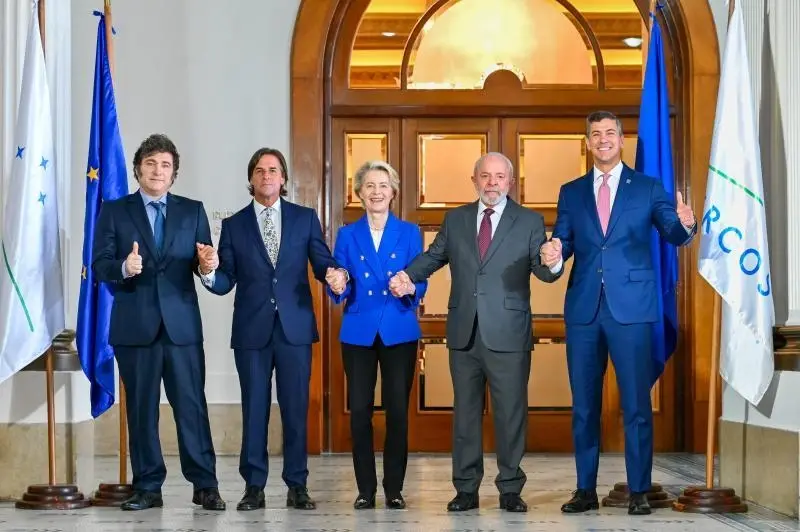
After 26 years of negotiations, the European Union (EU) and Mercosur, the South American economic bloc comprising Argentina, Brazil, Paraguay, and Uruguay, have concluded a free trade agreement. As Do (2026) notes, the agreement brings together markets representing approximately 700 million consumers, making it one of the largest free trade areas in the world. On 17 January 2026, the leaders of the European Union and Mercosur met in Asunción to sign the EU-Mercosur Partnership Agreement (EMPA), alongside the Interim Trade Agreement (iTA), a separate instrument covering the agreement’s trade and investment provisions pending the EMPA’s full entry into force.
The iTA entered into provisional application on 1 May 2026, following the completion of the necessary internal procedures by the four Mercosur countries. The EMPA, by contrast, remains subject to a lengthy ratification process, requiring the consent of the European Parliament and ratification by all EU Member States. This process has already been complicated by the European Parliament’s decision, adopted on 21 January 2026, to request an opinion from the Court of Justice of the European Union (CJEU) on the compatibility of the EMPA and iTA with the EU Treaties. Nevertheless, as de Sadeleer (2025) highlights, the conclusion of the negotiations had already been hailed in December 2024 as a “truly historic turning point” in this protracted courtship that had first begun in 1999.
Drawing on both EU and Mercosur official documents and the academic literature, the negotiations can be divided into two main phases: an initial round in the late 1990s and early 2000s, and a second phase launched in 2010, following a near six-year stalemate, which gained real pace and importance only from 2016. The drivers of this second and seemingly conclusive phase bear limited resemblance to those that originally led the Council to grant the European Commission its negotiating mandate in 1999. Indeed, this paper argues that, while the Commission was initially mandated to negotiate an Association Agreement grounded in the interregional framework of the post-Cold War period, the outcome reached in 2026 can be better understood as a full-fledged geopolitical instrument.
Accordingly, this research addresses the following question: How and why has the EU-Mercosur agreement evolved from an interregional integration project into a geopolitical instrument, despite retaining its original legal structure? To answer this question, the paper is structured as follows. First, it examines the original interregional framework that shaped the original negotiations and its neo-regional roots. Second, it analyses how shifts in the international context brought geopolitical drivers back to the forefront, making the negotiations more urgent and prominent. Third, it links these developments to the institutional and legal dynamics that enabled the agreement’s finalisation.
2. Building an Interregional Partnership: The EU-Mercosur Project (1995-2015)
To understand how the agreement changed, it is first necessary to establish what it was originally meant to be. According to Santander (2005), the EU, in its post-Maastricht configuration, can be viewed as the prime product of the 1990s wave of neo-regionalism that emerged in the aftermath of the Cold War. As Hettne and Söderbaum (2000) put it, “today’s regionalism is extroverted rather than introverted”, reflecting the growing interdependence of the global political economy. As economies became more open and exposed to external competition, traditional national policy instruments proved increasingly insufficient to absorb these changing dynamics. States therefore attached growing importance to regional structures as a way of recovering collectively the autonomy they were losing individually.
In this setting, the European Community, alongside the United States and a resurgent Japan, consolidated its position as one of the main centres of power in an increasingly interdependent global economy. Through the Maastricht Treaty, the new Union then sought to address one of its main limitations on the international stage by developing external policy instruments, most notably the Common Foreign and Security Policy (CFSP), reflecting an ambition to achieve broader international actorness. However, this projection into “high politics” raised expectations that the EU could not meet, giving rise to what Hill (1993) famously termed the “capability-expectations gap”, first exposed by the Yugoslav wars and later confirmed by the divisions over Iraq.
By contrast, the dimension of European power that continued to develop most consistently was its economic influence. Its market size and regulatory capacity made the EU an increasingly influential actor, particularly in the realm of “low politics”. This economic power has led Damro (2015) to conceptualise the EU as “Market Power Europe” (MPE): a power whose international influence derives principally from the externalisation of its “economic and social market-related policies and regulatory measures”. Taken together, these developments enabled the Union to move beyond the old interregionalism of the 1970s and 1980s, exemplified by the Community’s support for the Andean Pact and by the San José Dialogue (Santander, 2005). That earlier model was sporadic, constrained by the bipolar context and confined to development cooperation and political dialogue, whereas the Union’s new approach provided for mutual trade liberalisation.
Consequently, while neo-interregionalism does include strategic elements, it is mainly distinguished by its neoliberal economic leanings. For Petiteville (2004), interregional agreements are a form of economic diplomacy that operates within the gaps of the CFSP and compensates for its discontinuities through a broad network of institutionalised cooperation in which finance and trade circulate alongside political principles and values. As its market power consolidated, the EU therefore increasingly looked beyond its own borders to project its integration experience and economic model through relations with emerging regional organisations. As Nolte and Ribeiro (2021) argue, from the 1990s onwards Mercosur was perceived as a particularly promising partner and a potential “mirror” of the European integration experience.
This interest developed alongside the neoliberal reforms undertaken across South America, which sought to attract foreign direct investment and contributed to Mercosur’s consolidation as the world’s fourth largest trading bloc (Santander, 2005). The relationship therefore reflected the broader dynamics of neo-regionalism, in which integration is both a response to external competitive pressures and a means of strengthening collective credibility and economic weight. The EU’s engagement with Mercosur can thus be understood as an expression of neo-interregionalism, described as “a corollary of the new regional agreements” (Santander, 2005).
This blueprint took legal form in the 1995 Interregional Framework Cooperation Agreement, built on three pillars: political dialogue, cooperation and trade. As Alvarez (2024) observes, despite asymmetries in power and development, this framework eventually produced significant results, most notably the conclusion of the trade chapter of the Association Agreement in 2019, which briefly coincided with a moment of convergence on the benefits of a liberal economic order. Since then, however, the distributive effects of economic liberalism have been increasingly questioned, and the link between economic leadership and geopolitical power has gained wider recognition (Alvarez, 2024).
3. The Geopolitical Turn: From Liberal Interregionalism to Strategic Instrument (2016-2026)
As Przybylska-Maszner (2025) recounts, in June 2019 the parties announced the conclusion of technical talks on the trade text. On 6 December 2024 they reached a political agreement that added sustainability commitments, and on 3 September 2025 the Commission proposed Council decisions on the signature and conclusion of two parallel instruments: the EMPA and the iTA, the latter to be replaced by the former once it enters into force. After two decades of talks and years of paralysis, these last two steps came within nine months, and signature followed barely four months later. Such speed, captured in the question “Why such haste?” (de Sadeleer, 2025), points to a changed international context: the EU-Mercosur relationship “must be examined within the broader context of global power rivalry and the transformations of the international order after 2020” (Przybylska-Maszner, 2025).
Pose-Ferraro (2026) likewise contends that the final driver in the first half of the 2020s has been geopolitical. This logic had already surfaced from 2016, when political changes within Mercosur accelerated the talks and, amid the protectionist turn of the first Trump administration and Brexit, the Commission saw preferential trade agreements with Mercosur, as well as Canada, Japan, Singapore and Vietnam, as a way to present itself as “the guardian of the liberal or rules-based international order” and a rule-maker capable of projecting normative power (Pose-Ferraro, 2026). The same reading emerges from the wider setting of the negotiations, which were increasingly shaped by both geopolitical competition and political-economic constraints, especially against the backdrop of US-China rivalry (Przybylska-Maszner, 2025).
Over the past two decades, moreover, China has become the principal trading partner for most of the Mercosur countries, as it has offered great demand for natural resources and large-scale infrastructure investments. In turn, this has strengthened Mercosur’s bargaining position within the asymmetric dynamic with the EU. As a result, this growing Chinese presence, especially after the Belt and Road Initiative (BRI), compelled the EU to offer more attractive terms of cooperation (Przybylska-Maszner, 2025). On the US side, meanwhile, the Biden administration sought to rebuild lost influence with initiatives such as the Americas Partnership for Economic Prosperity (APEP). Nevertheless, the South American countries increasingly pursued a strategy of balanced engagement with multiple partners, including through the BRICS+ framework.
For the European Union, by contrast, the finalisation of this partnership holds strategic importance for advancing its concept of Strategic Autonomy, “understood as the capacity to act in the international environment independently of pressures from other major powers”, and for diversifying energy, mineral and food supplies after the loss of access to Russian resources (Przybylska-Maszner, 2025). These external pressures explain why the agreement became a geopolitical priority for the Union.
Stronger geopolitical incentives did not, however, remove domestic resistance. As early as 2017, France, Ireland and Poland pressed the Commission to limit its agricultural offer (Pose-Ferraro, 2026). This opposition is a constant: French, Irish and Dutch agriculture ministers and COPA-COGECA, the organisation representing EU agricultural producers, already resisted the negotiating mandate in 1999 (Santander, 2005). Although agricultural opening was only partial, COPA-COGECA again rejected the 2019 text on the day it was announced, citing “the huge difference in production standards” (quoted in Pose-Ferraro, 2026).
This resistance matters procedurally, because to enter into force the trade pillar must win a qualified majority in the Council, with no blocking minority, and the consent of the European Parliament (Pose-Ferraro, 2026). It is against this background that the Commission’s handling of the final stage becomes significant. Critics contend that, in pursuing this geopolitical aim, the Commission “took advantage of a period of political fragility in France – the biggest obstacle to the agreement – using its moment of distraction as an opportunity to assert the EU’s right of initiative” (de Sadeleer, 2025).
The author himself adds that “it is regrettable that the European Commission has not been more transparent about the institutional issues at stake”, since it asserted the EU’s right of initiative at the cost of democratic transparency. This timing, according to the author, allowed the Commission to announce the “agreement in principle” in Montevideo while France, one of the agreement’s most vocal opponents, was politically weakened and less able to mobilise a coordinated response within the Council. His core objection, however, concerns the mandate: the Council’s 1999 negotiating directives envisaged a single association agreement, and the Commission “is not empowered to submit to the Council two separate agreements under two different policies” (de Sadeleer, 2025). The iTA thus detaches the trade pillar from the three-pillar structure described in Section 2.
The legal stakes of this manoeuvre are therefore considerable. Under Articles 3(1)(e) and 207 TFEU, the common commercial policy is an exclusive Union competence, whereas Article 217 TFEU is the specific legal basis for association agreements, which Article 218(8) TFEU requires the Council to conclude unanimously. On the Commission’s reading, a trade agreement remains within exclusive EU competence even where it overlaps with policies of shared competence (Opinion 2/15), whereas association agreements are treated as mixed and require ratification by every Member State (de Sadeleer, 2025). It is Council unanimity and national ratification, not Parliament’s consent, that give each Member State an effective veto, while Article 13(2) TEU obliges every institution to act within its conferred powers. A Member State wishing to contest the Commission’s approach may request a preventive opinion from the CJEU under Article 218(11) TFEU, as Belgium did in Opinion 1/17 regarding CETA, or ask the Court to annul the Council’s decision on signature and provisional application for breach of Article 218 TFEU (de Sadeleer, 2025). The European Parliament’s own referral to the CJEU shows that this dispute is far from theoretical. Taken together, these provisions show that the Commission’s timing was not merely opportunistic but legally significant, since it sought to secure political momentum before the procedural safeguards built into Article 218 TFEU could be fully engaged (de Sadeleer, 2025).
4. Conclusion
This paper asked how and why the EU-Mercosur agreement evolved from an interregional integration project into a geopolitical instrument, despite retaining its original legal structure. The analysis shows that the agreement has undergone a significant transformation in both its rationale and its function. Initially conceived as an interregional project rooted in the principles of neo-regionalism, it aimed to promote trade liberalisation, cooperation and the diffusion of the European integration model, reflecting a post-Cold War context in which economic interdependence and liberal norms shaped international relations.
As to why the agreement changed, the answer lies in the evolution of the global political economy. The rise of new powers, particularly China, the protectionist turn of the United States and the increasing fragmentation of the international order introduced new strategic considerations. As a result, the EU began to reinterpret the agreement not merely as a mechanism for economic cooperation, but as a tool to enhance its geopolitical position, a shift reinforced by its pursuit of Strategic Autonomy and its need for diversified partnerships and supplies.
As to how, the transformation occurred through a change of function rather than of form. On paper, the legal structure was preserved: the EMPA retains the three pillars of trade, political dialogue and cooperation envisaged in the original mandate. In practice, however, that structure was put to a different use. Faced with persistent agricultural opposition, the Commission accelerated the final stage and placed the trade pillar in a separate interim agreement that can be adopted by qualified majority, thereby avoiding the unanimity and national ratification that an association agreement requires. The legal architecture thus became the very means by which a geopolitical objective was pursued, which is why its compatibility with EU law is now under review by the CJEU. In short, the agreement kept its name and formal design while its purpose changed, through a process that was not fully transparent with respect to the 1999 mandate. It now serves broader geopolitical objectives, including competition with other global actors and the consolidation of the EU’s role as a rule-maker in international trade.
Three broader implications follow from this analysis. First, the EU-Mercosur case suggests that the Union’s geopolitical turn has relied less on the creation of new instruments than on the redeployment of existing ones. Trade policy, the field in which the EU enjoys exclusive competence and its greatest external leverage, has become the most readily available vehicle for strategic objectives that the CFSP, still bound by unanimity, struggles to deliver. In this sense, the agreement confirms the persistence of the capability-expectations gap identified by Hill (1993), while showing how Market Power Europe can be mobilised to partly compensate for it.
Second, this redeployment comes at a cost. Separating the trade pillar allowed the Commission to overcome agricultural opposition, but it also moved the decision away from national parliaments and towards procedures in which individual Member States carry less weight. If geopolitical urgency becomes a recurring justification for such choices, the Union risks widening the gap between the speed demanded by its external ambitions and the democratic legitimacy on which its trade policy ultimately depends. The persistence of agricultural resistance, visible from the 1999 mandate to the 2019 text, shows that this legitimacy cannot be taken for granted.
Third, the opinion requested by the European Parliament will be decisive not only for this agreement but for the future of EU trade policy. Should the Court accept the separation of trade and association instruments, the EU-Mercosur model may become a template for future agreements with politically sensitive partners; should it reject it, the Commission’s geopolitical ambitions will once again be constrained by the requirement of unanimity.
Finally, this paper has certain limitations. It has approached the agreement primarily from the European perspective, and a fuller account would require closer attention to the domestic politics of the Mercosur countries, whose own strategies of diversification between the EU, China and the United States shaped the timing of the outcome. Future research could also assess, once the iTA has been applied for some time, whether the agreement’s geopolitical promise translates into concrete gains in supply diversification and regulatory influence, or whether, like earlier interregional ambitions, it remains largely declaratory.
References
Alvarez, M. V. (2024). Exploring Mercosur-EU interregionalism: A multifaceted analysis of its past, present, and future functions and dynamics. Contemporary European Politics, 2, e12. https://doi.org/10.1002/cep4.12
Damro, C. (2015). Market power Europe and new EU trade policies. In J. Wouters, A. Marx, D. Geraets, & B. Natens (Eds.), Global governance through trade: EU policies and approaches (pp. 19–42). Edward Elgar Publishing. https://doi.org/10.4337/9781783477760.00007
de Sadeleer, N. (2025). The draft EU–MERCOSUR agreement drawing the dividing line between policy cooperation and trade. European Journal of Risk Regulation, 16, 1156–1167. https://doi.org/10.1017/err.2025.32
Do, K. T. (2026). EU–MERCOSUR trade agreement: Political dynamics, stakeholder opposition, and strategic implications [Working paper]. SSRN. https://doi.org/10.2139/ssrn.6125547
Hettne, B., & Söderbaum, F. (2000). Theorising the rise of regionness. New Political Economy, 5(3), 457–472. https://doi.org/10.1080/713687778
Hill, C. (1993). The capability–expectations gap, or conceptualizing Europe’s international role. Journal of Common Market Studies, 31(3), 305–328. https://doi.org/10.1111/j.1468-5965.1993.tb00466.x
Nolte, D., & Ribeiro, C. C. N. (2021). Mercosur and the EU: The false mirror. Lua Nova, 112, 87–122. https://www.scielo.br/j/ln/a/9Msq5gFqccKCBxWL9zDFDps/
Petiteville, F. (2004, May–June). L’Union dans les relations internationales : du soft power à la puissance ? [The Union in international relations: From soft power to power?]. Questions Internationales, (7), 63–72.
Pose-Ferraro, N. (2026). Between geopolitics and political economy: The European Union–Mercosur negotiation to form a trade agreement. Journal of Common Market Studies, 64(1), 248–267. https://doi.org/10.1111/jcms.13743
Przybylska-Maszner, B. (2025). The relations between the European Union and Mercosur: A difficult partnership in the face of strategic challenges. Rocznik Integracji Europejskiej, 19, 221–235. https://doi.org/10.14746/rie.2025.19.13 Santander, S. (2005). The European partnership with Mercosur: A relationship based on strategic and neo-liberal principles. Journal of European Integration, 27(3), 285–306. https://doi.org/10.1080/07036330500190156