


Within the discussion around human rights, one important aspect is usually missed: language rights. 2025 saw a surge in social unrest in over 70 countries that spilled over into 2026 with people protesting against socioeconomic inequalities, for more governmental accountability, and in solidarity with Ukraine and Gaza (Mantoiu, 2026). The violent crackdown on many of these protests was associated with serious human rights violations by the respective governments, aligning with the dire picture of fundamental rights that Human Rights Watch paints in its recently published annual World Report (Bolopion, 2025).
The report mainly warns about the threats to the international human rights architecture posed by China, Russia and the US, predominantly focusing on funding cuts to healthcare programmes, restricted media and obstructed abortion access (Bolopion, 2025). What has received much less attention, however, are the battles over language and identity in India’s western state of Maharashtra in July 2025 and the hunger strikes in 2025 and 2026. These emerged in response to the national government’s decision to make Hindi classes compulsory for state-run primary schools alongside English and Marathi (Mollan, 2025), reflecting a deep-seated fear of Hindi replacing the state’s most dominant language Marathi.
The right to speak and maintain one’s language without discrimination is recognised as part of the UN Declaration on the Rights of Persons Belonging to National or Ethnic, Religious and Linguistic Minorities (Office of the United Nations High Commissioner for Human Rights [OHCHR], 1992). Nonetheless, there is often an epistemic and social hierarchy between officially recognised languages and those labelled as merely “local”. Public spaces such as education, law and administration are reserved for the exclusive use of “official” languages, while local languages are relegated to informal contexts (Baronchelli et al., 2025). This is an issue because it limits access to public and social services to those who speak the official language and can cause misunderstandings or incommunicability, which is particularly dangerous in the healthcare sector (Krugman et al., 2024). Moreover, it critically endangers many local languages with traditionally small speaker communities.
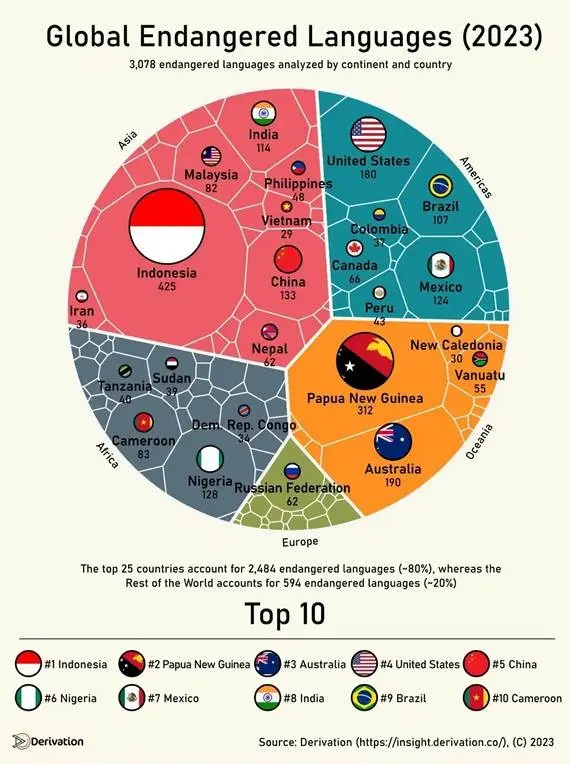
Fig. 1: Global Endangered Languages (Ethnologue, 2023).
The underlying issue here is a mismatch between the “one nation – one language” ideology of 18th-/19th-century Europe (Thiesse, 2021) and the reality of linguistic diversity on the ground. Under the pretext of ‘broader communication’ and ‘civilisation’, colonialism exported the ideal of linguistic homogeneity globally, leading to the imposition of Western European languages and/or the promotion of one “national” language at the expense of countless Indigenous languages, as in the case of Hindi and English in India. Such so-called “nation-state congruence” is achieved via legitimation and institutionalisation (May, 2025), rendering the standard language an “arm of the state” (Bourdieu, 1987, p. 27). The protests against Hindi in Maharashtra illustrate how these state-legitimated linguistic hierarchies persist until today and threaten to infringe on people’s fundamental right to language (Kinnemann Arnold, 2023).
Against this background, this article investigates (1) how the official/unofficial language binary perpetuates colonial power hierarchies and (2) to what extent linguistic human rights (LHR) can be invoked as a form of decolonial resistance to those hierarchies. Hereby, I will draw on Spolsky’s (2009) language policy model to examine the interplay of language beliefs, practices and management.
The article contends that Linguistic Human Rights should be recognised as a central component of contemporary human rights politics as they not only protect linguistic identities but also help dismantle prevailing colonial hierarchies in language policy and international human rights regimes as such.
The Coloniality of Power
Historical-ideological Roots
With Europeans’ search for new trade routes in the 16th century began the global expansion of European domination and accompanying exploitation of land, resources and people in what is today often called the “Global South”. Eurocentric ideas of modernity, progress, rationality and civilisation shaped and justified the imposition of European norms, which were presented as superior to local cultures and epistemologies (Quijano, 2024). This sheds light on the enduring “dark side” of modernity, which Aníbal Quijano (2024) labels coloniality. According to him, modernity/coloniality are two sides of the same coin. They are inextricably connected, one presupposes the other, and their patterns persist in the economic structures, political elites, culture and mentality of a country long after its formal independence.
The dual nature of modernity/coloniality also reappears in the colonial logic structuring reality into mutually exclusive dichotomies of mind/body, rational/emotional, human/nature, war/peace etc. Inherent to these pairs is a normative hierarchy that privileges one part over the other, i.e. rational over emotional, and human over nature. The concept of othering describes this process of how the dominant in-group (the “official” language) constructs out-groups (“unofficial” languages) characterised by stigmatising difference (Staszak, 2020). The out-group or “other” is devalued by attributing relative inferiority to it (Brons, 2015). Inventing such opposites enables neat separation and organization, serving as a means of social control and justification for domination. The asymmetric power relations built into this system are reproduced on various scales and can be subsumed under Quijano’s (2024) concept of the coloniality of power.
The same is true for languages. By promoting linguistic national homogeneity, languages are named and boxed into atomic entities that can be grouped, ranked and monitored. At the same time, the status of “official” / “unofficial” creates an in- and out-group dynamic within an inherent normative hierarchy. Depicting unofficial languages as “the other” and thus as inferior is a way of degrading and stripping them and their speakers of social status and prestige (May, 2025). Simultaneously, it protects the linguistic monopoly and control of the nation-state over communication, education, information flow and access.
Such artificial national linguistic homogeneity is usually achieved via processes of legitimation and institutionalisation (May, 2025). Legitimation means official recognition of a language through legal and state bodies, whereas institutionalisation leads to the broad acceptance of a language across a variety of cultural and social domains (May, 2025). Both processes are visible in postcolonial countries such as Kenya, Tanzania, Chile, Haiti and India, which experienced the imposition of a colonial language – i.e. English, French, Spanish. While these languages continue to exert hegemony after independence, they devalue local, Indigenous and contact languages like creole and pidgin (Heugh, 2022; Khan & Jayaraj, 2024).
In the case of India, Hindi filled a “linguistic power vacuum” after the end of the British Raj and the partition from Pakistan (Ellison, 2025 para. 1). Following independence, Hindi was promoted as the main official language of India and anchored in Article 343 of the 1950 Constitution, even though censuses only estimated 34-44% of the population to be Hindi speakers (Ellison, 2025 para. 1). The Eighth Schedule of the Indian Constitution has gradually recognised 21 other Indian languages as regional languages (Government of India, 2022), but the hierarchy between them and Hindi as the “official” language remains, resulting in feelings of injustice and riots (Ellison, 2025). Hindi experienced a massive boost under Narendra Modi’s Hindu nationalism; since 2014, the budget of the Department of Official Language, charged with promoting Hindi, has tripled in size (Ellison, 2025). Against this background, making Hindi mandatory in the state of Maharashtra appears as another step in the hegemonic expansion of Hindi in India.
Language Rights & Decolonial Resistance
What are Linguistic Human Rights?
Linguistic Human Rights refer to “fundamental rights protecting language-related acts and values that are entrenched in domestic law and policies or in international treaties” (Ran, n.d.), such as the Universal Declaration of Linguistic Rights (UNESCO, 1996). LHR can be negative, i.e. forbidding discrimination, or affirmative, i.e. the obligation to grant minorities certain rights like the right to use their language (Skutnabb-Kangas, 2012). Linguistic rights are protected through binding treaties, domestic laws and non-binding declarations, such as Article 27 of the International Covenant on Civil and Political Rights (United Nations, 1966) and the 1992 UN Minorities Declaration (OHCHR, 1992).
Notably, many decolonial scholars have criticised LHR for their continued reference to the notion of human rights. This is because the conceptual origins of human rights are deeply entangled with colonial and racist ideology, as the status of “human” was originally invented to demarcate humans from animals and the divine (Maldonado-Torres, 2021), yet only included the white male elite and thus helped justify racial hierarchies. With decolonisation came critique of those historical roots, but the question of “who speaks for the ‘human’ in human rights?” persists (Mignolo, 2009; Stroud, 2001). Further criticism deals with the potentially discriminatory and socially divisive nature of the concepts if disadvantaged groups receive special treatment that creates the impression of unfairness (Stroud, 2001).
Nonetheless, LHR are a valuable concept because granting or not granting LHR can be seen as a strategy in language policy to “modify the linguistic environment” (Skutnabb-Kangas, 2012 p. 2). With reference to international law, LHR may be used to challenge normative standards or push for legal recognition. Understanding language rights as human rights endows them with further credibility and legitimacy because they are treated as fundamental to human identity and dignity (Skutnabb-Kangas & Phillipson, 2022).
As established above, the language policy in most modern states follows deeply-entrenched majority/minority or “official”/“unofficial” distinctions informed by colonial structures. According to Bernard Spolsky (2009), language policy comprises three components: practices, beliefs and management. Language practices are “the observable behaviours and choices” of people, whereas beliefs concern the values assigned to different linguistic varieties and features (Spolsky, 2009, p. 3). Finally, language management denotes “the explicit and observable effort by someone or some group that has or claims to have authority over the participants in the domain to modify their practices or beliefs” (Spolsky, 2009, p. 4). Based on that, I will analyse the potential of LHR to influence language policy as a form of decolonial resistance.
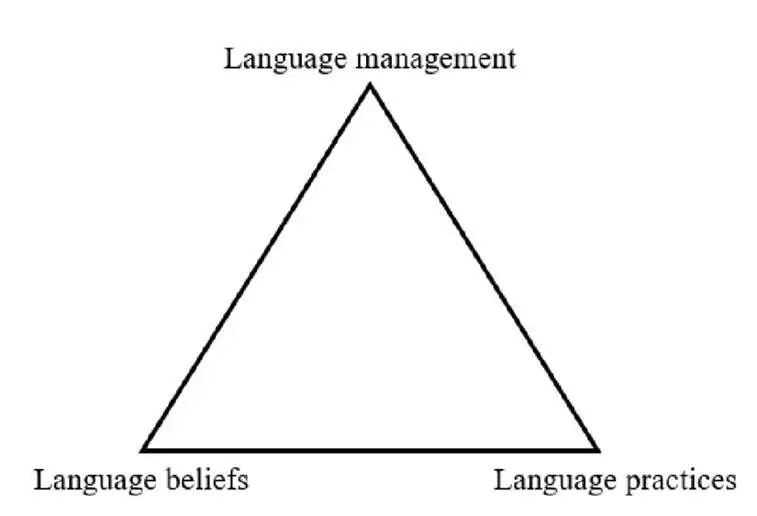
Fig. 2: Spolsky’s Language Policy Model (Van Oss, 2023).
Language Beliefs
First and foremost, LHR challenge colonial power and epistemic hierarchies by rejecting the narrative that Western European languages are “civilised” and therefore the only legitimate languages for education, governance and scientific knowledge production. Instead, they recognise marginalised and Indigenous languages as equally valid and important means of communication and cultural transmission. Thereby, they do not only oppose and replace colonial dualism with decolonial pluralism but also transform the values attached to different linguistic varieties.
Māori language revitalisation programmes in New Zealand serve as a fitting example to illustrate this shift: They reject the colonial narrative that English is the only language of progress and centre much more around the knowledge, tradition and cultural significance and continuity expressed in Māori.
Similarly, the protests in Maharashtra against the expansion and privileging of Hindi (and English) in the Indian education system suggest growing disagreement with the status and prestige ascribed to them. Ironically, Modi’s government and the Hindutva nationalist movement have frequently presented themselves as a force of decolonisation, yet this discursive appropriation only veils the structural violence against Muslims and Dalits as well as the reproduction of colonial stories about India’s history (Dhingra, 2023; Jyoti Dutta, 2026). Defending Marathi as a legitimate language of education may therefore be seen as an exercise of linguistic human rights and a decolonial critique of Hindutva language policy.
Language Practices
Changes in language beliefs become particularly visible in daily usage and speaking choices. LHR aid in this process by paving legal pathways for enabling such daily practices to take place in a variety of domains.
The Māori revitalisation movement demonstrates this through initiatives like Kōhanga Reo (language nests) where children are immersed in the language from early childhood onwards (May & Hill, 2018). Beyond that, Māori has become significantly more prevalent in broadcasting, public ceremonies and everyday communication. Thus, every time someone chooses to use Māori rather than English in their daily life, this may be interpreted as an exercise of linguistic rights. In this sense, everyday language use itself becomes an act of decolonial resistance because it challenges the colonial expectation that English should dominate public and private life.
A similar dynamic can be observed in the case of Marathi. Since language continues to be closely associated with education, social mobility, and political power in India, the use of Marathi in schools, local administration, public signage, literature, and everyday communication constitutes an important realisation of linguistic human rights. The widespread protests against the proposed expansion of compulsory Hindi instruction in 2025 reflected concerns that Marathi would gradually be displaced from these domains of everyday use (Mollan, 2025). Through the lens of Spolsky’s (2009) language policy model, the controversy must therefore not just be understood as a case of educational policy but of protecting established language practices. Defending Marathi thus represents resistance to a perceived process of linguistic homogenisation, in which the expansion of a dominant language threatened the continued public use of a regional language. In this sense, demands for Marathi language rights can be understood as a form of decolonial resistance against the reproduction of hierarchical language relations, even where these are justified through nationalist rather than colonial discourse.
Language Management
To sustain certain language beliefs and practices, they need to be institutionalised through what Spolsky calls language management. In New Zealand, continuous advocacy for Māori revitalisation resulted in the Māori Language Act 2016 (Te Ture mō Te Reo Māori 2016) that replaced the Language Act of 1987 and not only affirmed Māori as an official language of New Zealand but created a “partnership between iwi and Māori and the Crown to promote the knowledge and use of te reo Māori” (New Zealand Government, 2024). This aligns with Spolsky’s (2009) assertion that legal recognition represents the most obvious form of language management.
In the case of Marathi, such an institutionalisation has not fully taken place yet despite its inclusion into the Eighth Schedule of the Indian Constitution, as exemplified by the ongoing protests. Wales, however, offers another example that illustrates how linguistic rights can reshape relationships between minority communities and the state. Through legislation such as the Welsh Language Act (1993) and the Welsh Language (Wales) Measure 2011 nawm 1, Welsh acquired equal legal status with English in many areas of public administration. Combined with bilingual education and public media, these measures have substantially increased the institutional visibility of Welsh and strengthened obligations concerning Welsh-language public services. Their effect on everyday language use is more mixed, however, and recent census figures show that legal recognition alone does not guarantee continued growth in the number of speakers (Welsh Government, 2026).
These examples illustrate an important point: LHR extend beyond cultural preservation. They redistribute political power by challenging whose languages – and therefore whose knowledge and identities – are considered legitimate within state institutions. In doing so, they support what de Sousa Santos (2014) describes as an “ecology of knowledges”, in which multiple epistemologies coexist rather than being subordinated to a single Western model of modernity. The examples from New Zealand and Wales also suggest that embracing LHR can even increase rather than undermine national stability by preventing protests motivated by a sense of linguistic injustice. This, however, hinges on a certain degree of political will and commitment to the decolonial movement from the national government’s side, without which the institutionalisation and protection of language rights remain weak and fragile, as demonstrated by the debate surrounding Marathi in Indian schools.
Taken together, these debates suggest that linguistic human rights should not be romanticised as a complete solution to colonial injustice. Legal recognition alone cannot dismantle centuries of structural inequality, nor can language policy substitute for broader reforms addressing economic, political, and racial inequalities. Nevertheless, it would be premature to dismiss LHR completely because they operate within international human rights law. Indeed, this would mean overlooking their practical and symbolic significance. Rather, they demonstrate that legal recognition must be accompanied by institutional reform, rendering them one important component of broader decolonisation processes.
Policy Recommendations
- Launch programmes dedicated to the revitalisation and recognition of non-dominant languages. These may include language training in schools, public language and art festivals, dedicated broadcasting programmes or celebrating the International Mother Language Day on 21 February, for example.
- Recognise and embrace regional linguistic rights movements as an expression of and opportunity for dismantling colonial structures that can stabilise rather than destabilise the public administration in the long term.
- Invest in strengthening linguistic diversity especially in crucial domains such as healthcare and law; hire staff who speak at least two of the most popular local languages to facilitate interactions with patients and clients.
Bibliography
Baronchelli, A., Foresta, A., & Ricciuti, R. (2025). The words that keep people apart: Official language and accountability. Journal of Institutional Economics, 21, e35. https://doi.org/10.1017/S1744137425100209
Bolopion, P. (2025). World Report 2026. Human Rights Watch. https://www.hrw.org/world-report/2026
Bourdieu, P. (1987). Die feinen Unterschiede: Kritik der gesellschaftlichen Urteilskraft. Suhrkamp. https://www.suhrkamp.de/buch/pierre-bourdieu-die-feinen-unterschiede-t-9783518282588
Brons, L. (2015). Othering: An analysis. Transcience, 6(1). https://www.researchgate.net/publication/273450968_Othering_An_Analysis
de Sousa Santos, B. (2014). Epistemologies of the South: Justice against epistemicide. Paradigm Publishers.
Dhingra, S. (2023, August 14). How Hindu nationalists redefined decolonization in India. New Lines Magazine. https://newlinesmag.com/argument/how-hindu-nationalists-redefined-decolonization-in-india/
Ellison, C. (2025, May 22). Hindi hegemony in Modi’s India. Human Rights Research Center. https://www.humanrightsresearch.org/post/hindi-hegemony-in-modi-s-india
Ethnologue. (2023). Global endangered languages. https://www.ethnologue.com/insights/countries-most-endangered/
Government of India (2022, May 17). Languages Included in the Eight Schedule of the Indian Constitution. https://rajbhasha.gov.in/en/languages-included-eighth-schedule-indian-constitution
Heugh, K. (2022). Linguistic and epistemic erasure in Africa. In The Handbook of Linguistic Human Rights (pp. 55–70). John Wiley & Sons. https://doi.org/10.1002/9781119753926.ch4
Jyoti Dutta, M. (2026). Appropriating Decolonization: A Culture-Centered Critique of Hindutva’s Discursive Violence. Communication and Race, 3(2), 90–111. https://doi.org/10.1080/28346955.2026.2680405
Khan, S., & Jayaraj, T. (2024). From colonial legacy to contemporary reality: Attitudes towards English and Hindi hegemony in India. Humanities and Social Sciences Communications, 11(1), 1594. https://doi.org/10.1057/s41599-024-03878-6
Kinnemann Arnold, R. (2023). The language of human rights: Who gets to speak it? [Master’s thesis, University of Padua]. https://thesis.unipd.it/handle/20.500.12608/77431
Krugman, D. W., Litunu, A., Mbeya, S., & Rafiq, M. Y. (2024). Cancer linguistics and the politics of decolonizing health communication in Coastal Tanzania: Reflections from an anthropological investigation. Social Science & Medicine, 354, 117082. https://doi.org/10.1016/j.socscimed.2024.117082
Maldonado-Torres, N. (2021). On the coloniality of human rights. In The pluriverse of human rights: The diversity of struggles for dignity. Routledge.
Mantoiu, E. (2026, June 4). The 2025 surge in global protests is continuing in 2026. European Democracy Hub. https://europeandemocracyhub.epd.eu/the-2025-surge-in-global-protests-is-continuing-in-2026/
May, S. (2025, April). Language rights as human rights. GlobaLex. https://www.nyulawglobal.org/globalex/language-rights-as-human-rights.html
May, S., & Hill, R. (2018). Language revitalization in Aotearoa/New Zealand. In L. Hinton, L. Huss, & G. Roche (Eds.), The Routledge handbook of language revitalization (pp. 309–319). Routledge.
Mignolo, W. D. (2009). Who speaks for the “human” in human rights? Hispanic Issues On Line, 5(1), 7–25. https://scholars.duke.edu/publication/1022860
Mollan, C. (2025, July 10). Maharashtra: Row over language turns violent in India’s richest state. BBC News. https://www.bbc.com/news/articles/c93kwqvw3jxo
New Zealand Government. (2024, December 16). Revitalising te reo Māori. https://www.govt.nz/browse/history-culture-and-heritage/maori-language-culture-and-heritage/revitalising-te-reo-maori/
Office of the United Nations High Commissioner for Human Rights. (1992). Declaration on the rights of persons belonging to national or ethnic, religious and linguistic minorities. https://www.ohchr.org/en/instruments-mechanisms/instruments/declaration-rights-persons-belonging-national-or-ethnic
Quijano, A. (2024). Aníbal Quijano: Foundational essays on the coloniality of power. Duke University Press. https://doi.org/10.2307/jj.12250639
Ran, Y. (n.d.). Linguistic human rights: What are they and how can we better protect them? Australian Human Rights Institute. Accessed on 29 July 2026. https://www.humanrights.unsw.edu.au/research/commentary/linguistic-human-rights-what-are-they-how-we-can-better-protect-them
Skutnabb-Kangas, T. (2012). Role of linguistic human rights in language policy and planning. In The Encyclopedia of Applied Linguistics. John Wiley & Sons. https://doi.org/10.1002/9781405198431.wbeal1026
Skutnabb-Kangas, T., & Phillipson, R. (2022). Introduction: Establishing linguistic human rights. In The Handbook of Linguistic Human Rights. John Wiley & Sons. https://doi.org/10.1002/9781119753926.ch1
Spolsky, B. (2009). Towards a theory of language management. In Language management (pp. 1–9). Cambridge University Press. https://doi.org/10.1017/CBO9780511626470.001
Staszak, J.-F. (2020). Other/otherness. In A. Kobayashi (Ed.), International Encyclopedia of Human Geography (2nd ed., pp. 25–31). Elsevier. https://doi.org/10.1016/B978-0-08-102295-5.10204-5
Stroud, C. (2001). African mother-tongue programmes and the politics of language: Linguistic citizenship versus linguistic human rights. Journal of Multilingual and Multicultural Development, 22(4), 339–355. https://doi.org/10.1080/01434630108666440
Te Ture mō Te Reo Māori 2016 (Māori Language Act 2016) 2016 No 17 (NZ). https://www.legislation.govt.nz/act/public/2016/17/en/latest/
The Constitution of India (1950). Article 343: Official language of the Union. https://www.constitutionofindia.net/articles/article-343-official-language-of-the-union/
Thiesse, A.-M. (2021). One nation, one language. In The creation of national identities: Europe, 18th–20th centuries (pp. 49–60). Brill. https://doi.org/10.1163/9789004498839_005
United Nations Educational, Scientific and Cultural Organization. (1996). World Conference on Linguistic Rights: Barcelona Declaration. https://unesdoc.unesco.org/ark:/48223/pf0000104267
United Nations. (16 December 1966). Treaty collection: International covenant on civil and political rights. United Nations Treaty Collection. https://treaties.un.org/pages/viewdetails.aspx?src=treaty&mtdsg_no=iv-4&chapter=4&clang=_en
Van Oss, V. (2023). Multilingual policy dynamics of early childhood health care professionals [Doctoral dissertation, Ghent University]. Ghent University. http://hdl.handle.net/1854/LU-01GPGSCPA2SQDPHWE7V75VCFCC
Welsh Government. (2026, January 21). Welsh language data from the Annual Population Survey: October 2024 to September 2025. https://www.gov.wales/welsh-language-data-annual-population-survey-october-2024-september-2025-html